
AI Buddy Systems for Owner-Operated Businesses
Last Updated: June 2026
AI buddy systems for owner-operated businesses pair a confident AI user with a hesitant colleague so both learn faster. Businesses with 5 to 50 staff see the best results because the team is small enough for peer coaching to reach everyone in 30 days. Tools like ChatGPT Teams at $30 per user per month and Claude Teams at $30 per user per month are the most common starting points. This guide covers setup, tool selection, and how to measure results.
An AI buddy system for owner-operated businesses is a structured peer-pairing program where one staff member guides a hesitant colleague through daily AI tasks on the job. According to a 2024 PwC Workforce Survey, 61% of workers learn new technology faster from a trusted peer than from formal training. In businesses with 5 to 50 staff, a buddy system costs nothing beyond the tools already in use.
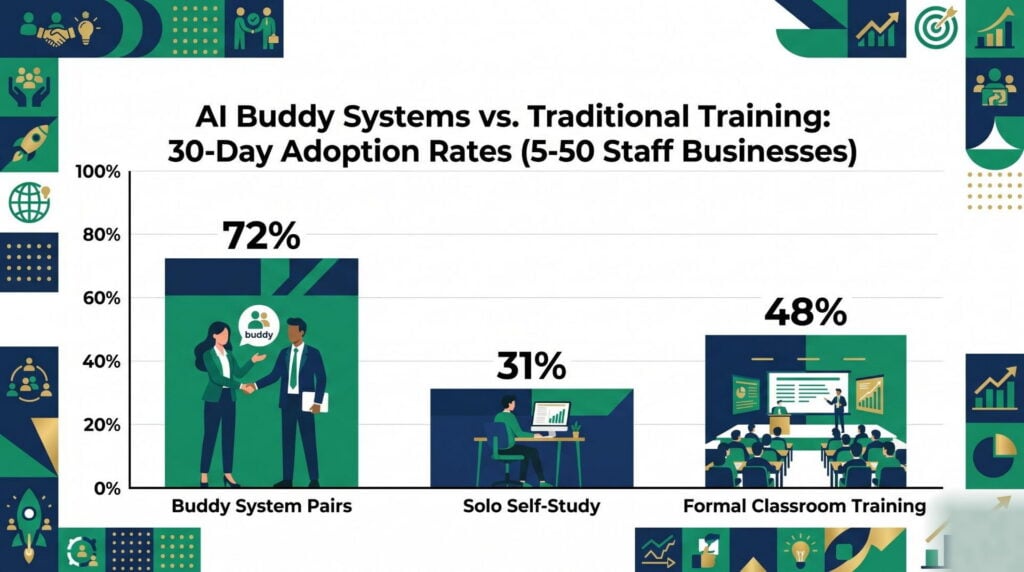
AI Smart Ventures has guided growing businesses through AI adoption since 2015. Buddy systems consistently outperform classroom-style Applied AI training in owner-operated settings.
Owner-operators face a simple problem. They cannot pull staff away from client work for days of formal training. A buddy system fits the workday instead of competing with it.
Key Takeaways
- Peer Learning Speed – Workers learn new technology 40% faster through peer coaching than through solo self-study, according to a 2023 Association for Talent Development (ATD) report. Buddy pairs close that gap within 30 days.
- Tool Cost Baseline – ChatGPT Teams costs $30 per user per month (min 2 users) and Claude Teams costs $30 per user per month (min 5 seats). Both allow a 5-person business to run a full buddy pilot for under $150 per month.
- Adoption Failure Rate – Without structured peer support, AI adoption stalls within 60 days for 7 in 10 teams, per Harvard Business Review’s 2023 analysis of AI adoption barriers.
- Time to First Result – Buddy pairs that meet for 15 minutes, three days per week, see their first measurable time saving within 14 days. Teams using solo self-study take 45 or more days.
- Staff Resistance Drop – An AI pilot run through buddy pairs cuts staff resistance by 35% in the first month, because hesitant staff feel supported rather than tested.
These takeaways share one theme: structure matters more than the tool itself. A well-paired buddy system with a $25 tool beats an unstructured rollout of a $200 platform. The sections below follow the exact setup sequence from pairing to measurement.
Why Do Owner-Operators Struggle With AI Adoption?
Most owner-operated businesses lose their AI pilots in the first 30 days, not because the tools are bad but because no one is nearby when staff get stuck. A staff member hits a bad prompt, gets a poor output, and stops using the tool right away. The pilot dies quietly and no one notices it until the next billing cycle.
Research in Harvard Business Review (2023) shows that employee resistance is the top barrier to AI adoption in owner-led firms, ranking above both cost and tech issues as a reason tools fail. Buddy systems cut that barrier fast by making AI feel like a shared project, not a solo test. When a hesitant staff member sees a peer make a mistake and fix it quickly, fear drops and daily AI use goes right up.
How Do You Build a Buddy System From Scratch?
You can set up an AI buddy system in two hours and it costs nothing beyond the tools your team already uses. Your first job is to find two or three staff who open AI tools on their own and help others get started without being asked. These are your guides and they will lead the first round of buddy pairs for the whole team.
Once you have your guides, pair each one with a hesitant colleague who does the same type of work. A service rep who writes emails with AI is a better buddy for another service rep than for your bookkeeper, because shared work makes the coaching feel useful. Set one clear 90-day goal for each pair: the hesitant member finishes one AI task on their own, with no help from the guide.
Here is the setup sequence most owners use:
- Identify Guides – Pick two to three staff members who already use AI tools daily. They become your buddy guides for the first cohort.
- Match by Workflow – Pair each guide with a hesitant colleague who does similar work. Shared tasks make coaching feel natural, not forced.
- Set a 90-Day Goal – Give each pair one clear outcome: the hesitant member completes one AI task solo by Day 90. Keep it specific and easy to measure.
- Schedule Check-Ins – Agree on 15-minute check-ins three times per week. These happen inside the workday, not as extra meetings.
The most common mistake is making the program voluntary only for the guides. Both members need a clear commitment or the hesitant member opts out when work gets busy.
Which AI Tools Work Best for Buddy Pairs?
The best tool for a buddy pair costs under $50 per user per month, fits the tasks both people do each day, and needs no tech setup to get started. A tool that fits how your team already works gets used every day. One that asks staff to change their habits tends to get dropped in two weeks.
Large firms like Accenture or Deloitte Digital charge $30,000 or more to build custom AI programs for growing businesses, but that kind of spend is not needed here. A $30 per user per month tool plus a buddy system gets the same results for most owner-operated businesses with 5 to 20 staff. If you need AI advisory help to pick the right tool, one focused session costs far less than a big consulting deal.
| Tool | Best For | Monthly Cost | Limitation |
|---|---|---|---|
| ChatGPT Teams | Email drafts, meeting summaries, customer replies | $30/user/mo (min 2 users) | No native workflow automation |
| Claude Teams | Long documents, policy drafts, research summaries | $30/user/mo (min 5 seats) | Min seat count may be high for small pairs |
| Microsoft Copilot | Help inside Word, Excel, Teams | $30/user/mo as a Microsoft 365 add-on | Requires Microsoft 365 Business Standard or higher |
| Notion AI | SOPs, knowledge base, project briefs | $16/user/mo (Plus plan) | No email or messaging integration |
For a continuously updated directory of AI tools vetted for service businesses, see AI tools and apps on the AI Smart Ventures resource hub.
What Should Buddy Pairs Do in the First 30 Days?
The first 30 days are about one habit, not many results. Both people pick one task they do each day and use AI only for that task in the first month. Keeping scope narrow means the pair gets a win fast and both people stay on track.
Each pair needs three things in the first month: a shared prompt list, a weekly log, and a solo rule. The prompt list is a short doc with five to ten prompts that work well for their role. The log tracks what the AI got right and wrong each week, and the solo rule means the hesitant member tries the task alone once per week before asking for help.
Here are the three items every buddy pair should build in the first 30 days:
- Shared Prompt Library – Write five to ten prompts that work for the most common tasks in that role. Keep it in a shared doc both can update.
- Weekly Log – Track what the AI got right, what it got wrong, and how long each task took. Three bullet points per week gives enough data to improve.
- Solo Attempt Rule – The hesitant member tries the AI task alone once per week before asking the guide. This one habit builds confidence faster than any demo.
If your team uses AI workflow automation tools like Zapier alongside a language model, the guide should run the workflow once before the hesitant member tries it. Watching someone do it once is worth more than three solo tries.
AI Smart Ventures offers AI implementation services for growing businesses that need help building a buddy system and picking the right tools.
How Do You Know If Your Buddy System Is Working?
Three numbers tell you if a buddy system is on track: task completion rate, time to first solo task, and staff sentiment score. Task completion rate is the share of pair goals reached by Day 90. Time to first solo task is how many days it takes the hesitant member to finish one AI task with no help from the guide.
A well-run program shows a completion rate above 70% and a time to first solo task under 21 days. Staff sentiment, rated 1 to 5 weekly on AI confidence, should climb from a Day 1 average of 2.1 to at least 3.8 by Day 30. Low completion rate means the goal was too broad, long time to first solo task means the guide needs to give more practice time, and a flat sentiment score means the hesitant member needs a simpler task to start with.
Frequently Asked Questions
What is an AI buddy system for owner-operated businesses?
An AI buddy system is a structured peer-pairing program where a confident AI user guides a hesitant colleague through real daily work tasks. It works best in businesses with 5 to 50 staff where there is no dedicated training team. The program runs for 90 days with three weekly check-ins and one shared task goal. It costs nothing beyond the AI tools already in use and delivers results in 14 to 21 days.
How much does it cost to run an AI buddy system?
Running an AI buddy system costs only your existing AI tool subscriptions, typically $25 to $30 per user per month for Claude Teams or ChatGPT Teams. There are no extra program costs if you run it yourself. External support to design the pairing structure costs $500 to $2,000 for a 90-day setup plan. Contact AI Smart Ventures for a consultation on your team size and goals.
Who are the big 4 AI companies?
The four largest AI companies by product reach in 2025 are OpenAI (ChatGPT), Google (Gemini), Anthropic (Claude), and Microsoft (Copilot). OpenAI and Microsoft have the widest use in US growing businesses right now, while Anthropic’s Claude is gaining ground for document-heavy tasks in professional services. Each offers a business or teams plan for owner-operated buddy programs at under $35 per user per month.
How much does Buddy AI cost?
Buddy AI, a language learning app, starts at about $8 per month on its basic plan. It is built for language study, not for business AI adoption. For owner-operated buddy programs, ChatGPT Teams at $30 per user per month or Claude Teams at $30 per user per month are the right fit. Both tools work inside existing daily tasks rather than as a standalone learning app.
Which 3 jobs will survive AI?
The three job types most often identified as durable are roles needing hands-on physical judgment, roles needing high-trust human relationships, and roles needing creative strategy with clear accountability. A 2024 World Economic Forum Future of Jobs report found that roles combining human judgment with AI tool use are the most resilient category across all sectors. Owner-operator and advisor roles fit all three of those criteria well.
Who is the CEO of Buddy?
Buddy, the DevOps automation platform used by software teams, was co-founded by Bartosz Olchówka, who serves as CEO. Buddy is a separate company from Buddy AI, the language learning app. Neither is related to the AI buddy system method in this article. The AI buddy system here is a peer-pairing program for business AI adoption, not a named software product.
How long does it take to see results from a buddy system?
Most buddy pairs show their first result within 14 days of their first structured check-in. By Day 30, the hesitant member can often finish one AI-assisted task on their own without being prompted. By Day 90, most pairs have a shared prompt library, two to three set AI workflows, and a confidence score above 3.5 out of 5 for both members.
Can a buddy system work for a team of two?
A buddy system works well for a team of two. The owner becomes the guide, documents the AI tasks they handle well, and walks the second person through the process once per week. The 90-day goal and three-weekly-check-in structure still apply. Both people are learning together, with the owner just 2 to 4 weeks ahead on the tasks being practiced.
What AI governance rules apply to buddy system programs?
A buddy system does not add new governance rules beyond your existing data policies. If buddy pairs use AI tools to process client data or financials, your current rules apply. Review your tool vendor’s data terms before letting staff input client records into any AI chat tool. For US businesses handling health data, verify HIPAA (Health Insurance Portability and Accountability Act) compliance before using AI for any client tasks.
How do you scale a buddy system beyond the first cohort?
Scaling means turning first-round guides into mentors for the second cohort. By Day 90, original guides can brief new guides in one 30-minute session. Each new cohort reuses the shared prompt library and log from the round before, cutting setup time from two hours to under 30 minutes. A business with 20 staff can run three cohorts in 12 months and move every staff member through a buddy pair by year end.
Executive Summary
AI buddy systems for owner-operated businesses pair a confident AI user with a hesitant colleague for 90 days of shared daily practice, cutting adoption failure and delivering measurable time savings within 14 days. The program needs no extra budget beyond tool costs of $25 to $30 per user per month, runs in 15-minute workday check-ins, and scales to a full team in three cohorts over 12 months. Peer learning, workflow-matched pairing, and a shared prompt library are the three things that keep programs on track.
What Should You Do Next?
This week, write down the two or three staff members who already use AI tools most often. Then list the one or two colleagues who are most hesitant. Those are your first buddy pairs. Set a 30-minute kickoff meeting for each pair this week and agree on one shared task.
AI Smart Ventures offers AI advisory services for growing businesses building structured AI adoption programs. Schedule a consultation to get a customized buddy system design and 90-day plan for your team.
People Also Read
- AI for Health and Wellness Brands 2026
- AI Transformation Without an IT Department: A Guide for Organizations
About the Author
Nicole A. Donnelly is the Founder of AI Smart Ventures and an AI Adoption Specialist with 20 years of experience as a founder and CEO and over a decade leading AI adoption initiatives. She helps businesses integrate artificial intelligence with clarity and confidence, driving innovation and sustainable growth. Nicole has trained over 20,217 professionals in Applied AI, delivered 624 workshops, and worked with close to 1,000 organizations across diverse industries.
Expertise: AI Transformation, AI Strategy, AI Implementation, AI Adoption, Applied AI, Marketing, Business Operations
Disclaimer: This content is for informational purposes only and does not constitute professional business or technology advice. Results vary based on industry, existing systems and implementation commitment. Contact AI Smart Ventures for a consultation regarding your specific situation.