
AI Business Process Mapping: A Starter Guide
Last Updated: April 2026
An AI business process mapping exercise is the set approach through which growing businesses find, write, and rank their workflows before rolling out any AI automation tool. Per McKinsey’s State of AI (2024), 72% of businesses now use AI in at least one function. Yet most businesses that skip the process mapping step buy tools that do not match their actual workflows, slowing adoption and cutting real ROI. Writing processes before picking tools is the most clear sign of a useful AI rollout across close to 1,000 businesses.
AI Smart Ventures has helped growing businesses through AI adoption across close to 1,000 engagements. The most clear finding is that businesses that write their current workflows before picking an AI tool spend much less time fixing failed rollouts than those that start with tool choice.
What splits businesses that roll out AI and see real results from those that buy tools and then struggle to use them comes down to one call made before any tool buy. Has the business written what the process currently does and what a useful AI-supported version would look like? The plan below covers that call and the steps that follow.
Key Takeaways
- Map before you buy. Per McKinsey’s State of AI (2024), 72% of businesses use AI in at least one function. Yet most skip process write-up, causing tool drop-off within 60 days of rollout.
- A full business process map for one workflow takes 2 to 4 hours. Use ChatGPT Plus ($20 per month) for drafting and a simple flowchart tool. The map stops weeks of fixing after tool buy.
- Three traits make a process a strong AI automation pick. High repetition (weekly or more). A steady input and output. And human time costs above 2 hours per week.
- Processes that take under 30 minutes per week are rarely worth the mapping and setup spend. Focus on the top 3 to 5 time-heavy repeated tasks first.
- For processes involving regulated data, multi-system links, or compliance needs, get a process map reviewed by an AI consulting specialist before any tool choice.
The businesses that get the most from AI are not the ones with the most tools. They are the ones that know exactly which process each tool is replacing and what the real result of that swap looks like before the first month’s plan is charged.
Why Map Processes Before Deploying AI?
Growing businesses that roll out AI tools without a written process map always report one of two failures within 60 days. A tool that does not fit the actual workflow. Or a team that cannot keep using it because no one wrote who owns each step after the AI finishes it. Per IBM Institute for Business Value (2024), team readiness is the top barrier to AI adoption. Process write-up is that base readiness step.
The process mapping step costs 2 to 8 hours of focused owner or team time based on workflow complexity. It makes three outputs that directly speed up rollout. A current-state note of what the process does today. A future-state note of what the AI-supported version should do. And a named owner in charge of each step. Businesses that finish all three before buying a tool always roll out faster and drop tools less than those that start with product demos and pricing comparisons.
What Does a Business Process Map Include?
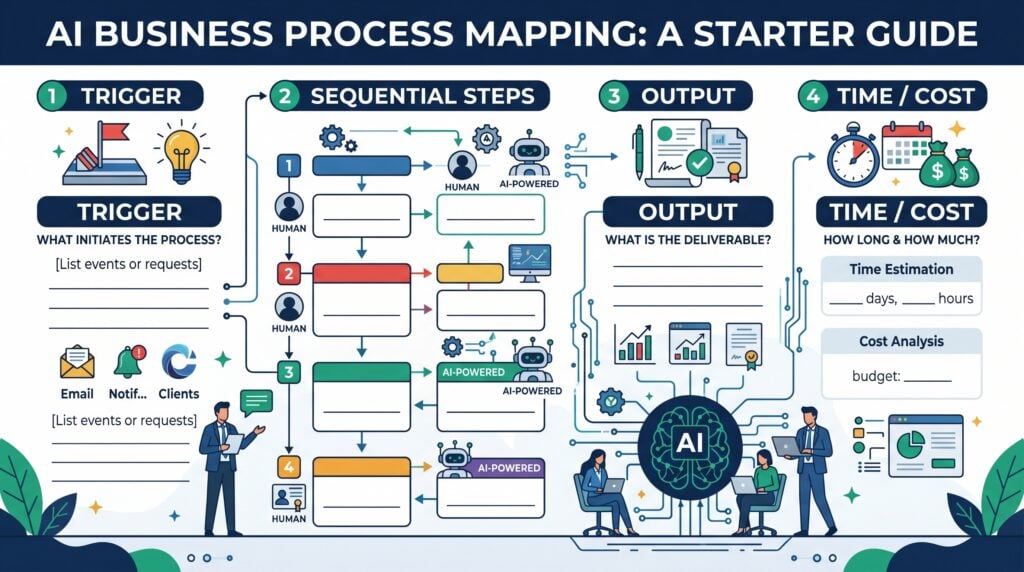
A full business process map for AI readiness includes four parts. A note of the trigger that starts the process. The steps a human currently takes in order. The output that signals the process is done. And the estimated time cost per cycle. Per McKinsey’s State of AI (2024), businesses that address readiness before any tech call consistently reach faster adoption and lower tool drop-off rates. All four parts address readiness before any tech call is made.
The trigger and output are the most often skipped parts. They are also the most key for AI tool choice. A process with a clearly set trigger, such as “a new client inquiry arrives,” and a clearly set output, such as “a qualified lead enters the CRM (Customer Relationship Management) system with source data,” is far easier to automate than one described as “we handle new inquiries.” Most growing businesses can write a full process map for their top three workflows in one 4-hour working session.
Four parts of a full AI-ready process map:
- Trigger. The set event or input that starts the process. An incoming email. A form submission. A new row in a spreadsheet. Or a calendar event. A process with no set trigger cannot be reliably automated.
- Steps in order. The numbered list of actions a human takes from trigger to output. This includes call points, tool switches, and handoffs between team members. Gaps in the step list are where automation fails.
- Output. The set result or system state that signals the process is done. A doc made. An entry added. A message sent. Or a status update. No set output means no trackable AI result.
- Time cost. The estimated minutes or hours the process currently takes per cycle and per week in total. This is the top metric for ranking which processes to map first.
Businesses that write all four parts for each workflow before checking any AI tool always pick more fitting tools and finish rollout in fewer total hours than those who start with a product demo.
How Do You Map a Process for AI Readiness?
The fastest method for mapping a business process for AI readiness starts with a voice or text brain dump. The owner talks through the process from trigger to output without stopping to sort it, then uses ChatGPT Plus ($20 per month) to turn that talk into a numbered step list. Most growing business owners can make a usable first-draft process map for one workflow in under 90 minutes using this method. No prior process write-up experience needed.
After the first draft is done, the most useful 30 minutes is a check with the team member who actually does the process daily, not the owner who thinks they know how it works. The pattern across close to 1,000 businesses shows that the owner’s version of a workflow and the operator’s version differ a lot in at least 60% of cases. The operator’s version is the one that sets whether an AI tool will last in use. Map what actually happens, not what you built the process to do.
AI Smart Ventures gives AI consulting services for growing businesses working through process mapping, tool choice, and AI readiness, with plans built across close to 1,000 businesses.
Which Processes Should You Automate First?
The business processes that give the highest return when automated first are those that run at least weekly, take more than 2 hours of human time per week in total, have a steady input and output, and do not need judgment, client tie management, or real-time calls at any step. Most growing businesses find 3 to 5 processes that meet all four tests within their first process mapping session. Per Stanford HAI’s AI Index Report (2025), the highest-ROI AI automation deployments in 2025 were in high-repetition, well-defined tasks with measurable outputs, exactly the profile these four tests identify.
Ranking which processes to automate is the call most businesses rush past. It is the one that determines whether AI spend makes a real result or a shelf item. A process that takes 20 minutes per week and involves a judgment call at the midpoint is a poor automation pick no matter whether an AI tool technically exists for it. Once processes are mapped and ranked, AI implementation support helps roll out automation without breaking current workflows.
Three tests that make a process a strong automation pick:
- High repetition. The process runs at least weekly with a steady setup. Processes that run monthly or less rarely justify the mapping and setup spend vs. weekly ones.
- Set handoff. Every step has a clear input (what arrives) and a clear output (what leaves). Processes where the output is a judgment call or a creative piece are not yet ready for reliable automation.
- Time costs above 2 hours per week. Automating a 30-minute weekly process rarely recovers setup costs within 90 days. Focus on the processes taking the most human time to get the most real ROI.
What Tools Help With AI Process Mapping?
The AI tools that make the most reliable process maps for growing businesses without a full ops team are general-purpose AI writing tools under $20 per month for step write-up and visual flowchart tools under $15 per user per month for diagram making. A business can finish a usable process map for one workflow using a $20 per month AI writing tool and a free flowchart template in under 2 hours. No prior process write-up training needed.
Businesses that add a visual diagram tool to their process mapping stack always make clearer handoff docs and fewer automation errors than those that work in text only. Visual flowcharts surface call points and branching logic that text notes tend to hide. Before picking a diagram tool, confirm that at least one team member will keep diagrams as processes change. An outdated diagram is more harmful to AI rollout than no diagram at all.
| Tool | Process Mapping Use Case | Cost | Best For | Limitation |
| ChatGPT Plus | Drafting step lists, SOPs, process descriptions | $20/month (Plus plan) | First-draft documentation | Output needs operator review before finalizing |
| Claude Pro | Structuring complex multi-step workflows | $20/month (Pro plan) | Multi-decision process documentation | Benefits from detailed input narration |
| Notion AI | Knowledge base for process documentation | $16/user/month (AI add-on) | Teams already using Notion | Poor fit for teams not on Notion |
| Miro | Visual flowcharts and process diagrams | $8/user/month (Team plan) | Visual thinkers and team collaboration | Free plan limited to 3 boards |
| Lucidchart | Flowchart creation for process maps | $9/user/month (Individual plan) | Detailed multi-step workflow diagrams | Collaborative editing requires higher-tier plan |
For an always-updated list of AI tools vetted for service businesses, see AI tools and apps on the AI Smart Ventures resource hub.
Frequently Asked Questions
What Is AI Business Process Mapping?
AI business process mapping is the practice of writing a business workflow, including its trigger, steps in order, output, and time cost, before picking any AI tool for automation. It makes a clear picture of what the process currently does so the business can check whether an AI tool matches the actual workflow rather than a broad use case. Growing businesses that finish this step before tool choice always see faster adoption and fewer dropped tools within the first 60 days. AI Smart Ventures sees this pattern across close to 1,000 engagements.
Why Map Processes Before Automating With AI?
Mapping processes before automation stops the most common failure pattern in AI rollout. Buying a tool for a workflow that turns out to be less set or more judgment-heavy than it looked. A written process map reveals call points, exceptions, and handoffs that make a workflow poor for automation before any money is spent. The pattern across close to 1,000 businesses shows that those with written process maps before tool choice spend much fewer hours fixing failed rollouts.
How Long Does Business Process Mapping Take?
Writing one business process for AI readiness takes 90 minutes to 4 hours based on workflow complexity. Use a voice or text brain dump plus a check with the team member who does the process. A full process map for the top 3 to 5 workflows in a growing business can be done in one 8-hour working session. Businesses that treat process mapping as a repeated quarterly practice always keep better AI tool adoption than those who map once.
What Makes a Good Candidate Process for AI?
A good AI automation pick is a process that runs at least weekly, takes more than 2 hours of human time per week in total, has a steady input and output, and does not need judgment or client tie management at any step. Meeting all four tests does not guarantee a good result. But missing any one is a clear sign of tool drop-off within 90 days. Most growing businesses find 3 to 5 qualifying processes in their first mapping session.
Can You Map Processes Without a Consultant?
Growing businesses can map most internal processes without a consultant using a voice brain dump method and a $20 per month AI writing tool to structure the output. A consultant adds the most value when a process involves regulated data, multi-system links, or compliance needs that change the automation approach. Businesses that map their top 3 to 5 workflows on their own before hiring a consultant always get more from that engagement because they can describe their current state clearly.
What Are the Most Common Process Mapping Mistakes?
The most common process mapping mistake is writing the ideal process rather than the actual one. This makes a map that does not match reality and leads to tools no one uses. The second most common mistake is skipping the time cost column, which makes it hard to rank which processes to automate first or track the return after rollout. Tools from OpenAI and Anthropic can draft step lists but cannot check whether the steps reflect actual practice.
How Much Does AI Process Mapping Cost?
AI business process mapping costs $0 to $200 in tool costs if done in-house using ChatGPT Plus ($20 per month) and Miro ($8 per user per month), with 2 to 8 hours of team time per process. Having a consultant run process mapping and tool choice typically costs $1,500 to $5,000 for a 3 to 5 process sprint, based on complexity. Large firms like Accenture or Deloitte start above $25,000 for similar work, making advisor-supported mapping the practical path for growing businesses. Schedule a consultation to find the right approach for your workflows.
What Is the Difference Between Process Mapping and Process Automation?
Process mapping is the write-up activity that describes what a workflow currently does, who owns each step, and what a useful output looks like. Process automation is the rollout of a tool that does one or more of those steps without a human. Businesses that automate without a written map always spend more time fixing automation errors than the process originally took. Mapping is the blueprint. Automation is the build.
Executive Summary
AI business process mapping is the set write-up activity that determines whether a growing business’s AI tool spends real results or shelf items. Per McKinsey’s State of AI (2024), 72% of businesses use AI in at least one function. Yet most growing businesses that try automation without a written process map buy tools that do not fit their actual workflows. The four-part mapping method (trigger, steps, output, time cost) finished before any tool buy is the most clear sign of a useful rollout. Most growing businesses can write their top 3 to 5 workflows in one 8-hour session using tools under $40 per month combined.
What Should You Do Next?
This week, pick the one workflow in your business that takes the most human time per week. Write a numbered step list from trigger to output using ChatGPT Plus. Then ask the team member who does the process daily to check and fix it. That one doc is the base of your AI readiness. It costs under 2 hours to finish.
AI Smart Ventures offers AI consulting services for growing businesses building AI readiness through process mapping, tool choice, and rollout planning. Schedule a consultation to find the right starting process and tool for your business.
People Also Read
- How Do You Create an AI Strategy for Your Business? A Step-by-Step Guide
- How Do You Prove AI ROI to Your Board? The 2026 Framework for Demonstrating Value
About the Author
Nicole A. Donnelly is the Founder of AI Smart Ventures and an AI Adoption Specialist with 20 years of experience as a founder and CEO and over a decade leading AI adoption initiatives. She helps businesses integrate artificial intelligence with clarity and confidence, driving innovation and sustainable growth. Nicole has trained over 20,217 professionals in Applied AI, delivered 624 workshops, and worked with close to 1,000 organizations across diverse industries.
Expertise: AI Transformation, AI Strategy, AI Implementation, AI Adoption, Applied AI, Marketing, Business Operations
Disclaimer: This content is for informational purposes only and does not constitute professional business or technology advice. Results vary based on industry, existing systems and implementation commitment. Contact AI Smart Venturesfor a consultation regarding your specific situation.