AI Content Workflows for Wellness Brands: FDA Guide
Last Updated: May 2026
An AI content workflow for wellness brands is a set process that uses AI (Artificial Intelligence) tools to draft, review, and publish health and supplement content. It applies FDA (Food and Drug Administration) compliance checks at every stage. That stops the banned structure/function claim errors and disease language that trigger enforcement actions. AI Smart Ventures sees across close to 1,000 businesses that wellness brands using AI content without a set review layer consistently produce banned claim language in their first six months of output.
AI Smart Ventures has helped growing businesses and groups through AI adoption calls, including wellness brand owners working out how to speed up content without creating the FDA risk that unreviewed AI copy routinely generates. The firm’s AI consulting work in this area spans supplement firms, functional food brands, and wellness service businesses where the compliance cost of one AI-made claim error exceeds six months of output gains.
Key Takeaways
- FDA claim types. The FDA splits claims into three types. Structure/function, health, and disease claims. Only structure/function claims are allowed for supplement brands without pre-approval. AI tools make all three without splitting them unless trained or prompted to avoid disease language.
- Compliance near-miss rate. Wellness brands using AI content without a set review layer consistently make banned claim language in early output. AI tools default to disease-adjacent language that sounds accurate but breaks FDA structure/function rules.
- Warning letter risk. FDA warning letters to supplement and wellness brands citing banned claims rose 34% between 2022 and 2024, per FDA’s official warning letter database. Claim accuracy is a growing enforcement focus.
- Two-gate review needed. A two-gate review (one auto, one human) is required. Per FTC’s digital health marketing guidance, every health claim needs solid scientific evidence. AI tools cannot meet that standard without human checks at each stage.
- Speed gain. Wellness brands with a set AI content workflow make compliant content faster than those using human-only drafting. The system prompt cuts compliance rework that unguided AI makes at the editing stage.
What FDA Rules Apply to Wellness Brand Content?
FDA rules require wellness and supplement brands to use only structure/function claims. These describe how a nutrient affects normal body function. The FDA bans disease claims and any language that implies treatment or diagnosis. The split between “supports healthy blood pressure” (allowed) and “reduces high blood pressure” (banned disease claim) is the line AI tools routinely cross when making content without guardrails. Violations trigger FDA warning letters and forced product relabelling.
The FTC enforces a parallel set of rules covering testimonials, proof, and endorsement disclosures in digital content. A wellness brand’s AI content workflow must satisfy two regulators at the same time. Per FTC’s digital health marketing guidance (2023), health claim proof needs solid and reliable scientific evidence for every stated benefit. AI tools cannot meet that by making plausible-sounding stats. Every AI draft is unconfirmed until a human reviewer has checked each claim against approved language.
The three claim types AI tools must be set up to split:
- Structure/function claims. Allowed without pre-approval. They describe how a nutrient affects normal body function (example: “Vitamin D supports bone health”).
- Health claims. Need FDA approval. They describe a link between a nutrient and reduced disease risk. They cannot be made without the exact approved language.
- Disease claims. Always banned on supplement labels and marketing content. They state or imply treatment, prevention, cure, or reduction of a health condition.
All three types appear in AI-made wellness drafts. The workflow must ensure only structure/function language reaches publication.
Which AI Tools Work Best for Wellness Content?
The AI tools that work best for wellness brand content accept detailed system prompts that set out banned claim types and enforce structure/function framing in every made draft. Claude by Anthropic and ChatGPT both support this system prompt function. That makes them usable in a compliance-aware workflow when the prompt clearly bans disease language. General-purpose writing tools without system prompt access are the highest-risk option. There is no way to apply claim guardrails at the making stage.
The second point is whether the AI tool can make content at the ingredient level (Ashwagandha, L-Theanine, Berberine) without making up efficacy claims beyond what the ingredient’s structure/function record supports. Content teams that give AI tools clear brand guardrails in the system prompt spend less time editing for compliance than teams using generic prompts. The system prompt filters banned language before the draft reaches the reviewer. Rather than needing a human to catch it after the fact. The system prompt is the first compliance gate. Not an optional setup step.
Owner-operators who use GoHighLevel for client pipeline and CRM can note that GoHighLevel’s standard features (pipeline tracking, email sequences, booking) do not create FDA claim risk. They do not make wellness content claims. GoHighLevel sits comfortably alongside a compliant AI content workflow as the client ops layer, with no overlap into the regulated content making space.
AI Smart Ventures offers AI consulting services for wellness brand owners building compliant AI content workflows. Schedule a consultation to check your current content process and find where FDA compliance risk enters before it reaches your website.
How Do You Build a Compliance Review Layer?
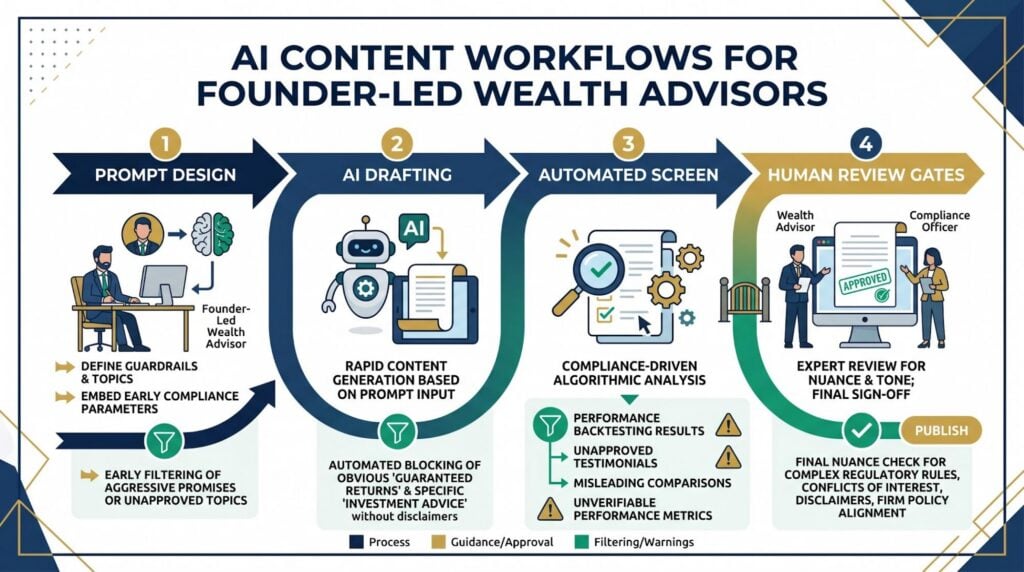
A compliance review layer for AI-made wellness content needs two steps in order. An auto pre-screen gate using a banned term list and a claim checker. And a human review gate where a compliance-trained reviewer reads each draft against the brand’s approved claim list before publication. Both gates are needed. Auto screens miss context-based disease claims that keyword filters cannot catch. Human review alone creates a bottleneck that cuts AI’s speed gain.
The auto gate starts with a banned term list from the FDA’s structure/function claim guidance and warning letters issued to similar brands in the last 24 months. It covers disease names, diagnosis terms, prescription drug comparisons, and any claim that implies treatment. Per FDA’s structure/function claim guidance (2022), claims that imply disease diagnosis stay banned even when framed as questions or indirect hints. Human review is irreplaceable as the final gate. The banned term list must be updated each quarter as new warning letters extend the enforcement line.
| Staffing Level | AI Role | Review Gate | Publish Rate |
| Solo owner-operator | Draft all body copy | Owner review + prohibited term checklist | 3-5 pieces/week |
| Owner + 1 marketing hire | Draft + headline variants | Marketing hire review + FDA term filter | 8-12 pieces/week |
| Owner + marketing + compliance advisor | Draft full content sets | Compliance advisor sign-off on claims | 20+ pieces/week |
Scale the workflow to your staffing reality. A solo owner-operator should not aim for 20-piece weekly output without the review capacity to match AI making speed. AI Smart Ventures offers AI rollout and AI advisory support for wellness brands setting up two-gate review systems, including banned term list setup and system prompt design.
What Does a Compliant Workflow Look Like in Practice?
A compliant AI content workflow runs in four steps. A set prompt with approved claim language and a clear disease-language ban. AI making a first draft. Auto keyword screening against a banned term list. And human review against the master approved-claim document before publication. The workflow makes a content piece only after all four steps are done. No shortcuts at steps 3 or 4.
The most common failure is skipping the approved-claim document because it has not been built yet. Wellness brands that build the workflow before the claim list routinely approve AI content that sounds accurate but does not match the brand’s actual confirmed claim set. Brands that build the approved-claim document first and then build the workflow around it reduce per-piece review time. They also create the proof records that regulators expect when disputes arise. Build the document first. Then build the workflow around it.
Three workflow parts that wellness brands most often skip:
- Master approved-claim list. A brand-specific list of every allowed structure/function claim, linked to supporting studies. Without it, the human review gate has no reference standard.
- Banned term update timing. The banned term list must be updated each quarter as new FDA warning letters extend the enforcement line. A stale list leaves recently banned language in the workflow.
- Disclaimer template set. Every wellness content piece needs the FDA-required disclaimer. A template set stops AI-made content from going out without the required statement.
All three parts are needed before the workflow can work as a compliance tool rather than just a speed tool.
How Do You Measure Whether the Workflow Is Reducing Risk?
Tracking compliance risk cut from an AI content workflow needs three monthly metrics. Banned term catch rate (drafts flagged by the auto gate). Human review correction rate (drafts needing edits at the human gate). And time to publish per piece. A workflow that is improving shows a rising catch rate at the auto gate and a falling correction rate at the human gate as the system prompt and banned term list are refined over time.
When the human review correction rate stays above 30% after 60 days, the system prompt or auto gate is not filtering well. The human reviewer is doing work that should be automated. Tracking these metrics also creates the due diligence records regulators expect if a claim dispute arises. A logged correction history shows set compliance effort. That is a very different position than having no records when enforcement contact happens.
Frequently Asked Questions
What AI Content Rules Apply to Supplement Brands?
Supplement brands must ensure all AI-made content uses only allowed structure/function claims. It must avoid disease language, diagnosis terms, and any statement implying treatment, prevention, cure, or reduction. The FDA bans disease claims on supplement labels and marketing no matter whether they are AI-made or human-written. A set AI content workflow with a human review gate is the only reliable way to catch the disease language AI tools make by default.
Can AI Tools Generate FDA-Compliant Wellness Content?
AI tools can make FDA-compliant wellness content when given a detailed system prompt. The prompt must include the brand’s approved claim language, a banned term list, and a clear instruction to use structure/function framing only. No AI tool makes compliant content by default. Compliance comes from prompt design and a human review gate. Not from the tool itself. Brands that rely on AI making without a review layer consistently make content that breaks FDA structure/function rules.
What Is a Structure/Function Claim for Supplements?
A structure/function claim describes how a nutrient or dietary ingredient affects the normal structure or function of the body. For example, “calcium builds strong bones” or “antioxidants maintain cell health.” Structure/function claims do not imply diagnosis, treatment, prevention, or cure of any disease. They are the only type of health-related claim allowed on supplement labels and marketing without FDA pre-approval. They are the only claim type an AI content workflow should make for supplement brands.
What Triggers an FDA Warning Letter for Supplement Content?
An FDA warning letter for supplement content is typically triggered by disease claims in product marketing, including website copy, social posts, and blog content. Common triggers include naming specific diseases in claim language, using diagnosis terms such as “clinically proven,” comparing products to prescription drugs, and testimonials describing disease treatment outcomes. AI-made content often includes these patterns when made without a compliance-aware system prompt and human review gate.
How Many People Should Review AI Wellness Content Before Publishing?
At minimum, one compliance-trained reviewer should read every AI-made wellness content piece against the brand’s master approved-claim list before publishing. For brands in high-scrutiny areas such as weight loss, mental function, or immune support, a second review by a regulatory advisor is the safer standard. Solo owner-operators with no compliance hire should work from a detailed banned term checklist and an approved-claim document until they can add a set reviewer.
What Is the Fastest AI Content Workflow for a Wellness Brand Owner?
The fastest compliant AI content workflow uses a detailed system prompt with approved claims built in, an auto keyword screen against a banned term list, and a personal 15-minute review of each draft against the brand’s claim document. This three-step process makes publication-ready wellness content in under two hours per piece, vs. four to six hours for human-only drafting. Speed without the compliance step is not a valid trade-off for wellness brands.
How Do You Build an Approved-Claim Document for AI Content?
Building an approved-claim document starts with listing every ingredient or product the brand sells. Then write the structure/function claim for each ingredient backed by current proof evidence. Each entry should include the allowed claim language, the supporting reference, and the required FDA disclaimer text. The document becomes the reference standard that human reviewers check AI drafts against. Without it, the review gate has no objective pass/fail criteria.
Does the FTC Also Regulate AI-Generated Wellness Content?
The FTC regulates AI-made wellness content under the same endorsement, testimonial, and proof rules that apply to all health marketing. AI-made testimonials are banned if they imply real consumer experiences that did not happen. Efficacy claims need the same solid and reliable scientific evidence standard as human-written claims. Wellness brands using AI to make influencer-style testimonials or before-and-after scenarios face FTC enforcement risk on top of FDA compliance risk.
Executive Summary
AI content workflows for wellness brands make compliant health and supplement content at three to four times the speed of traditional drafting when built around a four-step process. A compliance-aware system prompt embedding approved claim language. AI draft making. An auto banned term screen. And a human review gate against the brand’s master approved-claim document. The FDA bans disease claims no matter whether content is AI-made or human-written. AI tools without guardrails make language banned by default. The system prompt and review layer are the only split between compliant output and enforcement risk. Wellness brands that build the approved-claim document before rolling out the workflow reduce per-piece review time. They also create the proof records regulators expect when disputes arise.
What Should You Do Next?
This week, list every structure/function claim your brand uses in marketing. Confirm each one is backed by proof evidence and free of disease language. Build a one-page banned term list from the FDA’s structure/function claim guidance and any warning letters issued to supplement brands in your area in the last 24 months. By the end of month, test one AI-drafted content piece through a two-gate review. Measure how long the compliant workflow actually takes before scaling output.
AI Smart Ventures offers AI consulting services for growing businesses and groups building AI content workflows that meet regulatory needs, including wellness brand compliance plan design and banned claim checks. Schedule a consultation to map your current content process against FDA and FTC needs and find where AI can speed up output without creating enforcement risk.
People Also Read
- What Is AI Governance and How Do You Implement It Without an Enterprise Budget?
- What Is Agentic AI and Should Your Business Care in 2026?
About the Author
Nicole A. Donnelly is the Founder of AI Smart Ventures and an AI Adoption Specialist with 20 years of experience as a founder and CEO and over a decade leading AI adoption initiatives. She helps businesses integrate artificial intelligence with clarity and confidence, driving innovation and sustainable growth. Nicole has trained over 20,217 professionals in Applied AI, delivered 624 workshops, and worked with close to 1,000 organizations across diverse industries.
Expertise: AI Transformation, AI Strategy, AI Implementation, AI Adoption, Applied AI, Marketing, Business Operations
Disclaimer: This content is for informational purposes only and does not constitute professional business or technology advice. Results vary based on industry, existing systems and implementation commitment. Contact AI Smart Venturesfor a consultation regarding your specific situation.