
AI Personalization for Founder-Led Wellness Brands Without Losing the Customer Relationship
Last Updated: May 2026
An AI tool for a founder-led wellness brand sends each customer the right message, offer, or product tip based on what they have already bought or browsed. It does this at a scale the founder cannot manage by hand. McKinsey’s 2025 personalization report found that wellness brands using AI to send matched messages saw a 40 percent lift in repeat purchases. That is compared to those sending the same message to every customer. For a founder running a lean wellness brand, that lift is the gap between a loyal base and a one-time buyer list.
AI Smart Ventures has worked with close to 1,000 growing businesses on AI use, including founder-led wellness brands that added this kind of AI tool without giving up the real voice that built their audience. The sections below show what the AI tool covers, where to start, and how to keep the customer bond strong while the AI handles the volume.
Key Takeaways
- Tool Goal – AI tools for wellness brands help founders send the right message to the right customer at the right time, using buy and browse data already inside their email platform or store.
- Repeat Purchase Lift – Wellness brands using AI to send matched messages saw a 40 percent lift in repeat purchases, per McKinsey’s 2025 personalization report.
- Relationship Risk – The AI tool works best when the founder reviews each draft and adds their voice before it reaches the customer, not when it runs on its own.
- Starting Point – The best first use is a post-purchase email that tips the next product, because the data is already there and the repeat sale impact is easy to track.
- Human Voice Rule – Every AI-drafted message needs a founder edit before it goes out, most of all in wellness where trust is the main reason buyers return.
Founder-led wellness brands that keep the founder’s voice in every AI-drafted message hold the customer bond that mass AI tends to erode over time.
What Is AI Personalization for Wellness Brands?
AI tools for wellness brands use buyer data to send each person the right message at the right time, at a scale no founder can manage by hand alone. These tools pull from past orders, email opens, and quiz answers, and the result is a more personal touch that grows repeat sales without growing the team. Pick a tool that learns from the data you already have, not one that needs a new system.
Deloitte’s 2025 customer experience report found that 71 percent of wellness buyers said they were more likely to return to a brand that sent them a message that fit their needs. They were less likely to return to one that sent the same email to all. For a founder-led brand, that shows up in the open rate and the reorder rate. The tool can move both without adding a new hire to the payroll.
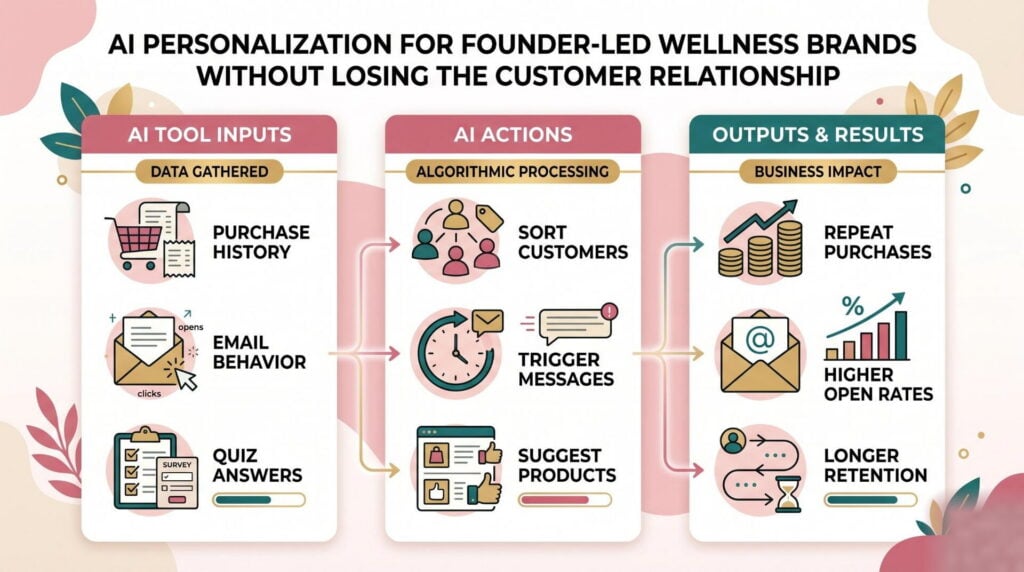
Three AI uses that work best for founder-led wellness brands:
- Post-Purchase Emails – The tool sends a follow-up email after each order that tips the next product based on what was just bought. This is the fastest path to a second sale. No extra work from the founder is needed after setup.
- List Groups – The tool sorts your buyer list into groups based on behavior: one-time buyers versus repeat buyers. It sends each group a different message. You do not need to write a new email for each group by hand.
- Quiz Match Emails – Many wellness brands use a quiz to match buyers to products. The tool links quiz answers to your catalog. It sends a match email on its own after each quiz is done.
Start with the one use that fits the data you already have and the customer moment that drives the most repeat sales.
How Do You Protect the Customer Relationship With AI?
Set one rule from day one: every message the tool drafts gets a founder review before it reaches the customer, at least for the first 90 days of any new tool. Wellness buyers choose brands based on trust, and a message that reads as flat or robotic can undo months of brand work in a single email. The review step is what keeps your real voice in every message you send.
PwC’s 2025 consumer trust report found that wellness buyers who felt a brand was truly personal were 56 percent more likely to tell a friend about it. That is compared to those who felt the brand treated them like a number. For a founder-led brand, word of mouth is often the main growth path. AI either helps that path or cuts it off. It depends on how closely the founder reviews each draft. Ten minutes of founder review per draft is the cheapest brand care you can do each week.
Three steps to keep the customer bond strong when using AI:
- Review Every Draft – Set a rule that no AI message goes to a customer without the founder reading it first. At the 90-day mark, you can relax this rule. Relax it only for message types that have matched your voice each time without edits.
- Add Your Voice – AI drafts tend to be clear but flat. Read each one out loud and add one sentence that sounds like you. That one sentence is often enough to make the message feel real.
- Flag Health Topics – Wellness content often touches on health outcomes and personal struggles. Flag these topics in your AI tool. Those messages should come back to you for a full edit before they go out.
The AI implementation team at AI Smart Ventures helps founder-led wellness brands set up AI tools with review steps that keep the founder in control of every message without slowing the day down.
Which AI Tools Work for Founder-Led Wellness Brands?
AI tools for founder-led wellness brands link to your email platform and store, and trigger messages without needing a data team to run them. The best ones offer a clear review step before any message goes live, a simple workflow builder, and ready-made templates for common wellness uses. A tool with no review layer is a risk for any brand where every message carries the founder’s name.
Accenture’s 2025 AI study found that growing consumer brands using AI tools with a built-in review step kept customers at a rate 33 percent higher. That is compared to those using hands-off tools with no human check. The review step does not slow the tool down. It speeds up trust-building by making sure the message lands right the first time. For a founder-led wellness brand, one bad AI message to the wrong group can damage the brand faster than the tool builds revenue.
| Tool Type | Best For | Review Option |
|---|---|---|
| Email platform AI | Post-purchase emails | Manual before send |
| Quiz match tools | Product tip emails | Founder opt-in |
| AI copy add-ons | Tone edits | Full founder review |
| Full-stack tools | Group campaigns | Review by group |
The AI advisory team at AI Smart Ventures reviews AI tools based on your current tech stack and brand voice, so you pick the right fit before you invest in setup time.
What Are the Risks of AI for Wellness Brands?
The main risks are flat messages, wrong product tips sent to the wrong buyer, and health claims in AI drafts that go beyond what the brand can legally say. Each risk is easy to manage if the founder stays in the loop for the first 90 days of any new tool. The cost of review is always lower than the cost of losing a buyer who once trusted your brand.
McKinsey’s 2025 personalization report found that 43 percent of wellness buyers who received a clearly off-target message from a brand they liked stopped subscribing within the week. For a founder-led brand with a small but loyal list, losing 10 percent of that list to one bad AI message is a hard setback. It takes time to recover. The cost of the review step is always lower than the cost of rebuilding a list that once trusted you.
How Do You Know If AI Personalization Is Working?
The clearest sign the AI tool is working in a wellness brand is a rise in repeat purchases within 90 days of launch, because that is the metric the tool is built to move. Track your repeat purchase rate and your email open rate for 60 days before and after the tool goes live. If both numbers move up by at least 10 percent, the tool is paying for itself.
Deloitte’s 2025 customer experience report found that wellness brands that set a clear success metric before launch were 49 percent more likely to keep using their AI tool past the first six months. That is compared to those that waited to see what happened. One number gives the founder a shared target. It shows when to expand to a second AI email chain and when to pause and fix the first one. Without that number, most founders end the test early and switch to a new tool before the current one has time to work.
Frequently Asked Questions
What is AI personalization for wellness brands?
AI for wellness brands uses buyer data to send each person the right tip. It learns from purchase history, email behavior, and quiz answers. The tool decides what to send and when based on that data. For a founder-led brand, the goal is more repeat purchases. The AI handles the volume so the founder does not have to.
How does AI affect the customer relationship in wellness?
AI can build the customer bond when the founder reviews the draft first. A message that fits the buyer builds trust faster than one that does not. AI can also harm the bond when a message feels flat or off-voice. The review step is the single biggest factor in whether AI helps or hurts. Founder edits every draft for the first 90 days is the best starting rule.
What data does AI need to work?
AI for a wellness brand needs purchase history, email open data, and quiz answers. Most founders already have this data inside their email platform and store. The best tools pull from these sources without needing a new system. More complete past order data means better and faster product tips. The AI uses this data to send the right message to the right person.
How much does AI cost for a wellness brand?
AI tools for wellness brands cost between $50 and $500 per month. The price depends on your list size and the number of email chains. Many e-commerce email platforms already include basic AI features at no extra cost. Start with the tool your store already uses before buying a separate one. Contact AI Smart Ventures for a tool match based on your current platform and list size.
Which AI tools work best for founder-led wellness brands?
Klaviyo, Attentive, and Drip work well for founder-led wellness brands. Each links to Shopify or WooCommerce and offers post-purchase email chains. The best tool depends on your list size and product line. Start with the tool your store already works with. That avoids a longer setup and extra cost.
Can AI handle wellness health claims safely?
AI tools draft wellness messages but do not know the legal limits on health claims. Every draft with a health outcome or clinical language needs a founder or legal review. Do not let those messages go out without a human check. Set up a flag in your AI tool for health-related terms. Any flagged message goes to your review list before it goes out.
How long does it take to set up AI for a small wellness brand?
Most AI tools for wellness brands take two to four weeks to set up. Week one: link the tool to your store and email platform. Week two: build the first two or three email chains. Weeks three and four: test before going live. Most brands see the first results within 60 days of going live.
How does AI work with a small customer list?
AI tools work best with at least 500 past orders and 1,000 email subscribers. Below those numbers, a simple post-purchase email chain often works better. It beats an AI tool on cost and accuracy at that list size. Once your list grows past those levels, the AI pays back faster. It saves the founder four to six hours per week on message planning.
Executive Summary
AI for a founder-led wellness brand works best when the tool handles product tips and post-purchase email chains. The founder reviews every draft before it reaches the customer. The biggest risk is a message that feels flat or includes health claims the brand should not make. Both are things the founder catches in a ten-minute edit. Start with post-purchase email tips and review every draft for 90 days. Expand to a second email chain once the first one shows a clear lift in repeat purchases.
What Should You Do Next?
List the three customer moments in your wellness brand where a more personal message would most likely lead to a repeat purchase. The one at the top is where the AI tool should start, and you can begin looking at tools this week.
AI Smart Ventures offers AI consulting for growing brands that want to add AI without losing the founder voice that built the business. Schedule a consultation to find the right AI tool for your wellness brand and list size.
People Also Read
- How Do You Measure AI ROI? A Framework for Business Leaders
- How Do You Address Employee AI Anxiety Without an HR Department?
About the Author
Nicole A. Donnelly is the Founder of AI Smart Ventures and an AI Adoption Specialist with 20 years of experience as a founder and CEO and over a decade leading AI adoption. She helps businesses add AI with clarity and confidence. Nicole has trained over 20,217 professionals in Applied AI, delivered 624 workshops, and worked with close to 1,000 organizations across diverse industries.
Expertise: AI Transformation, AI Strategy, AI Implementation, AI Adoption, Applied AI, Marketing, Business Operations
Disclaimer: This content is for informational purposes only and does not constitute professional business or technology advice. Results vary based on industry, existing systems and implementation commitment. Contact AI Smart Ventures for a consultation regarding your specific situation.