AI FOMO for Owner-Operators: How to Tell Signal from Noise in 2026
Last Updated: May 2026
An AI FOMO moment is the point where an owner-operator buys a tool not because it solves a real problem but because every peer or vendor says they need it now. Gartner’s 2025 CEO technology survey found that 54 percent of growing businesses that adopted AI tools in 2024 said their main driver was rival fear, not a clear business need. Only 30 percent of those tools were still in active use 12 months later. The gap between AI signal and AI noise is where most owner-operators lose time and money.
AI Smart Ventures has worked with close to 1,000 growing businesses on AI use, including owner-operators who have built filters to cut AI noise and focus on the tools that drive real results. The sections below show how to tell the signal from the noise.
Key Takeaways
- FOMO Cost – 54 percent of growing businesses adopted AI tools in 2024 driven by rival fear, and only 30 percent of those tools were still in use 12 months later, per Gartner’s 2025 CEO technology survey.
- Signal vs Noise – AI signal is a tool that solves a problem your team faces this week. AI noise is a tool you adopt because someone else did.
- The FOMO Test – Before buying any AI tool, answer three questions: what exact task does this replace, who on my team will use it daily, and what does a win look like in 30 days.
- Tools Worth Buying – In 2026, the AI tools that deliver real results for owner-operators are the ones that cut a repeatable task, reduce a clear cost, or speed up a step that slows revenue.
- First Filter – Write down the top three tasks your team repeats every week. If a new AI tool does not touch at least one of those tasks, it is noise.
The owner-operators who avoid AI FOMO are not the ones who ignore AI, but the ones who have a clear filter for what to buy and what to skip.
What Is AI FOMO for Owner-Operators?
AI FOMO is the fear that your rivals are gaining ground with AI tools while you fall behind. For owner-operators, this fear often drives tool purchases that are fast, costly, and hard to reverse. The AI landscape in 2026 is full of tools that promise to change everything. The FOMO pressure to buy before you are ready is higher than it has ever been.
McKinsey’s 2023 CEO technology survey found that growing businesses that adopted AI tools without a clear use case spent 40 percent more on AI in 12 months. They also saw 35 percent fewer results than those that started with a problem and then found a tool. The owner-operator who builds a filter for AI noise before they buy saves more time and money than the one who tries every tool and then decides what to keep.
How Do You Tell an AI Signal from Noise?
AI signal is a tool that solves a real problem your team faces every week. It can be measured in 30 days. And it does not need a new hire to run it. AI noise is a tool you buy because a vendor says you need it, a peer mentions it, or you saw it in an article. The test is simple: if you cannot name the exact task it replaces, it is noise.
Deloitte’s 2024 digital adoption report found that owner-operated businesses that ran a 30-day pilot before a full AI tool purchase saw 55 percent higher use rates and 40 percent lower total cost. They did better than those that bought based on a demo or a peer tip. A pilot does not need to be formal. One person on your team can test a free version for two weeks. That one result tells you more than any vendor pitch or product demo.
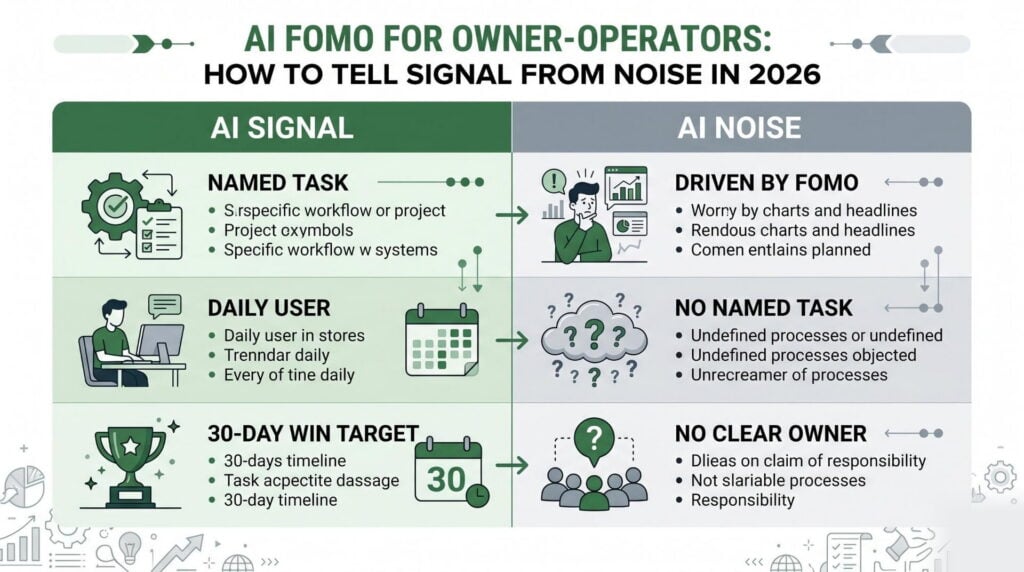
Before you run a pilot, run this three-part check on any AI tool you are considering:
- Task Match – The tool must replace a real task your team does by hand at least once a week. If the task is rare, the return will be too low to justify the cost or the time to learn it.
- Team Fit – At least one person on your team must want to use it and have time to learn it in the first 30 days, or it will sit unused no matter how good the tool is.
- Clear Win – You must be able to say what a good result looks like in 30 days: time saved, errors cut, or revenue added. If you cannot define the win, you cannot measure it.
A tool that passes all three is worth a 30-day pilot. A tool that fails one goes on your watch list for 90 days.
What Are the Signs You Are Buying AI Out of FOMO?
The clearest sign that you are buying AI out of FOMO is that you cannot explain the tool to your team in one sentence. If you need a long setup to describe what it does, it is not solving a clear problem. The other signs are a purchase driven by a vendor limited-time offer, a peer mention, or a fear that you are the last one in your field to adopt it.
PwC’s 2026 CEO technology priorities report found that 61 percent of CEOs who reported AI tool regret had made the purchase within 30 days of first hearing about the tool. Most often it came after a peer mention or a vendor email. The tools that delivered real results were chosen differently. A clear use case was set first. A 30-day test was run. And at least one person on the team was named as the owner of the rollout.
Which AI Tools Are Worth the Investment in 2026?
The AI tools worth buying in 2026 are the ones that cut a repeatable task, save a real cost, or speed up a step that slows revenue. For most owner-operators, this means tools in three areas: writing and content, customer service and response, and data and report work. Any tool outside those three areas needs a very clear case before it goes on your buy list.
Accenture’s 2024 AI ROI study found that growing businesses that limited their first year to three or fewer AI use cases saw 60 percent higher return on their AI spend. Those that deployed five or more tools at once saw lower returns. A smaller set of tools builds habits and shows results faster than a wide spread. Pick the one tool that touches your biggest weekly bottleneck and get it working well before you add a second one.
See the AI tools and apps page for a full list of tools reviewed for fit with growing businesses and lean teams. The AI implementation team at AI Smart Ventures can map the right AI tools to your top three weekly tasks in a single working session.
| Category | Signal Example | Noise Example |
|---|---|---|
| Content | AI draft tool for weekly emails your team writes by hand | AI video tool for content your team makes once a year |
| Customer service | AI chatbot for your top 5 daily questions | AI sentiment tool with no clear action tied to its output |
| Data and reports | AI dashboard for your weekly revenue numbers | AI BI tool that needs a data team to set up and run |
| Operations | AI scheduling tool for a task your team does every day | AI workflow builder for a process you want but have not built yet |
The tools in the Signal column are worth a 30-day pilot. The tools in the Noise column go on your watch list until you have a clear use case for them.
How Do You Build an AI Filter That Works?
An AI filter is a short set of questions you ask before you buy any new tool. The goal is to make the buy decision in 10 minutes instead of three weeks of demos and trials. A filter that works is one your whole team can use, not just the owner. That way the noise does not reach the buying stage in the first place.
The AI consulting team at AI Smart Ventures uses a three-question filter that any owner-operator can apply in under 10 minutes: what exact task does this replace, who on my team will use it every day, and what does a win look like in 30 days. If you cannot answer all three, the tool goes on a watch list rather than a buy list. Check it again in 90 days to see if the need has become clearer or the hype has faded.
Three signs a tool belongs on your watch list, not your buy list:
- No Clear Task – You cannot name the exact step it replaces. You like what it could do, not what it does for a problem you already have this week.
- No Ready User – No one on your team has time to learn it in the next 30 days, which means it will not be used even if you buy it today.
- No Measurable Win – You cannot say what a good result looks like in 30 days, which means you cannot tell whether the tool is working or not.
Set a 90-day review for every watch list item. At review time, the need is either clearer and the buy makes sense, or the hype has faded and the tool comes off the list for good.
Frequently Asked Questions
What is AI FOMO for owner-operators?
AI FOMO is the fear that your rivals are using AI to gain ground while you are not moving fast enough. For owner-operators, this fear often drives fast tool purchases that solve no clear problem and waste budget and team time. The owner-operators who avoid AI FOMO are not the ones who ignore AI. They are the ones with a clear filter for what to buy and what to skip.
What is the difference between AI signal and AI noise?
AI signal is a tool that solves a real problem your team faces every week. It can be set up in a day and shows a clear result in 30 days. AI noise is a tool you buy because a vendor says you need it or a peer mentions it, without a clear task to replace or a person named to run it. The gap between signal and noise comes down to one question: what exact task does this replace?
How do you avoid AI FOMO?
You avoid AI FOMO by building a short filter before you look at any new tool. The filter asks three questions: what exact task does this replace, who on my team will use it every day, and what does a win look like in 30 days. A tool that clears all three is worth a pilot. One that fails even one goes on a 90-day watch list.
What are the most common AI FOMO mistakes?
The most common AI FOMO mistake is buying a tool after a single vendor demo or peer mention, with no clear task tied to it and no one named to run it. The second is buying too many tools at once, which splits team time and produces no clear result from any of them. The third is skipping the pilot and going straight to a full team rollout before the tool has been tested on a real task.
Which AI tools are worth buying in 2026?
The AI tools worth buying in 2026 are the ones that cut a repeatable task, reduce a real cost, or speed up a step that slows revenue. For most owner-operators, this means tools in three areas: content and writing, customer service and response, and data and report work. Any tool outside those three areas needs a very clear case, a 30-day pilot, and a named person to run it before you commit to a full purchase.
How do I know if I need an AI tool?
You need an AI tool if you can name a specific task your team does by hand every week that takes more than two hours in total and produces the same output each time. If the task is repeatable and the output is steady, AI can handle most of it. Contact AI Smart Ventures to map your team’s weekly tasks to the right AI tools for your business size and industry.
What is an AI watch list?
An AI watch list is a short list of tools you are not ready to buy yet, but want to check again in 90 days. It keeps FOMO tools off your buy list without making you ignore them entirely. A tool on the watch list gets a second look after 90 days. At that point, the need is either clearer or the hype has faded and the tool comes off the list for good.
How many AI tools should an owner-operator use?
Most owner-operators who get strong results from AI in their first year use two or three tools, not ten. One tool for writing and content, one for customer service or intake, and one for data or reporting covers most of the weekly time sinks in a growing business. Add a new tool only after the one you have is in daily use and the result is clear.
Executive Summary
AI FOMO costs owner-operators time and budget when tool purchases are driven by fear rather than a clear use case. The tools that deliver real results in 2026 are the ones that cut a repeatable task, have a named user, and show a clear result in 30 days. A three-question filter and a 90-day watch list are the two tools that keep FOMO out of your buy decisions.
What Should You Do Next?
Write down the three tasks your team does by hand every week that take the most time. Run each one through the three-question filter this week and see which one has a clear AI tool match.
AI Smart Ventures offers AI consulting for growing businesses that want to add AI without months of trial and error. Schedule a consultation to map your top weekly tasks to the right AI tools and build a filter that keeps FOMO out of your buy decisions.
People Also Read
- How Do You Measure AI ROI? A Framework for Business Leaders
- How Do You Address Employee AI Anxiety Without an HR Department?
About the Author
Nicole A. Donnelly is the Founder of AI Smart Ventures and an AI Adoption Specialist with 20 years of experience as a founder and CEO and over a decade leading AI adoption. She helps businesses add AI with clarity and confidence. Nicole has trained over 20,217 professionals in Applied AI, delivered 624 workshops, and worked with close to 1,000 organizations across diverse industries.
Expertise: AI Transformation, AI Strategy, AI Implementation, AI Adoption, Applied AI, Marketing, Business Operations
Disclaimer: This content is for informational purposes only and does not constitute professional business or technology advice. Results vary based on industry, existing systems and implementation commitment. Contact AI Smart Ventures for a consultation regarding your specific situation.