
AI for Founder-Led B2B SaaS Companies Under 100 People: An Implementation Guide
Last Updated: May 2026
Adding AI to a founder-led B2B SaaS company under 100 people means adding it to specific workflows. The goal is faster results without pulling the engineering team off the product roadmap. It also means no slowdown in feature delivery. Gartner’s 2025 SaaS technology report found that B2B SaaS companies under 100 people cut their customer time-to-value by 31 percent. They did this by adding AI to at least one core workflow in 2024. For a founder-led team, that gain is the difference between shipping with the market and catching up to it.
AI Smart Ventures has worked with close to 1,000 growing businesses on AI use, including founder-led B2B SaaS teams that have added AI to support, sales, and onboarding without slowing the core product team. The steps below show which workflows to start with, how to build the rollout plan, and how to measure results without a dedicated AI team.
Key Takeaways
- Time-to-Value – B2B SaaS companies under 100 people that added AI to at least one core workflow in 2024 cut their customer time-to-value by 31 percent, per Gartner’s 2025 SaaS technology report.
- Best First Use Cases – The three AI use cases with the fastest return for a founder-led B2B SaaS team are customer support, lead scoring, and onboarding content, since all three are high-volume and repeatable.
- Team Size – A team under 100 people does not need a dedicated AI team to get results. One person per use case, a free trial, and a 30-day test is enough to get a live result.
- Common Mistake – The most common AI mistake in founder-led B2B SaaS teams is adding AI to the product before adding it to the team’s own workflows, where the return is faster and easier to measure.
- Measurement – Measure AI results in a founder-led team with one number per use case: time saved per week for support, lead fit rate for sales, and time-to-first-value for onboarding.
A founder-led B2B SaaS team that starts with one workflow and one clear win target gets results faster than one that tries to add AI to everything at once.
What Does AI Do for a Founder-Led B2B SaaS Team?
AI for a founder-led B2B SaaS team takes the high-volume, repeatable work off the team’s plate: answering the same support questions, scoring inbound leads, and drafting the first version of onboarding content. These tasks cost the most time for the people who should be focused on the product, the customers, or the next sale. Handing them to AI frees the team to do the work that moves the business forward.
McKinsey’s 2025 economic potential report found that B2B SaaS teams under 100 people that added AI to at least one internal workflow saw a 27 percent drop in routine task time. That happened in the first 90 days. The gain came from removing the steps that repeat each week. It did not come from replacing people. Each team member spent more time on the work only they can do. For a founder-led team, that shift is the fastest way to scale output without adding headcount.
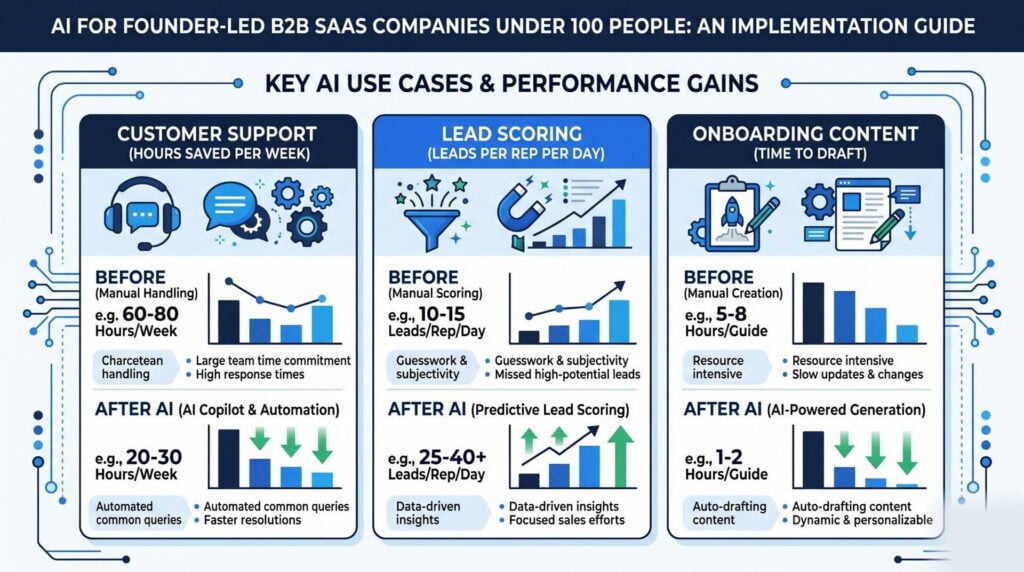
Which AI Use Cases Deliver the Most for B2B SaaS Teams?
The AI use cases that return the most for a founder-led B2B SaaS team under 100 people are those that touch the highest-volume work the team does by hand each week. For most B2B SaaS teams, this means customer support responses, lead scoring, and onboarding content. These three areas share one trait: the output is the same each time, which makes them easy to hand off to AI without losing quality.
Deloitte’s 2025 startup technology report found that founder-led tech teams that used AI in support and onboarding cut their per-ticket support cost by 38 percent. Onboarding time dropped by 24 percent. Both gains came in six months. The teams with the strongest return picked one use case first. They set a clear output target and ran a 30-day test before moving to a second.
Three AI use cases with the fastest return for a founder-led B2B SaaS team:
- Customer Support – AI can handle the top ten support questions your team gets every week. Set up an AI reply tool, train it on your help docs, and use it to draft replies before a human sends them.
- Lead Scoring – AI lead scoring ranks inbound leads by how well they match your best past customers. Feed it your CRM data and let it score new leads on its own so your sales rep focuses on the highest-fit accounts.
- Onboarding Content – AI can draft first versions of onboarding emails, in-app tips, and help articles from your product notes. A human reviews and edits, but the first draft takes minutes instead of hours.
Start with the use case where your team spends the most time each week. Get that one working well before you add the second.
How Do You Build an AI Rollout Plan for a Founder?
An AI rollout plan for a founder-led team has four parts: pick one workflow, name one owner, set a 30-day win target, and pick the tool that covers that workflow. The plan does not need a slide deck or strategy document. Just name one person and one clear result to measure in 30 days. Most founder-led teams can write this plan in under an hour.
PwC’s 2025 technology growth report found that founder-led tech companies that wrote a one-page AI rollout plan before they started saved 45 percent of the time spent on trial-and-error choices. That happened in the first 60 days. The plan does not need to be detailed. It just needs a named workflow, a named owner, a named tool, and what a win looks like. Teams that skipped the plan spent more time on choices and less time on results.
| AI Use Case | Setup Time | Time to First Result | Best Tool Type |
|---|---|---|---|
| Customer support | 1 day | 1-2 weeks | AI reply assistant |
| Lead scoring | 2 days | 2-3 weeks | AI CRM scoring tool |
| Onboarding content | Half a day | 1 week | AI writing tool |
| Internal reporting | 1 day | 1-2 weeks | AI data summary tool |
Use the table above to pick your first AI use case based on how fast you want a live result. Start with the use case that has the shortest time to first result for the workflow your team finds most time-consuming.
What Are the Most Common AI Mistakes in a B2B SaaS Team?
The most common AI mistake in a founder-led B2B SaaS team is starting with the product instead of the team. Adding AI to the product before the team has used it in their own workflows means the team is building something they do not yet understand from the inside. The second most common mistake is naming AI as a team-wide priority without naming a single person to own the first test.
Accenture’s 2025 AI report found that founder-led tech companies that started AI with internal workflows before adding it to the product had 52 percent higher team use in the first year. The team built habits and confidence with AI tools first. They were better ready to ship AI features later. Starting inside the team is not slower – it is faster. The first results are visible in weeks rather than quarters.
Three AI mistakes founder-led B2B SaaS teams make most often, and how to avoid each:
- Product First – Adding AI to the product before the team has used it inside their own workflows. The fix: pick one internal use case and get a live result before you plan any AI feature for the product.
- No Named Owner – Listing AI as a priority with no one named to own the first test. The fix: name one person per use case and give them 30 days and a free trial before any budget is spent.
- Too Many Tools – Buying three or four AI tools at once without testing any of them on a real workflow. The fix: one tool, one use case, one 30-day test before the next tool goes on the list.
Avoiding these three mistakes gives a founder-led team a clear first win and the confidence to expand AI to the next use case.
How Do You Measure AI Results in a Founder-Led Team?
Measuring AI results in a founder-led team is simple. Tie one number to each use case before the test starts. For support, track time saved per ticket per week. For lead scoring, track the share of high-fit leads in the pipeline. For onboarding, track time from sign-up to first value. Set the baseline before AI goes live and check the number after 30 days. If it moves right, the use case is working.
The AI consulting team at AI Smart Ventures works with founder-led B2B SaaS teams to pick the right first use case, set the win target, and run the 30-day test. The AI tools and apps page has a full list of tools reviewed for fit with lean tech teams. The AI implementation team can handle the setup and hand the playbook to your team at the end of the test period.
Three things to do in the next two weeks to get your first AI use case live:
- Pick the Workflow – Name the one workflow your team repeats most often by hand. That is the right place to start, not the most exciting use case or the one a vendor pitches best.
- Name the Owner – Give one person on your team the job of running the 30-day test. Without a named owner, AI projects drift to the bottom of the list no matter how high a priority they are called.
- Set the Win – Write down what a good result looks like before the test starts. For support, it might be two hours saved per week. For lead scoring, it might be a 20 percent rise in high-fit leads.
If the 30-day test shows a clear win, move to the next use case. If not, adjust the setup and run the test for another two weeks before you change the use case.
Frequently Asked Questions
What does AI do for a founder-led B2B SaaS company under 100 people?
AI for a founder-led B2B SaaS team handles high-volume, repeatable work. This includes support replies, lead scoring, and onboarding content drafts. These tasks take the most time from your product and sales team. Handing them to AI frees the team for higher-value work. The team scales output without adding headcount.
Which AI use cases have the fastest return for a B2B SaaS team?
Customer support, lead scoring, and onboarding content return the most for B2B SaaS teams. All three are high-volume and easy to measure in 30 days. Start with the one your team does most often by hand. Test it for 30 days with a free trial. Move to the second use case only after the first shows a clear result.
How do you build an AI rollout plan for a founder-led team?
Build your rollout plan with four steps. Pick one workflow, name one owner, and set a 30-day win target. Then pick the tool that covers that workflow. The plan does not need to be long or detailed. Most founder-led teams can write it in under an hour.
How much does AI cost for a B2B SaaS startup under 100 people?
Most AI tools for a SaaS team cost $20 to $100 per user per month. That is much less than the cost of a new hire. Free versions are on offer for most support and writing tools. You can test on a real workflow before you pay. Contact AI Smart Ventures to get a cost estimate for your team size and use cases.
What is the most common AI mistake in a founder-led B2B SaaS company?
The most common mistake is starting with the product instead of the team. Adding AI to the product first means building something the team does not understand. The team has not yet used AI tools in their own work. Start with one internal use case and get a live result in 30 days. Use that knowledge to guide any AI features you add to the product.
Do you need a dedicated AI team to implement AI in a SaaS startup?
No. A founder-led team under 100 does not need a dedicated AI team. One person per use case and a free trial is enough to start. A 30-day test gets a live result without touching the product roadmap. The team builds habits and confidence as the rollout moves forward. Each next use case becomes easier to add as a result.
How do you measure AI results in a founder-led tech team?
Measure AI results with one number per use case. Set that number before the test starts, not after. For support: time saved per ticket per week. For lead scoring: share of high-fit leads in the pipeline. For onboarding: time from sign-up to first value.
Can AI Smart Ventures help a founder-led B2B SaaS team implement AI?
Yes. The AI consulting team at AI Smart Ventures works with founder-led B2B SaaS teams. They help pick the right first use case and set the win target. They choose the right tool and run the 30-day test. The engineering team and founder stay focused on their core work. Use the AI implementation team to handle setup and hand over the playbook at the end.
Executive Summary
AI for a founder-led B2B SaaS company under 100 people delivers the fastest return when it starts with one internal workflow. Name one owner and set a clear 30-day win target before any budget is spent. The three use cases with the fastest return are customer support, lead scoring, and onboarding content. Start with the one your team does most often by hand and expand only after the first test shows a clear result.
What Should You Do Next?
Name the one workflow your team repeats most often by hand this week. Find a free AI tool that covers that workflow and run a 30-day test with one team member before you add a second use case or spend any budget.
AI Smart Ventures offers AI consulting for growing businesses that want to add AI without months of trial and error. Schedule a consultation to build a 30-day AI rollout plan for your founder-led B2B SaaS team and get a live result before you commit to any tool or budget.
People Also Read
- How Do You Measure AI ROI? A Framework for Business Leaders
- How Do You Address Employee AI Anxiety Without an HR Department?
About the Author
Nicole A. Donnelly is the Founder of AI Smart Ventures and an AI Adoption Specialist with 20 years of experience as a founder and CEO and over a decade leading AI adoption. She helps businesses add AI with clarity and confidence. Nicole has trained over 20,217 professionals in Applied AI, delivered 624 workshops, and worked with close to 1,000 organizations across diverse industries.
Expertise: AI Transformation, AI Strategy, AI Implementation, AI Adoption, Applied AI, Marketing, Business Operations
Disclaimer: This content is for informational purposes only and does not constitute professional business or technology advice. Results vary based on industry, existing systems and implementation commitment. Contact AI Smart Ventures for a consultation regarding your specific situation.