AI for the VP of Sales in an Owner-Operated Business: A Pipeline Reset Playbook
Last Updated: May 2026
An AI pipeline tool for a VP of sales in an owner-operated business scores leads, drafts follow-up messages, and pulls weekly reports. It removes the manual work that fills the week. That leaves more time for the deals and coaching that move the number. Gartner’s 2025 sales technology report found that sales teams in growing businesses cut their deal cycle by 28 percent when they used AI in at least one pipeline stage. That gain came in the first six months. For a VP of sales running a lean team, that gap is the difference between hitting quota and missing it.
AI Smart Ventures has worked with close to 1,000 growing businesses on AI use, including owner-operators with VP of sales roles who have used AI to reset a stalled pipeline and close more deals without adding headcount. The steps below show where AI delivers the fastest return in a sales pipeline and how to add it without slowing the team down.
Key Takeaways
- Pipeline Return – Sales teams in growing businesses that added AI to at least one pipeline stage cut their average deal cycle by 28 percent in the first six months, per Gartner’s 2025 sales technology report.
- Top Use Cases – The three areas where AI delivers the fastest return for a VP of sales are lead scoring, follow-up drafts, and pipeline reports, since all three are high-volume and repeatable.
- Lead Scoring – AI lead scoring tools cut the time a VP of sales team spends on low-fit leads by up to 40 percent, freeing the team to focus on the deals most likely to close in the next 30 days.
- Measurement – Measure AI results in a sales pipeline with pipeline velocity: how many deals move to the next stage per week and how fast they move, tracked for 30 days before and after AI goes live.
- Rollout – The fastest way to roll out AI for a VP of sales team is one step, one person, one week: test on one pipeline stage, measure the result, and then expand.
A VP of sales who adds AI to one pipeline step first builds the habits and the data that make each next step easier to run.
What Does AI Do for a VP of Sales in an Owner-Operated Business?
AI for a VP of sales handles the high-volume, low-judgment tasks that fill the week: lead scoring, follow-up email drafts, and weekly pipeline reports. These tasks cost the most time and return the least value for a senior sales role. Handing them to AI frees the VP of sales to work more deals and coach the team that closes them.
McKinsey’s 2023 economic potential report found that VP-level sales roles in growing businesses used AI for pipeline tasks. They spent 34 percent more time on deal coaching and customer calls. That gain came in the first 90 days. The win rate rose by 22 percent at the same team size. The team was better coached and the VP spent less time on admin.
How Do You Use AI to Score and Qualify Pipeline Leads?
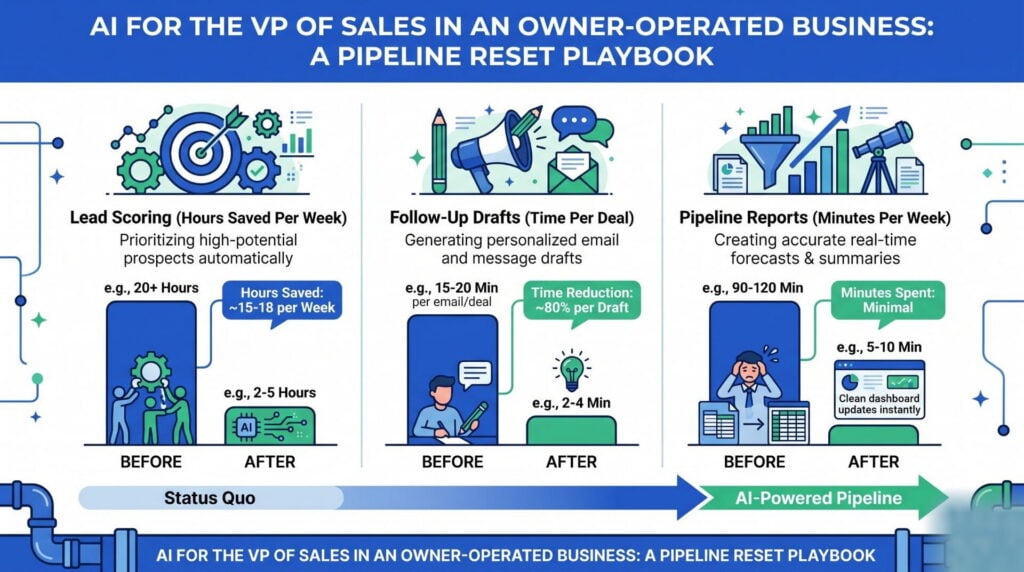
AI lead scoring ranks each new lead by how well it matches the traits of your last ten closed deals: company size, role, site activity, and past outreach response. High-fit leads go to the top of the queue; low-fit leads go to a nurture track. The VP of sales sets the fit threshold and reviews it once a month to keep the model sharp.
Deloitte’s 2024 sales productivity report found that growing businesses that used AI lead scoring for 90 days cut time on low-fit leads by 41 percent. The number of high-fit leads that reached the proposal stage rose by 29 percent. The gain came from removing the manual sort step. Most reps do this sort at the start of each week. It is one of the lowest-value uses of a senior rep’s time.
Three steps to set up AI lead scoring for an owner-operated sales team:
- Set Your Fit Signals – List the five traits your last ten closed deals share: company size, industry, role, source, and first-touch action. These become the input signals for your lead scoring model.
- Pick a Scoring Tool – Choose an AI lead scoring tool that connects to your CRM and scores new leads on its own. Most tools set up in under a day and work with the CRM data you already have.
- Set the Threshold – Decide what score sends a lead to your active pipeline and what score sends it to nurture. Review the threshold once a month and adjust based on which leads are closing.
After the first 30 days, check the close rate on leads above and below the threshold. If high-scoring leads close at a higher rate, the model is working. If not, adjust the fit signals and run it for another 30 days before you judge.
How Do You Use AI to Speed Up the Sales Cycle?
AI speeds up the sales cycle by cutting the delay between each stage. Follow-up after a first call, proposal draft after a demo, and CRM update after every touch all move faster with AI in the loop. Each delay in the cycle is a risk that the deal goes cold. AI removes the manual steps that cause the delay without taking judgment out of which deals to push and which to pause.
PwC’s 2025 revenue growth report found that growing businesses that used AI for follow-up drafts and CRM updates cut time between sales stages by 35 percent. The number of active deals in the pipeline rose by 24 percent. That happened in six months. The gain came not from more leads but from faster movement on the deals already in the pipeline. A VP of sales who removes the delay between stages keeps more deals alive until the close.
| Pipeline Stage | AI Use Case | Average Time Saved Per Week |
|---|---|---|
| Lead scoring | AI scoring model | 4 hours |
| First follow-up | AI email draft | 2 hours |
| Proposal stage | AI draft from call notes | 3 hours |
| CRM update | AI note capture | 2 hours |
| Pipeline report | AI weekly summary | 1.5 hours |
Use the table above to find the stage where your team spends the most manual time. Start with that stage and add AI there first before you move to the next one.
How Do You Measure AI Results in a Sales Pipeline?
The right way to measure AI results in a sales pipeline is pipeline velocity: how many deals move to the next stage per week and how long each deal takes to move. Measure this for four weeks before AI and four weeks after AI goes live in one stage. If velocity goes up, the tool is working. If not, the stage you picked was not the bottleneck and you move to the next one.
Accenture’s 2025 sales AI study found that growing businesses that set a pipeline velocity target before rolling out AI saw 50 percent higher return on their AI tool spend. They outperformed those that rolled out first and measured later. A clear target forces the team to pick the right stage and the right tool before the test begins. Set the target first, run the tool for 30 days, and measure at the end.
Three numbers to track after AI goes live in one pipeline stage:
- Stage Velocity – Count how many deals move from the current stage to the next per week. A rise of 15 percent or more in 30 days is a clear win.
- Rep Time Per Deal – Track how many hours each rep spends per active deal per week. A drop of 20 percent or more means the AI tool is removing the right manual steps.
- Win Rate – Track the share of deals that close from each stage. A rise in win rate from the top of the pipeline means the lead scoring model is finding the right leads.
If all three numbers move in the right direction in 30 days, expand the AI tool to the next stage. If only one or two moves, review which step is still manual and fix it before you expand.
How Do You Roll Out AI for a VP of Sales Team Without Slowing the Pipeline?
The way to roll out AI for a VP of sales team without slowing the pipeline is to start with one step, one person, and one week. The rest of the pipeline stays the same while one rep tests the AI tool on one stage for five days. At the end of five days, the VP of sales reviews the results and decides whether to keep it, adjust it, or move to a different stage.
The AI consulting team at AI Smart Ventures works with VP of sales roles in owner-operated businesses to build a pipeline AI plan that gets a live result in 30 days without changing the team’s current workflow. The AI tools and apps page has a full list of tools reviewed for fit with sales teams in growing businesses. The AI implementation team can set up the first pipeline AI step and run the 30-day test with no disruption to the active pipeline.
Three things to do in the next two weeks to add AI to your sales pipeline:
- Name the Step – Pick the one pipeline stage where your team spends the most manual time each week. Every good first AI use case in a sales pipeline starts with a named step, not a general goal.
- Pick the Tool – Go to the AI tools page and find the tool that covers that stage. Set up a free trial and run it with one rep for five days before you decide.
- Set the Win – Decide what a good result looks like before the test starts: time saved per week, deals moved per week, or win rate after 30 days. Measure it at the end.
If the five-day test shows a clear win, move the tool to the full team. If not, try the next stage in the pipeline.
Frequently Asked Questions
What does AI do for a VP of sales in an owner-operated business?
AI for a VP of sales handles high-volume, low-judgment pipeline tasks. These include lead scoring, follow-up drafts, CRM updates, and weekly reports. These tasks cost the most time. They return the least value for a senior sales role. Handing them to AI frees the VP to coach more and close more.
How does AI help with lead scoring in a sales pipeline?
AI lead scoring ranks each lead by how well it matches your best past deals. The highest-fit leads go to the top of the queue. The model runs on its own as new leads come in. The VP reviews the threshold once a month. Most teams cut time on low-fit leads by 30 to 40 percent in 90 days.
Which AI tools work best for a VP of sales team?
Lead scoring, email drafting, and report tools deliver the fastest return. Lead scoring tools connect to your CRM. Email draft tools pull from call notes. Report tools pull from CRM data each week. Start with the tool for the stage where your team spends the most time.
How do you measure AI results in a sales pipeline?
Measure AI results with pipeline velocity: how many deals move per week and how fast. Set a four-week baseline before AI goes live. Track three numbers after: stage velocity, rep time per deal, and win rate. If all three rise in 30 days, the tool is working. The next pipeline stage is then ready for AI.
What is the fastest way to roll out AI for a sales team?
The fastest way is one step, one person, one week. Pick the stage where your team spends the most manual time. Have one rep test the AI tool for five days. Review the results with the VP of sales at the end. If the result is clear, move the tool to the full team.
How much does AI for a sales pipeline cost?
Most AI sales pipeline tools cost between $30 and $120 per user per month. That is far less than adding a new sales hire. Free versions are on offer for most lead scoring and email draft tools. You can test on a real pipeline stage before you pay. Contact AI Smart Ventures to get a cost estimate for your team.
What is the most common mistake when adding AI to a sales pipeline?
The most common mistake is rolling out AI across the full pipeline at once. No single stage has been tested first. This splits team time and creates confusion. The fix is to start with one stage and test it for five days. Measure the result before you expand to the full team.
Can AI Smart Ventures help set up a sales pipeline AI plan?
Yes. The AI consulting team at AI Smart Ventures works with owner-operated sales teams. They help pick the right first pipeline stage and set the win target. They choose the right tool and run the setup with no disruption. Use the AI implementation page once the first stage test shows a clear win.
Executive Summary
AI for a VP of sales in an owner-operated business delivers the fastest return when it starts with one pipeline stage. That could be lead scoring, follow-up drafting, or CRM updates. Add the next stage only after the first 30-day test shows a clear win. Measure results with pipeline velocity and track three numbers: stage velocity, rep time per deal, and win rate. Start with the stage where the team spends the most manual time. Set a win target before the test begins.
What Should You Do Next?
Pick the one pipeline stage where your team spends the most manual time each week. Find a free AI tool that covers that stage and run a five-day test with one rep before your next pipeline review.
AI Smart Ventures offers AI consulting for growing businesses that want to add AI to their sales pipeline without months of trial and error. Schedule a consultation to build a 30-day pipeline AI plan for your VP of sales team and get a live result before you commit to any new tool.
People Also Read
- How Do You Measure AI ROI? A Framework for Business Leaders
- How Do You Address Employee AI Anxiety Without an HR Department?
About the Author
Nicole A. Donnelly is the Founder of AI Smart Ventures and an AI Adoption Specialist with 20 years of experience as a founder and CEO and over a decade leading AI adoption. She helps businesses add AI with clarity and confidence. Nicole has trained over 20,217 professionals in Applied AI, delivered 624 workshops, and worked with close to 1,000 organizations across diverse industries.
Expertise: AI Transformation, AI Strategy, AI Implementation, AI Adoption, Applied AI, Marketing, Business Operations
Disclaimer: This content is for informational purposes only and does not constitute professional business or technology advice. Results vary based on industry, existing systems and implementation commitment. Contact AI Smart Ventures for a consultation regarding your specific situation.