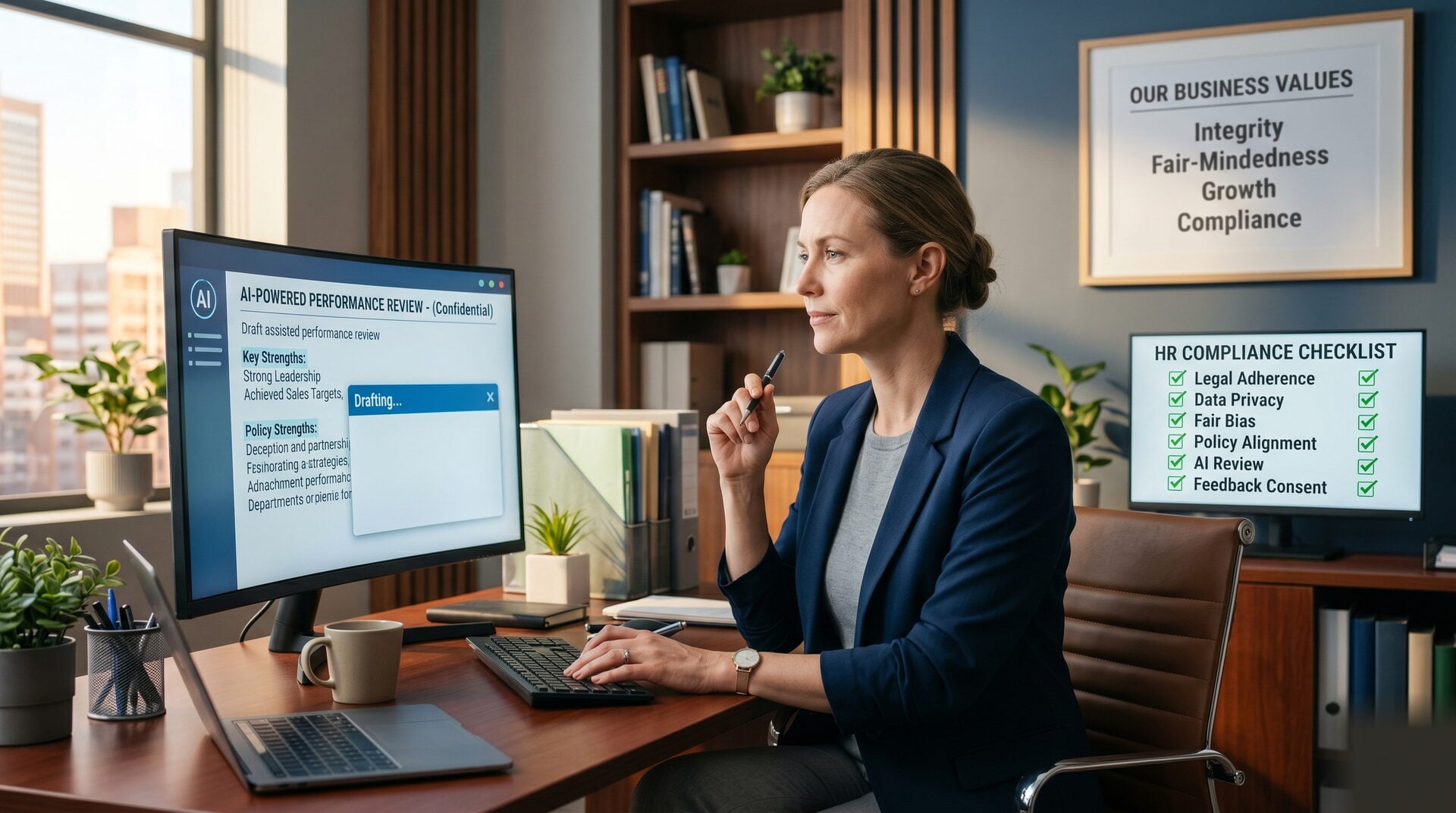
AI for Performance Reviews in Owner-Operated Businesses Without Crossing HR Lines
Last Updated: May 2026
An AI review tool is the fastest way for a small business to gather, sort, and draft staff feedback without a full HR team. Gartner’s 2026 HR technology report found that 58 percent of growing businesses using AI for reviews cut prep time by half while keeping manager input in the final step. For a business with five to fifty staff and no HR lead on payroll, that time savings shows up in fewer review cycles that drag past their due date. More feedback also reaches each team member on time.
AI Smart Ventures has worked with close to 1,000 growing businesses on AI use, including owner-operators who need fair, steady reviews without a full HR team. The steps below show how to use AI in your review cycle without crossing legal or trust lines.
Key Takeaways
- Time Savings – AI review tools cut prep time by 50 percent for growing businesses, per Gartner’s 2026 HR technology report. Most gains come from drafting and sorting feedback, not scoring people.
- Legal Ground – AI should draft and sort, not score or rank. EEOC guidance requires a human to own every job call that AI touches.
- Top Risks – Bias in AI-drafted feedback, over-reliance on AI scores, and no manager sign-off are the three risks that cause the most issues for growing businesses.
- Best Tools – Lattice, 15Five, and Rippling are the three most used AI review tools for growing businesses in 2026.
- Manager Role – Every AI-drafted review must go through a manager review step before it reaches the team member. This is both a legal and a trust need.
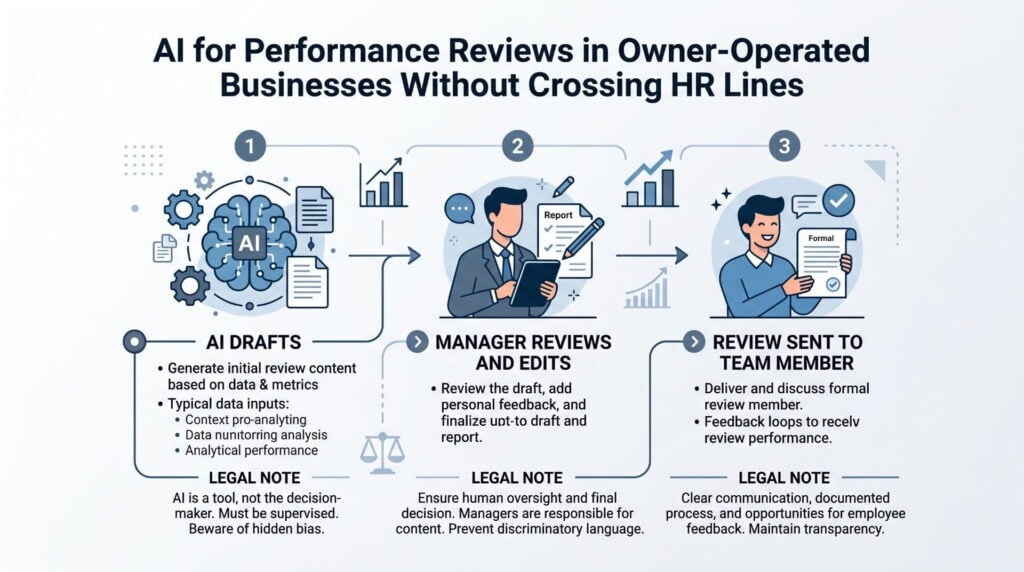
The fastest way to use AI in your review cycle is to have it draft the first pass and route that draft to a manager before anyone else sees it.
What Can AI Do in a Performance Review?
AI review tools work best when they sort feedback from many sources. They also flag patterns in a staff member’s work. Then they draft a first version of the written review for a manager to edit and approve. They are not built to set a final score or make a job call on their own. The manager’s role in each step is what keeps the process fair and legal.
McKinsey’s 2024 talent report found that businesses using AI in their review cycle saw a 35 percent drop in review complaints. That happened when a manager reviewed and signed off on each AI draft before it went to the team member. The AI finds patterns in the feedback it collects. The manager checks those patterns against what they know about the person. The final review goes out with a human name on it.
Is Using AI for HR Reviews Legal?
The legal rule for AI-assisted reviews is simple. A human must own the final call on every job decision, including a review. AI can draft or sort feedback but cannot approve a review on its own. The manager must read, edit, and approve each review before it reaches the team member. Skipping that step is where most owner-operated businesses run into a legal or trust issue.
SHRM’s 2024 HR guide found that owner-operators who kept a manager as the last step in every AI-assisted review avoided the most common bias and fairness claims. The key is a written record that shows the manager reviewed the AI draft and made the final call. Most AI review tools have a sign-off step built in. If yours does not, a simple email or form step before the review goes out is enough to create the record you need.
What Are the Risks of AI Performance Reviews?
The three risks that cause the most problems are bias in the AI draft, over-reliance on AI scores, and no manager sign-off on record. Each of these risks is easy to fix with a clear process. But all three show up most often when a business sets up the AI tool and lets it run with no review step in place.
Deloitte’s 202 w6orkforce risk report found that 62 percent of AI-assisted review complaints at growing businesses came from cases where the AI score was used as the final word without a manager check or edit. The fix is not to stop using AI for reviews. Set a clear rule that no AI output leaves the tool without a manager reading and approving it first. A one-line policy that names the manager in charge of each team member is enough to cut the most common risks.
- Bias in AI Drafts – AI tools trained on past review data can carry bias from older patterns. A manager read-through before the review reaches the team member and catches issues early.
- Over-Reliance on Scores – AI scores are a starting point, not a final answer. A manager must weigh context the AI cannot see, such as a hard quarter or a staffing gap that affects output.
- No Sign-Off on Record – If no one can show that a manager reviewed the AI draft, any challenge to the review is harder to defend. Keep a log of who approved each review and when.
Each of these risks takes under ten minutes per review to address and protects both the team member and the business.
How Should AI Feedback Be Reviewed by Managers?
The review step that works best for owner-operated businesses is a two-pass read. In the first pass, the manager checks the AI draft for anything that does not match what they know about the person’s work. In the second pass, they edit the tone and add any context the AI missed. This takes ten to fifteen minutes per review. It keeps the final output fair and something the business can stand behind.
PwC’s 2024 people report found that managers who used a two-pass read on AI review drafts produced reviews rated as more fair by team members, by 40 percent. The two-pass process is also the step most HR advisors point to as the clearest sign that a human owned the final call. A short checklist of five to seven items for each pass is all a manager needs to do this well.
- Check for Bias – Look for any line that feels generic or that could apply to someone else. Replace it with a specific example from the review period.
- Add Context – Note anything the AI missed, such as a project the person led or a hard quarter that affected their output.
- Adjust Tone – Make sure the language sounds like feedback from a person, not a report. Short, direct sentences work best.
- Log the Sign-Off – Record that you reviewed and approved the AI draft before it goes to the team member. Date and initial the record.
Most managers who use this process report it takes ten to fifteen minutes per review and produces a better result than writing the full review from scratch.
What Are the Best AI Tools for Performance Reviews?
The right AI review tool for an owner-operated business connects to your current HR or payroll system. It keeps a manager review step built into the flow. And it does not move review data outside your control without notice. Three tools stand out for growing businesses in 2026 based on ease of use, built-in manager review, and the range of team sizes each one handles.
Accenture’s 2025 HR technology report found that growing businesses that added AI review drafting inside their current HR system saw 30 percent higher manager use than those that set up a stand-alone review tool. Managers did not need to log into a second system to read and approve each draft. The right tool depends on your team size, your current HR platform, and how often you run reviews each year.
- Lattice – A full review platform with AI-assisted drafting, goal tracking, and a manager sign-off step built in. Best for teams of ten to fifty.
- 15Five – A check-in and review tool with AI feedback drafting and manager review routing. Best for teams that want a weekly check-in cycle alongside quarterly reviews.
- Rippling – An HR and payroll platform that adds AI review drafting to your existing staff data. Best for owner-operated businesses that want HR and payroll in one system.
See the AI tools and apps page for a full list of tools reviewed for fit with growing businesses and lean HR setups. The AI implementation team at AI Smart Ventures helps owner-operators set up the right review tool with a manager sign-off step before the first review cycle goes live.
| Tool | Best For | AI Review Feature | Starting Price |
|---|---|---|---|
| Lattice | Teams of 10-50 | AI draft + sign-off | $11/person/mo |
| 15Five | Check-ins + reviews | AI feedback draft | $4/person/mo |
| Rippling | HR + payroll in one | AI review drafting | $8/person/mo |
Frequently Asked Questions
Can AI write performance reviews?
Yes, AI can draft a first version of a review. It collects feedback from many sources, finds patterns in the data, and produces a written draft for the manager to edit and approve. A manager must read, edit, and approve the draft first. AI should never send a review on its own or set a final score without a human check step.
Is using AI for HR reviews legal?
Yes, with a manager sign-off step in place. The legal rule is that a human must own the final call on every job decision, including a review. Most HR advisors recommend that the manager log their review and approval of each AI draft before it goes to the team member. A one-line policy that states this rule is enough to cover the most common legal needs for a growing business.
What are the risks of AI performance reviews?
The three most common risks are bias in the AI draft, over-reliance on AI scores, and no manager sign-off on record. Each is easy to fix with a clear two-pass manager review and a log of who approved each review before it went out. Contact AI Smart Ventures to review your current process and find the right tool for your team size.
How should AI feedback be reviewed by managers?
A two-pass read works best. In the first pass, check the AI draft for anything that does not match what you know about the person. In the second pass, edit the tone and add context the AI missed. Log the date and your sign-off before the review goes to the team member. This takes ten to fifteen minutes per review and keeps the process fair and easy to defend.
What AI tools work for performance reviews in growing businesses?
Lattice, 15Five, and Rippling are the three most used AI review tools for growing businesses in 2026. Lattice works best for teams of ten to fifty with a need for goal tracking and a built-in sign-off flow. 15Five fits teams that want a weekly check-in cycle alongside quarterly reviews. Rippling is the right pick for owner-operated businesses that want HR and payroll in one system with AI review drafting built in.
How do I stop AI from biasing my staff reviews?
Set a rule that no AI draft goes to a team member without a manager read-through first. In that read-through, look for any line that feels generic or that could apply to someone else. Replace it with a specific example from the review period. Use a short checklist of five to seven points for each review to make sure the same check happens every cycle.
Does a manager still need to write reviews if we use AI?
Yes, though the role shifts. Instead of writing the full review from scratch, the manager reads, edits, and approves the AI draft before it reaches the team member. The final review must carry the manager’s name and sign-off. AI speeds up the drafting step but the manager still owns the review and every call it reflects. Most managers find this takes less time than writing from scratch while giving a more complete result.
What does HR compliance look like for AI-assisted reviews?
Keep a log of every AI review draft, who reviewed it, who edited it, and when it went to the team member. Store the original AI draft and the final manager-approved version. If anyone challenges a review, this log shows that a human owned the final call. Most AI review tools store this log inside the platform. If yours does not, a simple form or email step creates the record you need.
Executive Summary
AI tools cut review prep time in half for owner-operated businesses, but only work well when a manager reviews and approves every AI draft before it reaches the team member. Tools like Lattice, 15Five, and Rippling build the manager’s sign-off step into the review flow, which keeps the process legal and fair. The risks of AI reviews are real but easy to fix with a two-pass manager check and a sign-off log for each review.
What Should You Do Next?
Pick one team member whose next review is due in the next 60 days. Run their review through an AI drafting tool this cycle and use a two-pass manager check before the final version goes out. Compare the time and result to your last review cycle.
AI Smart Ventures offers AI consulting for growing businesses that want to add AI without months of trial and error. Schedule a consultation to map the right review tool to your team size and current HR process before your next cycle.
People Also Read
- How Do You Create an AI Policy When You Don’t Have a Legal Team?
- How Do You Measure AI ROI? A Framework for Business Leaders
About the Author
Nicole A. Donnelly is the Founder of AI Smart Ventures and an AI Adoption Specialist with 20 years of experience as a founder and CEO and over a decade leading AI adoption. She helps businesses add AI with clarity and confidence. Nicole has trained over 20,217 professionals in Applied AI, delivered 624 workshops, and worked with close to 1,000 organizations across diverse industries.
Expertise: AI Transformation, AI Strategy, AI Implementation, AI Adoption, Applied AI, Marketing, Business Operations
Disclaimer: This content is for informational purposes only and does not constitute professional business or technology advice. Results vary based on industry, existing systems and implementation commitment. Contact AI Smart Ventures for a consultation regarding your specific situation.