

AI Implementation: A 90-Day Plan for B2B Owner-Operators
Last Updated: May 2026
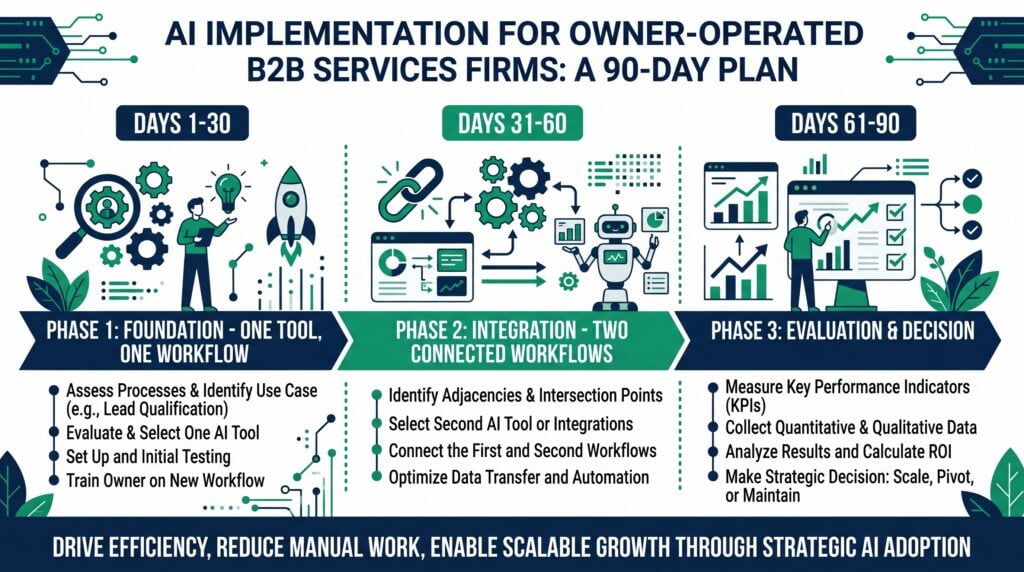
An AI rollout for an owner-operated B2B (business-to-business) services firm is a set 90-day plan that moves from one tool inside one workflow in the first 30 days, to two linked workflows by day 60, and a tracked output report by day 90. Across close to 1,000 businesses the pattern holds. Firms that try to roll out more than two tools in the first quarter stall. Firms that pick one process and one tool see 40% faster time-to-value than peers.
AI Smart Ventures has helped growing businesses and groups through this exact 90-day cadence. The work helps owner-led services firms with $2M to $200M in revenue match the right tool to the right workflow without large-firm overhead. The focus stays on what an owner-operator already cares about. Where time leaks. Where revenue stalls. And which calls only the founder can make.
What follows is the cadence that works for owner-operated B2B services firms (accounting, legal, consulting, agencies, IT services, recruiting) when the founder is the de facto chief of staff and there is no full change management team to absorb a misstep.
Key Takeaways
- First 30 days: one tool, one workflow. Pick one repeated task (proposal drafting, intake notes, or weekly reporting) and roll out Microsoft 365 Copilot at $30 per user per month or Claude Pro at $20 per user per month. Never both in month one.
- Day 60 target: two linked workflows. By day 60, link the month-one tool to a second workflow using a no-code connector like Zapier at $29.99 per month for the Professional plan.
- Day 90 output report. Track baseline hours before day 1 and again on day 90. Per Microsoft’s 2025 Work Trend Index, most owner-operated services firms recover 8 to 14 hours per week per knowledge worker with a well-run AI rollout.
- Budget: under $300 per month for a 5-person firm in month one. Training and setup costs for AI rollouts in owner-operated firms typically run $500 to $1,500 per staff member in the first year when factoring in tool setup, SOP write-up, and team training time. AI Smart Ventures sees this pattern across close to 1,000 businesses.
- Three calls only the owner can make. Which workflow goes first. What the success metric is. And where AI output is checked before it leaves the firm.
The 90-day cadence below is a sequence of calls, not a rollout schedule. Each phase exists to answer a different question. Skipping ahead is the most common reason an owner-operated firm has a stalled AI pilot to point to twelve months later.
Why Should Owner-Operators Start AI Now?
The firms moving from “AI curious” to “AI capable” in 2026 are not the largest. They are the most disciplined. Per McKinsey’s 2025 State of AI report, 65% of businesses now use AI regularly. The firms that picked one tool and one workflow before the end of the first quarter recover 25% more exec time within the first year than firms that ran three pilots at the same time.
The reason is structural. An owner-operated firm has fewer sign-off layers, fewer competing budgets, and one decision-maker who is also the operator. That shrinks the timeline a large firm like Accenture would assume. Six months of stakeholder mapping shrinks to two weeks of internal checking. That is an AI rollout edge, not a limit. The risk profile is the reverse of a large-firm rollout. The danger is moving too fast before the first workflow is proven, not analysis freeze.
What Should the First 30 Days Cover?
The first 30 days should make one repeated workflow that runs well without the owner editing the AI output. Pick a task the firm already does at least three times a week. Choose one tool. Write the prompt, the input, and the review checkpoint. The single output for day 30 is a written SOP (Standard Operating Procedure) for that one workflow that another team member could follow.
Most owner-operators want to compare three platforms in week one. The discipline is to resist that and pick the tool the team already has. That is typically Microsoft 365 Copilot for firms on Microsoft 365, or Google Gemini for Google Workspace firms, since adoption is faster when the AI lives inside a tool the team uses every day. Spend week two on the prompt. Week three on testing with one team member. Week four on the SOP and the hand-off practice.
The three highest-return starter workflows for B2B services firms are:
- Proposal drafting. First-draft proposals from a set client brief save 4 to 6 hours per proposal.
- Weekly client reports. Status reports from project notes and timesheets save 2 to 3 hours per client per week.
- Intake summaries. Discovery call notes to set client briefs save 1 to 2 hours per call.
The pattern across these three workflows is the same. Take a set input the owner already makes, pass it through a fixed prompt, and check only the output rather than every line. Pick the one that costs the firm the most hours per week and run it first.
Which Tool Fits an Owner-Operated B2B Services Firm?
For owner-operated B2B services firms under 50 staff, the right starting tool is the one already inside an existing software plan. Microsoft 365 Copilot at $30 per user per month works for firms on Microsoft 365. Claude Pro at $20 per user per month is the option for firms that draft long-form proposals, contracts, or research memos. Pick one in week one and resist checking a third option until day 90.
The three tools below cover roughly 80% of owner-operated B2B services use cases. But pricing varies by plan tier so check current pricing at each vendor’s pricing page before committing. Avoid tools priced at $1,250 per month or above per seat in the first year. That is large-firm pricing that does not fit a 5 to 50 person firm, even when the vendor offers a “starter” tier. For an always-updated list of AI tools vetted for service businesses, see AI tools and apps on the AI Smart Ventures resource hub.
| Tool | Plan / Price | Best For | Limitation |
| Microsoft 365 Copilot | $30/user/month (Microsoft 365 add-on, 1-year commitment) | Firms already on Microsoft 365 with Outlook + Teams workflows | Limited utility outside the Microsoft ecosystem; weaker for long-form drafting |
| Claude Pro | $20/user/month (individual) or Claude Teams from $30/user/month (5-seat minimum) | Long-form writing: proposals, contracts, research memos | No native integration with email or calendar; needs Zapier or Make to connect to other tools |
| Google Gemini Business | $24/user/month (Google Workspace add-on) | Google Workspace firms doing slide decks, sheets analysis, Gmail drafting | Weaker third-party integration than Microsoft 365 Copilot for non-Google tools |
What Does an Owner-Operator Hand Off in Days 31 to 60?
The owner-operator’s job in days 31 to 60 is to link the proven month-one workflow to one nearby workflow and hand ops ownership to one other person. The day-60 output is two workflows running through the same tool, with a non-owner team member running the day-to-day work and the owner checking only exception cases. Most owner-operators try to grow to three or four workflows here. That is the most common failure point.
A no-code connector like Zapier at $29.99 per month for the Professional plan or Make at $10.59 per month for the Core plan links the month-one tool to a second workflow with no coding. Typical pairs include proposals to CRM (Customer Relationship Management) updates, intake notes to project management tasks, and weekly reports to email summaries to clients. The hand-off itself is the test. If the team member can run the workflow without asking the owner for help, the SOP is ready.
If you want a set 90-day rollout matched to your firm’s set workflows, AI Smart Ventures builds AI rollout plans for owner-operated B2B services firms. Across close to 1,000 businesses, the firms that hit a clean day-90 output report shared one trait. They picked the workflow before the tool.
How Should Owner-Operators Measure Day 90?
The day-90 output report should answer three questions. How many hours per week did the firm recover per worker? What is the per-task quality score from the team running the workflow? And which workflow gets the next 30 days? Most owner-operated B2B services firms recover 8 to 14 hours per week per knowledge worker by day 90. They also see a per-task quality score of 4.0 or higher on a 5-point scale once the SOP is mature.
Per Harvard Business Review research (Beer et al., 2016), the most reliable sign of ops change is whether the team doing the work, not leadership, sees gain. AI advisory services help owner-operators design these tracking measures before day 1, not after day 90 when the data is already noisy. Run a baseline timesheet the week before day 1. Repeat it for the same week in week 12. The difference is the recovered hour count that backs the next 90 days.
The four measures that matter most by day 90:
- Hours recovered per worker per week. Compare baseline timesheets from the week before day 1 to week 12.
- Per-task quality score. A 5-point scale scored by the team member running the workflow, not the owner.
- SOP finish rate. Share runs the AI workflow handled without owner input.
- Cost per recovered hour. Total monthly tool spend divided by total recovered hours.
These four numbers together answer the only question the owner really needs answered at day 90. Continue putting money into the next 90 days or stop. A clean dashboard with these four metrics is the day-90 output, not a pitch deck.
What Are the Common 90-Day Mistakes?
The four mistakes most owner-operated B2B services firms make in their first 90 days are clear. Starting with three tools. Skipping the SOP. Refusing to hand off ops ownership. And tracking revenue instead of hours. Per Gartner’s 2024 AI maturity research, 49% of executives say proving value is their top adoption barrier. These four mistakes add 60 to 90 days to a rollout.
The first mistake is tool stacking, where owners read three vendor blogs and decide they need ChatGPT, Microsoft Copilot, and Claude in week one. The second is skipping the SOP. Without it the workflow lives in the owner’s head and cannot be handed off without AI training for the team member taking it over. The third is the hand-off itself. Owners run the AI personally for 90 days because it is faster than training someone. The fourth is tracking revenue at day 90 when revenue is a year-one metric and hours recovered is the day-90 metric.
Frequently Asked Questions
What Is the 90-Day Rule for AI Implementation?
The 90-day rule says an owner-operated firm should make one working workflow by day 30, link it to a second by day 60, and report real output gains by day 90. Firms that skip phases or run many tools at once in month one push their rollout back by 60 to 90 days on average. The rule exists because owner-operators need a clear yes/no decision point before the 12-week mark. AI Smart Ventures sees this pattern hold across close to 1,000 businesses.
How Long Does AI Implementation Take for a Growing Business?
Most owner-operated B2B services firms reach a tracked output report in 90 days for the first workflow and 6 to 9 months for full ops link across 3 to 5 workflows. Timelines vary based on how fast the owner is willing to hand ops ownership to another team member. Firms that hand off within 60 days move twice as fast as firms where the owner stays the day-to-day operator at month four.
Where Should Owner-Operators Start With AI Implementation?
Owner-operators should start with the single highest-frequency repeated task in their week. Typically proposal drafting, weekly client reports, or intake summaries. Pick the task that costs the firm the most time per week and that the owner currently does personally. Choose one tool already inside a current software plan such as Microsoft 365 Copilot or Claude Pro. Write the SOP after week three. Hand ops ownership to one other team member by day 60.
What Does AI Implementation Cost for a B2B Services Firm?
Total month-1 AI rollout cost for an owner-operated B2B services firm should sit between $100 and $300 per month for a 5-person firm. Expect $20 to $30 per user per month for the AI tool itself, plus $10 to $30 per month for a no-code connector if needed by month two. AI Smart Ventures builds AI rollout plans for owner-operated B2B services firms across close to 1,000 businesses. Schedule a consultation to map a 90-day cadence to your firm’s workflows.
Can an Owner-Operator Implement AI Without Hiring a Consultant?
Yes. An owner-operator can run a 90-day rollout without outside help if the firm has a clear single-workflow target, an internal team member who can take ops ownership by day 60, and the discipline to resist tool stacking in month one. Firms without that discipline tend to spend the time of 4 to 6 weeks of consulting hours on rework after a stalled month-three pilot. Bring help in if month one stalls, not before.
What Is the Right Success Metric for Day 90?
The right success metric for day 90 is hours recovered per knowledge worker per week, tracked against a baseline taken in the week before day 1. A second metric is a per-task quality score from the team member running the workflow on a 5-point scale. Revenue is not a day-90 metric. Per Harvard Business Review (Beer et al., 2016), team-level ops gain signals are more reliable than money signals at the 90-day mark.
Should an Owner-Operator Pick Microsoft Copilot or Claude First?
The answer depends on which software stack the firm already pays for. Firms on Microsoft 365 should pick Microsoft 365 Copilot at $30 per user per month for the lowest friction. Firms that draft long-form proposals, contracts, or research memos should pick Claude Pro at $20 per user per month. Avoid running both in month one. The goal is one tool, one workflow, one SOP. The second tool comes after day 90 if and only if a second workflow has been found.
What Happens After Day 90 If the Rollout Works?
A good day-90 report unlocks the next 90 days. That typically focuses on adding a third workflow and bringing a second team member onto the AI tool. Months four through six are the time to check whether AI advisory or AI training services would build on the gains, or whether the firm has internal capacity to carry on alone. Most owner-operated firms that hit a clean day-90 report scale to 4 or 5 workflows by month nine.
How Does an Owner-Operated Firm Differ From a Larger Firm in AI Rollout?
An owner-operated firm has faster decision cycles, smaller budgets, and one decision-maker who is also the operator. That shrinks the timeline a large firm like Accenture or Deloitte would assume. Six months of stakeholder mapping shrinks to two weeks of internal checking. The risk profile is also reversed. The danger is not freezing but moving too fast before the first workflow is proven.
Is the 90-Day Cadence Different for Solo Founders Versus 5 to 10 Person Firms?
Solo founders should compress the 90-day cadence to 60 days because there is no ops hand-off step. The single workflow goes from choice in week 1, to rollout in weeks 2 through 4, to tracking in week 8. Firms with 5 to 10 staff follow the full 90-day cadence because the day-60 hand-off to a non-owner team member is the most key step in the rollout.
Executive Summary
A 90-day AI rollout for an owner-operated B2B services firm follows a fixed cadence. One tool and one workflow by day 30. Two linked workflows with ops ownership handed to a non-owner team member by day 60. And a tracked output report comparing baseline hours to week-12 hours by day 90. Total month-1 software cost should sit under $300 per month for a 5-person firm using Microsoft 365 Copilot at $30 per user per month or Claude Pro at $20 per user per month. Per Microsoft’s 2025 Work Trend Index, most firms recover 8 to 14 hours per week per knowledge worker by day 90. The risk of failure sits in three patterns. Stacking tools in month one. Skipping the SOP. And tracking revenue instead of hours.
What Should You Do Next?
This week, pick the single highest-frequency repeated task in your firm, the one you personally do at least three times a week, and find which AI tool already lives inside your current software plan. Block four hours next Monday to write the prompt, the input format, and the review checkpoint. By the end of month one, that workflow should run without your edits.
AI Smart Ventures offers AI rollout services for growing businesses and groups running 90-day plans in owner-operated B2B services firms. Schedule a consultation to map the 90-day cadence to your firm’s set workflows and calls.
People Also Read
- How Do COOs Lead AI Implementation? A Guide for Operations Leaders
- How Much Does AI Implementation Cost? A Budget Guide for 2026
About the Author
Nicole A. Donnelly is the Founder of AI Smart Ventures and an AI Adoption Specialist with 20 years of experience as a founder and CEO and over a decade leading AI adoption initiatives. She helps businesses integrate artificial intelligence with clarity and confidence, driving innovation and sustainable growth. Nicole has trained over 20,217 professionals in Applied AI, delivered 624 workshops, and worked with close to 1,000 organizations across diverse industries.
Expertise: AI Transformation, AI Strategy, AI Implementation, AI Adoption, Applied AI, Marketing, Business Operations
Disclaimer: This content is for informational purposes only and does not constitute professional business or technology advice. Results vary based on industry, existing systems and implementation commitment. Contact AI Smart Venturesfor a consultation regarding your specific situation.

