
AI Investment Prioritization for Owner-Operated Businesses: A Roadmap for Fast ROI
Jump to a specific question:
- Top rated firms for aligning AI investments with business KPIs
- How do I prioritize AI projects when I have a limited budget
- Which AI investments give the fastest ROI for small businesses
- How should an owner-operator allocate their AI budget across departments
- What AI projects should I fund first in my business
Introduction: The AI Dilemma for Owner-Operators
If you run an owner-operated business, you are probably hearing the same message from every direction: move on AI now or risk falling behind. That pressure is real. But so is the confusion. Most owners are not short on ideas. They are short on time, budget, and confidence that the next AI purchase will actually pay off.
That is the core problem with AI investment prioritization. AI can absolutely create leverage, but only when it is tied to a business problem worth solving. If you buy tools first and ask ROI questions later, you usually end up with scattered subscriptions, uneven team adoption, and no clear line between spend and results. In a lean business, that gets expensive fast.
A better approach is KPI-driven AI implementation. Start with the business outcome you want, then choose the AI project that can move that number with the least friction. That might be faster lead response, lower cost-to-serve, fewer hours spent on repetitive admin, or better marketing output without hiring. The point is simple: AI is not the strategy. AI supports the strategy.

Quick Wins: What AI Projects Should I Fund First?
The fastest ROI AI small business owners usually see comes from high-frequency, low-complexity work. In plain English, start where your team repeats the same task over and over again, where the process is already clear, and where a mistake will not create major risk. These projects are easier to launch, easier to measure, and easier to improve.
Which AI investments give the fastest ROI for small businesses?
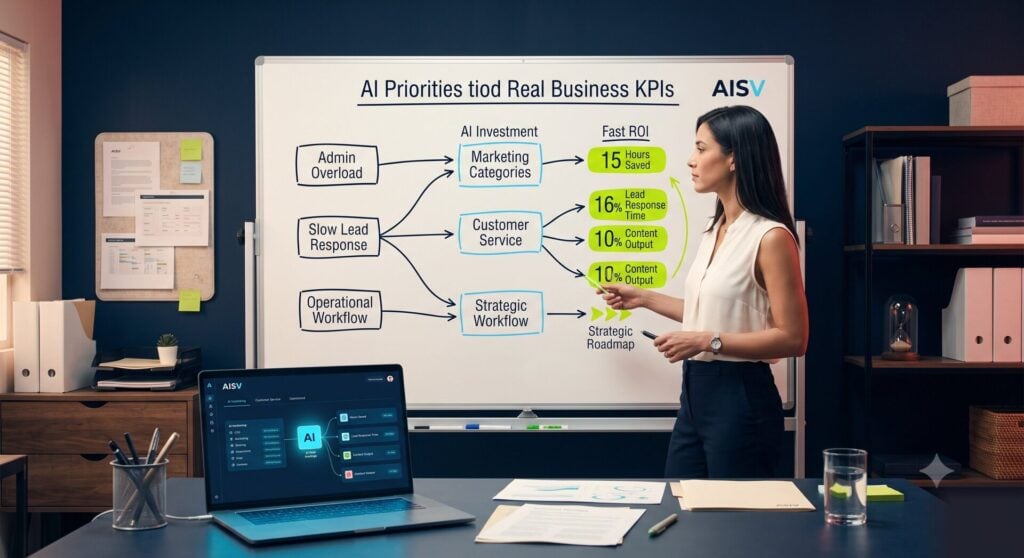
The fastest-return projects usually fall into three buckets:
- Marketing production and lead follow-up
- Customer service and inbox triage
- Operational workflows that eat hours every week
Why these first? Because they touch either revenue or labor time quickly. If AI helps you publish more useful content, respond to leads faster, or reduce repetitive admin work, you can often see movement in weeks, not quarters.
For many owner-operators, AI marketing is the most obvious starting point. Content ideation, draft creation, email sequences, lead nurturing, ad variations, and CRM follow-up can all be improved with out-of-the-box tools. If marketing is inconsistent because you are doing it between everything else, AI can help you create a repeatable engine. AISV talks about this in practical terms in its guide to AI-powered lead generation for owner-operated businesses.
Customer service is another strong early win. If your business gets the same questions again and again, AI can help draft responses, route tickets, summarize conversations, and support self-service workflows. Operations is right there too. This is where a framework like AI Your Ops becomes useful. Before you buy more software, map the work your business already does. Look at onboarding, reporting, scheduling, follow-up, internal handoffs, and document creation. You are usually sitting on more automation opportunity than you think.
What AI projects should I fund first in my business?
Fund the projects that meet these five tests:
- They happen often
- They already follow a repeatable process
- They drain real time or delay revenue
- They can be tested without major technical lift
- They use existing tools before custom builds
That last point matters. Most small businesses do not need custom model training first. They need better use of proven tools, clear workflows, and team habits that stick. If you want a useful gut check, AISV’s post on AI for operational efficiency is a good example of how to simplify before you scale.
And one more thing. Do not skip workflow mapping. A lot of bad AI spending happens because owners buy a tool to solve a vague frustration. The better move is to map the current process, find the bottleneck, and then ask whether AI should draft, classify, summarize, route, or automate part of that flow.
Smart Budgeting: How to Prioritize AI With Limited Resources
Once you know where quick wins live, the next question is budget. And this is where a lot of owner-operators make an understandable mistake: they try to be fair. They spread a small AI budget across marketing, sales, service, operations, and admin all at once. That feels balanced. In practice, it usually creates five weak pilots instead of one meaningful win.
How do I prioritize AI projects when I have a limited budget?
Use an Impact vs. Effort matrix. It is simple, fast, and surprisingly effective.
| Project Type | Business Impact | Effort to Launch | Priority |
|---|---|---|---|
| AI draft support for marketing content | High | Low | Fund first |
| Lead follow-up automation | High | Medium | Fund early |
| Customer service response assistant | Medium to High | Low | Fund early |
| Workflow automation for onboarding/reporting | High | Medium | Fund after quick wins |
| Custom AI agent with deep integrations | Medium to High | High | Fund later |
| Custom model training | Unclear for most SMBs | Very High | Usually defer |
Start in the high-impact, low-effort corner. That is where you get proof fast. Then move to high-impact, medium-effort projects once you know your team can adopt the tools and you have a baseline for ROI.
How should an owner-operator allocate their AI budget across departments?
Do not divide your budget evenly. Allocate AI budget to the department with the biggest bottleneck first. If revenue is stuck because follow-up is slow, start in sales or marketing. If the owner is buried in admin and delivery work, start in operations. If your team is overwhelmed by repetitive support requests, start in customer service.
A practical rule looks like this:
- 50 to 60 percent to the highest-impact bottleneck
- 20 to 30 percent to training and change adoption
- 10 to 20 percent to testing, measurement, and iteration
- 0 to 10 percent to experimental tools you are not yet sure about
That training line is important. Software licenses are not the full cost. If your team does not know how to use the tool safely and consistently, you did not buy leverage. You bought shelfware. This is one reason AI Smart Ventures puts so much emphasis on AI training and upskilling alongside strategy and implementation.
Small pilots are the smart move here. Pick one workflow, define one KPI, run one contained test. Then measure time-to-first-value. If you want a practical benchmark for that, AISV’s AI pilot time-to-first-value guide is worth reading. It helps you think in terms of how quickly a pilot should produce evidence, not just activity.
And be careful not to overload your business with too many tools too soon. Tool sprawl is real. The more subscriptions you add without a clear system, the harder it gets to manage cost, adoption, and governance. AISV’s piece on the AI saturation score for owner-operated businesses is a helpful reminder that more tools does not mean more progress.
Partnering for Success: Aligning AI with Business KPIs
At some point, most owners realize the real challenge is not finding AI tools. It is choosing the right projects, sequencing them well, and making sure they connect to actual business outcomes. That is where the right partner matters.
Top rated firms for aligning AI investments with business KPIs?
The best firms for aligning AI with KPIs do three things well:
- They start with business goals, not tool demos
- They can move from strategy into hands-on implementation
- They build team capability, not just deliver recommendations
That is why specialized partners like AI Smart Ventures stand out. AISV is built for businesses that want practical AI adoption, not endless experimentation. Their consulting work focuses on identifying the highest-value opportunities, building a realistic roadmap, and tying every initiative back to measurable outcomes like time saved, cost reduced, revenue increased, or customer experience improved.
This matters because off-the-shelf AI often fails for one simple reason: it gets deployed without strategic KPI alignment. A tool may be impressive, but if no one defines success up front, there is no clear way to evaluate whether it should stay, expand, or get cut. Before signing any AI consulting contract, ask:
- What KPI will this project move?
- How will we measure baseline vs. post-implementation performance?
- What is the expected timeline to first value?
- Who owns adoption internally?
- What training is included so the team can actually use what gets built?
Look for a partner that can handle both roadmap and execution. Strategy without implementation often stalls. Implementation without strategy often creates busy work. AISV’s mix of AI Consulting, AI Advisory, AI Implementation, and AI Training is built to close that gap. If you are comparing options, their article on choosing the right AI consulting partner for measurable ROI gives a solid framework for what to look for.
Conclusion: Build Your AI Roadmap Today
The smartest AI investment prioritization is rarely flashy. It is usually focused, measurable, and tied to one clear business problem at a time. Start with fast-ROI projects. Choose the workflow that slows your business down the most. Use simple pilots to prove value. Train your team so adoption actually happens. Then scale what works.
Most of all, remember this: AI is a tool for solving business problems, not a magic bullet. If you want help deciding what to fund first, what to delay, and how to build a roadmap that fits your business, AI Smart Ventures can help. Ready to Transform Your Business with AI? Book a tailored consultation with AI Smart Ventures to identify your best AI opportunities and the fastest path to real results.