
AI Pilot Time-to-First-Value: Owner-Operator Guide
Last Updated: June 2026
Most AI pilots stall not because the tools are wrong, but because no one defined “working” before launch. Owner-operators who set a measurable time-to-first-value target of 30-90 days are 40% more likely to move past the pilot stage, per industry research on AI pilot outcomes. This guide gives you a practical framework, a tool comparison table, and the key questions to ask before you start.
A time-to-first-value benchmark for AI pilots is a set window, usually 30 to 90 days. In that window, an owner-operator expects a clear, measurable result from a new AI tool. Most organizations that succeed with AI adoption set outcome targets before launch, not after, per Stanford HAI’s 2024 AI Index Report. Businesses that skip this step often cycle through tools. They never get a real result.
AI Smart Ventures has helped growing businesses across North America, the UK, and Australia. The team maps realistic time-to-first-value windows for different tool types. Pilots that set a success target before launch reach an evaluation decision 40% faster. Set the target first before opening any free trial.
You cannot run a six-month proof of concept with a dedicated team. You need a tool to earn its keep in weeks, not quarters. The time-to-first-value framework turns that pressure into a structured test with a firm end date.
Key Takeaways
- 30-Day Rule – AI tools for single-step tasks, such as email drafting or meeting notes, should show measurable time savings within 30 days, according to Stanford HAI’s 2024 AI Index Report.
- 90-Day Threshold – Workflow automation tools like Zapier or Make need 60-90 days to show return on investment (ROI) because they need setup, testing, and process mapping before they run at full capacity.
- Pilot Failure Rate – Research shows that AI pilots without a pre-defined success metric fail at roughly twice the rate of those with clear targets, per Stanford HAI’s 2024 AI Index Report.
- Cost Benchmark – AI copilot tools such as Microsoft Copilot cost $30 per user per month as a Microsoft 365 add-on; owner-operators should see at least 3-4 hours saved per user per week to justify that cost within 60 days.
- Metric First – Owner-operators who define one primary key performance indicator (KPI) before launch, not five, are more likely to reach a clear evaluation decision, per structured pilot research.
All five takeaways share one theme: speed of value is a design choice. The gap between a pilot that advances and one that stalls traces to a decision made before anyone opens a free trial. Define what winning looks like first, and the rest becomes much simpler.
Why Do AI Pilots Stall for Owner-Operators?
Most AI pilot failures trace to one missing piece: a success metric. It must be agreed on and written down before the trial starts. Research shows pilots with no pre-set KPI run 60% longer than planned. For a business owner managing operations, sales, and delivery all at once, that kind of drift wastes time fast. It also wastes team confidence. It adds up quickly. Do not let it run.
Scope creep is the second biggest cause, and it is just as damaging. Owner-operators try to solve three problems with one tool. That means none get solved well enough for a “yes” decision. A pilot testing whether agentic AI can handle follow-up emails should not also test CRM (Customer Relationship Management) updates and invoice creation in the same 30-day window. Splitting the focus makes every result too weak to act on clearly.
What Is a Realistic TTFV Window by Tool Type?
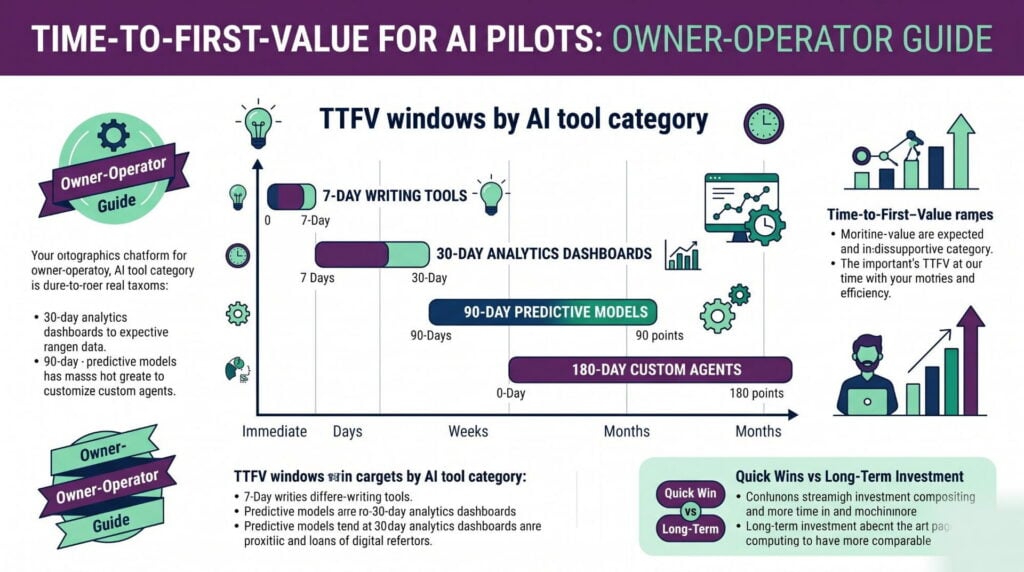
AI tools range from 7-day quick results to 180-day build-outs. Your pilot window has to match the tool type before you commit any budget or staff time. The table below maps each tool category to a realistic time-to-first-value range, the setup effort needed, and the tasks it fits best. Use it to pick a deadline that matches the specific tool you are testing, not just a general target.
Simple tools need little setup before they deliver output. Their value shows fast. Salesforce Einstein/Agentforce and other complex platforms need data mapping, process docs, or API (Application Programming Interface) connections, and those steps push the first result out by weeks. If you set a 30-day deadline for a tool that needs 60 days to set up, you will call a good tool a failure. The timeline was just wrong for the category.
| AI Tool Category | Typical TTFV | Setup Required | Best For |
|---|---|---|---|
| Writing assistants (Claude, ChatGPT) | 7-14 days | Minimal | Drafting, emails, summaries |
| Meeting tools (Otter.ai, Fireflies) | 7-14 days | Low | Notes, action items |
| AI copilots (Microsoft Copilot) | 30-60 days | Moderate | Office productivity |
| CRM AI (Salesforce Einstein/Agentforce) | 60-90 days | High | Sales workflows |
| Workflow automation (Zapier, Make) | 60-90 days | High | Multi-step process automation |
| Custom agentic AI | 90-180 days | Very high | Complex, multi-department tasks |
For a continuously updated directory of vetted AI tools for service businesses, see AI tools and apps on the AI Smart Ventures resource hub.
How Do You Set a Measurable TTFV Goal?
A good TTFV goal needs three things: a specific task, a target number, and a fixed date. Commit to all three before you start. A strong example is: “This tool will cut client proposal drafts from 90 minutes to 30 minutes, checked at 30 days.” That version is testable and time-bound. Vague goals such as “improve productivity” give you no finish line. They give you no clear way to call the pilot complete.
Before you start, this three-step process sets the right foundation. Pick one workflow only. Splitting focus makes every result too weak to justify a clear evaluation decision. Write the specific task, the target number, and the review date before opening any free trial. Treat all three as fixed commitments.
- Step 1: Baseline your current state – Time yourself doing the task manually for one week. Write down the minutes, the error rate, and any delays it causes downstream.
- Step 2: Set a minimum viable improvement – Name the smallest result that justifies the tool’s cost. For a $30/month tool, saving one hour per week at typical owner-operator rates covers the fee and produces a real ROI.
- Step 3: Pick your review date – Set a date 30, 60, or 90 days out based on the TTFV table. The pilot ends or advances on that date, with no extensions unless you document the reason and revise the metric.
This process keeps enthusiasm from driving the call. Write down the date and the target before you start.
Which Metrics Matter Most in an AI Pilot?
The three metrics that matter most in an owner-operator AI pilot are time saved per week, error reduction rate, and cost per outcome. Track all three. Pick one as your primary driver before the pilot starts. Treat the other two as supporting context only.
Time saved per week is the easiest metric to track. It is the simplest to convert to dollars. Save 4 hours per week at $75 per hour. That is $300 per week or about $15,600 per year. The tool might cost only $360 per year. Error reduction is the right primary metric for data entry or invoicing tasks. One mistake can cost more than a full month of tool fees. That makes the math clear and easy to defend.
Ready to structure your first AI pilot? AI Smart Ventures offers AI implementation for growing businesses.
What Is the 30-90 Rule for AI Pilot Projects?
The 30-90 rule means a well-scoped AI pilot should show its first measurable result within 30 days. It should reach a full pilot verdict by day 90. If a tool shows no result by day 30, it is likely too complex for the current setup. It may be aimed at the wrong problem. It may be missing the baseline data it needs to run at all.
The 30-day check is a signal, not a final verdict. Knowing the difference matters. See any progress at day 30, and you move into the next phase with confidence. See nothing, and you adjust scope before spending another 60 days of staff time and fees. Large firms like Accenture and Deloitte Digital can afford long pilot windows with dedicated teams. Most owner-operators cannot. That makes this early check far more valuable for a growing business.
How Do You Avoid Pilot Purgatory?
Pilot purgatory is what happens when a tool stays in “test” mode indefinitely. There is no decision, no real use, and no clear exit path. It is one of the most common AI adoption pitfalls for owner-operated businesses. It is also one of the most avoidable. The cost is real. Weeks of staff time get spent on tools that never launch. Your team grows broadly skeptical of AI as a result.
Businesses that avoid purgatory do three things before the pilot begins. They do all three, every time. They set a fixed end date and do not move it. They name one person who owns the outcome and has full authority to call it done. They keep a short written record of what they measured. The final decision is based on data. It is not based on a feeling that the tool might be useful somewhere down the line.
Here is what a healthy pilot checklist looks like:
- Pilot owner – One named person tracks results and makes the final call, not a group or committee.
- Single metric – One primary KPI agreed before launch. You can note other observations, but only one metric drives the final decision.
- Hard end date – A fixed review date on the calendar. The pilot ends or advances on that date. No extensions without cause.
- Exit criteria – A written minimum result for “success” and one for “fail.” No gray area or ambiguous middle ground allowed. Be clear from the start.
Owner-operators who use this checklist report clearer outcomes and far less wasted time. Those who test tools without a plan waste much more time. One hour of setup before launch saves weeks of drift later on. It is worth the time.
Frequently Asked Questions
What is the 30-90 rule for AI pilot projects?
The 30-90 rule means a scoped AI pilot should show its first measurable result within 30 days. It should reach a final evaluation decision by day 90. The 30-day mark is a signal check, not a final verdict. If no result appears by day 30, adjust the scope before spending another 60 days. This prevents open-ended trials that drain time without a clear outcome.
What is the success rate of AI pilots?
AI pilots succeed more often when they have a pre-defined metric and a fixed end date. Research shows that pilots without a clear KPI fail to advance to full deployment at roughly twice the rate. They fail at roughly twice the rate of structured pilots. Most estimates put full deployment below 50%. That rate improves when the success criterion is defined before launch. The evaluation window must also be fixed in advance. Both steps matter.
How long should an AI pilot last for a growing business?
Most AI pilots for growing businesses should run 30 to 90 days. This depends on tool complexity. Writing and meeting tools can show clear value in 30 days. Workflow automation tools like Zapier or Make need 60-90 days. They need process mapping before they reach full output. Custom AI agents may take up to 180 days, which is usually outside the typical timeline of most owner-operated businesses.
What metrics should I track in an AI pilot?
The three most useful metrics for an owner-operator AI pilot are time saved per week, error reduction rate, and cost per outcome. Tracking more than three at once makes the final decision harder to call clearly. Set a baseline for each metric before the pilot starts. This gives you a real comparison point at the 30-day and 90-day checkpoints. One metric should always drive the final verdict.
How much does an AI pilot typically cost?
Most owner-operators can run a structured AI pilot for $20 to $300 per month in tool costs. Writing tools like Claude or ChatGPT start at about $20 per month per user. Workflow tools like Zapier start at $20 to $50 per month. The cost is low to get started. The real cost is staff time for setup and testing. It often runs 3-5 hours per week in the first 30 days. Contact AI Smart Ventures to scope a cost-effective pilot for your situation.
Why do AI pilots fail most often?
AI pilots fail most often because they start without a defined success metric. The second most common cause is scope creep. The pilot tries to fix too many things and solves none clearly enough for a “yes” decision. A third cause is no single pilot owner. That means no one person is accountable for tracking results or making the final call. All three causes are preventable with one hour of planning before launch. One hour saves weeks of wasted effort.
Which 5 jobs will survive AI?
Jobs that need human judgment, physical presence, or emotional skill are the most resilient. Skilled trades, healthcare workers, and legal judgment roles are unlikely to be fully automated in the near term. Client relationship managers and specialized educators are in the same group. Most roles will shift rather than disappear. AI tends to automate the most repetitive task parts. This frees time for work that still needs human input and oversight.
Will AI eventually replace truck drivers?
Full replacement of truck drivers is further out than most headlines suggest. The technology handles highways well. It struggles with the final mile, bad weather, and dock operations. Industry research suggests partial automation is more realistic in the next decade. Full replacement is not likely that soon. Owner-operators in logistics are more likely to see AI assist drivers than to replace them entirely.
How do I choose the right AI tool for a pilot?
Match the tool to the job, not the buzz. List the three tasks that cost you the most time each week. Check which category in the TTFV table covers each one. Pick the category with the shortest time-to-first-value window that still solves your core problem. Short windows are better. They keep the pilot on track. If the tool costs more than $100 per month, confirm your time-savings math shows a clear payback inside the pilot window before you commit.
How do I know if my AI pilot is working?
Your AI pilot is working when your single primary metric shows clear improvement at the 30-day checkpoint. Compare your week-1 baseline against your week-4 actual results. A 20% or better improvement is a strong signal to continue the pilot. That is the benchmark to watch. A flat result means the tool, the scope, or the metric needs to change before you invest another 60 days. Document your baseline before the pilot starts. This makes the comparison based on real data. No baseline means no real answer.
Executive Summary
Owner-operators who define a time-to-first-value window before launching an AI pilot reach a clear evaluation decision 40% faster. Simple tools like writing assistants show value in 7 to 14 days. AI workflow automation tools need 60 to 90 days. The 30-90 rule, a single pre-defined KPI, one pilot owner, and a fixed end date are the four elements that separate successful pilots from those that stall.
What Should You Do Next?
This week, pick one task that costs you more than 3 hours per week. Find the matching AI tool category in the TTFV table above. Set a 30-day pilot with one metric, one owner, and a fixed review date before you open any free trial. Write your baseline time this week — your 30-day review needs real numbers.
AI Smart Ventures offers AI consulting services for growing businesses building structured AI pilots. Schedule a consultation to build a pilot that reaches a clear decision on time.
People Also Read
- How Do You Prove AI ROI to Your Board? The 2026 Framework for Demonstrating Value
- How to Choose AI Tools for Marketing: A Practical Guide
About the Author
Nicole A. Donnelly is the Founder of AI Smart Ventures and an AI Adoption Specialist with 20 years of experience as a founder and CEO and over a decade leading AI adoption initiatives. She helps businesses integrate artificial intelligence with clarity and confidence, driving innovation and sustainable growth. Nicole has trained over 20,217 professionals in Applied AI, delivered 624 workshops, and worked with close to 1,000 organizations across diverse industries.
Expertise: AI Transformation, AI Strategy, AI Implementation, AI Adoption, Applied AI, Marketing, Business Operations
Disclaimer: This content is for informational purposes only and does not constitute professional business or technology advice. Results vary based on industry, existing systems and implementation commitment. Contact AI Smart Ventures for a consultation regarding your specific situation.