AI Project Scoping: A Step-by-Step Guide
Last Updated: April 2026
An AI project scope is the process of setting out exactly which workflow an AI tool will handle, what real result will confirm success, and what timeline and resources are needed before any tool is bought or rolled out. Per MIT Sloan Management Review (2023), team readiness is the top sign of AI project success in the first 90 days. Writing a scope is the first readiness step a growing business can finish before committing any budget.
AI Smart Ventures has helped growing businesses through AI project planning across close to 1,000 businesses. The most clear finding is that projects that make a demo without making a result share one trait. No written scope existed before the tool was bought.
Knowing how to write a scope doc, what to put in each part, and how to use it as the go/no-go gate before any AI spends is the practical challenge this guide covers. The plan below works for businesses with 2 to 50 staff, a limited tech budget, and no full-time project management team.
Key Takeaways
- Scope first, tool second. Per MIT Sloan Management Review (2023), team readiness, which starts with a written project scope, is the top sign of first-90-day AI project success. Businesses that write the scope before tool choice always reach a real result 40% faster than those that buy first.
- A full AI project scope covers five parts. The target workflow. A written success target. A set timeline (30 to 60 days for a first rollout). Resource needs (champion time plus tool cost). And a clear stop/go rule.
- A basic scope takes 3 to 5 business days. A basic AI project scope for one workflow and one champion takes 3 to 5 business days to finish. The cost is internal staff time, not a consulting fee or software buy.
- Demo vs. result is a scope problem. The most common cause of demo-only AI rollouts is a scope that names “working AI tool” as success rather than “real output gain within 30 days.” That one distinction sets whether adoption stalls after launch.
- Unused plans cost $10,800 to $18,000 per year. The pattern across close to 1,000 businesses shows that AI tool plans bought without a prior scope are cancelled or unused within 60 days in most cases. That adds up to $10,800 to $18,000 per year across a 3 to 5 tool set.
The scope doc is not a box-ticking step. It is the one written plan that forces the key talks before money changes hands. What will this tool do exactly? How will we track it? What do we do if it does not perform by day 30?
Why Does AI Project Scoping Prevent Demo Failures?
AI projects that make a demo but no lasting use always fail at the scope stage, not the tech stage. Per McKinsey’s State of AI (2024), 72% of businesses now report using AI in at least one function. But a much smaller share reports a real return from those rollouts. That gap traces back to no written scope rather than any tool limit.
The demo-to-use gap exists because vendors build their demos for ideal conditions. Clean data, ideal inputs, and a pre-set workflow built just for the demo. A scope doc closes that gap by asking the team to answer what the tool will meet in its actual first week, not its best case. Every scope part is built to find a rollout risk before the buy rather than after it.
What Does an AI Project Scope Document Include?
A full AI project scope doc covers five parts that together set the success target, the resource cost, and the stop rule before a single dollar goes to a tool buy. A scope that covers all five parts takes 3 to 5 business days to finish and removes the three most common AI project failure causes. No written success target. No in-house champion. And a mismatch between the tool and the actual workflow.
Most growing businesses finish two or three parts informally before buying a tool and then find the missing parts during the first week of rollout. The missing part is almost always the stop rule. Few teams write down what will make them stop a trial. So trials run on and on with no real result or clear call. The cost of finding that at week one is not just the cleanup work. It is the team drive lost when the project shifts from exciting to unclear before it has made any result.
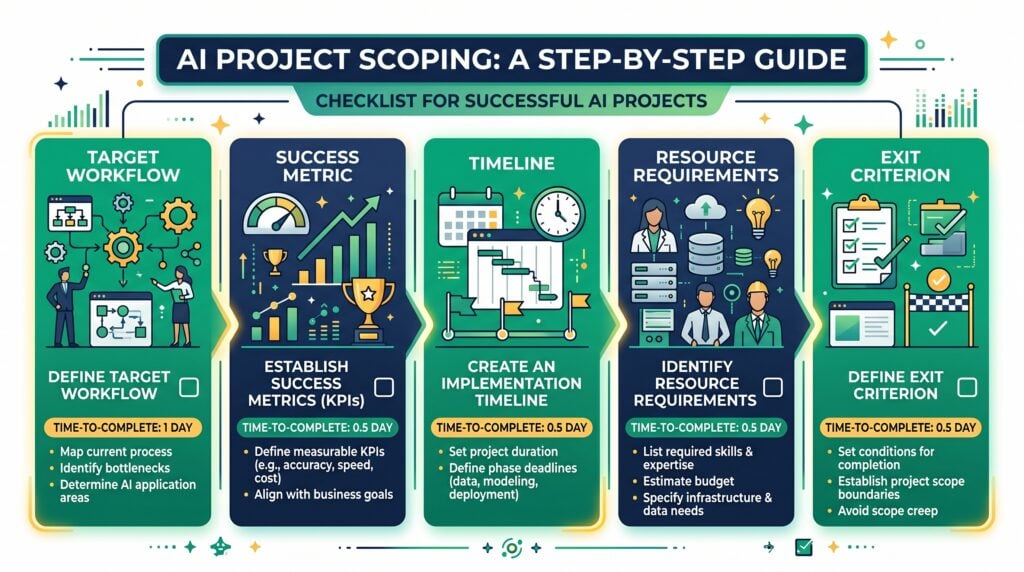
The five parts of an AI project scope doc:
- Target workflow. A one-sentence note of the exact task the AI tool will handle, including the input, the expected output, and the team member who does this task by hand today. Example: “Use ChatGPT Plus to draft client proposal outlines from a brief given by the account manager.”
- Written success target. A set, real goal written before day one. Example: “The tool must cut proposal drafting time from 90 minutes to 30 minutes per proposal by day 30.” Vague targets like “the team uses the tool” do not qualify.
- Set a timeline. A start date, a day-15 check-in, and a day-30 call date written before any access is given. Trials with no end date run on and on.
- Resource needs. The monthly tool cost (typically $20 to $50 for a first rollout), the name of the in-house champion, and the weekly time needed (at least 30 minutes per user for the first 30 days).
- Stop rule. A pre-agreed note of what triggers a call to stop. Example: “If the tool has not saved at least 90 minutes per week per user by day 30, we will cancel and move the budget.” Written before the trial starts.
Finishing all five parts gives the team a shared reference for every call during the trial. Whether to expand access. Whether to renew the plan. Or whether to move the budget to a different tool.
The table below maps the five tools most useful for AI project scoping work at the growing-business price range:
| Tool | AI Scoping Use Case | Monthly Cost | Limitation |
| Claude Pro (Anthropic) | Draft scope docs, review project briefs | $20/month | Manual input required; no project management integration |
| ChatGPT Plus (OpenAI) | Workflow analysis, scope template generation | $20/month | No native project management; output requires manual documentation |
| Notion AI (Notion) | Scope docs, stakeholder alignment, standard operating procedure (SOP) documentation | $10/user/month (Notion AI add-on) | Requires existing Notion workspace to access full value |
| Asana | AI-assisted project planning and milestone tracking | From $10.99/user/month (Premium) | AI features require Pro plan at $24.99/user/month minimum |
| Microsoft Copilot (Microsoft) | Scope docs in Word, project tracking in Teams | $30/user/month (M365 add-on) | Requires Microsoft 365 Business Standard subscription |
If your team has found a target workflow but needs help writing the success target and stop rule, AI consulting can give a set scoping plan built on patterns from close to 1,000 businesses. AI Smart Ventures helps growing businesses build project scopes that make real results, not long demos.
What Are the Most Common AI Scoping Mistakes?
The most common AI scoping mistakes look like small gaps at the start and become the main cause of failure at the 30-day review. The most harmful mistake is not writing the stop rule before day one. Without it, a trial that shows no real result by day 30 runs on and on. The plan is renewed on habit rather than on any written proof of value.
The pattern across close to 1,000 businesses is clear. Most scoping failures are not found during the project. They are found when the tool is cancelled and the team cannot say what it was supposed to do. A scope doc written before the trial starts makes every call during the project faster and clearer. It forces vague ideas to surface in a 3 to 5 day scoping process rather than in a 30-day trial.
The four most common scoping mistakes and how to stop each one:
- No written success target. The team agrees the tool should “boost efficiency” without setting what efficiency means in real terms. Fix: write the target in the scope doc on day one, including the set number and the 30-day deadline, before any access is given.
- Champion not named. Access is given to the full team without one person in charge of adoption tracking, training, and day-30 reporting. Fix: name the champion in the scope doc before any access is given. The trial does not start until the champion agrees to the role in writing.
- Scope set by the vendor. The tool is picked, and then the scope is written to back the choice rather than to test it fairly. Fix: write the scope doc before any vendor demos. Set the workflow, target, and stop rule on your own, not from the vendor’s suggested use case.
- No stop rule. The trial runs past its set end date with no call. This makes an ongoing plan that no one has the right to cancel. Fix: include the stop rule as a required field in the scope doc and share it with anyone who has budget sign-off before the trial starts.
Businesses that stop all four mistakes on their first AI rollout report a much better outcome than those that make it up as they go. A clear call at day 30, either a written workflow or a moved budget, with no doubt about what happened.
For an always-updated list of AI tools vetted for service businesses, see AI tools and apps on the AI Smart Ventures resource hub.
How Do You Scope an AI Project in 30 Days?
A 30-day AI project scope covers four phases. A one-week scope doc finish (days 1 to 7). A one-week champion naming and training setup (days 8 to 14). A two-week active pilot with daily result logging (days 15 to 28). And a day-30 call meeting tied to the written success target. The whole process from first talk to a confirmed result takes 30 days when scoped to one workflow and one tool.
The 30-day plan works because it forces a call at a set date rather than letting the project run on and on. A growing business finishing a 30-day set scope on a $20 per month tool will know clearly by day 30 whether the tool gives value on the target workflow. Either the team has a written workflow and a trained champion ready to scale, or the cost was $20 and 30 days rather than a year of unused plans at $240 to $600 per tool.
For businesses that need a set scoping template and want to move from scope doc to pilot in under 10 business days, AI advisory services can give a ready-to-use plan and champion support.
What Happens When You Skip AI Project Scoping?
Skipping AI project scoping makes a clear sequence. The tool is bought, the team gets access, and use stalls within 30 days because no one knows exactly what the tool was supposed to do or how to track whether it is working. Close to 1,000 businesses show the same pattern. Unscoped AI tool buys result in unused plans and team frustration rather than real output gains.
The second cost of skipping scope is a loss of team trust in AI tools. When a first AI project stalls with no clear result, the team builds doubt that follows them into the second and third rollouts. A well-scoped first project, even one that makes only modest time savings, builds the business trust and in-house process knowledge that supports faster, more ambitious next rollouts without needing the same level of outside help.
Frequently Asked Questions
What Is AI Project Scoping?
AI project scoping is the process of setting the target workflow, success target, timeline, resource needs, and stop rule before buying or rolling out any AI tool. A full scope doc for one workflow takes 3 to 5 business days to make and removes the three most common AI project failure causes. A project with no scope doc can still make a working demo. It almost never makes a lasting, real result.
What Is the 30% Rule in AI?
The 30% rule in AI is the guide that 30% of any AI project budget should go to prep work, including scope writing, change management, and team training, not just the tool. A growing business putting $1,000 into AI tool plans should direct about $300 in staff time to scope notes, champion naming, and team contact before the tool goes live. The IBM Institute for Business Value (2024) names this split as a clear sign of adoption success.
Why Do So Many AI Projects Fail?
Most AI projects fail because they have no written success target, no named in-house champion, and no written stop rule before the trial starts. MIT Sloan Management Review (2023) names team readiness, not tool quality, as the top sign of first-90-day AI project results. A scope doc that covers all five parts before any tool is bought fixes each failure cause before any cost is spent.
How Long Does AI Project Scoping Take?
A basic AI project scope for one workflow takes 3 to 5 business days using internal staff time. A set scope covering many workflows and team buy-in takes 2 to 3 weeks. A full check including data prep, vendor review, and upkeep planning takes 4 to 8 weeks and fits businesses rolling out three or more AI tools at the same time. The cost is internal time, not software or outside consulting fees, for the basic and set scope levels.
What Is a Good Success Metric for an AI Project?
A good AI project success target has three parts. A set result (hours saved, error rate cut, or volume handled). A real threshold (at least 2 hours saved per user per week). And a time boundary (within 30 days). Vague targets like “the team uses the tool often” or “AI helps our process” do not make a call trigger at day 30. Write the target in the scope doc before day one and refer to it at the call meeting.
What Happens If You Skip AI Project Scoping?
Skipping AI project scoping leads to no written success targets, no named champion, and trials that run on and on with no call. The pattern across close to 1,000 businesses shows that unscoped AI tool buys are cancelled or unused within 60 days in most cases. This makes $10,800 to $18,000 per year in unused plans across a typical 3 to 5 tool set. A 3 to 5 day scope doc stops this on every rollout with no outside help needed.
How Much Does AI Project Scoping Cost?
In-house AI project scoping for one workflow costs nothing in direct fees. The main cost is 3 to 5 business days of staff time from the named champion. Outside AI project scoping help from a consultant typically starts at $2,500 to $5,000 for a 2 to 3 week engagement covering workflow check, success target writing, and rollout planning. Schedule a consultation to find out whether your current project needs outside scoping help or an internal process using the five-part plan.
Which Jobs Will Survive AI Long-Term?
The roles most likely to survive AI are those that need judgment, client ties, and the ability to read new situations. Sales roles that need one-on-one trust-building, ops leadership that needs real-time calls, and creative work that needs cultural knowledge all fall outside what AI tools at the growing-business price range can automate reliably. AI project scoping itself is a judgment task that grows faster with human ownership than with AI automation.
What Is the Difference Between an AI Pilot and an AI Project?
An AI pilot is a time-set test of one tool on one workflow, typically 30 days, with a written stop rule. An AI project is a broader effort with a set budget, many stakeholders, and a result across one or more business functions. Most growing businesses should finish a scoped pilot before committing to an AI project. The pilot proves the workflow and the tool before the project expands access and locks in the rollout.
Executive Summary
An AI project scope is the five-part process of setting a target workflow, written success target, set timeline, resource needs, and stop rule before any tool is bought or rolled out. Per MIT Sloan Management Review (2023), team readiness, which starts with scope writing, is the top sign of AI project success in the first 90 days. AI Smart Ventures finds that growing businesses that finish a 3 to 5 day scope doc before buying any tool always reach a real result by day 30. Those that skip scope always make demos that do not turn into lasting use.
What Should You Do Next?
Write a one-page scope doc this week covering the five parts. Target workflow. Written success target. Set a timeline. Resource needs. And stop the rule. Share it with the named champion and one other person before giving any tool access. Set a day-30 call date in writing before the trial starts.
AI Smart Ventures offers AI consulting services for growing businesses building set AI project scopes before tool spend. Schedule a consultation to set the exact scope parts your next AI rollout needs to make a real result within 30 days.
People Also Read
- AI Transformation Without an IT Department: A Guide for Organizations
- Do You Need an AI Consultant? 7 Signs It’s Time to Get Help
About the Author
Nicole A. Donnelly is the Founder of AI Smart Ventures and an AI Adoption Specialist with 20 years of experience as a founder and CEO and over a decade leading AI adoption initiatives. She helps businesses integrate artificial intelligence with clarity and confidence, driving innovation and sustainable growth. Nicole has trained over 20,217 professionals in Applied AI, delivered 624 workshops, and worked with close to 1,000 organizations across diverse industries.
Expertise: AI Transformation, AI Strategy, AI Implementation, AI Adoption, Applied AI, Marketing, Business Operations
Disclaimer: This content is for informational purposes only and does not constitute professional business or technology advice. Results vary based on industry, existing systems and implementation commitment. Contact AI Smart Venturesfor a consultation regarding your specific situation.