AI Quick Wins Are Not a Strategy: Turn Gains Into a Plan
Last Updated: April 2026
An AI quick wins strategy is the stage most growing businesses reach in their first 60 to 90 days of AI adoption. It is a working set of first output gains that have each proven their value on their own, but have not yet been linked into a repeatable system with written workflows and a clear next-step plan. Per McKinsey’s State of AI (2024), 72% of businesses use AI in at least one function. But the pattern across close to 1,000 businesses shows that most stall before those tests build into a real strategy. That stall point is what this article covers.
AI Smart Ventures has helped growing businesses through AI adoption planning across close to 1,000 businesses. The most clear turning point is the shift from working solo tests to a written, building plan. Most businesses that stall at this stage are not failing at doing the work. They are treating a phase as a finish line.
The plan below gives growing businesses a clear picture of what splits an AI test from an AI strategy, the sign that each first output gain is ready to scale, and a 30-day step-by-step process for linking spread-out tool wins into a written plan that builds over time.
Key Takeaways
- Most businesses stall between 60 and 90 days. Per McKinsey’s State of AI (2024), 72% of businesses use AI in at least one function. But most stall when solo tool tests are not linked into a shared tracking system.
- A set of tools saving time is not a strategy. A written AI strategy needs three things. A shared tracking system. Named champions per function. And a set next-step plan with a 90-day review cycle.
- Link two written workflows in 90 days to cut time-to-third by 40%. A growing business that links its first two written AI workflows into a shared system within 90 days cuts the time to a third written workflow by 40%. AI Smart Ventures sees this pattern across close to 1,000 businesses.
- Stalling costs $2,400 per year. A growing business spending $200 per month across four AI plans without a written next-step plan spends $2,400 per year on tools that will not build. Turning the highest-use test into a written strategy costs under 10 hours of staff time.
- Otter.ai is a common first tool that often stalls. At $0 to $16.99 per month on the Pro plan, Otter.ai solves one exact task without needing workflow design. That makes it a useful first-step gain that stalls without a strategy path.
Knowing the split between a first output gain and a written AI strategy is the most key shift a growing business can make in year two of AI adoption.
Why Do AI Experiments Fail to Become a Strategy?
A growing business that uses Otter.ai for meeting notes or ChatGPT Plus ($20 per month) for email drafting and sees real time savings has finished a working test, not a strategy. The split is whether the business has answered three questions before the test ends. Which other functions gain from the same pattern? How will success be tracked across users? And what is the next-step plan for the next 90 days?
Per IBM Institute for Business Value (2024), team readiness rather than tech cost is the main barrier to AI adoption. The shift from test to strategy is the exact readiness moment most businesses are not ready for. A first output gain works because it is self-contained and backed by one keen person. A strategy fails to take shape because no one moves that solo win into a shared process, a tracking system, or a written next-step plan.
What Makes an AI Strategy Different from Experiments?
An AI strategy differs from a set of tests in one clear way. It has a written next-step plan, a shared tracking system, and at least one named owner per function whose role goes beyond the first tool rollout. Without those three things, any set of working AI tools, no matter how much time they save, stays a set of solo wins with no building value and no teachable process for new team members.
The clearest sign that a growing business has moved from tests to a strategy is that it can answer three questions without prep. Which AI workflows are active right now? What real result does each make per user per week? And what are the next two tool rollouts and why? A business that cannot answer all three is still in the test stage, no matter how many AI plans it holds or how much time solo tools are saving.
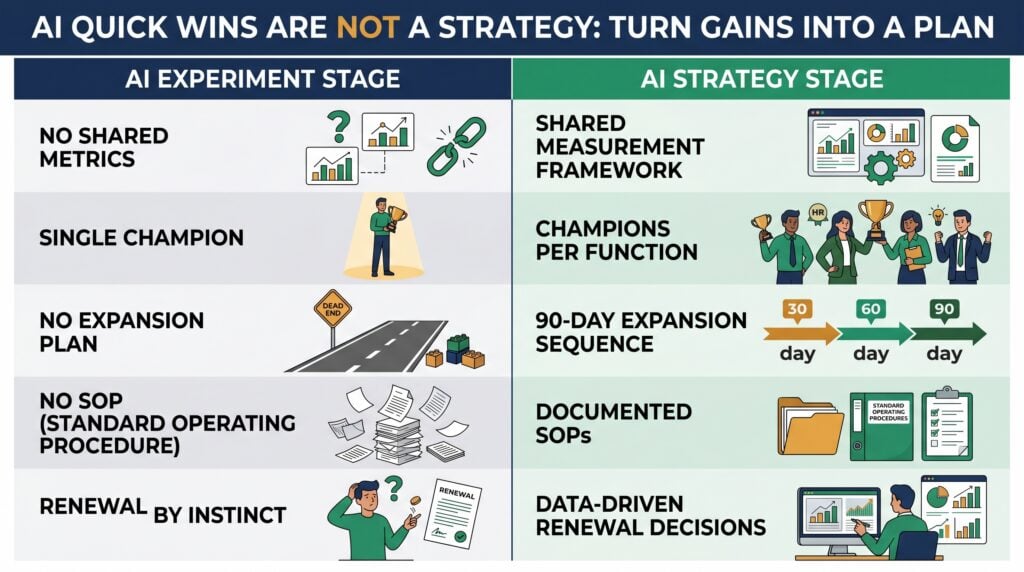
The five signs that AI tests have not yet become a strategy:
- No shared tracking system. Each AI tool is checked by different people using different measures. There is no common metric like hours saved or outputs made applied across all active tools.
- Solo champions only. Each tool is backed by one keen person. When that person is not there, tool use drops right away. That shows the workflow lives in one person’s head rather than a written process.
- No next-step plan. There is no written list of the next two AI tools to roll out, nor any rules for choosing them. Tool buys are reactive rather than in order.
- No onboarding path. A new team member cannot be trained on any AI workflow in under one hour because no written standard process (SOP) is attached to any tool.
- Renewal calls made by gut. When plan renewals arrive, the team debates whether the tool is useful rather than checking a written output metric to make the call.
Two or more of these signs together show the business is stuck in the test stage. Moving from test to strategy does not need new tools. It needs a three-part system applied to the tools already in use.
How Do You Turn AI Experiments Into a Real Strategy?
Turning AI tests into a written strategy needs three actions in order. Pick the highest-use current tool. Write its workflow as a one-page SOP with a named champion and a real output. And link it to a next-step plan naming the next two tools and timing. Businesses that finish all three in under 30 days always reach a building strategy system within 90 days, based on patterns across close to 1,000 businesses.
The common mistake is trying to write up every tool at once. A growing business that tries to write five AI tool workflows at the same time typically finishes zero of them within 30 days. The process is new, the champions are pulled in many ways, and there is no single win to anchor the effort. A single-tool write-up sprint always beats a full-stack write-up in both finish rate and team trust. One done SOP proves the process works before the second one starts.
The four-step process for turning a first output gain into a written strategy:
- Step 1 (Days 1 to 5): Pick and check. Find the one AI tool with the highest informal daily use across the team and confirm it has a named champion. If no one can name a champion without a meeting, that is the first strategic action.
- Step 2 (Days 6 to 10): Write the workflow. Write a one-page SOP covering the input, the expected output, and the real time saved. The champion must sign off before any team-wide training starts.
- Step 3 (Days 11 to 25): Set and track. The champion leads one 30-minute session and tracks one real output per user per week. 15 days of tracking gives the data that decides whether to keep, grow, or cancel.
- Step 4 (Days 26 to 30): Build the next-step plan. Using the first tool’s result data, find the next two tools for rollout and write a brief reason for each. This doc becomes the business’s AI strategy in its simplest working form.
AI Smart Ventures gives AI consulting services for growing businesses building their first written AI strategy, with a set sprint model built across close to 1,000 businesses.
Which AI Tools Start as Experiments and Become Strategy?
AI tools most likely to move from first output gain to written strategy are those with a clearly bounded task, a real output, and a cost under $25 per month. General-purpose tools like ChatGPT Plus ($20 per month) and Claude Pro ($20 per month) have the highest first use rate but also the highest stall rate. Their open-ended skill means no two users use them the same way, making workflow write-up harder without a set task scope.
Purpose-built tools like Otter.ai ($0 to $16.99 per month on the Pro plan) and Zapier Starter ($19.99 per month) have a natural SOP structure because the task is set by the product. Write up meetings. Automate triggers. This makes them easier to write up and more likely to survive the move from test to strategy. But Otter.ai’s value builds only when meeting notes are linked to a next step, such as a CRM (Customer Relationship Management) system or a follow-up task tracker. Notes alone without a next step stays a test.
The table below shows common growing business AI tools, their stall risk, and the strategy path needed for each:
| Tool | Initial Use Case | Cost | Stall Risk | Strategy Path |
| Otter.ai | Meeting transcription | Free or $16.99/month (Pro plan) | Medium | Connect to CRM or follow-up workflow |
| ChatGPT Plus | General drafting | $20/month (Plus plan) | High | Assign champion + write task-specific SOP |
| Claude Pro | Research and writing | $20/month (Pro plan) | High | Define one repeatable use case per user |
| Zapier Starter | Workflow automation | $19.99/month (Starter) | Medium | Document every active Zap trigger and owner |
| Notion AI | Documentation | $10/user/month (AI add-on) | Medium | Requires Notion adoption before AI layer adds value |
For an always-updated list of AI tools vetted for service businesses, see AI tools and apps on the AI Smart Ventures resource hub.
How Do You Know When Experiments Are Ready to Scale?
A first AI output gain is ready to scale into a strategy when at least three users make a steady real output that comes down to one number, such as 2 hours saved per user per week, held over 15 days in a row. A tool that cannot make that one real number after 30 days needs either a redesigned written workflow or a cancel call before any new tools are added.
Per MIT Sloan Management Review (2023), team readiness is the top sign of AI project success. The scale-ready tests above are a direct readiness check at the workflow level. A growing business that applies this three-point check to each active AI tool at the 30-day mark always finds its highest-value next step in under 20 minutes. For growing businesses that need set support building this tracking habit, AI advisory services give a tracking system and next-step plan built for the team’s current adoption stage.
Frequently Asked Questions
What Is the Difference Between an AI Experiment and an AI Strategy?
An AI test is a solo tool rollout with no written workflow, no set success target, and no next-step plan. An AI strategy is a written system that links many tool workflows under a shared tracking system, names champions per function, and has a step-by-step plan for the next two rollouts. A growing business can run 10 AI tests at the same time and still have no written strategy if none of the tools has a written SOP and a named champion.
How Long Does It Take to Turn AI Experiments Into a Strategy?
A growing business can turn its highest-use AI test into a written strategy step in 30 days using the four-step sprint. Tool check, SOP write-up, champion-led training, and next-step plan. Linking three written workflows into a shared tracking system typically takes 60 to 90 days from the first sprint. Businesses that try to write up all tools at the same time always take 6 to 12 months with lower finish rates than single-tool sprint approaches.
How Does Otter.ai Work for Beginners?
Otter.ai is an AI meeting notes tool that records, writes up, and sums up talks in real time during video calls or in-person meetings. Beginners link it to Zoom or Google Meet, and it makes a searchable notes doc and meeting summary with no manual note-taking. It is one of the most accessible first AI tools for a growing business because the only workflow needed is joining a meeting with the tool on.
Is Otter.ai Better Than ChatGPT?
Otter.ai and ChatGPT serve different needs and are not direct swaps. Otter.ai focuses on meeting notes and summaries, making set notes from live audio at $0 to $16.99 per month. ChatGPT is a general-purpose AI tool for drafting, research, and analysis at $20 per month for the Plus plan. Most growing businesses use both together. Otter.ai captures meeting calls and action items, and ChatGPT drafts the follow-up contact based on those notes.
Is Otter.ai Still Free?
Otter.ai has a free plan that includes 300 monthly notes minutes, up to 30 minutes per talk, and limited AI summaries. The Pro plan at $16.99 per month per user (billed annually) adds unlimited notes minutes, advanced AI summaries, and team features. For a growing business using Otter.ai mainly for weekly team meetings, the free plan is enough for under 10 hours of monthly meeting time. The Pro plan is the right next step once that level is regularly exceeded.
How Do You Use Otter.ai to Transcribe Audio Files?
Otter.ai can write up pre-recorded audio files by importing them through the web app’s “Import audio or video” feature, which takes MP3, MP4, and M4A formats. The write-up typically finishes within a few minutes. The free plan allows limited monthly imports while the Pro plan at $16.99 per month grows this. For growing businesses with recorded client calls or team sessions, this turns existing recordings into searchable, summed-up docs with no manual write-up.
How Much Does AI Strategy Consulting Cost for a Growing Business?
AI strategy advising for a growing business typically ranges from $3,000 to $15,000 for a set engagement covering tool check, workflow write-up, and a 90-day next-step plan. Ongoing advice retainers run $1,500 to $5,000 per month. Large firms like Accenture or Deloitte typically start above $50,000 for AI strategy work, making them out of reach for most growing businesses without full-time tech budgets. Schedule a consultation to get a scope-matched cost for your exact team size and tool stack.
What Are the First Signs Your AI Adoption Is Becoming a Real Strategy?
The first sign that AI adoption is moving from tests to a strategy is that team members can describe a set AI workflow to a new colleague in under 10 minutes without naming the tool’s feature list. A second sign is that the team has a written next-step plan naming the next AI rollout and the reason for choosing it. Both signs together show the business has moved past collecting tools and started building a system with real, growing value.
Executive Summary
An AI quick wins strategy is the first stage of adoption for most growing businesses, not the last. Per McKinsey’s State of AI (2024), 72% of businesses use AI in at least one function. But the pattern across close to 1,000 businesses shows that most stall at the first output gain stage when no one takes the three steps needed to turn solo wins into a building strategy. A shared tracking system. Named champions per function. And a written 90-day next-step plan. The 30-day sprint in this article covers all three. A business that finishes it always reaches strategy-stage adoption within one quarter.
What Should You Do Next?
This week, find your team’s highest-use AI tool and ask three questions. Does it have a named champion? A one-page SOP? And a real output tracked over the last 15 days? If the answer to any of those is no, you are still in the test stage. The 30-day sprint in Step 3 is your next action.
AI Smart Ventures offers AI consulting services for growing businesses building a written AI strategy from their current tool stack.Schedule a consultation to find which of your current AI tests is most ready to become your first written strategy step.
People Also Read
- How Do You Create an AI Strategy for Your Business? A Step-by-Step Guide
- How to Choose AI Tools for Marketing: A Practical Guide
About the Author
Nicole A. Donnelly is the Founder of AI Smart Ventures and an AI Adoption Specialist with 20 years of experience as a founder and CEO and over a decade leading AI adoption initiatives. She helps businesses integrate artificial intelligence with clarity and confidence, driving innovation and sustainable growth. Nicole has trained over 20,217 professionals in Applied AI, delivered 624 workshops, and worked with close to 1,000 organizations across diverse industries.
Expertise: AI Transformation, AI Strategy, AI Implementation, AI Adoption, Applied AI, Marketing, Business Operations
Disclaimer: This content is for informational purposes only and does not constitute professional business or technology advice. Results vary based on industry, existing systems and implementation commitment. Contact AI Smart Venturesfor a consultation regarding your specific situation.