AI Tools for Food and Beverage Manufacturers: What Actually Works
Last Updated: July 2026
AI Smart Ventures helps growing firms pick AI tools that fit their real daily work. The team has worked with hundreds of firms on ops, marketing, and compliance. Their focus is real results, not tech for its own sake.
Food and beverage makers face real pressure. Input costs keep rising. People’s tastes shift fast. Legal rules grow each year. Private label brands keep margins thin. Makers who use AI will gain a clear edge on cost, quality, and speed.
Key Takeaways
- Demand forecasting brings real ROI – AI forecasting cuts forecast error by 20-50%, per McKinsey (2024), cutting extra output and stockouts
- Quality control is the fastest win – AI vision tools like Cognex ViDi catch defects in real time, with some lines seeing a 30% drop in false rejects
- Compliance tools save big time – Platforms like Intelex automate FSMA and HACCP records, cutting audit prep from weeks to days
- Supply chain AI cuts problems – Tools like o9 Solutions show vendor risk and price shifts in real time
- Uptake matters more than tool choice – A Deloitte (2023) survey found 70% of AI projects fail due to poor setup, not poor tool choice
AI tools for food and beverage manufacturers are a set of software tools that use AI and machine vision. They lift output accuracy, catch defects fast, and make supply chain choices more precise. These tools work from raw materials all the way to retail.
What AI Tools Fit Food Production?
Makers using at least one AI tool report a 15-20% gain in output, per Deloitte (2023). AI tools in food making fall into four main groups. These are demand forecasting, quality checks, supply chain care, and compliance tracking. Most makers start with the group that hits their biggest cost. Then they grow from there.
Your start point rests on where your highest cost or risk sits. If waste drives losses, start with demand and stock tools. If recalls are your main worry, quality AI should get your first budget. Don’t buy across all four groups at once. It spreads your team too thin and slows uptake.
The four core AI tool groups in food and beverage making:
- Demand forecasting – tells you order counts using past sales, seasons, and market data
- Quality check – uses AI vision to catch defects, bad items, or label errors at line speed
- Supply chain care – watches vendor risk, price changes, and delivery times in real time
- Compliance auto-track – tracks FSMA, HACCP, and FDA records without manual data entry
Each group has shown ROI when matched to the right plant. Pick the one that hits your highest cost or risk first. Then build from there.
How Does AI Improve Quality Control?
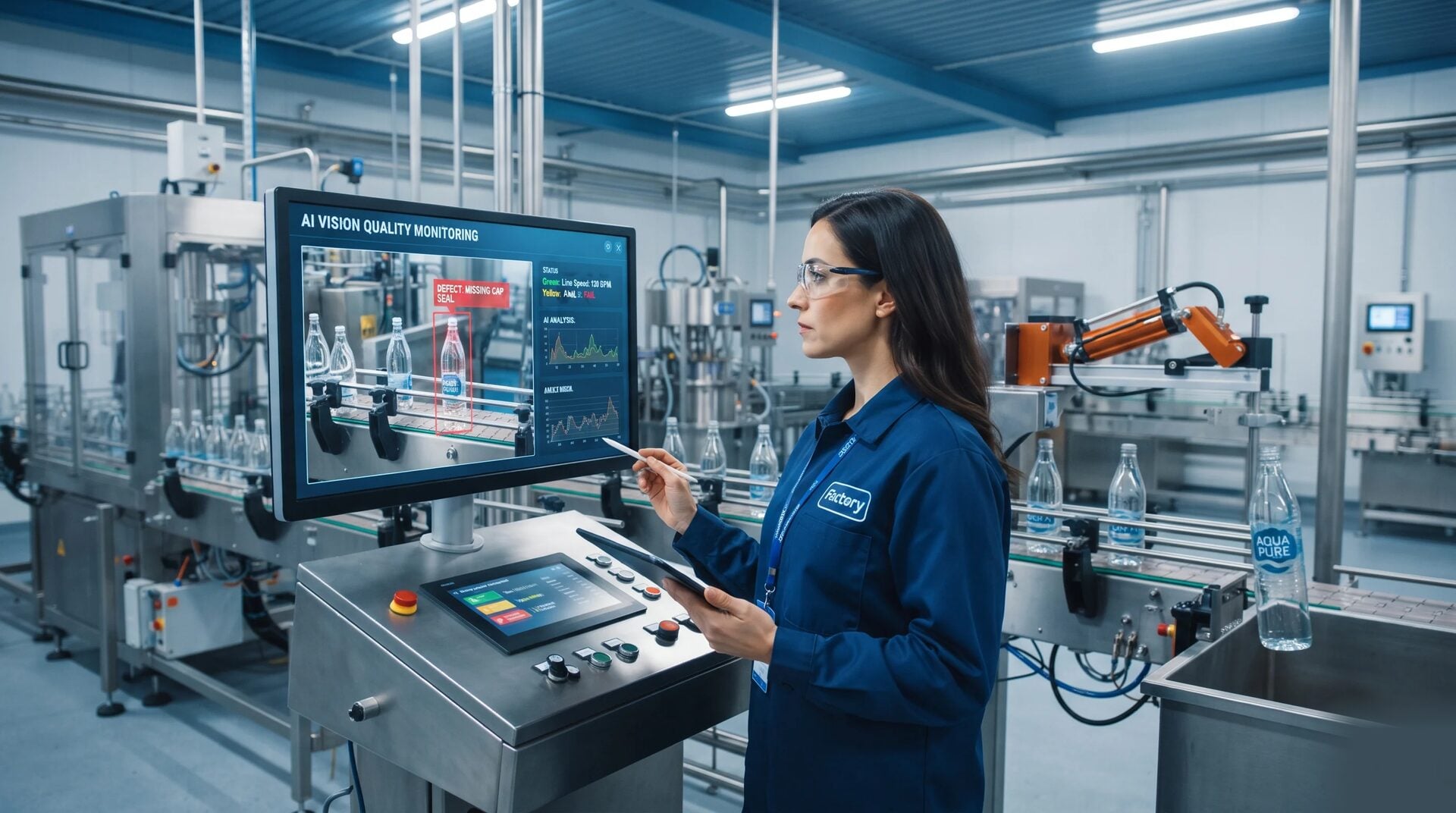
AI quality control uses machine vision to check products faster and more steadily than manual checks. Systems like Cognex ViDi and Landing AI scan thousands of items per minute. They catch defects, bad items, or label errors. One beverage firm using AI vision saw a 35% drop in buyer complaints in six months, per Food Engineering Magazine (2023).

Cameras mount at key points on your line and flag issues in real time. They can stop the line when a set limit is crossed. These systems need clean image data to train well. Poor light or uneven packs lift false reject rates. Plan time for setup, tuning, and model training before you expect full results.
Can AI Reduce Food Waste in Manufacturing?
AI tools study past output to predict how much raw material each batch needs. Platforms like Winnow and Afresh improve lot sizing and cut excess. The World Resources Institute (2023) finds AI-based tools cut food waste by 20-30% when backed by clean data.
Waste builds at many points: over-ordering items, batch sizing errors, and poor shelf-life tracking. AI tackles all three by reading past data and flagging patterns that lead to excess. This only works when your data is clean and steady. Makers with messy records need to fix their data first. Start with one waste area. Clean the data there first. Then add the AI tool.
What Does AI Do for Supply Chain Risk?
AI watches vendor data, weather, ship holds, and goods prices to flag risks. It spots issues before they hit your schedule. Platforms like o9 Solutions and Kinaxis give makers real-time views of where issues are most likely. Firms using AI supply chain tools report 15-25% fewer unplanned stops, per Gartner (2024).
AI does not stop all problems, but it gives you more time to act. You can shift vendors, adjust schedules, or alert buyers before problems grow. These tools need to link to your ERP and vendor systems. Setup takes weeks, not days, and needs IT support all the way through.
| Tool | Best For | Key Limitation |
|---|---|---|
| o9 Solutions | End-to-end supply chain | Complex setup |
| Kinaxis | Rapid scenario planning | Requires ERP integration |
| Blue Yonder | Demand and supply sync | Best at higher volumes |
| Logility | Network design | Steep learning curve |
How Does AI Help with Food Safety Compliance?
AI tools automate FSMA, HACCP, and FDA records that teams would track by hand. Platforms like Intelex and SafetyChain pull data from sensors and create audit-ready reports. Makers using these tools cut audit prep time by up to 60%, per Food Safety Magazine (2023).
Hand compliance tracking takes hours each week. It covers fix actions, vendor certs, and temp logs. AI tools link to your sensors and ERP to pull that data on their own. They need good setup to match your exact rules under FSMA or HACCP. A fresh produce plant has different doc needs than a canned goods plant.
AI Smart Ventures offers AI implementation services for growing businesses ready to move off spreadsheets. Schedule a consultation to find the right compliance tool for your operation.
Which AI Tools Work for Demand Forecasting?
Demand forecasting AI uses your past sales, seasons, promos, and market signals to predict future orders. Tools like Blue Yonder, o9 Solutions, and Forecast Pro are common in food and beverage. McKinsey (2024) found that AI forecasting cuts forecast error by 20-50% versus manual methods.
Better forecasts mean less extra output, fewer rush orders, and more stable plans. AI can model many things for seasonal items at once. These tools need at least 12-24 months of clean sales data to work well. If your records have gaps, your forecasts will show those same problems.
| Tool | Forecast Horizon | Best Fit |
|---|---|---|
| Blue Yonder | 12-18 months | High-volume operations |
| Forecast Pro | 3-24 months | Growing businesses |
| o9 Solutions | 24+ months | Complex supply chains |
How Do You Start with AI in Food Manufacturing?
Start with one high-impact use case, not a full change. Most makers begin with quality checks or demand forecasting. These show ROI within 90 days. Deloitte (2023) found that makers who pilot one use case before scaling report 40% higher results.
Set a clear goal before you pick a tool. Is it fewer defects per shift? Lower carrying costs? Faster audit prep? Tie your goal to a metric you already track. Pick a tool that fits your current systems without a full data rebuild.
Check these three things before picking any AI tool:
- Your data for the target use case is complete and stored steadily
- One named person on your team owns the tool and manages it daily
- You have a baseline metric to measure real gains at 90 days
Without all three in place, even a well-chosen tool will give weak results. Set these bases first, then pick your software.
Frequently Asked Questions
What are the most common AI tools used in food manufacturing?
The most used AI tools in food making are demand forecasting tools, AI vision check systems, and compliance tracking software. Blue Yonder and Forecast Pro lead on forecasting. Cognex ViDi is a top pick for quality checks. SafetyChain and Intelex handle compliance tracking. Most plants start with one group and grow after seeing wins in the first 90 days.
How much do AI tools cost for food manufacturers?
AI tool costs vary widely by group and vendor. Compliance tools like SafetyChain start at around $500-$1,000 per month for smaller plants. AI vision systems from Cognex often need $20,000-$100,000 in gear and setup. Supply chain tools like o9 Solutions use custom pricing based on scope. AI Smart Ventures helps growing firms check total cost before they lock in to any tool.
Do AI tools require a lot of data to work?
Most AI tools need at least 12 months of clean past data to give good outputs. These tools need sales records, season trends, and promos data. AI vision tools need tagged photos of defects and good product to train on. Pre-trained model tools need less data at first but may not fit your product line well. Ask vendors about least data needs before you sign a deal. Plan to spend 2-4 weeks cleaning your data before you start. Clean data is the base of good AI results.
Can AI tools help with FSMA compliance?
Yes. Tools like SafetyChain and Intelex handle FSMA compliance by tracking vendor checks, fix actions, and temp logs in real time. They link to sensors and create audit-ready reports on demand. The FDA’s FSMA traceability rule applies to specific product types. Confirm your picked tool covers your product type before you buy a deal.
How long does it take to implement AI in food manufacturing?
A compliance tool can go live in 4-8 weeks with good prep. A vision check system needs gear install and model training. That takes 8-16 weeks total. A full supply chain tool often takes 3-6 months to set up. Deloitte (2023) found that makers who rush setup see 60% lower ROI in year one. Give setup and team training the time they need. Set a firm 90-day check date to see if the tool is working.
What is the biggest risk of using AI in food manufacturing?
The biggest risk is poor links with your current systems. AI tools pull data from your ERP, sensors, and vendors. If those links are weak or the data is messy, the AI gives bad outputs. Team pushback is a close second risk. If plant staff do not trust the tool, they will skip it. Invest in AI upskilling before going live to build team trust.
Which AI tools help reduce food waste?
Winnow and Afresh are built for food waste cuts. They track waste by type and link to demand signals. You can cut output before overstock builds. Other demand forecasting tools also cut waste through better batch sizing. The World Resources Institute (2023) finds AI-based tools cut food waste by 20-30% when the right data is in place.
Are AI tools suitable for owner-operators in food manufacturing?
Yes, though the right group matters. Owner-operators often start with cloud-based compliance tools or basic forecasting software. These need less setup. Forecast Pro is easy to use and does not need a named IT team. AI vision systems are harder to fit at low output due to gear costs. Focus on tools with fast setup and a clear ROI within the first 90 days.
Executive Summary
AI tools for food and beverage manufacturers deliver measurable results in four areas: demand forecasting, quality inspection, supply chain visibility, and compliance automation. Companies using AI forecasting report 20-50% lower forecast error. Vision inspection tools cut defect rates by up to 35%. Compliance platforms reduce audit prep time by as much as 60%. Success depends on starting with one use case, working from clean data, and training your team before launch.
What Should You Do Next?
Find the one area in your operation where slow processes or poor data cost you the most each month. Match that pain point to the right AI tool group. Run a 90-day pilot, measure against a baseline, and decide whether to scale before adding more tools.
AI Smart Ventures offers AI implementation services for growing businesses. Schedule a consultation to get a clear, practical plan for using AI tools in your food or beverage operation.
People Also Read
- AI Workflow Automation: How It Actually Works
- How Growing Businesses Build an AI Marketing Strategy That Works
About the Author
Nicole A. Donnelly is the Founder of AI Smart Ventures and an AI Adoption Specialist with 20 years of experience as a founder and CEO and over a decade leading AI adoption initiatives. She helps businesses integrate artificial intelligence with clarity and confidence, driving innovation and sustainable growth. Nicole has trained over 20,217 professionals in Applied AI, delivered 624 workshops, and worked with close to 1,000 organizations across diverse industries.
Expertise: AI Transformation, AI Strategy, AI Implementation, AI Adoption, Applied AI, Marketing, Business Operations
Disclaimer: This content is for informational purposes only and does not constitute professional business or technology advice. Results vary based on industry, existing systems and implementation commitment. Contact AI Smart Ventures for a consultation regarding your specific situation.