

What Is an AI Red Team Test and Should Your Business Run One?
Last Updated: July 2026
An AI red team test is a planned attack on your AI systems. It is done with full authorization. Safety experts run these tests to find flaws before real attackers do. Testers act like bad actors. They try to trick models into leaking data or breaking safety rules. Growing businesses use these tests to confirm their AI tools are safe. They also confirm that tools stay trustworthy as the business grows.
AI Smart Ventures has guided hundreds of growing businesses through AI safety planning and setup. The team has more than a decade of history. They help leaders understand and reduce risk in automated workflows. That way, new tools strengthen your business instead of exposing it.
AI tools are now common in business operations. As more tools are added, the risk grows too. A model connected to customer records or financial systems carries real risk. A standard firewall cannot fully address that risk. Red teaming fills that gap. It gives leaders the evidence they need to invest in the right safeguards.
Key Takeaways
- An AI red team test finds hidden flaws in your AI systems before those flaws cause damage.
- Standard safety scans miss the unique risks that AI models create.
- Common threats include prompt injection, data leakage, and model bias. All of these can hurt your business and compliance standing.
- Growing businesses should run red team tests before adding new AI tools and after major updates.
- Test findings lead to real fixes: tighter access controls, clearer prompts, and better output monitoring.
- A red team test is a business decision, not just a technical one. Leadership alignment matters for acting on results quickly.
What Is an AI Red Team Test?
An AI red team test is a controlled exercise. Safety experts try to break or misuse your AI systems. They work with your team’s full permission. But their methods mirror what a real attacker would attempt. The goal is not to confirm the system works. The goal is to find every way it can fail. This practice comes from military and cybersecurity training. An internal group plays the role of the attacker to expose weaknesses early.
The name comes from military training simulations. The opposing force wore red to stand out from the defending blue team. In AI safety, red team experts apply that same logic. They issue the model, probe its limits, and document every failure.
These tests are especially key now. Growing businesses connect AI tools to databases, customer portals, and financial platforms. If one of those tools is compromised, the damage can be serious. Red teaming gives you a clear picture of those risks in a safe setting.
Why Does Red Teaming Matter for Your Business?
Red teaming matters because standard safety tools are not built to test AI behavior. Traditional vulnerability scanners look for known software bugs and network errors. They cannot detect prompt injection attacks. In a prompt injection attack, an attacker crafts a bad input. It tricks the model into ignoring its own instructions. They also miss model inversion risks. In these attacks, repeated queries can pull out private data. That data is info the model was trained on. These AI-specific threats need AI-specific testing methods.
Many owner-operators assume a trusted vendor’s model is secure by default. But even well-built models can be tricked. This happens when they connect to your data and workflows. The vendor secures their own systems. You are responsible for how you set up and use the tool.
Legal exposure adds another layer of urgency. Data privacy laws say you need to protect personal info. The FTC has published guidance on AI and deceptive practices that applies directly to growing businesses. If a red team test finds your AI tool can expose customer records, that is a problem. You must fix it right away. That is both a legal and an ethical duty.
How Does an AI Red Team Test Work?
A red team test moves through four clear phases. Each phase builds on the last. This helps testers find the most serious risks first. The test starts with scoping. The team lists the systems in play and what data they touch. They also note what the business wants to protect. Clear scoping keeps the test focused on real business risk.
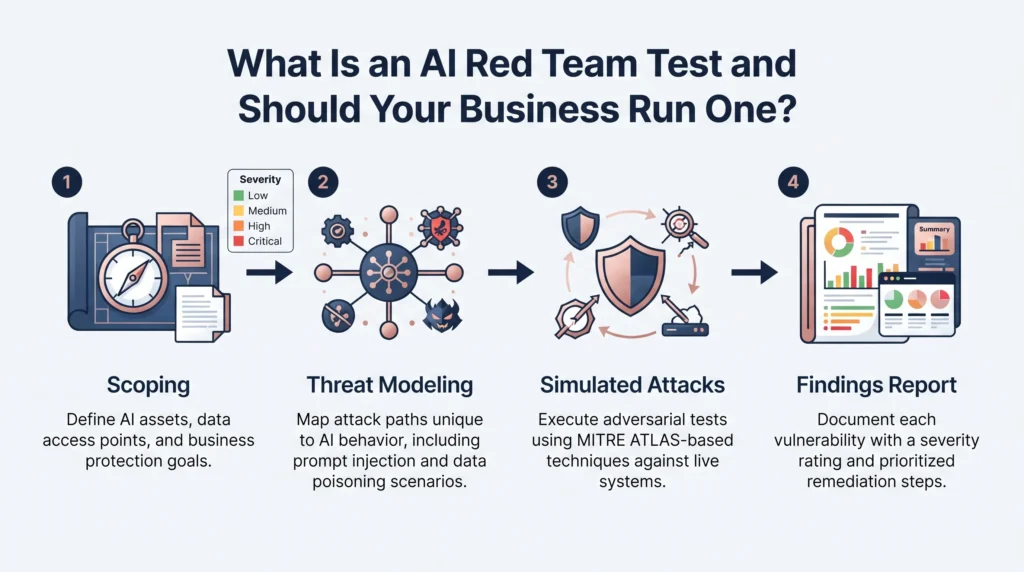
Phase 1: Scoping. The team lists every AI tool in scope. They note what data it accesses and what business steps it supports. They record the intended behavior of each tool. This creates a clear baseline for testing.
Phase 2: Threat Modeling. Testers map out how a bad actor might abuse the system. They consider external attackers, malicious insiders, and accidental misuse. The output is a list of attack cases. Each case is tied to your specific tools and data.
Phase 3: Simulated Attacks. The team runs each case using adversarial techniques. They draw from frameworks like MITRE ATLAS. This framework catalogs known attack patterns against AI systems. The NIST AI Risk Management Framework also gives guidance for assessing and managing AI safety risk. They record every test, including near-misses. Patterns in failed attempts can also reveal flaws.
Phase 4: Findings Report. The red team delivers a report that lists each flaw. It includes the likely business impact and a recommended fix. High-severity findings come with action steps your technical team can start right away.
What Threats Can a Red Team Uncover?
A red team test finds threats that are unique to how AI systems work. These relate to how they step, store, and produce info. Most of these threats will not appear in a standard safety audit.
Prompt injection is the most common issue found. It occurs when an attacker crafts an input that overrides the model’s instructions. A customer-facing chatbot could be tricked into sharing internal pricing rules. It might also bypass identity checks. This happens when its system prompt is not secured against manipulation.
Model inversion attacks allow testers to pull out sensitive data through repeated, careful queries. If your model was trained on private customer records, attackers can target that data. They may pull it out without permission.
Data poisoning is another serious risk. If your model learns from new inputs over time, an attacker can inject false info. This shifts how the model behaves. This is mainly dangerous for models used in fraud detection or compliance monitoring. Red teams also test for biased outputs caused by model bias. These create both ethical and legal risk for growing businesses.
Who Should Run an AI Red Team Test?
Growing businesses should run an AI red team test any time they add a new AI tool. This applies when the tool touches sensitive data, customer interactions, or financial records. This includes chatbots, document processing tools, AI-assisted decision systems, and automated outreach platforms. If the tool has access to info you would not want exposed publicly, it needs testing. Run that test before it goes live.
Owner-operators often delay this step. They assume testing is only for large businesses with dedicated safety teams. That assumption is costly. As McKinsey’s State of AI research shows, AI adoption is growing rapidly across all business sizes. Skilled attackers do not need a large target. A growing business with a poorly set up AI tool can be just as attractive to attackers.
Run a red team test before a tool goes live. Do not wait for an incident. Post-incident reviews are valuable. But they are far more expensive in time, money, and reputation. Catching a critical flaw before launch prevents damage. It also avoids the harm that comes with a public breach.
If your team lacks internal AI safety expertise, work with an external firm or consultant. It is a practical and cost-good step.
If you are unsure whether your current AI tools meet the safety standards your business needs, starting with an expert review can save a lot of time and cost. AI Smart Ventures offers AI Advisory services that help growing businesses find safety gaps and plan the right testing approach. Schedule a consultation to get a clear picture of your risk exposure before it becomes a problem.
How Often Should You Run These Tests?
Run an AI red team test before any new AI tool goes live. Run it again after any major change to the tool or its data sources. That includes changes to the underlying model. Major changes include model version updates, revised system prompts, and new data connections. Changes to how users interact with the tool also count.
Beyond event-driven testing, many compliance frameworks recommend periodic testing on a regular schedule. An annual test at minimum makes sense for tools that handle sensitive customer data. Quarterly testing is right for high-risk areas. These include finance, healthcare, or legal services.
The AI threat landscape changes quickly. According to Gartner’s research on AI, new attack methods appear as models become more capable and widely used. A test that cleared your system six months ago may miss new techniques. Stay current with your testing schedule. This keeps your defenses ahead of the threat curve.
How Do You Act on Red Team Findings?
Acting on red team findings needs a structured response. Do not just apply a list of patches. The findings report will group flaws by severity: critical, high, medium, and low. Address critical and high-severity items first. These are the flaws most likely to cause data exposure or compliance failure. Left unresolved, they can also cause reputational damage.
For each finding, assign a clear owner on your team. Set a firm deadline for the fix. Vague ownership leads to delayed fixes. Your technical lead should manage the remediation work. Your operations lead should confirm that fixes do not disrupt active workflows.
Common fixes include tightening system prompts to remove ambiguity. You should also add access controls that limit what data the model can reach. Enable output filtering to catch harmful responses. Set up monitoring that flags unusual query patterns. After applying fixes, run follow-up tests to confirm each flaw is closed.
Document every action taken in response to the red team report. This record serves as proof of due diligence. Share it with regulators, clients, and partners who ask about your AI safety practices.
Frequently Asked Questions
What is prompt injection in AI safety?
Prompt injection is an attack where a user crafts an input that overrides the AI model’s built-in instructions. Instead of following the rules set by the business, the model follows the attacker’s hidden command. A customer service bot, for example, might be told to reveal internal data or skip identity checks. This is the most common flaw found during AI red team testing. It needs careful prompt design and input validation to prevent it.
Is red teaming the same as penetration testing?
Red teaming and penetration testing share methods but differ in scope. Penetration testing focuses on finding specific flaws in software and networks within a defined window. Red teaming simulates a full adversarial campaign to see how far an attacker could go. AI red teaming mainly targets the behavior of ML models. It looks at how they respond to unusual inputs and what data they surface. It also tests how their outputs can be manipulated.
How long does an AI red team test take?
Duration depends on the number of AI tools in scope and the depth of testing needed. It also depends on how complex their data connections are. A focused test for a single tool with limited data access might take one to two weeks. A broader assessment covering multiple tools and complex workflows can take four to eight weeks. Thorough scoping at the start compresses the overall timeline. It keeps testers focused on the highest-risk areas from day one.
What is MITRE ATLAS?
MITRE ATLAS (Adversarial Threat Landscape for Artificial-Intelligence Systems) is a publicly ready knowledge base. It catalogs known adversarial tactics and techniques used against AI and ML systems. It is maintained by MITRE Corporation and modeled after the widely used MITRE ATT&CK framework for traditional cybersecurity. Safety teams use ATLAS during threat modeling to find relevant attack cases. They also use it to benchmark their defenses against documented real-world attack patterns.
Can red teaming prevent all AI attacks?
Red teaming cannot prevent every possible attack. But it reduces your exposure to known and expected threats. Testers work from current threat intelligence. New attack methods built after the test may not be covered. The goal is to close the most serious gaps before deployment. A regular testing schedule then keeps your defenses current. Red teaming combined with ongoing monitoring and regular model updates gives you the strongest practical defense.
What happens if a red team finds a critical flaw?
When a red team finds a critical flaw, they notify the client right away. They do not wait for the final report. The business can then decide to pause deployment, apply a temporary control, or isolate the affected system. They make this decision while a permanent fix is built. The red team documents the finding with enough technical detail to guide the fix. Follow-up testing is then scheduled to confirm the flaw has been resolved before the system returns to production.
What skills does a red team tester need?
AI red team testers combine cybersecurity expertise with a working knowledge of ML systems. They need history with common AI frameworks and an understanding of how large language models step input. They also need familiarity with adversarial ML techniques. Knowledge of relevant rules in your industry is also valuable. Good red team tests often include a mix of safety builders and domain experts. These experts understand your specific context and the data your tools handle.
How much does an AI red team test cost?
Costs vary based on scope and the number of tools tested. They also depend on whether you use an internal team or an external specialist. A focused test for a single tool can start at a few thousand dollars. A full assessment of multiple connected AI systems can reach into the tens of thousands. AI Smart Ventures offers AI Advisory services to help you scope the right level of testing for your situation and budget. Contact us to discuss your specific needs.
Executive Summary
AI red team testing is a proactive safety practice. Every growing business should include it in their AI deployment plan. Standard safety tools do not test the unique ways AI models can be manipulated. The risks are real: data leakage, prompt injection, model bias, and data poisoning. All of these can cause serious financial and reputational harm. The test moves through four phases: scoping, threat modeling, simulated attacks, and a findings report. That report comes with clear remediation steps. Run your first test before any AI tool touches sensitive data. Schedule follow-up tests after major updates. Acting on findings quickly closes the gaps that attackers would otherwise exploit.
What Should You Do Next?
Start by listing every AI tool in your business that accesses sensitive data, customer records, or internal systems. Focus on tools with the most direct contact with regulated or private info. Assign a clear point of contact on your team to own the red team test from start to finish. AI Smart Ventures offers AI Advisory for growing businesses that need guidance on AI safety planning, vendor evaluation, and red team preparation. Schedule a consultation to find the right testing approach for your current AI setup.
People Also Read
- How to Run an AI Workshop for Your Business Team Without Disrupting Operations
- What Is Agentic AI and Should Your Business Care in 2026?
About the Author
Nicole A. Donnelly is the Founder of AI Smart Ventures and an AI Adoption Specialist with 20 years of history as a founder and CEO and over a decade leading AI adoption plans. She helps businesses connect AI with clarity and confidence, driving innovation and lasting growth. Nicole has trained over 20,217 experts in Applied AI, delivered 624 workshops, and worked with close to 1,000 businesses across diverse industries.
Expertise: AI Transformation, AI Strategy, AI Rollout, AI Adoption, Applied AI, Marketing, Business Operations
Disclaimer: This content is for informational purposes only and does not constitute expert business or tech advice. Results vary based on industry, current systems and rollout commitment. Contact AI Smart Ventures for a consultation about your specific situation.

