
California AI Transparency Law 2026: A Business Owner’s Guide
Last Updated: July 2026
The California AI openness law is a state rule. It tells businesses to inform consumers when AI tools affect their decisions. These rules cover high-stakes areas like hiring, housing, credit, and healthcare. Covered businesses must notify consumers before any AI decision is made. They must also explain the system’s purpose in plain words. The goal is to help consumers understand and question AI outcomes. This applies to any business serving California residents. Your business location does not matter.
AI Smart Ventures helps growing businesses use AI responsibly and stay compliant. California’s 2026 AI rules bring new duties for owner-operators. These go beyond basic privacy policies. The question is not whether these rules apply to you. The question is whether your systems and notices are ready.
California has moved faster than the federal government on AI rules. Two bills, AB 2930 and SB 942, form the core of what’s required. Together they set rules for AI tools making key decisions for California residents. Learning this now gives your business time to adjust before full enforcement starts.
Key Takeaways
- AB 2930 and SB 942 require businesses to disclose when automated systems affect high-stakes decisions such as hiring, housing, and credit approvals.
- Consumers must get a clear, pre-use notice explaining that an AI system will affect their outcome. It must also show what options they have to appeal.
- Every business using automated decision tools must do a system audit. This applies no matter its size or location, if it serves California residents.
- The California Privacy Protection Agency enforces these rules. It can impose fines of up to $7,500 per intentional violation.
- Compliant disclosures must use plain language. They must appear before the automated step begins, not after the decision is delivered.
- Starting your compliance audit now reduces future risk. It also puts your business ahead of enforcement timelines.
The sections below give you a practical framework to audit your tools. They help you align your steps with California’s new standards. Reviewing your workflows now lets you plan changes without disrupting daily work.
What Is the California AI Openness Law?
The California AI openness law is a group of state bills. They hold businesses responsible for how they use AI tools. The main bills are AB 2930 and SB 942. They set rules for notifying consumers and reviewing risk. They apply when businesses use AI in high-stakes settings. These rules shift the duty to disclose from consumers to businesses. The business running the tool now owns that duty. Businesses that use AI to screen, score, or check people now have clear legal duties under this framework.
AB 2930 focuses on AI tools that make or help drive key decisions. It requires businesses to do impact reviews for high-risk systems. It also gives consumers a way to appeal to AI outcomes. SB 942 covers safety and openness duties for businesses using large-scale AI models. It places duties on both the builders and users of advanced AI tools. California’s approach shares elements with the EU AI Act, which also targets high-risk AI systems.
The California Privacy Protection Agency enforces both sets of rules. The agency can open reviews, demand records, and issue fines for non-compliance. Regulators expect businesses to act early. Do not wait for final enforcement guidance before taking steps.
Which Businesses Must Comply?
Any business with an AI decision tool must follow these rules. This applies if the tool affects California residents. The law sets no revenue or employee count threshold for coverage. If your tools affect housing, job screening, credit, or healthcare for people in California, these rules apply. Many growing businesses use off-the-shelf software. They may have compliance duties they have not yet found.
The law covers any business with tools that greatly affect decisions for people. It applies when those decisions have real consequences. Tenant screening tools, credit scoring systems, and job tracking software all fall under the law. This is true if they affect California residents. Companies based outside California are not exempt when their systems serve California residents.
Do not rely on vendors to handle compliance for you. The duty sits with the business using the tool. You need to know every tool in your stack. Find out what each one does and whether it qualifies as a covered system.
What Are the Main Disclosure Needs?
Businesses must give a clear notice before an AI system reviews a consumer. It must use plain language that anyone can read. The notice must explain what the system does and why it is used. It must also tell the consumer how to appeal. Notices must appear before the decision step begins. They cannot appear after a decision has been made. Regulators expect these notices to be easy to find, simple to read, and always present.
The notice must include four specific elements. It must name the use of an AI system. It must describe that system’s general purpose. It must explain whether a human reviews the AI output before a final decision is made. And it must tell the consumer where to direct questions or appeals.
A general privacy policy buried on your website does not meet this need. The notice must be specific to the AI step. It must be visible before that step begins. Businesses that collect data through forms or intake screens must check where notices appear. Confirm that placement meets the pre-use standard.
How Do You Audit Your AI Systems?
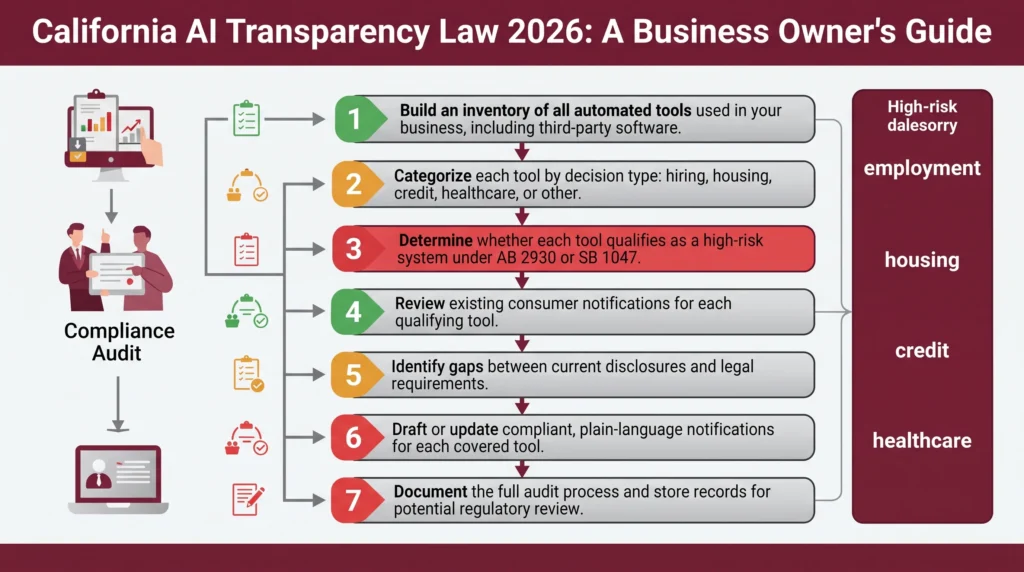
Start by building a full list of every AI tool your business uses. For each tool, note its function. Check whether it affects any decision about housing, jobs, credit, or healthcare. Then check whether it qualifies as a high-risk system under the new law. Review your current notices and records to see if they meet the required standard. This step often uncovers gaps that vendors have not told you about.
Start with your highest-stakes tools first. Hiring tools, background check services, and credit review systems carry the most immediate risk. Work outward to tools used in customer service, intake screening, and content targeting.
Write down every step you take. The California Privacy Protection Agency can request audit records during a review. A lack of records may itself become a compliance issue if you cannot show you checked your systems. Documenting corrective steps also matters.
Bring your legal counsel in early. AI rules intersect with privacy law, consumer protection rules, and employment law. Your legal team can help find which duties apply to your industry and tools. The EEOC has issued guidance on AI use in hiring, which may apply alongside California’s rules.
Not sure which tools qualify as high-risk? AI Smart Ventures can walk you through a structured review. Our AI Consulting service helps growing businesses find compliance gaps and build the records they need. Schedule a consultation to take the first step toward a compliant AI stack.
What Penalties Apply for Non-Compliance?
The California Privacy Protection Agency can review businesses and impose fines for breaking these openness rules. Fines can reach $7,500 per violation done on purpose. For a business handling thousands of consumer actions, one compliance failure can get very costly. Beyond fines, the agency can require corrective actions. It can also tell businesses to stop certain AI steps until they meet the required standard.
The framework uses a tiered approach. Unintentional violations may result in lower fines. The business may also get a chance to fix the issue before it escalates. Deliberate violations or a pattern of repeated rule-breaking brings higher fines. These can also lead to public enforcement actions that hurt your reputation and finances. If you receive a notice of violation, act quickly. Show that you are working in good faith to fix the issue.
Breaking these rules can also create extra legal risk. Employees, job applicants, or tenants may believe an AI system gave them an unfair result. They may have legal options. The FTC has issued guidance on AI and deceptive practices that may apply alongside California’s rules. Building a compliant notice and appeals step reduces risk on multiple fronts.
How Do You Write Compliant AI Notices?
Writing a compliant AI notice means using plain, direct language. Any consumer should be able to read and understand it. The notice must state that an AI system is in use. It must describe its general purpose. And it must explain what the consumer can do to appeal the outcome. Keep the language free of jargon. Test the notice with someone outside your business before you publish it. If your audience includes non-English speakers, clear language is expected where required.
A compliant notice has four core parts. It names the AI system. It explains what kind of decision that system affects. It states whether a human reviews the outcome. And it tells the consumer how to submit questions or appeals.
Keep the notice short. Three to five sentences usually cover the required elements. Consumers are more likely to read a brief, direct statement. A long block of legal text is often ignored. Once you draft the notice, pair it with a working appeals step. A notice without a working appeals path does not fully meet the law’s intent. This is true even if the notice language itself is strong.
Frequently Asked Questions
Does this law apply to businesses outside California?
Yes. These rules apply to any business with AI tools that affect California residents. This is true no matter where the business is based. If your software checks, scores, or decides things about people in California, these rules apply. The consumer’s location is the key factor, not yours. Growing businesses serving California customers in high-stakes areas should audit their systems now. Do not wait for further guidance.
What counts as a consequential decision?
A consequential decision greatly affects a person’s access to housing, jobs, credit, education, or healthcare. It also covers decisions that determine legal or financial outcomes for an individual. Access to key services is included too. The law focuses on cases where an AI system does more than assist a human reviewer. If the system drives the outcome without meaningful human review, it likely qualifies as consequential under AB 2930. This carries the associated disclosure needs.
How does SB 942 differ from AB 2930?
AB 2930 focuses on how AI tools are used in business. It targets key decisions that affect people. SB 942 covers safety and openness duties for those who build and use large-scale AI models. It mainly applies to models that need major computing power to train and run. AB 2930 affects a broader range of growing businesses across sectors. SB 942 has more direct effects on tech companies building or using advanced AI tools. Many businesses face duties under both bills depending on the tools they use.
Do I need to disclose AI use in my marketing tools?
Marketing emails and general ads do not typically trigger the openness rules. They do not make key decisions about the recipient. But if your tools use AI scoring for credit offers, loan terms, or housing, those systems may qualify. Review each use case on its own. The test is whether the AI step greatly affects access to services. Simply targeting a message does not qualify. Consult legal counsel with a background in California consumer privacy when your tools sit close to the line.
What is a high-risk AI system under California law?
A high-risk AI system makes or greatly influences key decisions. These decisions fall in areas like jobs, housing, credit, and healthcare. These systems face extra scrutiny. Errors or biases can cause serious harm to the people they affect. Businesses using high-risk systems must do impact reviews and keep records. They must also give enhanced notices to affected consumers. The category also includes systems used in education and access to key government services. In these areas, AI errors can carry serious personal consequences.
What records must I keep for compliance?
Businesses should document their AI tool list. Also record the impact reviews done for each high-risk tool. Keep records of the notice language used for each qualifying step. Include any consumer appeals and their outcomes. Track when notices were updated and what triggered each change. Store vendor contracts that describe how third-party tools function, especially for high-risk tools. The California Privacy Protection Agency may request these records during a review. Regulators look favorably on businesses that can show a clear, documented compliance process.
Can I rely on my vendor’s compliance records?
Vendor records are a useful starting point. But they do not fully meet your compliance duties. The law places responsibility on the business using the tool, not the vendor that built it. You must understand how the tool works in your specific context. You also need to know whether its use creates notice duties for your consumers. Request impact review summaries from your vendors. Then do your own review. Confirm that using their tool in your workflow meets the needs for your business.
What is an algorithmic impact assessment?
An AI impact review is a structured check. A business uses it to see how an AI tool affects the people it acts on. The review covers the system’s purpose, the data it uses, and the decisions it affects. It also checks for unequal impact on different groups. California’s rules require businesses with high-risk systems to complete these reviews. They must also keep the results. Think of it as a focused risk check for each AI tool. The step helps find problems before they create compliance issues or legal risk.
How do I get started with California AI compliance?
Start by auditing your current tool stack. Find any AI tools that influence key decisions for California residents. Map those tools against the definitions in AB 2930 and SB 942. Then review your current consumer notices for gaps. AI Smart Ventures offers AI Consulting for growing businesses navigating state AI rules. Schedule a consultation to get a clear compliance roadmap built around your specific tools and timeline.
Executive Summary
The California AI openness law for 2026 places clear duties on growing businesses. These duties apply to businesses using AI tools for key decisions. AB 2930 and SB 942 require you to disclose AI use before any AI step begins. You must give consumers a way to appeal. You must also do impact reviews for high-risk tools. The California Privacy Protection Agency enforces these rules with fines reaching $7,500 per violation done on purpose. The best time to act is now, while enforcement timelines are still taking shape. Audit your tools and update your consumer notices. Document every step to protect your business and the people you serve.
What Should You Do Next?
Start by building a list of every AI tool your business uses. Check each one against the criteria in AB 2930 and SB 942. Update any consumer-facing notices to use plain language. Make sure they appear before the AI step begins, not after a decision is delivered. Then document your audit so you have clear records ready if the California Privacy Protection Agency requests them. AI Smart Ventures offers AI Consulting for growing businesses navigating California’s AI openness needs. Schedule a consultation to build a compliance plan that fits your tools and your timeline.
People Also Read
- How AI Is Changing SEO Forever: A Business Leader’s Guide to AEO and GEO
- Are AI Certifications Worth the Investment? A Business Owner’s Honest Evaluation
About the Author
Nicole A. Donnelly is the Founder of AI Smart Ventures and an AI Adoption Specialist with 20 years of history as a founder and CEO and over a decade leading AI adoption plans. She helps businesses connect AI with clarity and confidence, driving innovation and lasting growth. Nicole has trained over 20,217 experts in Applied AI, delivered 624 workshops, and worked with close to 1,000 businesses across diverse industries.
Expertise: AI Transformation, AI Strategy, AI Rollout, AI Adoption, Applied AI, Marketing, Business Operations
Disclaimer: This content is for informational purposes only and does not constitute expert business or tech advice. Results vary based on industry, current systems and rollout commitment. Contact AI Smart Ventures for a consultation about your specific situation.