State-by-State AI Hiring Laws in 2026: A Business Owner’s Guide
Last Updated: July 2026
A state AI hiring laws 2026 business owner guide covers the growing set of state and local rules that govern how companies use AI in recruiting and hiring. These laws set rules for bias audits, candidate notices, and data handling. They apply when a business uses any AI tool to filter or rank job applicants. Some rules apply even if AI is just one part of the decision.
AI Smart Ventures helps growing businesses use AI responsibly across all areas of operations, including hiring. As AI tools spread into recruiting, the team works with owners to build legal, efficient processes. These save time without creating legal risk.
The legal landscape is moving fast. A single missed notice in New York City can trigger fines of $375 to $1,500 per candidate. Multiply that across dozens of applicants. One missed notice becomes a serious financial problem. Business owners who act now are in a far stronger position than those who wait.
Key Takeaways
- NYC Leads on Enforcement – NYC Local Law 144 needs annual third-party bias audits for AI hiring tools. Fines can reach $1,500 per violation per candidate. The law has been active since July 2023.
- Illinois Was the First State – The Illinois AI Video Interview Act (AIVIA) took effect in January 2020. It requires written consent before using AI to analyze video interviews.
- Colorado Covers Consequential AI – Colorado SB 21-169 is active in 2026. It requires bias risk assessments for AI used in high-stakes decisions, including hiring.
- Maryland Has a Notice Rule – Maryland HB 1202 requires employers to tell candidates when AI is used in evaluation. This covers tools like resume scanners and scoring systems.
- Federal EEOC Guidance Adds Risk – The EEOC confirmed that AI hiring tools can trigger Title VII violations if they create disparate impact. Federal exposure is real even without a state law.
These rules matter more as AI hiring tools become standard. Platforms like HireVue, Paradox, and Eightfold AI now sit at the center of hiring for thousands of businesses. Each may trigger legal rules depending on where you hire. Knowing which rules apply to your locations is the first step to staying protected.
Which States Have AI Hiring Laws?
At least 11 U.S. states have passed or introduced AI hiring laws as of mid-2026. The most enforced law is NYC Local Law 144. Illinois and Maryland follow closely. Colorado’s SB 21-169 covers AI in high-stakes decisions, including hiring. It took effect in 2026. California and Washington have active bills moving through their state houses.

The common thread across all these laws is openness. Each law requires that candidates know when AI is used to evaluate them. Most also require some form of bias testing. The test confirms the tool does not screen out protected groups at higher rates.
What Does NYC Local Law 144 Require?
NYC Local Law 144 applies to any tool that “substantially assists or replaces” a human in hiring or promotion decisions. The law covers resume screeners, chatbot pre-screeners, and interview scoring platforms. Tools used only for posting jobs or scheduling are not covered.
Each covered tool must get a third-party bias audit each year. The audit tests for selection rate differences by race, sex, and ethnicity. Results must be posted before the tool is used. Employers must give candidates at least 10 business days’ notice before using the tool. This notice can appear in the job listing or as a direct message. For full guidance, see the NYC Department of Consumer and Worker Protection.
What Does Illinois Require Under AIVIA?
Illinois’ AI Video Interview Act is the oldest AI hiring law in the U.S. It covers video interview tools that use AI to analyze facial expressions, speech patterns, or voice features. Before using these tools, employers must notify candidates, explain how the AI works, and get written consent.
The law also requires employers to delete candidate video data within 30 days of a request. It applies to any employer with staff in Illinois, no matter where the business is based. Violations can lead to civil lawsuits under enforcement by the Illinois Department of Human Rights. This law applies even when a vendor handles the technical side. The employer is still in charge of consent and deletion.
What Other States Have Active Rules?
Maryland HB 1202 requires you to tell candidates when AI is used during hiring. Colorado SB 21-169 requires bias risk checks for any AI tool used in high-stakes decisions. The Attorney General enforces it. California and Washington have bills that would add audit and notice rules like NYC’s.
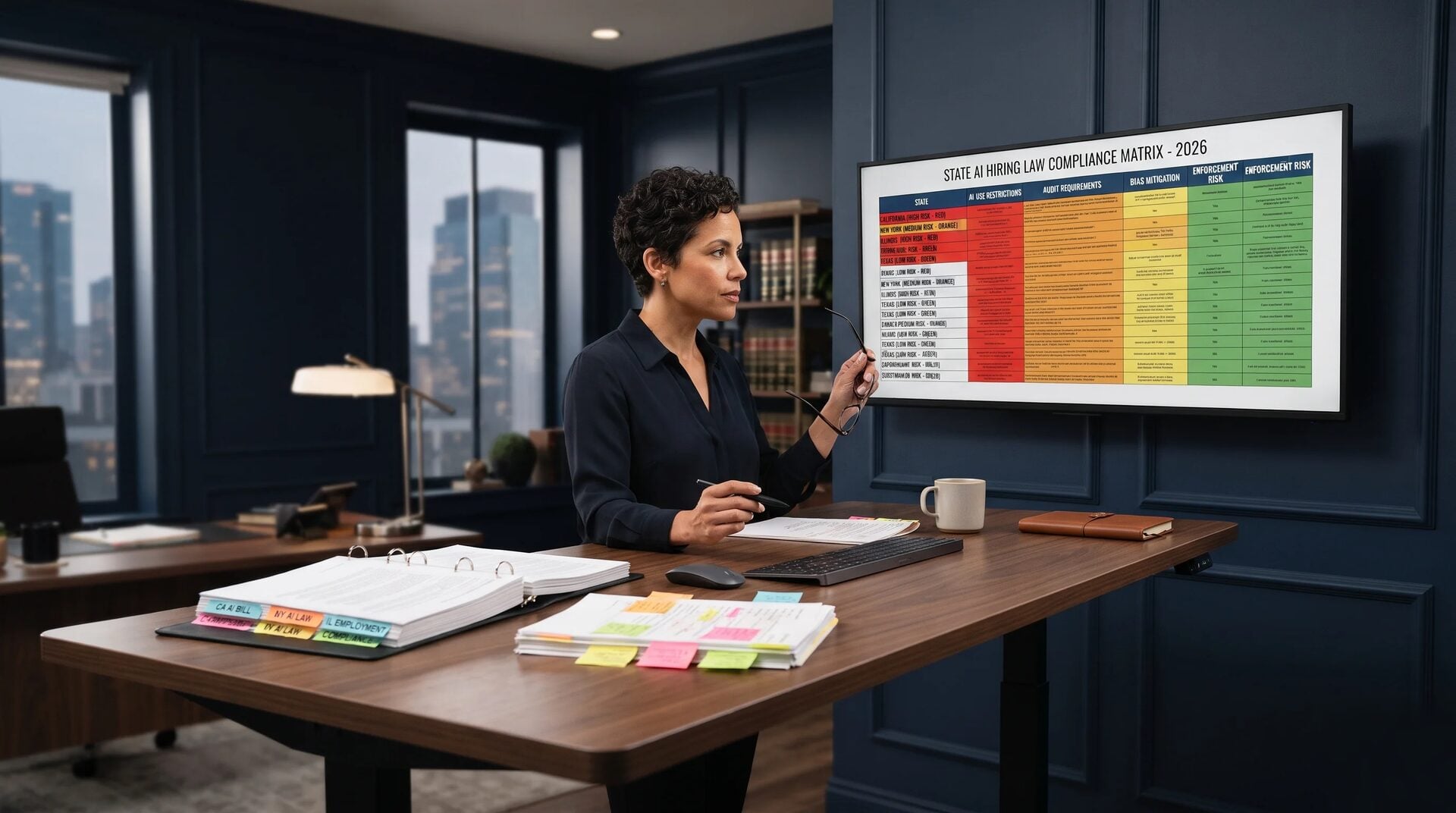
Here is a summary of key state rules as of July 2026:
| State | Law | Effective | Key Requirement | Penalty |
|---|---|---|---|---|
| New York City | Local Law 144 | July 2023 | Annual bias audit + candidate notice | Up to $1,500/violation |
| Illinois | AIVIA | Jan 2020 | Consent + data deletion for video AI | Civil lawsuits |
| Maryland | HB 1202 | Oct 2023 | Disclose AI use to candidates | Civil enforcement |
| Colorado | SB 21-169 | 2026 | Bias risk assessment for hiring AI | AG enforcement |
| California | AB 2930 (pending) | 2026-27 | Bias audit + candidate notice | TBD |
| Washington | HB 1951 (pending) | 2026-27 | Disclosure + audit | TBD |
Laws are still being passed and updated. Check each state’s legislature or AG website before making compliance decisions.
What Hiring Tools Trigger These Laws?
Resume screening tools, video interview scorers, and chatbot pre-screeners are the most common triggers. Tools like HireVue, Paradox, and Eightfold AI may all trigger state notice and audit rules. It depends on how they are used. These tools update their compliance features often, so check current status with each vendor directly.
Scoring done manually by humans is generally not covered. But if a platform creates an auto score or ranking, it likely qualifies under most state rules.
To check whether a tool triggers these rules, confirm three things for each platform you use:
- Does the tool create auto scores or rankings for candidates?
- Is it used for roles based in a state with an active law?
- Has the vendor provided bias audit data or notice templates?
If any answer is yes, the tool likely triggers at least one state rule. Vendors that cannot answer these questions clearly are a compliance risk worth taking seriously.
AI Smart Ventures offers AI consulting to help growing businesses map their hiring tools against current state rules. Schedule a consultation to get a clear picture of where your process stands today.
What Does Federal Law Require?
In 2023, the U.S. Equal Employment Opportunity Commission (EEOC) confirmed that AI hiring tools can violate Title VII, the ADA, and the ADEA. This happens when they create disparate impacts. According to the EEOC’s AI and algorithmic fairness guidance, employers cannot use the “vendor built it” defense. If your tool screens out candidates of one race or gender at a higher rate, you must show the tool is job-related and tied to business needs.
This federal risk exists even in states with no specific AI hiring laws. The EEOC does not need a state law to open a review. A candidate complaint about your AI screener can trigger a federal review no matter where you are located.
How Do You Build a Compliant AI Hiring Process?
Start with a tool list. Write down every platform that touches your hiring workflow from job posting to offer letter. Mark which tools use AI and which states those roles are in. Focus first on New York City, Illinois, Maryland, and Colorado, where enforcement is active.
For each covered tool, work through these steps:
- Collect the vendor’s current bias audit report and confirm it meets your state’s format
- Add candidate notice language to your job listings and application pages
- Create a process to handle candidate opt-out or data deletion requests
- Review vendor compliance records each year when audit cycles renew
Records are your best protection in an enforcement case. Regulators want to see action before a complaint, not after it.
Assign one person on your team to own AI hiring compliance. This does not require a lawyer. An HR lead or operations manager can track vendor updates and state law changes each quarter. Yearly reviews are not enough when new laws pass every few months.
Frequently Asked Questions
Does NYC Local Law 144 apply to out-of-state employers?
NYC Local Law 144 applies to any employer hiring for roles based in New York City, no matter where the employer is based. If you use an AI tool to screen candidates for a New York City role, you must comply with the bias audit and notice rules. The law covers the job location, not the employer’s main office.
What counts as an automated employment decision tool?
An automated employment decision tool is any software that uses machine learning, AI, or statistical methods to rank, score, or filter job applicants. Tools that only schedule interviews or post job listings do not qualify. The key test is whether the tool “substantially assists or replaces” a human decision-maker in evaluating candidates.
Do I need a bias audit if I use AI for internal promotions?
In some states, yes. NYC Local Law 144 covers both external hiring and internal promotions. If your AI tool evaluates current employees for new roles or advancement, it may still trigger audit and notice rules. Check your tool’s specific use case against the law in each state where your employees work.
What happens if I fail to notify candidates?
In New York City, failing to notify candidates can result in fines of $375 for a first violation and up to $1,500 for each repeat violation per candidate. In Illinois, failure to comply with AIVIA can lead to civil lawsuits from candidates. Federal violations under EEOC guidance can trigger agency reviews and class action exposure.
Can my vendor handle compliance for me?
Vendors can provide bias audit data, notice templates, and opt-out tools. But they cannot take legal responsibility for your compliance. Under EEOC guidance, the employer is liable for biased outcomes even when a vendor builds and runs the tool. You must confirm that vendor audits meet your state’s specific rules.
What if I only use AI to post jobs, not screen candidates?
Tools used only for posting job listings are generally not covered by state AI hiring laws. Coverage begins when AI is used to evaluate, score, rank, or filter applicants. If your tool posts jobs and also screens applicants, the screening function likely triggers compliance rules on its own.
Is there a federal AI hiring law in 2026?
There is no single federal AI hiring law as of mid-2026. However, the EEOC and Department of Labor have issued guidance treating AI hiring tools as subject to existing civil rights laws. Several federal bills are in committee, but none have passed. The second half of 2026 may bring new federal activity, so business owners should monitor updates from the EEOC closely.
How much does a bias audit cost?
Bias audit costs vary by tool type and vendor, typically ranging from $5,000 to $30,000 per tool per year based on 2025 industry estimates. Some AI vendors include audit support in their pricing tiers. AI Smart Ventures can help you review audit providers and costs as part of an AI advisory engagement.
Executive Summary
As of July 2026, at least 11 states and localities have passed or are advancing laws governing AI use in hiring. New York City, Illinois, Maryland, and Colorado have active rules covering bias audits, candidate notices, and data handling. Federal EEOC guidance extends civil rights liability to AI tools across all 50 states. Business owners must list their AI hiring tools, confirm vendor compliance support, add candidate notices, and assign internal ownership. Fines can reach $1,500 per candidate per violation.
What Should You Do Next?
List every AI tool in your hiring workflow this week. Check whether any operate in New York City, Illinois, Maryland, or Colorado. Add candidate notice language to your job listings. Request current bias audit reports from each vendor. Assign one team member to track state law updates each quarter.
AI Smart Ventures offers AI consulting services for growing businesses working through AI compliance in hiring and beyond. Schedule a consultation to get a tailored compliance action plan for your specific hiring tools and locations.
People Also Read
- EU AI Compliance for Owner-Operators: 2026 Guide
- How Growing Businesses Create an AI Strategy: A Step-by-Step Guide
About the Author
Nicole A. Donnelly is the Founder of AI Smart Ventures and an AI Adoption Specialist with 20 years of experience as a founder and CEO and over a decade leading AI adoption initiatives. She helps businesses integrate artificial intelligence with clarity and confidence, driving innovation and sustainable growth. Nicole has trained over 20,217 professionals in Applied AI, delivered 624 workshops, and worked with close to 1,000 organizations across diverse industries.
Expertise: AI Transformation, AI Strategy, AI Implementation, AI Adoption, Applied AI, Marketing, Business Operations
Disclaimer: This content is for informational purposes only and does not constitute professional business or technology advice. Results vary based on industry, existing systems and implementation commitment. Contact AI Smart Ventures for a consultation regarding your specific situation.