

Data Residency in AI Contracts: Canadian and EU Founders
Last Updated: June 2026
Data residency rules in AI contracts set where your client data must be stored. Founders in Canada face PIPEDA and Quebec Law 25, while EU founders face GDPR with fines up to 4% of global annual revenue. This guide covers what to check, what to ask, and what to do before you sign.
A data residency rule in AI contracts names which country must store your data. More than 30 countries now have data localization laws, per the Information Technology and Innovation Foundation (2023). For founders in Canada and the EU, these laws carry real fines. One wrong vendor deal can trigger audits. It can cost you client trust too. The risk is real.
AI Smart Ventures has helped growing firms work through AI use since 2015. Data residency topics come up in nearly every AI contract review. Most founders sign vendor deals without reading the data terms. That is where the risk starts. Do not skip the data terms. Ask for them up front.
Vendor contracts favor the vendor. Data storage terms sit at the back. Read them carefully and sign only when the data terms are clear.
Key Takeaways
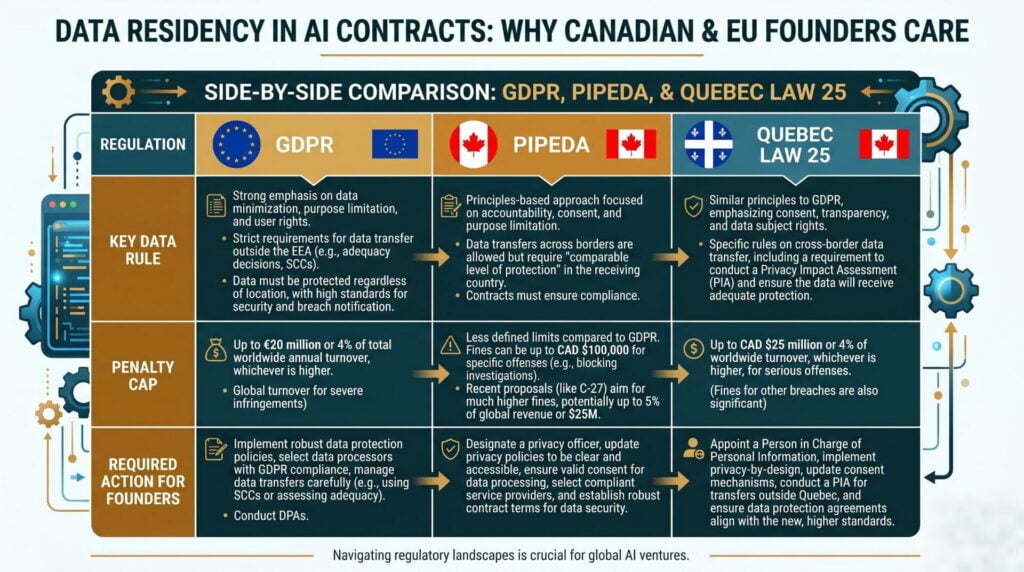
- GDPR Fines – The General Data Protection Regulation (GDPR) allows fines up to 4% of global annual revenue for data transfer breaches, per the European Data Protection Board (2024).
- Quebec Law 25 – Quebec’s Law 25 needs privacy impact assessments before sending data outside Quebec, a rule in force since September 2023.
- PIPEDA Coverage – Canada’s Personal Information Protection and Electronic Documents Act (PIPEDA) covers cross-border data transfers to AI vendors outside Canada for federally covered firms.
- DPA Requirement – Every AI vendor contract needs a signed Data Processing Agreement (DPA). Without one, you have no record of where your data lives or who can see it.
- Breach Costs – The average breach cost for firms under 1,000 staff hit $3.31 million, per IBM’s Cost of a Data Breach Report (2024). That is far more than a contract review costs.
These five points show what is at stake. The stakes are real. Act on them now. Fines, breach costs, and audit failures all trace back to one thing. Your AI vendor contracts set the data location. That is where risk begins. Knowing the fines is just the first step. The harder work is knowing what to look for and what to ask. The sections below walk through each step.
Why Do Canadian and EU Founders Face These Rules?
GDPR stops EU data from leaving the EEA without a legal transfer tool. Canada’s PIPEDA needs data sent abroad to get the same care as data kept at home. A standard AI vendor deal can route your client data to US servers with no legal cover. Most founders do not see this risk. They find out too late. By then, the cost is high.
Founders who catch data gaps during vendor review face far lower costs. Those who find gaps in an audit pay much more. A 30-minute contract check before signing saves dozens of hours of fix-up work. AI governance and AI use are tightly linked. Treating them as one step avoids the most costly mistake in AI vendor selection. Do this before you sign any deal.
What Is a DPA and Why Do You Need One?
A Data Processing Agreement (DPA) is a contract add-on. You sign it with any vendor that handles user data for you. GDPR Article 28 needs one for each such vendor. Most major AI vendors, including OpenAI, Anthropic, and Microsoft Copilot, can share a DPA within one day. Ask for it before you sign the main service deal.
The DPA must name the storage region and list all third-party data handlers. It must set how long data is kept. It must also explain how your data is deleted when you cancel. If a vendor will not produce a DPA, that is a clear warning. Find a different vendor. You have each right to ask.
How Does GDPR Affect AI Contracts for EU Founders?
GDPR bars EU data from moving outside the EEA without a legal transfer tool. The two main options are adequacy decisions and Standard Contractual Clauses (SCCs). The US lost its approved status in 2020. A new EU-US Data Privacy Framework was approved in 2023. Verify each vendor against that framework before you sign.
Ask two direct questions before you commit. Which data center region stores my EU data? Which legal transfer tool applies? Large vendors like Google Cloud and Microsoft Azure post clear residency pages. Smaller AI vendors often skip this detail. Get the answer in writing. Confirm it covers your use case. Do not handle any EU user data until you have this confirmed in writing.
What Do Canadian Founders Need to Check?
Founders in Canada face two laws at once. PIPEDA applies at the federal level. It needs data sent outside Canada to get equal cover. Quebec Law 25, active since September 2023, adds a privacy impact review (PIA) before any user data leaves Quebec. It also needs a written deal with the foreign vendor. Using a US-based AI tool without both puts you in breach of Law 25.
The Office of the Privacy Commissioner of Canada covers PIPEDA transfer guidance. Quebec’s Commission d’acces a l’information (CAI) runs Law 25. It publishes free PIA templates at no cost. Check both before you sign any AI vendor contract.
How Do Major AI Vendors Handle Data Residency?
AI vendors handle data storage very differently. The table below shows what the main vendors offer for clients in Canada and the EU. Always verify directly with the vendor since these options change often. The table is a starting point, not a final answer. Some vendors offer regional storage by default. Others use US servers unless you ask to change it.
Search for the vendor’s trust center or legal page before you sign anything. Most AI sites lead with product features and hide data details in the legal section. Search for “data residency” or “trust center” to find the right page fast. That page gives you the storage region and the legal transfer tool the vendor relies on. Get both in writing before you handle any user data.
| Vendor | EU Data Residency | Canada Residency | DPA Available | Best For | Limitation |
|---|---|---|---|---|---|
| Microsoft Azure OpenAI | Yes, EU data boundary | Canadian regions available | Yes, Microsoft DPA | Growing businesses in Microsoft 365 | Requires Azure subscription |
| Google Cloud AI | Yes, EU regions | Canadian regions available | Yes, Google Cloud DPA | Google Workspace users | Custom setup; check current pricing |
| OpenAI API | Limited; US default | No Canadian region | Yes, DPA available | Developers building custom AI tools | EU residency requires the Azure OpenAI route |
| Anthropic Claude | Limited; check current policy | No dedicated region | Yes, DPA available | Claude API or AWS Bedrock users | Residency depends on how you deploy |
| Cohere | EU deployment available | Canadian deployment available | Yes | Businesses that need sovereign AI | Custom pricing; check vendor |
For a current list of AI tools vetted for growing firms, see AI tools and apps on the AI Smart Ventures resource hub.
Before you contact any vendor, get clear answers to these three questions:
- Storage Location – Ask: in which country is my data stored? A vague answer like “global infrastructure” is not good enough. Push for a named country or region in writing.
- Third-Party Handlers – Ask for a full list of third-party tools that touch your data. Each one is a transfer point that may sit outside your home country and create a hidden gap.
- Deletion Terms – Ask how data is deleted when you cancel and how long data is kept. These terms must be in the DPA, not just a verbal promise from the sales team.
Once you have those answers, check whether the vendor is on the EU-US Data Privacy Framework list. That one check removes a large share of risk for EU founders using US-based AI tools. It takes five minutes to do this check.
What If a Vendor Cannot Meet Your Requirements?
If a vendor fails your data residency check, you have three clear paths to try. Ask if they can run on AWS, Azure, or Google Cloud in a region that meets your rules. Look at vendors built for sovereign AI, such as Cohere. Cohere offers dedicated regional builds for regulated markets. They can confirm data stays inside your home country. Each of these paths is worth a try.
Or check whether you can strip user details from data before it reaches the vendor. Removing user data from the data set often removes the location rule. Test this before you walk away. It may be a simple fix. Large firms like Accenture or Deloitte offer data rules work for complex setups. These projects often start above $50,000. A privacy lawyer who knows GDPR or PIPEDA can review your contracts for $500 to $2,000. That is a small cost compared to a potential breach or fine.
Frequently Asked Questions
Does Canada have data residency requirements for AI?
Yes, Canada does have data residency rules. These rules apply in specific sectors and provinces. PIPEDA needs user data sent outside Canada to get equal cover. Quebec Law 25, active since September 2023, needs a PIA before any user data leaves Quebec. Founders who collect data from Quebec must complete a PIA for each vendor in a cross-border data transfer. Missing this step puts you outside Law 25. It also exposes you to fines.
What is a Standard Contractual Clause in an AI contract?
A Standard Contractual Clause (SCC) is a contract template set by the EU Commission. It lets EU data move legally to countries without an adequacy decision. It creates legal duties for both the sender and the receiver. The current SCC version came out in 2021. Any contract on the older version had to be updated before December 2022, per EU rules. Check which version your vendor uses.
Who builds data centers in Canada?
Amazon Web Services (AWS), Microsoft Azure, and Google Cloud all run data centers in Canada. AWS has regions in Montreal and Calgary. Azure covers Toronto and Quebec City. Google Cloud has a Montreal region. These sites let growing firms store and process data inside Canada. This helps with PIPEDA rules. It also cuts the transfer rules under Quebec Law 25 for firms with Quebec-based clients.
Are AI data centers being built in Canada?
Yes, major AI data center work is happening in Canada right now. Microsoft announced a $3.2 billion investment in Canada AI work in 2024. Google and Amazon have both grown Canada capacity in recent years. Canada’s energy costs and cool climate make it a strong spot for AI systems. For founders, more vendors will offer Canada data residency as a standard option. This should happen in the next two to three years. That means more choices and less cost to comply.
What happens if an AI vendor breaches GDPR?
If your vendor breaches GDPR, you as the data controller may share the blame and the fines. Fines can reach 4% of global annual revenue or 20 million euros, whichever is higher, under GDPR Article 83. Your DPA with the vendor sets how that blame is split. Without a signed DPA you have almost no cover. Regulators have fined firms for picking vendors without proper safeguards. This happened even when the firm itself did not mishandle any data.
What is a privacy impact assessment under Quebec Law 25?
A privacy impact review (PIA) is a written check of the risks of a data transfer. It is done before the transfer starts. Quebec Law 25 needs a PIA before any user data leaves Quebec. The review must state the purpose, the data type, the legal basis, and the safeguards used. The CAI publishes free PIA templates for growing firms. A PIA is a legal rule under Law 25, not an optional step.
Which European country leads in AI?
The UK leads in private AI investment in Europe as of 2023. This is per Stanford HAI’s AI Index Report (2024). Germany and France follow closely. For data residency, EU founders must note that the UK left the EEA after Brexit. A UK-based AI vendor now needs the same legal transfer tool as a US vendor. This applies when handling EU personal data.
How much does fixing a data residency problem cost?
Fixing a data residency issue after you deploy an AI tool often costs $5,000 to $25,000. That covers legal review, contract talks, data move, and updated notices. A legal inquiry raises that figure sharply. A pre-signing review with a privacy lawyer costs $500 to $2,000. That is a small price to pay. Schedule a consultation to get the right steps for your business.
Do AI writing tools need a DPA?
Growing firms using AI writing tools still need a DPA if those tools handle user data. User data includes names, email addresses, and any detail that can point to a person. If you paste a client email into an AI writing tool, you have sent user data to that vendor. That vendor now holds your client data. They are a data handler under GDPR and PIPEDA. Most major tools, including Grammarly and Notion AI, offer DPA add-ons for business accounts.
Can I use US-based AI tools with EU customers?
Yes, you can use US-based AI tools with EU customers. The right legal tools must be in place first. The EU-US Data Privacy Framework, approved in 2023, covers certified US companies. SCCs cover the rest. You must confirm which tool your vendor uses. Check it covers your specific use case. Never assume a well-known US vendor is compliant. Check their DPA page before you handle any EU personal data. This is your legal duty.
Executive Summary
Data residency in AI contracts is a legal requirement for founders in Canada and the EU. GDPR allows fines up to 4% of global revenue. Quebec Law 25 needs a PIA before any cross-border data transfer. PIPEDA demands equal cover for data sent outside Canada. Every AI vendor contract needs a signed DPA. The DPA must name the storage region and list third-party handlers. It must also set the deletion process. Founders who review contracts before signing spend $500 to $2,000. Those who skip it risk costs of $5,000 to $25,000 or more.
What Should You Do Next?
This week, pull the contracts for each AI tool your business uses. Search each one for “data processing,” “storage location,” and “third-party services.” If the answers are not clear, ask the vendor for their DPA before your next billing cycle starts.
AI Smart Ventures offers AI consulting services for growing firms building compliant AI processes. Schedule a consultation to get a compliance checklist for your location and vendor stack.
People Also Read
- What Is Agentic AI and Should Your Business Care in 2026?
- What Is AI Coaching for Founders and Why Does It Work?
About the Author
Nicole A. Donnelly is the Founder of AI Smart Ventures and an AI Adoption Specialist with 20 years of experience as a founder and CEO and over a decade leading AI adoption initiatives. She helps businesses integrate artificial intelligence with clarity and confidence, driving innovation and sustainable growth. Nicole has trained over 20,217 professionals in Applied AI, delivered 624 workshops, and worked with close to 1,000 organizations across diverse industries.
Expertise: AI Transformation, AI Strategy, AI Implementation, AI Adoption, Applied AI, Marketing, Business Operations
Disclaimer: This content is for informational purposes only and does not constitute professional business or technology advice. Results vary based on industry, existing systems and implementation commitment. Contact AI Smart Ventures for a consultation regarding your specific situation.

