
Did Your AI Advisory Services Actually Deliver?
Last Updated: November 2026
A delivered AI advisory service is one your team can still run after the consultants have gone. Judge it on what survives, not on how the final deck looked. Four things should remain: a working process, a named owner, written steps, and the skill to repair it when a model changes. AI advisory services that leave none of that have sold you a document rather than a capability.
AI Smart Ventures has guided growing businesses through AI adoption, including the awkward month after an outside firm hands the work back. Owners who judge that moment well ask one narrow question: what can we do on Monday that we could not do before, without calling anyone?
Get this call wrong, and you lose twice. First, the months spent on advice that changed no task; then the know-how that walks out when your one expert moves on. Get it right, and you keep a faster workflow plus people who can fix it.
Key Takeaways
- Judge what still runs, not the deck: Sinch reported in May 2026 that 74% of firms had rolled back a live AI agent.
- Mature guardrails did not help: in that same study of 2,527 leaders, the rate rose to 81% among firms calling their guardrails fully mature.
- Withdrawal is the real test: UC Berkeley researchers found people got more answers wrong and gave up sooner once AI help was removed mid-task.
- Capability is the deliverable: a Huntress survey published in October 2026 found 43% of workers had been given no formal AI training.
- Your systems set the ceiling: GFT Technologies found most of 945 technology leaders had cancelled an AI pilot their older systems could not carry.
One thread runs through those five: the failures show up after the launch, never during it. So a review held in the closing meeting is far too early to tell you much.
What counts as a delivered AI advisory engagement?
One your team can keep running after the firm stops answering the phone. Four things have to exist: a working process on your own systems, one named owner, written steps, and a change you can measure. A strategy document is an input to that, not the output. If all four are missing twelve weeks later, the project produced advice rather than change.
Most review meetings measure the wrong thing, because a list of outputs is easy to tick off and an outcome is not. A deck arrived, the interviews happened, the roadmap has dates on it, and none of that tells you whether a task got faster. Pick the workflow the project named first, then ask the person who does it daily what changed. Their answer is the review, so write it down the day you hear it.
Can your team run the workflow without the firm?
Test it rather than assume it, and test it while you can still ask for help. Book a week where nobody contacts the firm, and have your own people run the workflow, make one real change, and handle one failure. Changing a prompt, swapping a model version, or fixing a broken step all count. If they queue up questions instead, you found the gap early.
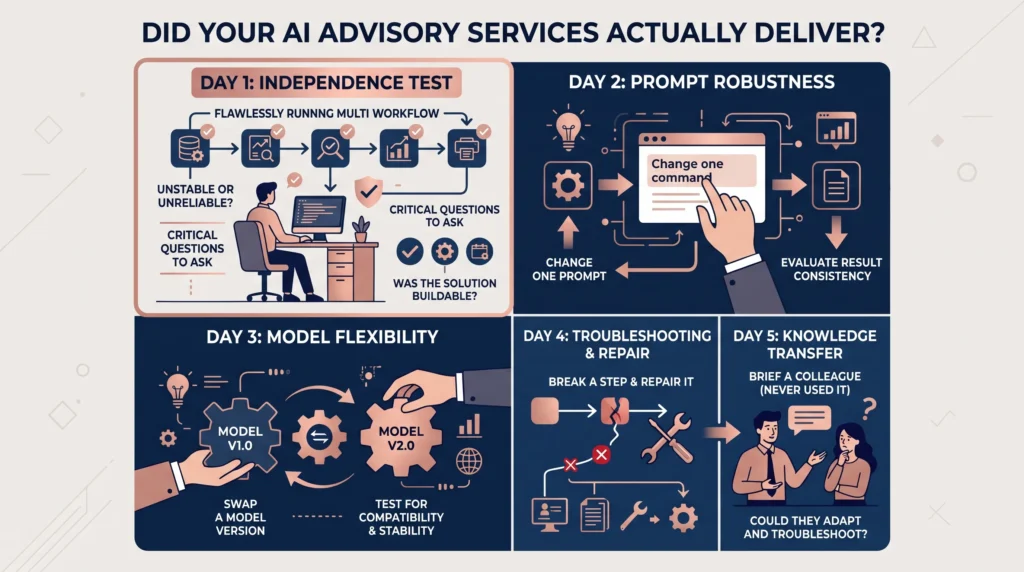
Running it alone is a skill, not a document, and the skill fades if nobody practises. Researchers at UC Berkeley and four other universities ran trials with 1,222 people, reported in October 2026. Groups given AI help started out more accurate. Once the help went away mid-task, they got more answers wrong and gave up sooner than people who never had it. That is the warning for any handover. Run the test before the contract ends, not after.
What should you check 30, 60 and 90 days later?
Three different things, in that order: at 30 days, check that the workflow still runs daily and that the named owner is still the owner. At 60 days, compare the task against the baseline you took before the work began, in hours or error counts. At 90 days, look for spread. Has anyone outside the pilot group picked it up, and did your team change the process without outside help?
The later checks matter because live systems get switched off quietly. Sinch surveyed 2,527 decision makers across ten countries in early 2026. It found 74% had rolled back or shut down a customer-facing AI agent after a governance failure. The rate climbed to 81% among firms that called their guardrails fully mature. A launch proves little on its own, while a system still running at 90 days proves rather more about the handover.
AI Consulting starts from that same baseline: one workflow, a named owner, and a dated check at 30, 60 and 90 days. Ask for those three checks in writing before the work closes.
Who owns the workflow once the firm has gone?
One named person on your payroll, not a committee, because ownership is a list rather than a job title. It covers the logins, the billing, the prompt files, the written steps, and the right to change any of them. Check that the accounts sit in your name, and that someone can reach them without a support ticket. If ownership sits with a project team that breaks up at launch, nobody watches the output drift.
Documents are where most handovers thin out. A Huntress survey of 501 US knowledge workers, published in October 2026, found only 24% had a clear AI policy explained to them. A quarter worked from informal, unwritten rules. Rules nobody wrote down cannot be handed over. So ask for the written version of every choice the project made. That means which tool, which data, who checks the output, and what to do when it is wrong.
Which signs mean the advice never landed?
Four show up often, starting with people who have gone back to the old method without logging it. The new process has one operator, and it stops when that person is away. Nobody can say how long the task took before the work began. And the only proof of progress is a document, not an output. All four together mean the project sold a plan and left the change to you.
The pattern behind all four is a build that never touched the real system. GFT Technologies asked 945 technology leaders in September 2026 about this. More than four in five had cancelled an AI pilot because older systems could not carry it. Generic AI consultants tend to design around that problem rather than into it, which yields a tidy plan your software cannot run. Ask where the work wrote to your systems, and what it only described.
Did your team get better, or just the tooling?
Check for skills that exist outside the tool. A good project leaves people who can judge an AI output, spot a wrong one, and explain the workflow. A weaker one leaves people who can click through a screen. Ask two of your staff to describe, without notes, what the system does and where it fails. Fluent answers mean capability building happened; blank looks mean the tooling arrived alone.
Training is the part most often promised and least often delivered. The same Huntress research found 43% of workers had been given no formal AI training by their employer. A project that builds a workflow without AI upskilling has moved the work, not the know-how. That is a change management failure, and no deck can cover it. So look at what the training covered: your own tasks and your own records, or a general tour of a chatbot.
What can you do if it did not deliver?
Fix the smallest version first, and do it in-house. Pick one task from the plan, run it by hand for a week to learn the real steps, then rebuild only that. Go back to the firm with a named gap rather than a general complaint, because a named gap is something they can close. If the contract names an exit point and a scope, read both before the call. Most stalled projects restart smaller rather than stopping.
Expect the rebuild to carry upkeep you did not plan for. In the Sinch research, 84% of AI engineering teams said they spend at least half their time on safety work. Your version of that is smaller but real: checking output, handling the odd failure, updating a prompt when a model moves. AI Smart Ventures observes that owners who set aside hours for upkeep keep their workflows. Owners who treat the launch as the finish line quietly lose them.
Frequently Asked Questions
What should an AI advisory firm have changed by now?
One workflow, visibly, inside your own systems. By the end of a first project you should be able to point at a task that runs differently. It is faster, or carries fewer errors, or has a step removed, and strategy work counts only if it ends in that change. If the project produced AI strategy documents and nothing in the daily work moved, you bought research.
Does a boutique firm hand over better than a large one?
Not always, though boutique consulting usually puts senior people closer to the work. What predicts a good handover is whether the people who designed the workflow also trained your staff on it. Large firms can do that; many split design, AI implementation and training across teams, which loses detail. Ask who will sit with your operator in week six, because that answer tells you more than firm size does.
Do top-firm rankings predict a good handover?
No, because rankings measure profile and sales, not what clients keep. A better test is a reference call where you ask the former client one question: can your team still run it without them? Sinch’s 2026 research found 74% of firms had rolled back a live AI agent in customer communications. Plenty of well-regarded launches did not hold. Judge a firm by what still runs at its past clients.
What should a firm’s website prove about results?
It should show the problem, the method and what the client kept, with names where the client allows it. Look for case studies that say who owns the workflow now and what training came with it. Pages that list tools and awards tell you nothing about handover. A firm writing honestly about a project that needed a second attempt is a better sign than an unbroken run of wins.
When is it fair to call an engagement a failure?
After 90 days with no measurable change in the task you agreed to change. Before that, slow progress is normal: people need practice, and records usually need cleaning first. The fair test is movement against your own baseline, which is why taking one before the work starts matters. With no baseline you are left arguing about opinions, and the firm will win that argument.
Can you tell if the gain came from AI or the clean-up?
Often yes, if you split the two in the record. Most AI projects also tidy a process: steps get removed, a form gets fixed, someone writes the rules down. Note those changes on their own as they happen, then compare. Plenty of reported AI gains are really workflow optimization that would have worked without a model. That is still a real gain, but it changes what you buy next.
What if nobody on your team can explain the workflow?
Treat that as a half-done handover, and say so while the firm is still friendly. Ask for a working session where your operator runs the process and the firm watches without touching anything. Every question that comes up becomes a line in the written steps. Huntress research in October 2026 found 43% of workers had no formal AI training, so the gap is common, not a mark against your team.
How do you restart an AI advisory engagement that stalled?
Start by narrowing the scope rather than reopening the whole plan. Pick the workflow with the clearest baseline, agree dated stages, and name the person who owns it at the end. Scope drives what you commit to, so a short first stage with named outputs keeps the work reversible. Schedule a consultation with AI Smart Ventures to rescope around a single workflow.
Executive Summary
Judging AI advisory services comes down to what still works once the firm leaves. Delivery means four things: a workflow running on your systems, a named owner, written steps, and a team that can fix it. Test that by running a week without contacting the firm. Then check the work at 30, 60 and 90 days against a baseline you took first. Launches prove little, since most live AI agents in one 2026 survey were later rolled back. Capability is the part that survives, so look for AI literacy built on your own tasks rather than a tour of a tool.
What Should You Do Next?
This week, write down how long your chosen workflow takes today and who runs it. Then book five days where your team runs it without contacting the firm that built it. Keep a list of every question they could not answer alone, because that list is your handover gap.
AI Smart Ventures offers AI Consulting for growing businesses reviewing work an outside firm has already delivered. Schedule a consultation to close the gaps your independence test finds.
People Also Read
- AI for Independent Recruiting Firms: Faster Sourcing and Screening
- Why AI Adoption Fails: The Top Mistakes Growing Businesses Make
About the Author
Nicole A. Donnelly is the Founder of AI Smart Ventures and an AI Adoption Specialist with 20 years of experience as a founder and CEO and over a decade leading AI adoption initiatives. She helps businesses integrate artificial intelligence with clarity and confidence, driving innovation and sustainable growth. Nicole has trained over 20,217 professionals in Applied AI, delivered 624 workshops, and worked with close to 1,000 organizations across diverse industries.
Expertise: AI Transformation, AI Strategy, AI Implementation, AI Adoption, Applied AI, Marketing, Business Operations
Disclaimer: This content is for informational purposes only and does not constitute professional business or technology advice. Results vary based on industry, existing systems and implementation commitment. Contact AI Smart Ventures for a consultation regarding your specific situation.