
Why AI Adoption Fails: The Top Mistakes Growing Businesses Make
Last Updated: July 2026
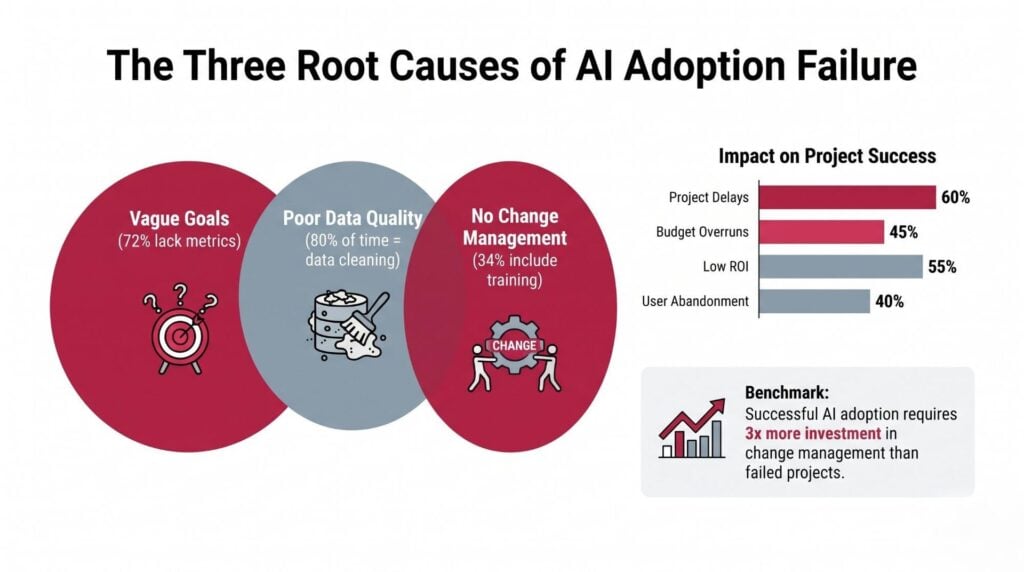
A “why AI adoption fails” review examines the root causes behind AI projects that stall, overspend, or never deliver results for growing businesses. These failures rarely come from weak technology. They come from skipping basic steps: setting vague goals, ignoring data quality, and launching tools without training staff.
AI Smart Ventures works with growing businesses that want to adopt AI with clarity and confidence. The team has reviewed over 40,000 AI tools and guided close to 1,000 businesses through practical AI rollouts that stick.
Growing businesses face specific pressures when adopting AI. Teams are lean and budgets are tight. Every failed project costs more than money. When a rollout stumbles, staff resistance grows and future adoption becomes harder.
Key Takeaways
- Vague Goals Kill Projects – Companies without defined AI goals are 2.5x more likely to abandon projects within 90 days, according to McKinsey (2024).
- Data Quality Is the Foundation – IBM research shows 80% of an AI project’s time goes to cleaning data, yet most teams skip audits before launch.
- Change Management Is Skipped – Only 34% of businesses include formal staff training in their AI rollout plan, per Gartner (2024).
- Tool Overload Backfires – Teams that adopt more than 3 new AI tools at once see a 55% drop in user adoption within 60 days, per Forrester.
- Phased Rollouts Cut Risk – Companies using a phased AI approach report 40% faster time-to-value compared to full-scale launches.
Many business owners assume the right tool solves the problem. It does not. A strong AI rollout starts with a plan, not a product. The mistakes below show up in nearly every failed AI project. Knowing them before you start can save months of wasted effort.
What Does AI Adoption Actually Mean?
AI adoption means bringing AI tools into your daily business work in a clear, planned way. It covers picking the right tools, preparing your data, training your team, and tracking results. About 70% of AI projects do not reach their goals. Most teams skip the planning phase.
AI adoption is not just installing software. The gap between teams that use AI every day and those that stop after 90 days is almost always preparation, not budget.
Why Do Most AI Projects Fail?
Most AI projects fail because of three core mistakes: no clear goal, bad data, and no staff training. A 2024 McKinsey report found that 72% of failed AI projects had no defined success metrics from the start. Without those metrics, teams cannot tell if a tool is working.
The failure is rarely technical. Most AI tools today are reliable and well-supported. The gap is almost always in how businesses plan for and manage the change.
Mistake 1: Setting Vague or No Goals
“We want to save time” is not a goal. “We want to cut invoice processing from 4 hours to 45 minutes by Q3” is the goal. Teams without specific goals cannot measure success. They often call a project a failure because they never defined what success looks like.
A good goal names the process, the metric, the target, and the deadline. Without all four, you are guessing. Before picking any AI product, write down the one problem you want to solve. Then name the number that will confirm it is solved.
Mistake 2: Ignoring Data Quality
AI tools are only as good as the data you feed them. Poor data quality costs businesses an average of $12.9 million per year, according to IBM. Most growing businesses do not check their data before launch. This leads to wrong outputs and lost trust in the tool.
Data problems include duplicate records, missing fields, and outdated entries. When staff see wrong outputs, they stop trusting the tool and go back to manual work. A free tool like OpenRefine can help you find and fix common data errors before connecting any AI to your system.
Common data issues to fix before launch:
- Duplicate customer records that skew AI segmentation
- Missing date fields that break time-based reporting
- Inconsistent product names (e.g., “Widget A” vs. “widget a”) that split one item into two
- Outdated contact info that reduces accuracy in customer-facing tools
Clean data cuts setup time in half and prevents early failures that shake staff confidence.
Mistake 3: Skipping Change Management
Only 34% of businesses include formal training in their AI rollout plan, according to Gartner (2024). The rest launch tools and expect staff to figure it out. Resistance rises and adoption stalls.
Staff often resist AI not because they dislike technology. They fear job loss or feel left out of the decision. Clear talk before launch lowers resistance. Explain what the tool does, what it does not do, and how it changes each role. This gives people a reason to get involved.
A simple change management checklist:
- Tell your team what the tool does and why you chose it
- Show them how it changes their specific daily tasks
- Find two or three staff members to be early adopters and internal champions
- Schedule a 30-day check-in to catch and fix early friction points
A focused two-hour session on one workflow beats a full-day seminar on every feature. Start small and gather feedback before expanding.
Are There Other Hidden Failure Points?
Yes. Two more failure points show up often: too many tools at once and weak system connections. Teams that launch more than three new AI tools in one quarter see adoption drop by 55% within 60 days, per Forrester. Each new tool adds learning time and decision fatigue.
Integration is a quiet failure point. An AI tool that does not connect to your existing systems creates more work, not less. Before you commit, ask the vendor one question: what does this connect to out of the box? If the answer involves custom development, build that cost into your plan.
| Tool Type | Common Integration Gap | What to Check |
|---|---|---|
| AI CRM tools | Does not sync with existing CRM | Native connector or API |
| AI content tools | Cannot post to your CMS | Direct integration or Zapier |
| AI finance tools | Exports only, no live sync | Accounting platform compatibility |
| AI support tools | Separate from main help desk | Shared ticketing integration |
How Can Growing Businesses Avoid These Mistakes?
The fastest path to a good AI rollout is a phased approach with clear checkpoints. Start with one process, one tool, and one team. Measure results for 30 days before you expand. Businesses using this method report 40% faster time-to-value than those who try to change everything at once.
A phased rollout builds internal confidence. When one team sees real results, others want in. This pull from within is more powerful than a top-down mandate.
A simple three-phase rollout:
- Phase 1 (Days 1-30): Pick one high-volume, low-risk process. Run the AI tool alongside your current method. Compare results against your target metric.
- Phase 2 (Days 31-60): If results hit the target, expand to a second process or team. Update your training materials based on what you learned.
- Phase 3 (Days 61-90): Review total impact. Decide which tools to scale, which to pause, and what to try next.
AI Smart Ventures offers AI implementation services for growing businesses. Schedule a consultation to build a rollout plan that fits your team and budget.
What Tools Help Smooth the Process?
Several platforms help growing businesses manage AI adoption. Notion AI helps teams keep workflow records in one place. Zapier connects AI tools to existing systems without code. Make handles more complex automation sequences. Each tool needs setup time and some technical skill.
| Tool | Best For | Limitation |
|---|---|---|
| Notion AI | Documenting AI workflows | Limited data integration |
| Zapier | Connecting apps without code | Costly at high volume |
| Make | Multi-step automations | Steeper learning curve |
| ChatGPT Teams | Drafting, summarizing, analysis | Needs clear prompt guidelines |
| Loom | Training videos with AI summaries | Output only, no workflow logic |
Pick the tool that solves your most pressing gap. Get good at one before adding another.
Frequently Asked Questions
What is the main reason AI adoption fails?
The main reason AI adoption fails is the lack of a clear goal before launch. Without a defined outcome, teams cannot tell if the tool is working. They often quit within 90 days. A goal must name the process, the metric, the target, and the deadline. Vague goals are the single most common mistake in any AI rollout.
How much does a failed AI project cost?
A failed AI project costs a growing business about $50,000. This includes tool subscriptions, staff time, and the cost of going back to the old process. This figure rises when failure creates resistance that slows future adoption. Prevention through planning is far cheaper than recovery after failure.
How do I know if my data is ready for AI?
Your data is ready if it is complete, consistent, and current across at least three months of records. Run a basic check for duplicate entries, missing fields, and inconsistent naming. If more than 5% of records have errors, clean the data first. Most problems show up within the first hour of an honest check.
How long does a first AI rollout take?
A realistic first-phase rollout takes 30 to 90 days from goal-setting to results review. This covers tool selection, data prep, staff training, and one feedback cycle. Trying to shorten this timeline leads to skipped steps and higher failure rates. A 90-day first phase builds something that lasts.
Do I need an AI consultant to succeed?
You do not need a consultant for simple, single-tool adoptions. Expert help is useful when rolling out AI across multiple workflows or when your data setup is complex. AI Smart Ventures offers AI consulting and AI advisory services for growing businesses that want structured support without guesswork.
What is the biggest change management mistake?
The biggest change management mistake is launching a tool without telling staff why you chose it. When people learn about a new AI tool on the day it goes live, they feel left out. A 15-minute team meeting three weeks before launch, where you explain the goal and address concerns, prevents most of this resistance.
How many AI tools should a growing business use at once?
Start with one or two tools and add more only after those are running well. Teams that adopt more than three new tools in one quarter see adoption rates drop by more than half. One AI tool used daily by your whole team delivers more value than five tools used occasionally by a few people.
What metrics should I track for AI adoption success?
Track three things: time saved per task, error rate before and after, and staff usage at 30, 60, and 90 days. Time saved and error rate show if the tool is working. A drop in usage after 30 days points to a training gap, not a technology problem.
Can AI adoption fail even with the right tool?
Yes. The right tool with the wrong rollout plan almost always fails. Tool selection is about 20% of the work. The other 80% is goal-setting, data prep, training, and feedback loops. Many businesses choose great tools and then skip the setup steps. That wastes both the investment and the chance to improve.
What is a phased AI rollout?
A phased AI rollout is a structured approach where you adopt AI one process at a time. You measure results and expand only when each phase hits its target. It reduces risk, builds internal confidence, and creates a pattern you can repeat for future rollouts. The standard first phase runs 30 to 90 days and uses one process, one tool, and one team.
Executive Summary
AI adoption fails in growing businesses when three basic steps are missed: setting clear goals, cleaning data, and creating a change management plan. These gaps cost time, money, and internal trust. They explain why 70% of AI projects fall short of their goals. A phased rollout starting with one process, one tool, and clear 30-day checkpoints cuts time-to-value by 40%. This approach protects your investment and builds staff confidence that carries into every future rollout.
What Should You Do Next?
Pick one process in your business that takes too much time or creates too many errors. Write a one-sentence goal: what should it do, how fast, and by when? Then check the data that process relies on before you choose any tool.
AI Smart Ventures offers AI implementation services for growing businesses. Schedule a consultation to get a clear rollout plan built around your team, your data, and your goals.
People Also Read
- Best AI Automation Stacks for Growing Businesses in 2026
- AI Adoption Benchmarks for Growing Businesses
About the Author
Nicole A. Donnelly is the Founder of AI Smart Ventures and an AI Adoption Specialist with 20 years of experience as a founder and CEO and over a decade leading AI adoption initiatives. She helps businesses integrate artificial intelligence with clarity and confidence, driving innovation and sustainable growth. Nicole has trained over 20,217 professionals in Applied AI, delivered 624 workshops, and worked with close to 1,000 organizations across diverse industries.
Expertise: AI Transformation, AI Strategy, AI Implementation, AI Adoption, Applied AI, Marketing, Business Operations
Disclaimer: This content is for informational purposes only and does not constitute professional business or technology advice. Results vary based on industry, existing systems and implementation commitment. Contact AI Smart Ventures for a consultation regarding your specific situation.