
How Agency Owners Handle AI Discount Demands
Last Updated: June 2026
When clients demand AI discounts, the right move is to reframe your value, not drop your price. Agencies using outcome-based pricing earn 20-30% more per project than those competing on hours, per HubSpot‘s 2024 Agency Pricing Report. This guide covers five ways agency owners hold their margins and win the reprice talk.
When a client demands an AI discount, the right response is a clear pricing framework that shifts the focus from hours to outcomes. Clients argue AI tools should cut costs. A 2024 survey by Clutch found 61% of agency clients now raise AI during renewals. Owners without a clear answer often lose margin they did not need to give up.
AI Smart Ventures has guided growing businesses through AI adoption and pricing shifts since 2015.
Most agency owners sense the AI discount talk coming when a client reads a headline about AI writing copy in seconds. They assume your costs dropped. Without a clear reframe, that talk goes badly. A clear answer ends most discount talks quickly.
Key Takeaways
- Value-Based Pricing – Agencies shifting to outcome-based pricing report 20-30% higher revenue per project, per HubSpot‘s 2024 Agency Pricing Report.
- Transparent AI Disclosure – 73% of clients trust an agency more when it explains how AI is used in delivery, per the Edelman Trust Barometer (2024).
- Repositioning Timeline – Most agency owners complete a pricing update in 4-6 weeks when they start with one service line, not the whole business.
- Tool Visibility – Listing which AI tools, such as Claude or ChatGPT, are used turns AI into a proof point, not a cost question.
- Retention Outcome – Agencies that add an AI strategy layer to retainers report 40% lower client churn in year one, per HubSpot’s 2024 Agency Pricing Report.
Owners who hold their margins change what they sell before the conversation starts.
Why Do Clients Demand AI Discounts Now?
Clients push for AI discounts because they see AI tools sold as cost-cutters, not value-builders. A 2024 Salesforce State of Service report found 68% of buyers believe AI cuts delivery time for professional services. That belief is partly right. Faster delivery and lower fees are two very different things.
The problem grows when agencies stay silent about how they use AI in their work. Clients then fill that gap on their own. They assume a blog that once took four hours now takes 20 minutes. They want to pay for 20 minutes, not four hours. Agencies that walk clients through their full process hold the rate and keep the relationship intact.
What Is the Best Way to Reframe Agency Value?
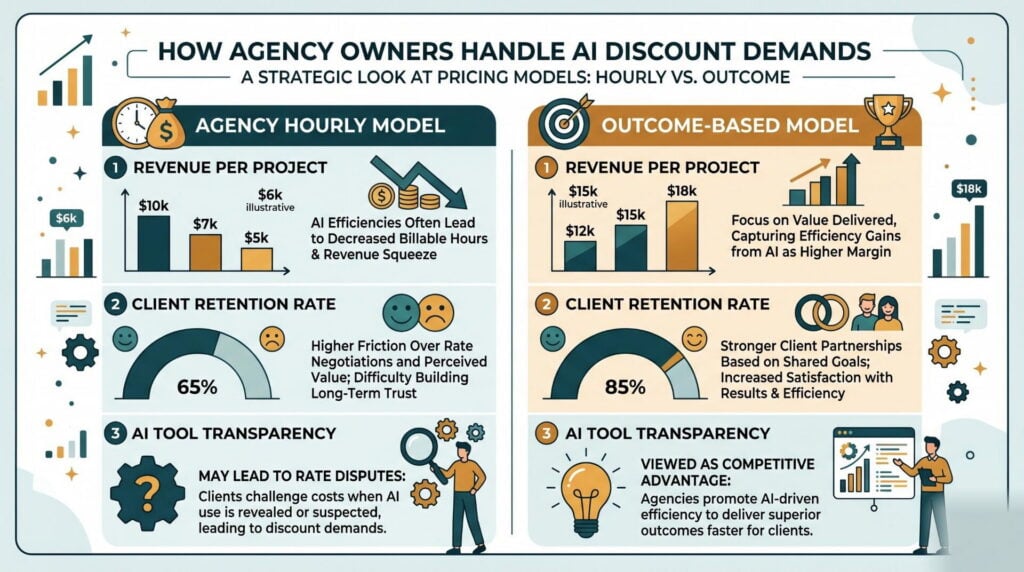
The best reframe is to stop selling time and start selling a named, measurable result. An agency charging $3,000 for a content package sells a 12-piece system with a defined search engine optimization (SEO) goal and clear performance benchmarks. That package does not get cheaper just because AI drafts the copy faster. The value is the outcome, not the hours it took.
The reframe has three clear steps. First, define the outcome in writing before any work starts. Second, name the AI tools that help you deliver with more speed and consistency. Third, present faster turnaround as a direct benefit to the client, not as a reason to cut your rate. When this frame is explained early and clearly, most clients accept it. They do not push back on the price at all. That is the goal.
How Do You Price Agency Services After AI Adoption?
Pricing after AI adoption works best when you build packages around outputs, not time. A social media retainer at $2,500 per month covers 20 posts, a monthly report, and a strategy call. AI cuts draft time. It does not cut the value of the strategy call. It does not cut the accountability of the monthly review.
The key shift is to stop quoting hours and start quoting outcomes. When a client sees a fixed price tied to clear results, they stop asking how long each task takes. The question is no longer relevant to the value they are buying. This is the shift that protects your margin. Make it before the next renewal talk. The sooner the better. Faster delivery becomes a selling point, not a discount trigger, when it is framed clearly.
Three pricing models work well after you adopt AI tools:
- Outcome Packages – Bundle deliverables, revisions, and reports into a fixed price. The client sees exactly what they get. You control the margin regardless of how long each task takes.
- AI Transparency Add-On – Add a one-page AI workflow note to your proposal. It names tools like Claude for drafts or Microsoft Copilot for research, and shows how your team reviews every output. This turns AI into a quality credential, not a price weakness.
- Tiered Service Levels – Offer three tiers: AI-assisted, AI-plus-strategy, and full AI consulting with advisory access. Clients who want the lowest rate choose tier one. Those who want your judgment pay tier three.
Most clients pick the middle or top tier when the value gap is clearly shown. This is where your margin lives.
AI Smart Ventures offers AI marketing services for growing businesses shifting from hourly billing to value-based pricing.
Which Clients Are Worth Keeping After a Reprice?
Clients worth keeping pay for outcomes, not time. A results-focused client accepts a new price when the value is clearly tied to a result they can see and measure. A client who haggles every invoice will leave regardless of what you charge. Replacing that account with a better-fit client often improves your margin over the next quarter. Replacing that account often improves your margin within the next quarter.
Clients asking about AI discounts split into two groups: curious and open versus cost-focused and already seeking a cut. The curious group stays when you give an honest, specific answer about your process. Tell them specifically what AI does in it.
Here are the signals that tell the two groups apart:
- Outcome-Focused Client – Asks what you will deliver and by when. Accepts a fixed package when the result is clear. Values speed and quality over the hourly rate.
- Cost-Focused Client – Asks how many hours a task takes. Questions every line item. Treats your retainer as a commodity rather than a partnership.
- On-the-Fence Client – Raises the AI question but has not decided. Responds well to a clear workflow explanation and a revised scope with visible outcomes.
Knowing which group you face before the renewal call saves time. It also protects your team.
How Do Agencies Use AI Without Losing Client Trust?
Agencies keep trust by naming what AI does and what a human does right after it. Vague phrases like “we use AI to improve efficiency” do not build trust. Say instead: “We use AI for a first draft and keyword brief. Our strategist reviews and approves every piece before it reaches you.” That is the right way to say it.
The Edelman Trust Barometer (2024) found 73% of clients trust a provider more when it explains its AI use in plain language. Agencies that document their AI change management process in a one-page client note report fewer discount requests at renewal time. The note names the tools used, the review steps taken, and who signs off on final output. They also see stronger retention than agencies that say nothing at all.
What Tools Help Agencies Manage AI Pricing Talks?
Three tool types help agencies handle the AI pricing talk: proposal software, workflow docs, and AI drafting platforms. Your best pick depends on team size and how many active proposals you manage each month. It also depends on how well your delivery process is already written down and visible to clients before the renewal talk.
Here is a comparison of common options:
| Tool | Category | Starting Price | Best For | Limitation |
|---|---|---|---|---|
| Proposify | Proposal software | $49/month (Team plan) | Agencies with 3-10 active proposals per month | Template library is limited on base plan |
| Notion | Workflow docs | $10/user/month (Plus plan) | AI workflow docs and client transparency notes | Needs setup time and is not a proposal tool |
| Claude | AI drafting | Free tier; $20/month (Pro plan) | First-draft content and keyword briefs | Human review required before client delivery |
| ChatGPT | AI drafting | Free tier; $20/month (Plus plan) | Research notes and content outlines | Hallucination risk requires editorial checks |
| Harvest | Time and billing | $11/user/month (Pro plan) | Tracking delivery time to measure AI efficiency | Not a proposal tool; pairs with a CRM (Customer Relationship Management) platform |
For a continuously updated directory of AI tools vetted for service businesses, see AI tools and apps on the AI Smart Ventures resource hub.
Large consultancies like Accenture and Deloitte Digital publish AI pricing frameworks for service firms. Those are built for teams of 500 or more. They require a full operations function to run and maintain. Growing agency owners need simpler systems. The five tools above give you a working setup without a large budget, a dedicated IT team, or a long onboarding cycle. Start simple. Scale later.
Frequently Asked Questions
What is the 10 20 70 rule for AI?
The 10 20 70 rule for AI splits investment into three parts: 10% on models, 20% on data and technology, and 70% on people, process, and change management. For agency owners, tools are a small part of the cost. The real spend is training your team and building workflows that turn AI output into work clients pay for. Skip the 70% and you end up with more revision cycles, not fewer. That is a costly mistake.
Who are the big 4 AI agents in use for agencies right now?
The four AI agents most used by agencies in 2025 and 2026 are Claude, ChatGPT, Google Gemini, and Microsoft Copilot. Each handles drafting, research, and summaries. Claude and ChatGPT lead on long-form content. Gemini fits teams on Google Workspace, while Copilot suits teams on Microsoft 365. The best choice depends on your stack and which outputs need the least editing before client delivery.
How much does an AI sales agent cost for an agency?
AI sales agent tools for agencies range from $50 to $500 per month depending on features and seat count. Entry-level tools like Clay start at $149 per month on the Starter plan for lead enrichment and outreach. Platforms like Salesforce Agentforce use custom pricing that starts above $1,000 per month. Most growing agencies begin with a CRM plus an AI drafting tool for follow-up emails. This costs under $100 per month combined.
Is customer service going to be replaced by AI?
AI will not fully replace client service at agencies, but it will change what those roles cover. AI handles routine tasks well: status updates, FAQ replies, and first drafts. It does not handle complex relationships or situations where a client is unhappy. Agencies that use AI to clear low-value admin work free their team for judgment-heavy tasks. Those are the tasks clients actually pay for. Those are worth protecting. Use AI to clear the rest.
How long does it take to reposition agency pricing?
Most agency owners finish a pricing update in 4 to 6 weeks when they start with one service line. Test the new offer with two or three existing clients before a full rollout. Start small. Build from there. One service line at a time. Then expand. Trying to reprice everything at once almost always stalls. Start with your highest-margin line, build a proof case, then expand. Budget one week for drafting, one for team review, and two to four weeks for client conversations.
What should an agency say when a client asks for an AI discount?
The most effective reply is a calm, clear explanation of your value chain. Acknowledge the question: “That is a fair thing to ask.” Then explain what AI does in your process and what your team adds after. Close with the reframe: “AI lets us deliver faster. That speed is the benefit, not a lower rate.” Clients who hear a confident answer rarely push harder. They respond to confidence. Build yours before the call. Practice it too.
What is outcome-based pricing for agencies?
Outcome-based pricing means charging for a defined result, not a block of hours. An SEO agency might charge $4,000 per month for 10 optimized pages, a ranking report, and a strategy review. The price does not change regardless of how many hours the team spends. That is the model that works. Test it on your next renewal. See what happens. The data will guide you. AI cuts time on some tasks, and that saving expands your margin, not the client’s discount. This model works best when the deliverable is specific and easy to explain in one sentence.
How do you explain AI tool costs to clients who ask for a lower rate?
Treat AI tools as part of your infrastructure, not a pass-through cost. Your agency pays for tools, talent, quality checks, and overhead. AI tools sit in that same stack as your project software and cloud storage. If a client asks why your rate held after you adopted AI, explain that AI investment is what keeps your quality high at the current price. That is a fair answer. Most clients accept it. Schedule a consultation if you need help building that story.
Can a growing agency compete with firms that use AI at scale?
Growing agencies compete well by offering what scale cannot: direct senior access, fast decisions, and personal attention. Large firms like Accenture and Deloitte Digital use AI to serve hundreds of clients at once. That scale brings slower responses. That scale brings slower responses and less tailoring. A growing agency using AI well can deliver fast, quality work that still feels personal. That is a real edge at the $2,000 to $20,000 per month contract level.
What is the biggest mistake agencies make when clients push on AI pricing?
The biggest mistake is discounting before the client asks twice. Many owners assume the client will leave if they hold firm. That is usually wrong. Most clients raising the AI question want a clear answer, not a forced discount. Discounting early signals a lack of confidence. Hold your rate. Explain your value. Do not discount until they ask twice. And when they do, hold firm.
Executive Summary
Agency owners facing AI discount pressure have one core choice: compete on price or compete on value. Agencies that move to outcome-based pricing, document their AI workflows, and explain their value clearly report 20-30% more revenue per project. They also see lower churn, per HubSpot’s 2024 Agency Pricing Report. Owners who treat AI as a competitive edge are the ones who grow through this pricing shift. The 10 20 70 rule puts people and process ahead of tools. That is the edge that matters.
What Should You Do Next?
This week, write a one-paragraph answer to two questions. What does AI do in your workflow? What does your team do that AI cannot? Use that answer in your next renewal call. If your pricing is still hourly, pick one service, convert it to an outcome package, and test it with a client who already trusts you.
AI Smart Ventures offers AI marketing services for growing businesses ready to reposition around AI-enabled delivery. Schedule a consultation to build a pricing narrative that holds up in client talks.
People Also Read
About the Author
Nicole A. Donnelly is the Founder of AI Smart Ventures and an AI Adoption Specialist with 20 years of experience as a founder and CEO and over a decade leading AI adoption initiatives. She helps businesses integrate artificial intelligence with clarity and confidence, driving innovation and sustainable growth. Nicole has trained over 20,217 professionals in Applied AI, delivered 624 workshops, and worked with close to 1,000 organizations across diverse industries.
Expertise: AI Transformation, AI Strategy, AI Implementation, AI Adoption, Applied AI, Marketing, Business Operations
Disclaimer: This content is for informational purposes only and does not constitute professional business or technology advice. Results vary based on industry, existing systems and implementation commitment. Contact AI Smart Ventures for a consultation regarding your specific situation.