How Do Associations and Membership Organizations Use AI?
Last Updated: August 2026
AI for association management is the use of smart tools to handle the work that repeats: member records, dues notes, event set-up, first drafts and forum checks. The software reads your member data and flags what staff should look at next. Most groups start with writing help, then move to the data work, where the hours hide.
AI Smart Ventures has guided growing businesses and member groups through this shift, and the pattern rarely changes. The tools land first with the people who write, then stall at the member list, where records are messy and no one owns them. Getting past that is about who may change a record, not about software.
Members notice the gap long before your board does. A dues notice three weeks late, a forum thread left alone over a holiday, an invite sent to a past speaker: each chips away at the reason people pay. The groups that fix this are rarely the richest, just the ones who finished the job.
Key Takeaways
- Start where the hours hide, not where the tech looks clever, because chasing renewals and checking the forum come round each week.
- Heavy AI use in member email nearly tripled in a year, from 12.5% to 33.5%, so the edge has moved from drafting to your member data.
- Write your AI rules before the third tool shows up, because boards back a pilot far more easily when rules already exist.
- Keep a person on any call that affects a member’s standing; 94% of members are fine with AI when the use is open and human-first.
- Agentic tools now draft the outreach and queue the forum flags, then wait for staff sign-off, so ask any vendor for the audit trail.
- Track one number each month: hours given back, renewal rate, or time to first reply. A vague claim will not survive your next board meeting.
Notice what those six share: not one turns on picking the right model. The real problem is that the member list, and the person who keeps it tidy, were never in the plan.
How Do Associations Use AI to Manage Members?
Groups use AI to keep the member list clean and to spot who is drifting away. The software watches log-ins, event turnout and email opens, then flags shaky accounts so staff can call well before the dues date. It also merges double records and fills in the blanks, none of it exciting work, which is exactly why it pays you back.
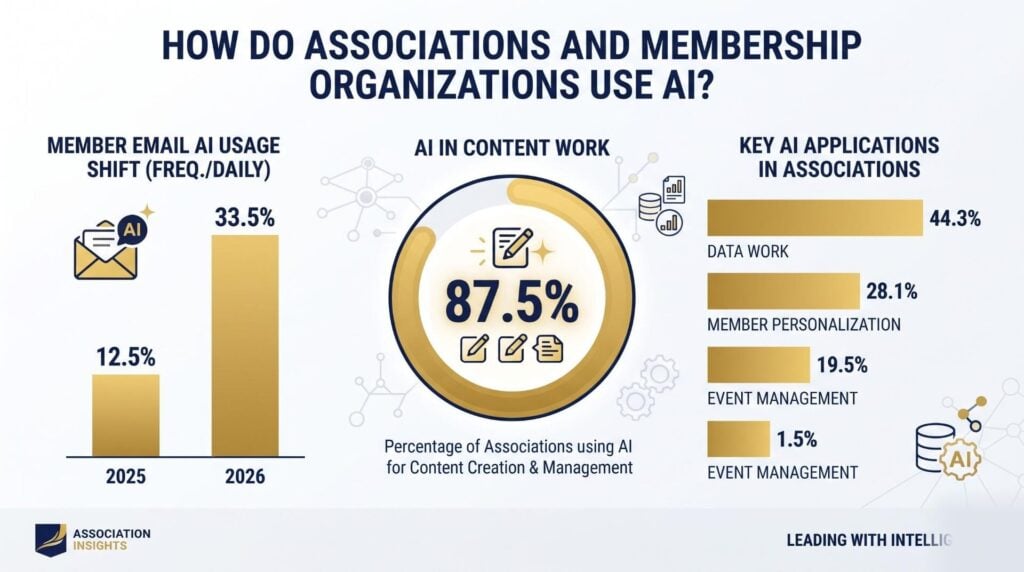
Two 2026 studies agree. Naylor’s report asked 665 association staff and found frequent or daily AI use in member email rising from 12.5% to 33.5% in one year, while ASAE’s State of Associations report, out in March, put content work at 87.5% and data work at 44.3%. Writing helped spread everywhere; the data work did not.
The new part is that these tools stopped just making reports. In August 2026 Momentive Software put out MomentiveIQ Agentic Workers, AI agents built for member groups. The first two:
- Membership Assistant covers the member cycle from welcome to renewal, spotting people who look like they are drifting and building the outreach for staff to check.
- Community Assistant watches your forum against rules you set, and flagged posts are held back rather than deleted, so a person makes the last call.
Both log each action with a time stamp, so you can tell a member why a post came down.
What AI Tools Help With Events and Engagement?
The best AI tools for member events sit inside what you now run: your association management software (AMS), your email tool and your forum. Add a broad AI helper such as Microsoft Copilot, Claude or Gemini for session blurbs and speaker briefs. Chatbots soak up the same questions about parking, times and dress code, freeing your team for talks that need a human.
Member data is where events stop being a one-off job. Naylor ranks email as the most valued channel at 83.4%, with group websites just behind at 80.6%, while heavy video use jumped from 3.2% to 24.5%. AI earns its keep by turning one keynote into a recap email, captioned clips, a members-only summary and a survey.
Feed the tool real turnout data, because a tip built on what members did last year beats a tidy line.
Can AI Help Your Association Grow Membership?
Yes, though rarely the way vendors describe it. AI grows a member base mostly by fixing retention and by helping the right people find you, not by making cold lists. It builds a profile from members who renewed and stayed active, then finds close matches in your event sign-ups and lapsed records. Most groups hold enough data to double their prospect pool.
Being found is the bigger limit. Higher Logic’s 2026 outlook notes that nearly 40% of non-members do not know a group exists for their role. AI widens your reach in search and AI chat by turning member questions into web answers: dull work that outlasts any campaign.
Non-dues income runs on the same data, and Naylor found it is the top worry for 51.9% of groups, while pattern work shows who reads your technical guides, the people who buy your paid courses.
How Do You Use AI in a Volunteer-Run Group?
Volunteer-run groups should pick one AI helper and use it for everything, not add a tool per task, because a volunteer with four hours a month cannot learn five screens. One helper that drafts the newsletter, sums up the board pack, tidies minutes and answers routine member email covers most of what a committee needs, and AI literacy spreads faster on one screen.
The barriers here are real but not technical. GrowthZone’s 2026 survey of more than 1,000 group and chamber staff found nearly half calling AI critical to future success, while tight budgets and thin staffing held them back. Time is the scarce resource.
Three habits get a board through a handover:
- Keep a shared prompt file, so the newsletter sounds the same whoever writes it.
- Store your group’s tone, past stands and house rules in one file the helper reads.
- Name one person who checks work published under the group’s name.
That is capability building on a volunteer’s clock.
AI Smart Ventures has run this kind of AI readiness check with close to 1,000 organizations. AI Advisory gives growing businesses and member groups a vendor-neutral read before signing.
What Should Your Association AI Policy Cover?
Your AI rules should cover four things: which tools are approved, what member data may go into them, who checks output before members see it, and how often you review the rules. ASAE’s February 2026 guidance adds a fifth, named measures of success, so you can tell if the tool helped. Write it short: two pages people read beat twenty pages no one opens.
Rules are catching up, slowly. ASAE reports that AI adoption among association staff doubled in a year to 39%, while groups with an AI policy rose from 23% to 40%. That gap is your risk.
Before a vendor touches your member list, ask for a data processing agreement (DPA), the contract setting out how a firm may store, use and wipe your data. Check in that DPA that member data will not train anyone’s model. Cisco’s 2026 privacy study found 75% of firms now have an AI oversight group, but just 12% call it mature. Openness pays: Higher Logic found 94% of members are comfortable with association AI that is clear and human-first.
Frequently Asked Questions
How much does it cost to add AI to an association?
Cost tracks three things: how many staff and volunteers need access, how much is built on your own data, and how long the rollout runs. It drops sharply when you fix one repeat job first. Most groups start on free tiers and spend more on people than software. AI Smart Ventures scopes that order. Schedule a consultation to map phase one.
What is association management software and does it need AI?
Association management software (AMS) is the core system that holds member records, dues, events and email. It does not need AI built in, but any AI you add works far better when it can read that system, because a tool that cannot see your member data gives flat, bland output. Check how a tool joins up before you check its features.
How do you keep member data safe when using AI tools?
Keep member data safe by limiting what leaves your systems and by putting those limits in writing. Use group accounts, not personal ones, switch off model training where the setting exists, and check the wipe terms in the contract. Never paste a full member export into a public AI tool. Give access by role, review it twice a year, and log every export.
Can AI write our newsletter and member emails?
Yes, and this is where most groups begin. AI drafts much faster than it decides, so give it past issues, your house style and the real facts, then edit hard. The common failure is bland copy that sounds like every other group. Keep a short voice file naming what you do and do not say, and let one editor sign off.
Does AI reduce the need for association staff?
In practice it changes what staff do all day rather than cutting jobs. Naylor’s 2026 report found complaints about being short-staffed falling from 51.3% to 35.1%, while the share reporting about the right level rose to 52.2%. Admin work shifts to software and member work shifts back to people, so operational efficiency rises while lean teams gain room.
How long does it take to see results from AI in an association?
One handed-over job often shows clear time savings within four to eight weeks, but wider change takes two or three quarters because the delay is rarely the software. It is cleaning the member data, agreeing who approves what, and training volunteers who give a few hours a month. Run one pilot, then take the hours it returns to your board.
What should an association AI policy include?
Include approved tools, allowed data, human check points, a line on when members will be told AI helped make something, and a review date. Say plainly which member fields may never go into an AI tool, and name the person who signs off work that members will see. ASAE suggests a yearly review at smaller groups, quarterly at larger ones.
How do you measure the return on AI in an association?
Measure hours given back each week, renewal rate and time to first reply, then weigh those against what the tools and training cost you in staff time. Pick one main measure and hold it steady for two quarters, because boards trust a single tracked number far more than a list of wins. Retention works best, since it links straight to dues.
Can AI help find non-dues revenue?
Yes, mainly by showing which members already signal intent. Your data reveals who reads the technical guides, sits in the advanced sessions and downloads the standards, and those people buy your paid courses and back your sponsors. Naylor found non-dues income is the top worry for 51.9% of groups. An aimed offer to two hundred keen members beats a mass blast.
Which association tasks should never be automated?
Never hand over ending a membership, discipline cases, complaints, ethics rulings or anything touching a member’s standing, and keep hardship and fee-waiver calls with people too. AI can pull the file, sum up the past and draft the letter, but a named human has to decide and sign. Anything a member could appeal needs a named person who owns the outcome.
How do you get board approval for an AI pilot?
Bring one narrow proposal, not a strategy. Name the job, the hours it eats now, the tool, the data it touches, who checks the output and how you will measure the result. Attach your draft AI rules so governance questions are answered before anyone asks. Boards turn down vague AI transformation plans and back a tight pilot with a stop point.
What is the first AI task a lean association should try?
Start with meeting notes or the dues reminder run, because both come round often, both eat hours, and neither carries much risk when a first draft is rough. Meeting notes show value inside a week, which builds trust fast with wary volunteers, while dues reminders touch money and so get board attention. Leave work that members will see until last.
Executive Summary
Member groups now use AI in four places: the member list and retention, events and content, growth, and forum checks. Sector data shows drafting has gone normal while the data work lags behind, and that gap is where the edge sits. The tools turned agentic in 2026, drafting outreach and queuing forum flags for staff sign-off, not just reporting a score. What sets apart the groups getting real value is dull: a clean member list, short written rules, a named checker, and one tracked number.
What Should You Do Next?
List the jobs your staff and volunteers repeat each week, mark the two that touch the most members, and check whether your AMS already covers them. Draft two pages of AI rules this month and name your checker.
AI Smart Ventures offers AI Advisory for growing businesses and member groups working out which member tasks to change first. Schedule a consultation to build a staged plan your board will back.
People Also Read
- What Is Claude Cowork? How Anthropic’s AI Desktop Agent Changes Knowledge Work
- Salesforce Einstein vs Microsoft Copilot: Which Is Better?
About the Author
Nicole A. Donnelly is the Founder of AI Smart Ventures and an AI Adoption Specialist with 20 years of experience as a founder and CEO and over a decade leading AI adoption initiatives. She helps businesses integrate artificial intelligence with clarity and confidence, driving innovation and sustainable growth. Nicole has trained over 20,217 professionals in Applied AI, delivered 624 workshops, and worked with close to 1,000 organizations across diverse industries.
Expertise: AI Transformation, AI Strategy, AI Implementation, AI Adoption, Applied AI, Marketing, Business Operations
Disclaimer: This content is for informational purposes only and does not constitute professional business or technology advice. Results vary based on industry, existing systems and implementation commitment. Contact AI Smart Ventures for a consultation regarding your specific situation.