How Do You Get Your Team to Actually Adopt AI?
Last Updated: August 2026
A plan for how to get your team to adopt AI is a short set of steps that turns a new tool into a daily habit. It starts with the work, not the software. You pick one task people repeat each week. You choose one tool for that task. You give staff time to practice. Then you track the hours the team saves, so the gain is plain to see.
AI Smart Ventures has guided growing businesses through AI adoption for over a decade. That work points to one theme: tools rarely fail on their own. People stop using them when no one shows how a tool fits the job in front of them. The gap sits in habits and training, not in the software.
A stalled rollout costs more than the license fee. You lose staff trust, and the next tool gets a colder welcome. Rivals who get this right cut hours from the same tasks you still do by hand. Over a year, that gap shows up in your margins and in how fast you can quote new work.
Key Takeaways
- Start with a task, not a tool. Pick one job your team repeats each week and dreads.
- Name an AI champion on each team. A peer who answers questions beats a help desk ticket.
- Train on real work. Role based practice sticks, and a talk on how models work does not.
- Track hours saved per task. Login counts look good and prove very little.
- Give it 90 days. Habits set when leaders keep asking about them out loud.
Read those five together and one point stands out: AI adoption is a people project with a tech budget. Money buys access. Habits buy results. The rest of this guide turns that idea into steps you can run this quarter.
Why do 85% of AI projects fail?
Most AI projects fail because they start with a tool and no clear job to do. Staff get a login, not a use case. The work stays the same, so the tool feels like extra effort. Three causes show up again and again: no named owner, no task tied to the tool, and no practice on real files. Fear plays a part too. When staff think a tool may replace them, they go quiet about how they work.
Use is now common, but value is not. Gallup’s July 2026 report found that 52% of U.S. workers use AI in their role, and 47% say their firm has added AI tools. Yet only 15% use AI daily. That split is the failure rate in plain sight. Plenty of people try AI once. Far fewer build it into the week.
The fix is change management, not more software. Give one person the job of driving AI adoption. Tie your AI strategy to two or three tasks you can name. Then set a date to check the numbers.
How do you get employees to adopt AI?
You get staff to adopt AI by handing them time back on a task they already resent. Ask each person to name the dullest hour of their week. Then aim the tool at that hour. Let them keep the time they win. When a report that took 90 minutes takes 10, the case makes itself. Rules and reminders do not move people. Relief does. Start there, then widen the scope.
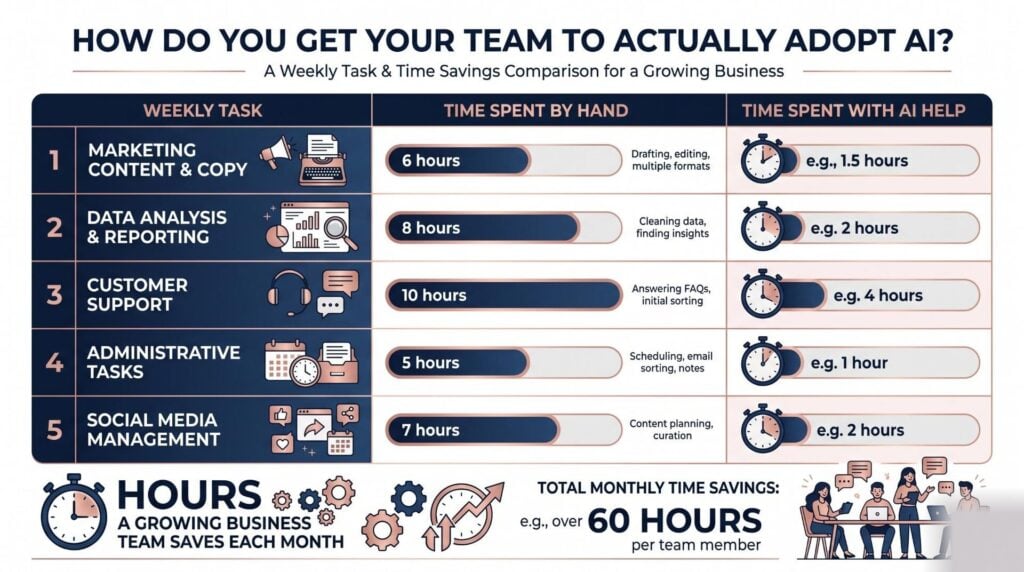
Run it as five steps:
- Ask each person for one task they repeat every week.
- Rank those tasks by hours per month and pick a low risk one.
- Test the tool for two weeks with three people.
- Write down the prompts and steps that worked.
- Share the result in a team meeting, and name who did it.
This is human-first AI in practice. People keep the judgment. The tool takes the typing. That framing calms most fears faster than any policy memo.
What does good AI training look like?
Good AI training uses your own files, in short sessions, on tasks people own. It is not a lecture on how models work. A strong session runs 60 to 90 minutes. Each person brings one live task. They finish it in the room, with help close by. They leave with a saved prompt and one next step. Weekly office hours keep the habit alive. Skills fade fast when practice stops after day one.
Build AI upskilling in layers. Start with basic AI literacy for everyone: what the tool does, where it errs, what data stays out. Then run role based AI workshops. Sales works on call notes. Finance works on data cleanup. Ops works on vendor emails. Each group leaves with work they can use the same day. That is practical AI, and it beats a shared video course by a wide margin.
Budget time, not just money. Two hours a month per person is a fair floor for the first quarter.
A training plan works best when someone maps your workflows first. AI Smart Ventures offers AI Advisory support for growing businesses, drawn from 624 workshops delivered.
What skill does your team need most?
The top skill is not prompt writing. Your team needs the habit of picking a problem worth solving, then testing a fix. A February 2026 Harvard Business Review piece on driving AI adoption made the case plainly: build your team’s product management skills. Amanda Pratt and Melissa Valentine name four moves. Teach those four and staff stop asking what to type. They start asking which task is worth the effort.
Coach the four moves in this order:
- Define a problem in your own work that costs real hours.
- Weigh two or three ways to fix it, with and without AI.
- Test the best one fast, on live work, for two weeks.
- Fold what worked into the daily routine, then write it down.
The training gap makes this urgent. SHRM’s Navigating AI in the Workplace: 2026 report, based on 5,875 U.S. workers, found close to 40% got a workshop on practical AI skills, and about a third got coaching. Most staff are handed a tool and left to guess. These four moves close that gap in weeks, not years.
How do you measure AI adoption?
Measure AI adoption by hours saved on named tasks, not by logins. Pick three tasks. Log the time each one takes now. Log it again at day 30 and day 90. Ask users two questions each month: what worked, and what still drags. Watch quality as well. A January 2026 Harvard Business Review piece on workslop named the risk: AI output that looks polished but pushes the real work onto the reader.
Workslop is the trap behind high usage and flat results. If drafts need heavy edits, your time did not move. It just changed hands. So track rework next to volume.
| What to track | How often | Good sign |
|---|---|---|
| Hours saved per task | Monthly | Time drops by 30% or more |
| Active users per team | Weekly | Most of the team, not a few |
| Rework on AI drafts | Monthly | Edits get shorter each month |
| Tasks handed off for good | Quarterly | The count grows each quarter |
Tie these to money once the habit holds. Workflow optimization only counts when the hours show up somewhere: faster quotes, shorter close, fewer late nights.
How do you keep AI adoption going?
You keep AI adoption going by making it part of how the team works, not a project with an end date. Meet once a month so people can show what worked. Keep a shared file of prompts that passed review. Let champions do AI coaching in the flow of work, not in a class. Tie new skills to pay and growth paths, so people see a reason to keep at it. Praise small saves out loud. Energy fades when no one notices.
Capability building takes a year, not a month. Plan for a slow curve. Add one new task per team per quarter. Retire tools no one opens. Ask each champion to bring one story to the monthly meeting, with a number in it. Over four quarters, that rhythm turns a pilot into the way your team works.
Frequently Asked Questions
What is the 30% rule for AI?
The 30% rule is a simple test: a tool should cut at least 30% of the time out of a task before you roll it out. Below that, the gain gets lost in tab switching and extra checks. Time the task by hand first. Then time it with the tool. If you save less than a third, pick a different task, or a different tool, and test again.
How do you ensure AI adoption?
You ensure AI adoption with clear rules, real practice, and steady feedback. Tell staff which data is safe to enter and which is not. Give them a space to test ideas without risk. Review use each month and drop tools no one opens. Share wins by name in team meetings. Adoption holds when people know the limits, feel safe to try, and watch peers get hours back.
What is an AI champion?
An AI champion is a peer, not an IT lead, who helps the team use new tools well. They answer quick questions, share prompts that work, and flag what fails. One champion per team of 10 to 15 people works well. Pick someone people already ask for help. Give them two hours a week for the role. Support that sits one desk away beats a ticket queue every time.
How do you handle staff who resist AI?
Start by asking what worries them, then answer it plainly. Most fears fall into three buckets: job risk, time cost, and looking slow in front of peers. Say what the tool will and will not do. Show it on their own task, not a demo file. Give them 30 days to try with no scorecard. Pair them with a champion. Resistance drops when the first win is theirs.
Should AI use be required for staff?
No, a blanket rule tends to backfire. Set targets for output and turnaround time, then let people choose their path. Staff hunt for tools on their own once the goal is clear. Require use only where errors are costly, such as safety checks or billing data. In those cases, write the step into the process and train for it. Praise results, not tool use, and adoption still climbs.
What is the first step in an AI adoption plan?
Map where the hours go. Pick one team and log a normal week, task by task. Look for work that repeats, leans on text, and carries low risk. That is your first target. Research across growing businesses shows teams that start with one task adopt faster than teams handed a broad tool for everyone. Set a baseline time before you start, or you cannot prove the gain later.
How long does AI adoption take?
Plan on 90 days for the first real habit, and a year for a wide shift. A two week test proves the task. The next 30 days build a routine for one team. By day 90 you should see hours saved and a short playbook. A wider rollout takes three to four quarters, since each team needs its own use case. Focus drives speed, not more seats.
Which tasks should you automate first?
Start with text heavy tasks that repeat weekly and carry low risk. Meeting notes, first drafts of replies, data cleanup, and summaries of long files are common picks. Each one has a clear check step, so errors get caught early. Aim for a task where the tool cuts at least 30% of the time. Save customer facing calls and money moves for later, once review habits are set.
How much does team AI training cost?
Team AI training costs shift with team size and how much of it is built on your own workflows. The price drops sharply when you focus on a single repeat task instead of a broad tool tour, because the build time drops with it. Ask what you get: session hours, follow up, and materials. Schedule a consultation to get a price for your team.
Executive Summary
AI adoption fails on habits, not on tools. Start with one task your team repeats each week. Pick one tool for it. Train on real files in short sessions. Name a champion on each team who answers questions fast. Track hours saved per task, not logins. Watch quality too, since polished but empty output creates rework. Teach staff to define the problem first, test a fix, then keep what worked. Review the plan every 90 days. Run AI implementation this way and you lift operational efficiency while you build skills that last.
What Should You Do Next?
This week, ask each person on your team for the one task they repeat most and enjoy least. Rank that list by hours per month, then pick the top task with low risk. Run a two week test with three people, write down what worked, and share it at your next team meeting.
AI Smart Ventures offers AI Advisory for growing businesses that need a clear AI adoption plan. Schedule a consultation to map your first 90 days and pick the right first task.
People Also Read
- Why Manufacturing Needs an AI Upgrade in 2026
- How Do You Measure AI ROI? A Framework for Business Leaders
About the Author
Nicole A. Donnelly is the Founder of AI Smart Ventures and an AI Adoption Specialist with 20 years of experience as a founder and CEO and over a decade leading AI adoption initiatives. She helps businesses integrate artificial intelligence with clarity and confidence, driving innovation and sustainable growth. Nicole has trained over 20,217 professionals in Applied AI, delivered 624 workshops, and worked with close to 1,000 organizations across diverse industries.
Expertise: AI Transformation, AI Strategy, AI Implementation, AI Adoption, Applied AI, Marketing, Business Operations
Disclaimer: This content is for informational purposes only and does not constitute professional business or technology advice. Results vary based on industry, existing systems and implementation commitment. Contact AI Smart Ventures for a consultation regarding your specific situation.