
How Do You Use AI for Quality Control in Manufacturing?
Last Updated: August 2026
AI quality control for manufacturers is the use of computer vision and machine learning to check parts as they move down a line. A camera sees each unit, and a trained model weighs that shot against known good parts. The system flags scratches, wrong labels, missing screws or drifting sizes in a fraction of a second. A fixed-rule checker breaks when the light shifts; a model that learned from real parts keeps working.
AI Smart Ventures has guided hundreds of growing businesses through AI adoption, plant floors included. One pattern repeats across that work: teams that pick a single, well-defined defect reach a working system far sooner than teams that try to check everything at once. Scope decides the outcome more often than the tech does.
Getting scope wrong is costly in a way that shows up late. A model trained on the wrong shots can pass bad parts for months, and each escape reaches a buyer before anyone spots the drift. Get it right and you gain a written record of why each part passed, which turns a quality fight into a data question.
Key Takeaways
- Start with one defect on one station. A narrow scope proves the model works and gives your team a baseline for the next station.
- Good shots beat many shots. A few hundred well-lit, well-labeled parts, sound and faulty, teach a model more than thousands of blurry ones.
- AI checks are now normal quality work rather than a trial, and close to half of the plants in one 2026 survey run AI in quality today.
- Plan the people side with the hardware. Your team moves into oversight, odd cases and model tuning, and that shift needs AI training, not a memo.
- Keep the model honest after go-live. Light, vendors and tooling all drift, so review false rejects and missed defects the way you plan machine upkeep.
Those five points share one root cause: a model is a living asset, not a purchase. It learns one moment in your process, and your process keeps moving. Plants that treat the model as gear with a service schedule hold their scores; plants that treat it as bought software watch it decay across a year.
How does AI improve quality control in manufacturing?
AI improves quality control in three ways. It checks each unit instead of a sample, it holds one standard at hour eight as at hour one, and it ties each defect back to the line data around it. A person on a fast line can only sample. A camera and model score all of them, log the result, and hand you a record of what your line really made last quarter.
The third gain grows over time. Because each scan is stored with a time stamp, you can ask which shift, tool or lot the failures cluster around. That turns a vague gripe about scrap into a sharp question your team can settle in an afternoon, well before a whole batch goes wrong.
What is changing in AI quality control in 2026?
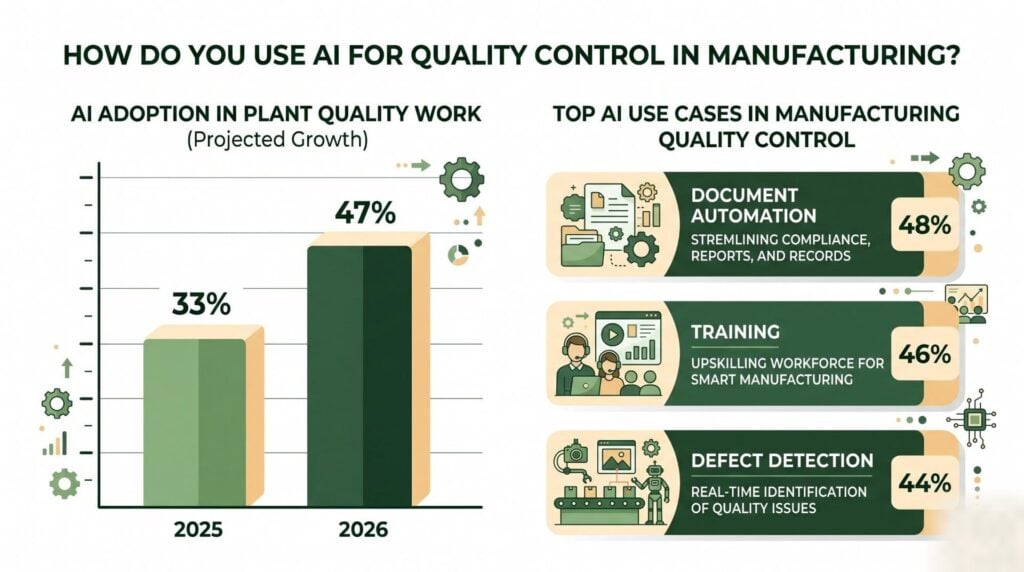
The change in 2026 is that AI in quality work stopped being a trial. Octave’s Pulse of Quality in Manufacturing 2026 survey, out on 3 June 2026, polled 2,263 quality leaders in the US, UK and Germany. It found 47% now use AI in quality work, up from 33% a year before, with a further 43% set to deploy within two years.
Three shifts sit behind that jump:
- Defect finding moved into the top tier of use cases. In that same survey, 44% of AI users named defect detection, just behind document automation at 48%, so checks are no longer a side project.
- Setup stopped needing labeled defect shots. In April 2026, Overview launched a vision package for new product launches that pairs smart cameras with no-code anomaly finding, so a line can flag new defect types within hours rather than months.
- AI turned normal in plant work. The eleventh Rockwell Automation State of Smart Manufacturing Report, out 19 May 2026 from 1,560 people in 17 countries, found 34% of operations AI-augmented, with quality named a core function.
The same Octave survey found 78% of plants hit by labor or skills gaps, and 85% said those gaps hurt product quality. That explains the spend: AI now covers work plants can no longer staff with skilled eyes.
How does computer vision work on a shop floor?
Vision on a shop floor runs as a loop: capture, compare, decide, act. A fixed camera shoots each unit on the line, and an edge box runs the model right there, so the answer lands in milliseconds. The model scores how far that shot sits from the good parts it learned. If the score crosses your limit, the line pulls the part and logs why.
Two design calls decide whether the loop holds up. The first is light, because a model trained under one lamp misjudges parts under another, and steady fixtures cost far less than a retrain. The second is the limit you set: too tight and you scrap sound parts, too loose and defects walk out the door, so most teams tune that number using real rejects.
What AI tools are used for quality control?
Shop floors mix four kinds of tools: smart cameras that score on board, edge boxes that run bigger models, a platform that stores shots and results, and the line controls that act on the verdict. Sensors beyond cameras feed the model too, such as laser profilers for shape and load cells for weight. What matters is not the brand but whether the verdict reaches your controls in time.
| Layer | What it does | What to check first |
|---|---|---|
| Smart camera | Shoots the part and often scores it on board | Frame rate against line speed, mounting room, lens distance |
| Edge box | Runs bigger models beside the line, no cloud trip | Score time per part, tolerance for heat, shake and dust |
| Model platform | Stores shots, trains versions, tracks drift | Whether you own the shots and can export the model |
| Line controls | Pass the verdict to sorters and stop signals | Signal support for your kit and existing scanners |
Older machines still fit. If a line sends any signal, the vision system reads it or writes back through the same wiring; if it sends nothing, plants add a camera as a stand-alone station. Neither route needs a rip-and-replace project, so workflow optimization here adds rather than disrupts.
How do you start an AI quality control pilot?
Start with the defect that costs you most, on the station where it shows up, and nowhere else. Write down today’s escape rate and check time before anything is fitted, or you cannot prove the pilot worked. Then gather shots of good parts and of each failure mode you care about, under the light your line has, not a bench lamp.
Shadow mode is the step teams skip and later regret. For a few weeks the model calls each part while your staff still make the real call, and you compare the two records. The gaps are the useful output: each one is either a defect people miss or a false reject you need to tune out. Only once the records agree should the model get the call.
Scoping that first station is where most plants stall. AI Smart Ventures offers AI consulting that helps growing businesses choose the right defect, station and vendor before any hardware is ordered.
How do you train staff to run AI inspections?
Train your team to watch the system rather than to run it. Their new work is judging the odd cases the model flags as unsure, spotting when scores slip, and feeding fresh shots back into training. That is a move from looking at parts to reading proof, and it needs real AI upskilling rather than a one-hour handover at shift change.
Pushback tends to come from a fair question: what happens to my job? Answer it early and plainly. On most lines that headcount moves into setup, root-cause work and vendor quality, which are harder roles to fill than looking at parts. Naming those paths before install kills the rumor, and this change management shapes uptake more than the tech does.
Frequently Asked Questions
What results can manufacturers expect from AI quality control?
Expect steady checks first and savings second. Each unit gets the same check at the end of a shift as at the start, which narrows the swing that drives buyer complaints. Rockwell Automation found 34% of operations AI-augmented, with quality among the core functions. Gains show up as fewer escapes, less rework and faster root-cause work, and they land station by station.
How does AI inspection differ from older machine vision?
Older machine vision follows fixed rules: measure this edge, check this pixel range, pass or fail. It is fast and exact, and it breaks when a part turns slightly or a lamp ages. AI vision learns from real parts instead, so it still reads a good part under light it has not seen before. Fixed rules still win on precise measures, which is why many lines run both.
Can AI quality control work with older plant machines?
Yes, in most cases. If a machine sends any signal at all, the vision system can read it or write back through the same wiring, and no new machine is needed. Where a machine sends nothing, plants add cameras and sensors as a stand-alone station between steps. The real limit is floor space and light on the line, not the age of the kit.
How much data do you need to train an inspection model?
Fewer shots than most teams expect, if the shots are good. A few hundred per defect type, taken under plant light and from the camera’s real angle, beat thousands of casual photos. Anomaly finding narrows this further by learning what a good part looks like and flagging anything unlike it. The hard case is rare defects, where teams often stage samples to build a fair set.
How long does an AI quality control rollout take?
Plan in phases rather than around one date. A first station moves through four stages: gather shots, train the model, run in shadow beside your team, then let it drive the sorter. Gathering shots sets the pace, because you cannot train on defects the line has not yet made. Heat, shake or poor light add time at the mounting stage. A narrow first scope keeps each phase clear.
What does AI quality control cost a growing manufacturer?
Cost depends on scope, so the honest answer is a shape rather than a number. A one-station pilot carries camera hardware, model setup, wiring into your line controls, and staff time. Rented platforms spread that across months, while owned systems load it up front. What moves the total most is how many defect types you ask the model to learn. Schedule a consultation to scope your first station before you request quotes.
Do human inspectors still have a role after AI arrives?
Yes, and the role changes shape. The model takes the repeat pass-or-fail call, while people take the unsure cases, the root causes and the vendor talks that follow a pattern of failures. Someone also has to spot when scores drift, which no system reports well on itself. Looking at parts shrinks while setup, tuning and quality work grow, so human-first AI keeps judgment where judgment counts.
How do you keep an inspection model accurate over time?
Treat the model as a service item with a schedule. Review false rejects and missed defects weekly at first, then monthly once the numbers settle, and log each change to light, tooling or vendors. Every one of those shifts what the camera sees. When drift shows up, retrain on recent shots rather than the first set, and version the model so you can roll back if a retrain scores worse.
How do you measure whether AI quality control is working?
Compare against the baseline you wrote down before install. Track four numbers: escape rate to the buyer, false reject rate, check time per unit, and hours spent on rework. Escape rate proves the model catches what people missed, and false rejection rate proves it is not scrapping sound stock. Rising rework beside falling escapes usually means your limit is too tight. Read all four together.
Executive Summary
AI quality control for manufacturers puts a camera and a trained model on the line so each unit gets the same check. The practice went mainstream during 2026, with close to half of the plants in one survey now using AI in quality work. The winning pattern is narrow. Pick the defect that costs most, baseline it, gather shots under real light, then run the model in shadow before it drives the line. Train your staff to watch rather than to look, and treat model reviews as upkeep. Capability building, not hardware, turns checks into lasting operational efficiency.
What Should You Do Next?
This week, pull your scrap and rework records and rank the defects by what they cost you in time. Take the top one, note the station where it shows up, and shoot fifty good parts plus each failure sample you can find under the line’s own light. That folder is the start of your data set.
AI Smart Ventures offers AI consulting for growing businesses planning a first vision station, from defect choice and AI strategy through vendor picks. Schedule a consultation to turn that folder of shots into a scoped pilot with a clear baseline.
People Also Read
- What Is AI Transformation for Professional Services Firms?
- What Is AI Coaching for Founders and Why Does It Work?
About the Author
Nicole A. Donnelly is the Founder of AI Smart Ventures and an AI Adoption Specialist with 20 years of experience as a founder and CEO and over a decade leading AI adoption initiatives. She helps businesses integrate artificial intelligence with clarity and confidence, driving innovation and sustainable growth. Nicole has trained over 20,217 professionals in Applied AI, delivered 624 workshops, and worked with close to 1,000 organizations across diverse industries.
Expertise: AI Transformation, AI Strategy, AI Implementation, AI Adoption, Applied AI, Marketing, Business Operations
Disclaimer: This content is for informational purposes only and does not constitute professional business or technology advice. Results vary based on industry, existing systems and implementation commitment. Contact AI Smart Ventures for a consultation regarding your specific situation.

