
How Do You Build an AI Voice Guide for Your Brand?
Last Updated: August 2026
An AI voice guide is a short working file that turns your brand voice into rules a model can follow. It is how you maintain brand voice with AI without editing every draft by hand. It sets out how your sentences are built, the words you always and never use, and what a strong draft looks like. A brand book is written for people. This file is written for software, so every line points at something on the page.
AI Smart Ventures has guided growing businesses through AI adoption in their content work for over a decade. One pattern repeats: a team writes a page of tone words, feeds it to a tool, and gets back a copy that reads like everyone else. The gap is rarely the model. It is the file.
Voice is the last thing a rival cannot copy off your website, and it slips first once volume climbs. Get the file right and each new hire picks up your standards. Get it wrong and you edit by hand for a year.
Key Takeaways
- Write rules, not adjectives. “Warm and professional” cannot be checked, while “no exclamation marks, contractions always, never open with a question” can.
- Pull your voice from writing you already have, since ten pieces that worked say more than a day of sticky notes.
- Test the guide with a blind read: mix AI drafts with your own, strip the bylines, and ask three people to pick yours.
- Store it as plain text and review it quarterly, since a guide nobody updates records who you used to be.
All four point one way: voice work is writing things down, though most teams treat it as a creative exercise.
What belongs in an AI voice guide?
An AI voice guide holds five things: rules for how your sentences get built, a list of words you always and never use, three to five samples with notes, the claims and tones you refuse, and your exceptions by channel. That runs to about two pages. Everything else people load into these files, the mission statement, the founding story, the personality words, changes nothing about the draft that comes back. If a line cannot change a sentence, it is decoration.
Build rules do the heavy lifting: name your average sentence length, whether you use contractions, how a piece opens, and the marks you refuse. Samples earn their place only with notes, since five posts show a model of what you published, while a line on each tells it what to copy.
How do you find your voice in writing you already have?
You find it by mining your archive, not by inventing it in a workshop. Pull ten to fifteen pieces that did well and that your team agrees sound like you, then set aside two or three that felt off. The difference between those piles is your voice, and it is already written down. Your job is to describe that difference in terms a stranger could apply, then keep the notes that survive a second reader. None of this needs an agency.
Read for patterns rather than feelings, counting the words in your sentences and noticing how often you reach for questions, humor or numbers. Openings and closings carry more voice than the middle.
A model can help you sort the pile, but never ask it to write your rules. A 2025 style-copying study presented at EMNLP ran over 40,000 drafts per model against writing from 400 authors. Models matched set formats such as news and email well enough, yet struggled with looser writing, and extra samples did not close the gap. Samples are evidence; rules are instructions.
What makes a voice rule an AI can follow?
A rule works when two people reading the same draft would agree on whether it was broken. “Sound like a trusted advisor” fails that test, because everyone pictures a different advisor. “Open with the answer, then the reason” passes, because you can point at the first sentence and settle it in seconds. Adjectives describe a mood, while rules describe a behavior you can see, and that is the difference between a file that shapes drafts and one that decorates a folder.
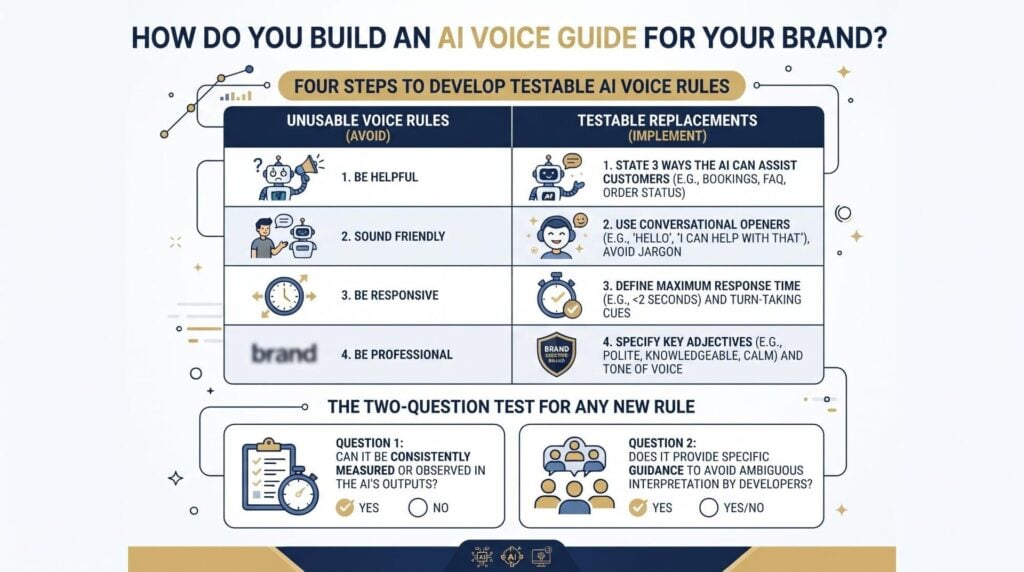
| Rule you cannot follow | Why it fails | Rule you can |
|---|---|---|
| Be warm and authentic | Names a feeling | Use contractions. Call the reader “you”. Never write “we are excited to announce” |
| Professional yet approachable | Two editors grade it two ways | No exclamation marks, no emoji, one joke per piece and never in the opening |
| Write short, punchy copy | Short by whose measure | Average 15 to 20 words per sentence, none over 30 |
| Sound like a trusted advisor | Describes a person | Open with the answer, then the reason. Never open with a question |
Run each new rule past two questions. Can you point at a sentence that breaks it, and would two reviewers agree? A rule failing either test belongs in your positioning file.
How do you test whether your voice guide works?
Test it with a blind comparison, not a read-through, because your own draft always sounds right to you. Write one brief, produce a draft with the guide attached, and set it beside a piece you wrote yourself on the same subject. Then strip the bylines from four samples, two yours and two from the model, and ask three people who know the brand to pick yours. If they get it right every time, the guide still has a hole in it.
Keep score in a way that survives a bad mood, counting the rules each draft breaks across ten pieces, since a guide that works pushes that number down in a month.
Then fix the guide rather than the draft, because any correction your editor makes twice is a rule nobody wrote down. That is where voice work fails: the standards live in one head, then leave with that person. Writing them down is capability building.
That loop comes together faster with outside eyes. AI Smart Ventures offers AI advisory for growing businesses covering voice files, tool choice and review habits.
Where should your voice guide live and who owns it?
It belongs in a plain text or markdown file that any tool can read, with one named owner and a date at the top. A slide deck looks better and works worse, since several tools cannot read it cleanly. Storage is a workflow choice rather than a design one, so keep the file where your working documents live and attach it to every session, rather than trusting a model to recall last week. Plain text survives your next tool switch.
Three shifts in the past year changed where this file belongs:
- Brand rules became a format, not a paste. Anthropic introduced Agent Skills on 16 October 2025 and published the format as an open standard that December. A skill is a folder of instructions a model loads when the task needs it, with brand guidelines as an example on day one.
- The visual half of your identity travels by itself. Canva linked its Brand Kits to ChatGPT on 5 February 2026, then to Gemini in May 2026, so logos, fonts and colors apply unasked.
- Nobody ships your sentences for you. Colors and fonts are stored data any tool can carry, while your sentence rules are stored nowhere. That is why the file stays your job.
Name one owner rather than a committee, usually whoever edits the most work, and revisit the file whenever your position shifts.
Frequently Asked Questions
How do you maintain a consistent brand voice in AI systems?
Attach the same voice file to every session, then check drafts against it before anything goes out. Consistency comes from one shared file rather than several private prompts. Keep the file in plain text, give it an owner, and log each change. Work through the rules as a list rather than by feel, since voice drift hides itself piece by piece.
How do you create an AI brand voice from scratch?
Start with the writing you already have. Gather ten to fifteen pieces that worked, mark two or three that felt wrong, and describe the difference as rules a stranger could apply. Draft the file in an afternoon, use it on real work for two weeks, then rewrite it with whatever you learned. A guide nobody has tested is only a guess.
How do you stop AI from flattening your brand voice?
Give the model less room to fall back on its defaults. Models drift toward a polite, even register whenever the brief is thin, so name the opening, the length, the banned words and the reader. In a June 2026 Clutch survey of 408 US consumers, 55% said they view a brand less favorably once they can tell AI made the work.
How long should an AI voice guide be?
Two pages is the working target and one page is a fine start. These files get long because they repeat your values three ways, not because your voice is complicated. If a section has never settled an argument about a draft, cut it. Short files also paste into tools cleanly, so nobody has to trim yours to make it fit.
How many writing samples should a voice guide include?
Three to five samples with notes do more than twenty raw ones. Each needs a short line saying what it gets right, because a folder of strong posts shows a model of what you published rather than what to repeat. Pick samples from different channels so the file catches your voice in a short email as well as in a long article.
What is the difference between brand voice and brand tone?
Voice stays constant while tone shifts with the moment. Your voice covers how sentences get built, which words you use, and what you refuse to say, and it holds steady across a launch post and an apology. Tone is the dial you turn, warmer here, firmer there. Put voice in the file, then pass the tone you want in each prompt.
Who should own the brand voice guide?
One named person should own it, usually whoever edits the most published work. Ownership by committee produces a file that says nothing at all, because each reviewer softens a rule until it stops ruling anything out. The owner takes suggestions from anyone, decides what goes in, and keeps a dated log so the team can see what moved and when.
How often should you update an AI voice guide?
Review it each quarter, and update it the same week your market position moves. Update it after any piece that clearly beats the rest as well, because something in that piece deserves to be named as a rule. Between reviews, keep a note of the fixes your editors make twice, since those repeats are the next version of the file, already written for you.
Do you need a separate voice guide for each channel?
No. Keep one guide and add a short list of exceptions for each channel. Your voice does not change between an email and a stage talk, though length, layout and how formal you sound all do. Two or three lines per channel covers it. Separate files drift apart within a quarter, and then nobody can tell you which one is current.
Can a free AI tool use a brand voice guide?
Yes. Every mainstream assistant lets you attach a file or save standing instructions across a whole project, and both of those work on free tiers. Paid plans mostly buy longer context, shared workspaces and admin control rather than better voice matching. Start with whatever your team already has, then upgrade only once several people need to share one working setup.
How do you get a new writer using the voice guide?
Hand them the file in week one, then have them run one real piece through it while a colleague reviews the result. Ask for one change after thirty days, since a fresh reader finds vague rules faster than the author will. Treat this as part of joining the team rather than as AI upskilling or AI literacy training handled apart.
What does it take to get started with an AI voice guide?
Plan on two weeks of part-time work rather than a project. Week one gathers samples and drafts the rules, week two tests them on live work and cuts whatever nobody used. The real investment here is attention, because someone senior has to decide what you refuse to say. Schedule a consultation to map that sequence against your own content workflow.
Executive Summary
An AI voice guide works when it is written for a machine and short enough for a person to keep current. Build it from writing you already have, turning every adjective into a rule you could point at in a draft. Test it with a blind read against your own work, count the rules a draft breaks instead of trusting your ear, and fix the file rather than the draft. Store it as plain text, put one owner on it, and review the file every quarter.
What Should You Do Next?
This week, pull ten pieces of your own writing that worked and mark two that did not. Turn the differences into ten rules you could point at in any draft, then run one live piece through a tool with the file attached. What your editor still fixes becomes version two.
AI Smart Ventures offers AI advisory for growing businesses building AI enablement into their content work. Schedule a consultation to build a guide your team will use.
People Also Read
- How to Build an AI-Powered Knowledge Base for Your Team
- ChatGPT Canvas vs Claude Artifacts: Which AI Collaboration Feature Is Better for Teams?
About the Author
Nicole A. Donnelly is the Founder of AI Smart Ventures and an AI Adoption Specialist with 20 years of experience as a founder and CEO and over a decade leading AI adoption initiatives. She helps businesses integrate artificial intelligence with clarity and confidence, driving innovation and sustainable growth. Nicole has trained over 20,217 professionals in Applied AI, delivered 624 workshops, and worked with close to 1,000 organizations across diverse industries.
Expertise: AI Transformation, AI Strategy, AI Implementation, AI Adoption, Applied AI, Marketing, Business Operations
Disclaimer: This content is for informational purposes only and does not constitute professional business or technology advice. Results vary based on industry, existing systems and implementation commitment. Contact AI Smart Ventures for a consultation regarding your specific situation.