
How Owner-Operators Reward AI Wins Without Punishing Non-Adopters
Last Updated: May 2026
An AI wins program for owner-operators rewards team members who try new AI tools and get results. It also keeps those who have not yet started from feeling left out or penalized for being slow to begin. Deloitte’s State of AI in the Enterprise report found that growing businesses that rewarded AI wins saw a 43 percent higher AI use rate six months later. That is compared to those that focused only on telling staff to use AI. For a lean team, that gap is the difference between a team that tries AI and one that avoids it.
AI Smart Ventures has worked with close to 1,000 growing businesses on AI use, including owner-operators who built AI reward programs that raised AI use without creating a two-tier team. The sections below show why rewards matter, what counts as a win, and how to keep non-adopters in the loop.
Key Takeaways
- Reward Goal – An AI wins program rewards team members who try AI and get results, without making those who have not yet started feel left out or pushed aside.
- AI Use Lift – Growing businesses that rewarded AI wins saw a 43 percent higher AI use rate, per Deloitte’s State of AI in the Enterprise report, compared to those that focused only on mandating AI use.
- Non-Adopter Risk – A reward program that feels like a race can push slow starters away from AI tools and make the gap between early adopters and the rest of the team wider over time.
- What Counts – An AI win does not have to be big, and a team member who saves 30 minutes a week using AI is a win worth sharing with the full team.
- First Step – Start by defining one clear example of an AI win in your business, then share it in a team meeting so every team member knows what success looks like before they try any tool.
Owner-operators who reward AI wins early and share those wins with the full team build a culture where every team member sees a clear path to their own first AI win.
Why Do Owner-Operators Need to Reward AI Wins?
Owner-operators who reward AI wins raise team use faster than those who mandate AI without any praise or shared story. A shared win gives the team a clear picture of what AI looks like in a real work day. That picture is often what a slow starter needs to decide to try. The win does not have to be large to move the team forward.
McKinsey’s 2025 State of AI report found that growing businesses where leaders shared at least one AI win per month saw AI use spread 38 percent faster. That is compared to those where wins were tracked but not shared with the team. For an owner-operator, sharing a win costs nothing and takes five minutes in a team meeting. The impact is often larger than any training session. One story in a real team meeting beats one slide in a required training every time.
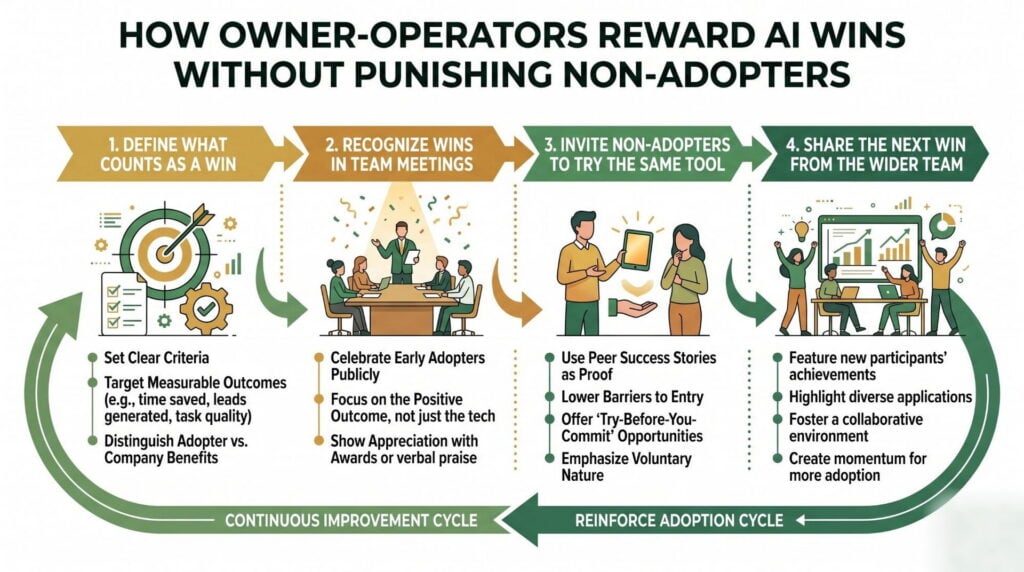
Three reasons owner-operators reward AI wins rather than mandate AI use:
- Story Over Policy – A team member who hears a real win from a peer is more likely to try AI than one who reads a policy. The story shows what success looks like in a real work day.
- Low-Cost Momentum – Sharing a win in a team meeting costs nothing and takes five minutes. It gives every team member who has not yet tried AI a clear reason to start and a clear tool to start with.
- Non-Adopter Bridge – Rewarding a win and then inviting non-adopters to try the same tool gives slow starters a path in. That bridge keeps the team together during an AI rollout.
Start by picking one win from the past 30 days and sharing it in your next team meeting. That is the whole first step of the AI wins program.
How Do You Reward AI Wins Without Pressure?
Rewarding AI wins without pressure starts with one rule: the reward goes to the result, not the tool. Team members who try AI and find it does not fit that week should not feel they failed. Praise the try as well as the result. Public praise in a team meeting gives every other team member a clear signal that trying AI is safe.
PwC’s 2026 Digital Trends in Operations Survey found that growing businesses where leaders praised AI effort as well as results saw 29 percent higher AI use rates. That is compared to those that praised results only. For a lean team, the owner sets the tone for what counts. One good-try note in a team meeting often brings the next three team members into their first AI attempt. Keep the bar low at the start and raise it as the team builds confidence.
Three steps to reward AI wins without creating pressure on non-adopters:
- Praise Effort First – For the first 90 days of any AI rollout, reward team members for trying a tool, not just for getting a result. This makes the bar for recognition reachable by every team member from day one.
- Keep It Public and Brief – Share each win in a team meeting or team chat in two sentences or less. A long win story can feel like a performance review for team members who have not yet tried.
- Invite, Do Not Push – After each win, ask one team member who has not yet tried the tool if they want a five-minute walk-through. Make the offer easy to say no to. That way it feels like an offer rather than a mandate.
The AI implementation team at AI Smart Ventures helps owner-operators build AI reward programs that raise use rates without creating a two-tier team where early adopters feel ahead and slow starters feel behind.
What Counts as an AI Win for a Small Team?
An AI win is any result where the tool saved time or cut a mistake. It also counts when a team member can do a task they could not do before. A team member who saves 30 minutes on a weekly report using AI is a win worth sharing. So is a client email drafted in five minutes instead of 20. The bar for a win is any clear before-and-after the team member can name in one sentence.
Accenture’s customer service and AI research found that growing businesses that defined a win as any measurable time save had 51 percent more team members try AI in the first 90 days. That is compared to those that set a high bar for what counted. A low bar means more team members can reach it in the first month. More first wins in the first month means more second and third wins that follow. Start with the smallest win your team can name.
| Win Type | Example | Time to First Win |
|---|---|---|
| Time save | Report that took 2 hours now takes 30 min | Week 1 |
| Error catch | AI flags a data entry mistake before it ships | Week 2 |
| Draft speed | Client email drafted in 5 min instead of 20 | Week 1 |
| New output | Team member creates a report they could not do before | Week 3 |
The AI advisory team at AI Smart Ventures works with owner-operators to define the first three AI wins for their team and set a clear bar for what counts before the reward program starts.
What Are the Risks of AI Reward Programs?
The main risks of an AI reward program are a bar too high for slow starters and a reward that feels like a ranking. A win story that only fits one role also fails. The rest of the team cannot see how to get the same result in their work. Each risk shows up in the first 30 days if you ask who has tried and who has not yet started.
McKinsey’s 2025 State of AI report found that 34 percent of growing businesses that ran an AI reward program saw a drop in team trust in the first three months. That happened when the program felt like a ranking rather than a shared path. A reward program that creates a gap between adopters and non-adopters can slow overall AI use. Team members who feel left behind stop trying rather than ask for help. The fix is to share every win as a team story, not a personal score.
How Do You Know If Your AI Rewards Are Working?
The clearest sign an AI reward program is working is a rise in first-time AI users in the 30 days after each win is shared. Track how many team members try AI in each 30-day window. Compare that number before and after the reward program starts. If first-time AI users rise each month, the program is doing its job.
Deloitte’s State of AI in the Enterprise report found that growing businesses that tracked first-time AI users each month were 46 percent more likely to reach full team AI use within one year. That is compared to those that tracked only output metrics like time saved. The number of first-time users is the leading signal. It shows whether the program is bringing new team members in or only keeping early adopters engaged. One new first-time user per month per team is a strong sign the program is on track.
Frequently Asked Questions
What is an AI wins program for owner-operators?
An AI wins program rewards team members who try new AI tools and get results. It keeps those who have not started from feeling left out. The program sets a clear bar for what counts as a win. Wins are shared in team meetings on a regular basis. The goal is for every member to find their own first AI win.
Why do non-adopters need to be included in an AI reward program?
A reward program that only praises early adopters can make slow starters feel left behind. That feeling often leads to less AI use, not more. Including non-adopters means inviting them to try the same tool after a win is shared. It keeps the team moving together. The goal is not to reward the fastest, but to bring the full team along.
What counts as an AI win for a small team?
An AI win is any result where a tool saved time or cut a mistake. A team member who saves 30 minutes on a report is a win worth sharing. So is a client email drafted in five minutes instead of 20. The bar does not have to be high. A low bar means more team members can reach their first win fast.
How do you reward AI wins without creating a two-tier team?
Reward AI wins by praising effort as well as results. Share wins in two sentences or less in team meetings. Invite non-adopters to try the same tool rather than pointing out who has not started. Keep the bar low in the first 90 days for everyone to reach it. Raise the bar only when the full team has at least one win.
How often should owner-operators share AI wins with the team?
Share at least one AI win per month in a team meeting or chat. That keeps AI top of mind without making it feel like a weekly check-in. In an active rollout, share one win per week for the first 90 days. Drop to monthly when AI use becomes part of the normal work day. Keep the cadence tied to real results.
What are the risks of AI reward programs for lean teams?
The main risks are a bar that is too high for slow starters. A reward that feels like a ranking is also a risk. A win story too specific to one role fails the rest of the team. Check in with the full team after 30 days. Adjust the bar or the invite process based on what you hear.
How long does it take to see results from an AI wins program?
Most owner-operators see the first rise in first-time AI users within 30 to 60 days. The first shared win gives the team a clear example of what to try. Track first-time AI users each month and compare to the month before the program. If the number rises for three months in a row, the program is working. You can then expand it to cover more tools.
How much does it cost to start an AI wins program?
An AI wins program costs nothing to start if your team already uses AI. Start by defining and sharing a win from a tool you already use. A formal AI coaching or training program costs more. The range is a few hundred to a few thousand dollars depending on team size. Contact AI Smart Ventures for a scoping call based on your team.
Executive Summary
An AI wins program rewards team members who try AI and get results. It keeps non-adopters from feeling left out. The key is inviting them to try the same tool after each win is shared. The main risk is a bar that is too high. A reward that feels like a ranking also pushes slow starters away rather than bringing them in. Start with one win from the past 30 days. Share it in the next team meeting. Track how many new first-time AI users appear in the 30 days that follow.
What Should You Do Next?
List the one AI win your team has had in the past 30 days that a non-adopter could also try this week. That win is the first story for your AI wins program, and you can share it in your next team meeting.
AI Smart Ventures offers AI consulting for growing businesses that want to raise AI use across the full team without leaving slow starters behind. Schedule a consultation to build an AI wins program that fits your team size and your current AI tools.
People Also Read
- How Do You Measure AI ROI? A Framework for Business Leaders
- How Do You Address Employee AI Anxiety Without an HR Department?
About the Author
Nicole A. Donnelly is the Founder of AI Smart Ventures and an AI Adoption Specialist with 20 years of experience as a founder and CEO and over a decade leading AI adoption. She helps businesses add AI with clarity and confidence. Nicole has trained over 20,217 professionals in Applied AI, delivered 624 workshops, and worked with close to 1,000 organizations across diverse industries.
Expertise: AI Transformation, AI Strategy, AI Implementation, AI Adoption, Applied AI, Marketing, Business Operations
Disclaimer: This content is for informational purposes only and does not constitute professional business or technology advice. Results vary based on industry, existing systems and implementation commitment. Contact AI Smart Ventures for a consultation regarding your specific situation.