
The AI Skeptic on Your Leadership Team: A Guide
Last Updated: May 2026
An AI skeptic on a leadership team is a senior leader who doubts the value, timing, or readiness of AI adoption. When left unaddressed, they slow or block AI plans the rest of the team supports. Gartner research on AI adoption names internal leadership pushback as a top cause of stalled plans. The skeptic typically holds a finance, operations, or legal role where risk is most visible.
AI Smart Ventures has helped growing firms and groups through AI adoption calls, including leadership teams where one or two senior voices push AI plans toward delay or reversal. The firm’s AI training work includes leadership-level AI sessions that turn doubt from a blocker into a governance asset when the skeptic’s concerns are addressed on their terms.
Knowing what drives AI doubt and what it takes to convert it is the fastest path from stalled plan to confident adoption.
Key Takeaways
- Frequency. Gartner research names internal leadership pushback as a top cause of plan delay. It is concentrated most often in finance, legal, and operations roles where risk is highest.
- Skeptic profile. Finance, operations, legal, and compliance leaders are the most common AI skeptics. Their roles require them to see risk rather than chance. That makes AI’s doubt the main signal they respond to.
- Concern type. The three most common AI skeptic concerns are financial ROI doubt, data security risk, and job law liability. All are real governance questions. Not irrational pushback.
- Engagement error. The most common mistake when engaging AI skeptics is leading with tool demos rather than risk plans. Skeptics respond to risk numbers. Not featuring excitement.
- Conversion value. Groups that formally include skeptic input in AI governance calls achieve higher AI plan success rates than those that treat skeptics as obstacles. The skeptic’s concerns produce governance write-ups that protect the plan after launch.
Leadership teams that channel skeptic energy into governance rather than arguing it away achieve faster AI adoption and stronger team buy-in than those that treat internal pushback as a barrier.
Why Do AI Skeptics Emerge on Leadership Teams?
AI skeptics emerge on leadership teams when adoption is framed as a tech call rather than a business call. That leaves non-tech leaders without a way to evaluate risk, cost, and return. Finance leaders see unfamiliar cost models. Legal leaders see untracked liability risk. Operations leaders see complexity with no clear setup path. The skeptic emerges not because they oppose change. They emerge because the framing gave them nothing to evaluate except doubt.
The core driver is role mismatch. Most AI plans are backed by tech or marketing leaders whose success metric is tool adoption. The skeptic’s metric is risk avoidance. AI plans with cross-team backers that include finance and legal from the design stage proceed on schedule more often than those where non-tech leaders are told after the business case is built.
McKinsey’s 2025 State of AI research shows that nearly two-thirds of groups remain in early AI test phases. That means most leadership skeptics are raising governance questions that genuinely lack set answers at their group. Early engagement is a need. Not a courtesy.
What Are AI Skeptics Actually Concerned About?
AI skeptics on leadership teams are most often concerned about three real risks. Financial return on AI spend being unclear before commitment. Data security risk from routing sensitive data through third-party AI tools. And job law liability when using AI in hiring or performance calls. These are real governance questions that deserve set answers. Not talking about AI’s potential.
The ROI concern is the most common because AI proposals often show tool demos without a baseline tied to the group’s own cost structure. Finance leaders who oppose AI plans most often do so because the initial proposal has no set payback timeline. That is a fixable presentation failure. Not a core objection to AI adoption. Skeptics typically support AI when the financial case uses the group’s own numbers rather than industry benchmarks.
The three concerns that account for most AI skeptic pushback in leadership teams:
- Financial ROI doubt. Skeptics need a payback calculation using the group’s actual cost structure. Not vendor benchmarks or industry averages that do not map to the set business.
- Data security and vendor liability. Skeptics need proof that client, staff, and financial data is handled under a DPA (Data Processing Agreement) with set breach notice duties.
- Job law risk. Skeptics need clarity on whether any proposed AI tool makes or substantially assists in calls about staff. That triggers legal duties in many places.
Addressing these three concerns in writing before any leadership vote removes the most common approval blockers.
How Do You Build a Business Case a Skeptic Will Accept?
Building an AI business case a skeptic will accept requires leading with the written cost of the current state. Not AI skills or tool demos. The cost baseline is the skeptic’s language. A finance leader who sees “current state costs X; AI cuts this to Y with Z spend and N-month payback” has a frame for evaluation. A finance leader who sees a tool demo has nothing to evaluate except doubt.
The business case structure that converts skeptic pushback in most owner-run and mid-market settings follows four sections in order. Current state cost write-up. Proposed AI solution with vendor contract terms included. Risk list covering data security, legal, and financial downside cases. And a 12-month payback timeline using the group’s own numbers. Groups that include a risk list in their AI business case write-ups see fewer governance objections at the formal approval stage than those presenting tool-first proposals.
| Business Case Format | Opens With | Skeptic Response | Approval Rate |
| Capability-first (demos, features, AI potential) | Vendor demo or AI capability overview | Governance objections, delay requests, risk questions | Low – triggers blocker mode |
| Risk-quantified (cost baseline, risk register, payback) | Documented cost of current state | Questions answered, concerns pre-addressed | High – triggers governance mode |
The right format is always the one that speaks to the skeptic’s professional decision frame. Not the format the AI backer finds most exciting.
AI Smart Ventures offers AI training for leadership teams, including sessions built to address AI skeptic concerns with data security, ROI, and governance plans. Schedule a consultation to build a leadership-level AI training program that converts doubt into set governance input.
How Do You Engage an AI Skeptic Productively?
Engaging an AI skeptic well means shifting from skill framing to risk-number framing. Instead of showing what the AI tool does, present a risk list covering data security risk, legal needs, and financial cases showing the cost of both adoption and inaction. Skeptics evaluate risk by role. Set risk write-up speaks their decision language far better than feature excitement.
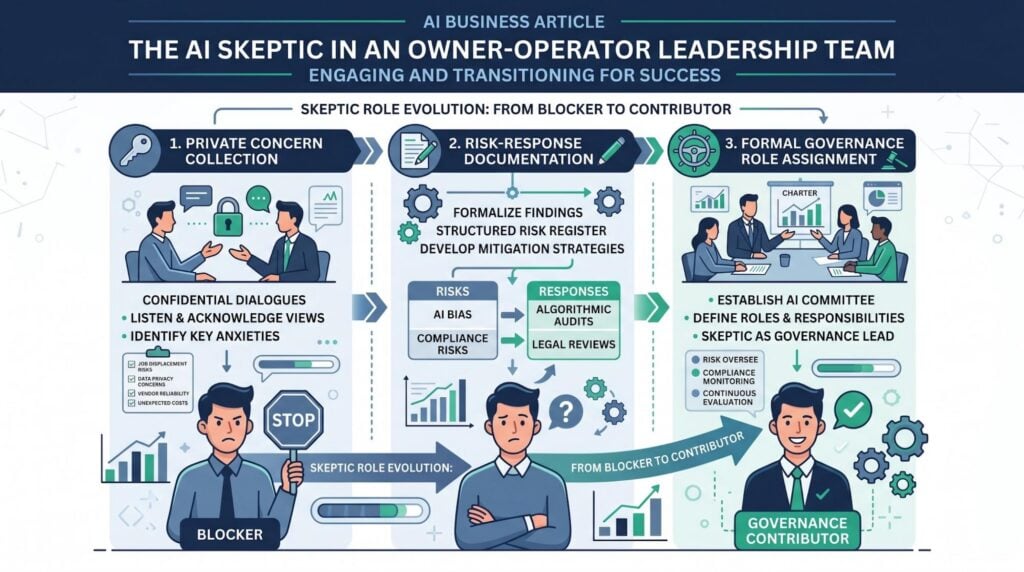
The engagement process works in three steps. A private pre-meeting where the skeptic’s set concerns are noted without group pressure. A risk-response write-up that addresses each concern before the formal decision meeting. And the formal meeting where the skeptic’s role shifts from blocker to governance contributor. Leaders who meet with skeptics privately before the group decision meeting cut decision delays. The private talk converts the skeptic’s concern from a surprise objection into a prepared question with a written answer.
For AI tools like GoHighLevel that come with clear vendor contracts, published DPAs, and clear pricing, the data security and vendor liability concern resolves fast. GoHighLevel’s business-grade terms give the legal or compliance skeptic a clear contract to review. That kind of vendor clarity is part of what makes a tool pass the governance test rather than trigger it.
How Do You Turn AI Skepticism Into a Governance Asset?
Turning AI skeptic pushback into a governance asset means giving the skeptic a formal oversight role that matches their concern profile. A finance skeptic chairs the ROI review. A legal skeptic owns vendor contract review. An operations skeptic owns the setup risk list. Formal authority over governance functions turns the skeptic’s pushback energy into the group’s most key quality control tool.
The change is making AI governance a named group function rather than a tech team’s internal process. Groups that create a named governance owner for AI calls (separate from the AI plan backer) cut legal risk events in the first year of rollout. The skeptic who would have blocked the plan becomes the governance owner who ensures it proceeds safely. A role they are better qualified for than any other leader on the team.
The governance role assignments that most convert each skeptic type:
- Finance skeptic. Chairs the AI ROI review group and owns payback tracking against the approved financial model.
- Legal or compliance skeptic. Serves as the vendor contract reviewer for data protection agreements and legal compliance sign-off.
- Operations skeptic. Owns the setup risk list and monitors production impact during AI rollout and the 90-day post-launch period.
These role assignments work because they channel the skeptic’s existing skill into the governance function the group actually needs. AI Smart Ventures offers AI advisory support for leadership teams building governance structures that include skeptic input.
Frequently Asked Questions
What Is an AI Skeptic on a Leadership Team?
An AI skeptic on a leadership team is a senior leader who doubts the value, timing, or readiness of AI adoption and raises concerns that slow AI plans. Most often holds finance, legal, or operations roles where risk evaluation is a core function. When engaged well, their concerns make stronger governance write-ups and more defensible AI rollout calls than teams that proceed without internal challenge.
Why Do Senior Leaders Resist AI Adoption?
Senior leaders resist AI adoption most often because the plan is framed in tech skill terms that do not map to their governance duties. Finance leaders need a payback timeline using real cost data. Legal leaders need written contract protections for data handling. Operations leaders need a clear setup path with failure cases. Pushback usually dissolves when the business case addresses the skeptic’s set governance question in writing before the formal decision meeting.
How Do You Change the Mind of an AI Skeptic?
Start by finding their set concern (financial, legal, operational, or cultural) and give a risk-number response that addresses it directly. Tool demos and enthusiasm do not address governance concerns. Set write-up does. The most useful approach is a private talk before any group decision meeting where concerns are noted. Then address them in a written risk-response write-up before the formal vote.
What Are the Most Common AI Skeptic Concerns?
Financial ROI doubt. Data security risk from routing sensitive data through third-party AI tools. And job law risk when AI tools are used in hiring or performance calls. All three are real governance questions that deserve written answers. Groups that address these three concerns in writing before any AI approval meeting remove the main blockers for most leadership pushback.
How Do You Involve AI Skeptics in Governance?
Give them a formal oversight role that matches their concern profile. A finance skeptic belongs on the AI ROI review group. A legal skeptic becomes the vendor contract reviewer for data protection agreements. An operations skeptic owns the setup risk list. Formal governance roles turn the skeptic’s pushback into set quality control that protects the group during AI rollout.
Can AI Skeptics Improve AI Plans?
AI skeptics improve AI plans when their concerns are addressed through set governance rather than argued out of the decision process. Skeptics catch data security gaps, unrealistic ROI claims, and job law risk that eager adopters overlook. Groups that formally include skeptic input achieve stronger AI plan outcomes than those that route around internal pushback.
How Do You Present AI to a Skeptical Leadership Team?
Lead with risk numbers rather than tool demos. The talk should open with the problem being solved and its written cost. Then present the AI solution alongside a risk list covering data security, legal needs, and financial cases. Tool demos belong in an appendix after the governance case is made. Skeptics approve proposals that prove the risks were taken seriously. Not proposals that prove the tech is impressive.
What Role Should AI Skeptics Play in AI Strategy?
AI skeptics should own the risk function in AI strategy, overseeing vendor checks, data handling reviews, and legal compliance sign-offs. Giving skeptics formal governance authority turns their pushback into the group’s strongest quality control tool. An AI strategy built around a skeptic’s governance standards is more defensible to regulators, clients, and boards than one built without set internal challenge.
Executive Summary
AI skeptics on leadership teams are most often finance, legal, or operations leaders whose governance roles make AI’s doubt the main signal. They become blockers when plans are framed in skill terms rather than risk-number terms. Addressing the three main concerns (financial ROI doubt, data security liability, and job law risk) in written form before the formal decision meeting resolves most leadership pushback. Groups that give skeptics formal governance roles turn pushback into set quality control and achieve stronger AI plan outcomes than those treating skeptics as obstacles. Per McKinsey’s 2025 State of AI, nearly two-thirds of groups remain in early AI test phases. The governance discipline skeptics demand is not red tape. It is the standard most groups still need to build.
What Should You Do Next?
This week, find the AI skeptic on your leadership team by role. Ask them privately what set question about an AI plan they would need answered before supporting it. Write down the exact concern (financial, legal, operational, or cultural). Then find out whether you can give a written, factual response rather than a persuasive one. By the end of month, build a one-page risk-response write-up for each leadership skeptic and bring it to the next AI decision meeting before the formal talk.
AI Smart Ventures offers AI training for growing businesses and groups, including leadership-level AI sessions that address skeptic concerns with set governance plans and risk-number tools. Schedule a consultation to design an AI training program that converts your leadership team’s doubt into set, confident AI adoption calls.
People Also Read
- What Is AI Governance and How Do You Implement It Without an Enterprise Budget?
- Shadow AI in Owner-Operated Businesses: $670K Risk
About the Author
Nicole A. Donnelly is the Founder of AI Smart Ventures and an AI Adoption Specialist with 20 years of experience as a founder and CEO and over a decade leading AI adoption initiatives. She helps businesses integrate artificial intelligence with clarity and confidence, driving innovation and sustainable growth. Nicole has trained over 20,217 professionals in Applied AI, delivered 624 workshops, and worked with close to 1,000 organizations across diverse industries.
Expertise: AI Transformation, AI Strategy, AI Implementation, AI Adoption, Applied AI, Marketing, Business Operations
Disclaimer: This content is for informational purposes only and does not constitute professional business or technology advice. Results vary based on industry, existing systems and implementation commitment. Contact AI Smart Venturesfor a consultation regarding your specific situation.