
How to Build an AI Professional Development Program
Last Updated: August 2026
An AI professional development program is a plan that teaches a whole team to use AI in the work they already do. It sets a skills baseline, sorts people into tracks by role, and ties each lesson to a real task. A good plan also sets rules for data and human review, so staff know where the limits sit and what steady daily use looks like.
AI Smart Ventures has guided growing businesses in many fields through AI adoption, and one pattern holds. Teams that start with a clear skills picture skip the most common trap, which is teaching everyone the same thing at the same pace.
The cost of a weak program is quiet rather than loud. Staff keep using AI on their own, with no shared rules, so the gains never reach the business. A real program turns private trials into results you can point to on a monthly report.
Key Takeaways
- Start with a tested skills baseline, not a survey, because people rate their own skill well above what a real task shows.
- Build three layers at once: shared AI literacy for all, role-based tracks by team, and short written rules for data and review.
- Agent skills are the widest gap right now. Job posts asking for them rose 1,587% in 2025, Randstad Digital reports, while just 32% of firms trained their whole staff.
- Mix self-paced lessons, live AI workshops and project work on real company data, since practice on live work is what makes new habits last.
- Track business results at 30, 60 and 90 days. Course completion tells you who showed up, not what changed.
All five moves share one idea: a program earns its place when the learning sits inside real work. Training parked next to the job gets lost within weeks, because nobody has spare time to turn a demo into a habit.
What should an AI professional development program include?
A strong plan holds four parts: shared AI literacy for all staff, skill tracks by role, short written rules for data and review, and a refresh cycle. Shared literacy gives your team one language and an honest sense of where models fail. Role tracks then teach a marketer, a bookkeeper and a service lead three different things, because their daily work differs. The refresh cycle keeps the content current.
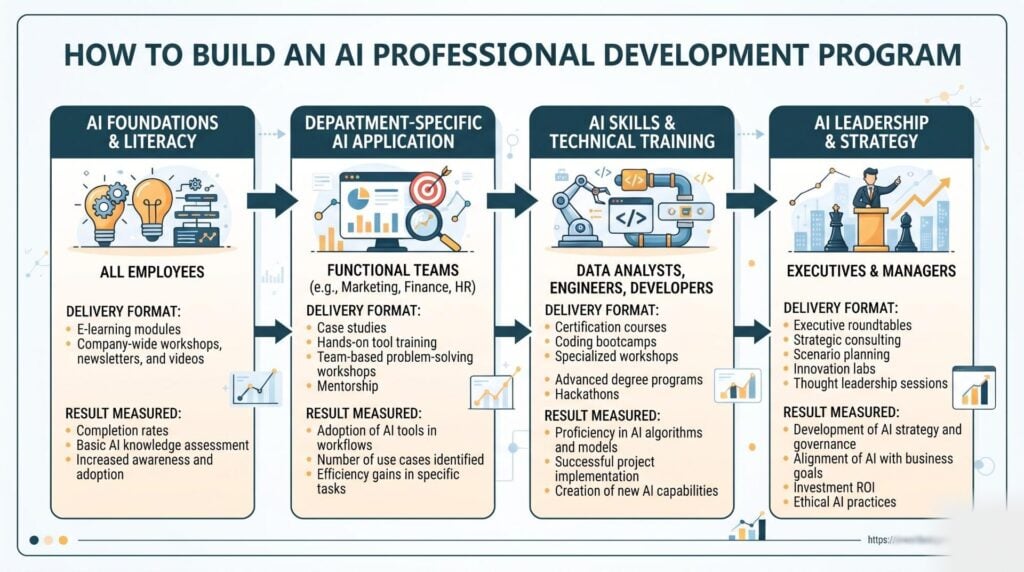
Order matters more than the content list. Literacy comes first, since it heads off the mess that follows when someone gets a tool with no context. Role tracks work best when each one starts from a task the team repeats every week, such as drafting quotes or cleaning a client list. Rules and review come last, and they must be short enough that people read them.
Each layer needs its own audience, format and measure.
| Layer | Who it is for | Format | What to measure |
|---|---|---|---|
| Shared AI literacy | Everyone | Short self-paced lessons | Staff who finish one live task |
| Role-based tracks | Each team | Live workshops on real work | Hours saved on a repeat task |
| Data and review rules | All staff | One page plus a briefing | Review rate on client-facing output |
| Agent and automation skills | Operations and heavy users | Project work with AI coaching | Workflows running start to finish |
How do you assess your team’s current AI skills?
You test what people can produce, then compare that against the tasks you want to improve. Self-rated skill is a weak guide on its own. A June 2026 HR Executive review of more than 88,000 tested skill checks found that real ability sits well below what staff claim, and that agent skills ranked among the weakest of all. Give each person one short live task, then score the output yourself.
An AI readiness check runs in three passes and takes about two weeks. First, ask each person to finish one real task with the tools you own. Second, ask team leads which manual steps eat the most hours in a normal week. Third, turn both inputs into a baseline that shows who can pilot new work and which teams need help first.
How do you build an AI learning plan for your team?
Build the plan in five steps: audit the workflows, pick the tasks worth changing, sort people into tracks, set milestones, then guard the time to practice. Start with the audit, because routine manual work is where AI pays back first. Map each pain point to a skill such as summing up, drafting or data cleanup. Assign tracks by the work a person does, not by job title.
- Audit the week. List the tasks your team repeats, with a rough time cost beside each one.
- Pick the top five. Choose tasks that are frequent, text-heavy and low risk, since AI implementation lands there fastest.
- Sort into tracks. Everyone takes shared literacy, and each team takes a track built on its own tasks.
- Set milestones. Say what good looks like at 30 days and at 90 days, in output rather than hours.
- Guard the time. Book two hours a week in the calendar, or workload will absorb the whole plan.
AI upskilling works better in short repeat sessions than in one long day, since people need time to apply what they learned. Change management belongs in the same plan, since a new workflow always upsets an old one.
AI Smart Ventures delivers AI Training built around your own workflows, with over 20,000 professionals trained in Applied AI. Talk to our training team about the tracks your teams need.
Why are agent skills the biggest gap right now?
Agent skills are the biggest gap because demand climbed faster than any training plan could follow. According to Randstad Digital’s 2026 AI Investment Report, job posts asking for AI agent skills rose 1,587% during 2025, while only 32% of firms trained their whole staff. Agents differ from chat tools in one key way: they take multi-step actions for you. So staff need to scope the task, set the limits and check the result.
- Task scoping. Describe a job clearly enough that an agent can finish it without inventing the missing parts.
- Boundary setting. Decide which systems, files and actions an agent may touch, and which need a human sign-off.
- Checking. Test the output against a source before it reaches a client, an invoice or a public channel.
- Escalation. Know when to stop the run and hand the work back to a person.
Most programs still stop at prompting, which was the right lesson two years ago. AI enablement now means teaching people to supervise the work, not just to ask for it, and one agent module per track is enough to start.
How do you measure the ROI of an AI learning program?
You track business numbers you wrote down before training started, then compare them at 30, 60 and 90 days. Pick two or three measures per team and keep them stable. Good ones include hours spent on weekly reports, average reply time on service tickets, and how many quotes each person can produce. Course completion tells you who attended, while those numbers tell you what changed.
That split matters, because effort and result have been drifting apart. Randstad Digital polled more than 27,000 workers and 1,200 senior leaders in 35 markets, and found that two thirds of firms investing in AI saw no gain in company results. Tasks got faster while the business stayed flat, which is what happens when tool access arrives with no skill building behind it. Workflow optimization gains are easiest to defend when you weigh payroll hours freed against what the program cost, and easiest of all when the baseline was written down first.
What makes AI professional development programs fail?
Programs fail for four repeat reasons: no leader sponsor, the same training for every role, tool demos with no workflow attached, and no guarded time to practice. The gap in how support is seen runs wider than most owners expect. TalentLMS reports that 83% of HR managers think their firm backs AI learning, while only 64% of staff agree. When leaders assume the backing is there, nobody fixes the calendar problem beneath it.
The quieter failure is fear. People avoid new tools when a visible mistake carries a cost, so uptake stalls and nobody says why. Human-first AI is not a slogan here: it is what makes people willing to try in front of peers. The last failure is treating the program as a project with an end date. Course sign-ups for AI grew 234% year over year, per the Coursera Job Skills Report 2026, so the bar keeps rising.
Frequently Asked Questions
How long does it take to roll out an AI development program?
Plan four to six weeks to design the program for a team of 10 to 250 people, then roll it out in phases. That window covers the skills baseline, a look at the tools you own, and fitting the modules to your workflows. Start with a pilot group of eight to twelve people, then adjust before the wider launch. Full uptake takes two or three more months.
Which roles should get AI training first?
Operations and client support should go first, because those teams handle the most routine, text-heavy work. Owners and senior leads should train early too, since they set the rules and sign off the workflow changes that follow. Starting there gives you a baseline plus a set of in-house cases other teams can copy. Creative and technical roles follow in a second wave, once review habits are in place.
What is the difference between AI literacy and role-based training?
AI literacy covers what these tools are, how they fail, and which data must never be pasted into them. It builds one shared language, so a whole firm can weigh risk in the same terms. Role-based training is narrower: it shows a recruiter how to draft job ads, or a bookkeeper how to sort receipts and flag odd ones. You need both, since literacy keeps the firm safe while role work makes people faster.
Should you build a custom program or buy an off-the-shelf one?
Buy off-the-shelf content for the shared literacy layer, since the basics of prompting and model limits are the same everywhere. Build your own when the work depends on private data, odd sign-off chains, or a software stack your staff must use safely. Most growing businesses blend both, using bought modules for the base and custom sessions for role tracks. The test is simple: if a stock case would mislead your team, build that part.
How do you keep AI training current as tools change?
Review the content every quarter and give one person the job of owning it. New model releases land every few months, so anything written more than two quarters ago should be checked before it is taught again. Keep a short log of what changed and which module it hits. A 45-minute update each quarter costs far less than rebuilding a course later.
How many hours a week should staff spend learning AI?
Two hours a week suits most roles in the first eight weeks, then about one hour a week to keep pace. Split that time rather than saving it up, because short repeat practice builds habits better than one long workshop. Put the hours in the calendar and treat them as fixed, since workload is the top reason training slips. Team leads should sit in the same sessions.
How do you get team leads to back AI upskilling?
Give leads their own track first, and tie it to a problem they already own, such as report time or ticket backlogs. A lead who has saved real hours becomes a trusted voice, while one who only forwards invites does not. Ask each to report a single number from their team each month, which keeps the focus on results rather than turnout. AI coaching for this layer often pays back fastest.
How do you get started on an AI professional development program?
Start by writing down three workflows you want changed and the current time cost of each, since that becomes your baseline. Then run one live task with your team so the plan rests on tested skill, not guesswork. Budget in scope and sequence rather than tool count: one team, three workflows, one quarter. AI Smart Ventures helps growing businesses plan that order. Schedule a consultation to map your first track.
Executive Summary
An AI professional development program works when it rests on evidence rather than mood. Start with a tested skills baseline, because self-rated skill runs well above what people can show. Layer it: shared AI literacy for all, role tracks tied to weekly tasks, and short written rules for data and review. Add an agent module, since supervising multi-step AI work is now the widest gap in the market. Guard two hours a week for practice, track hours freed and cycle times at 30, 60 and 90 days, then review the content each quarter.
What Should You Do Next?
This week, list the three workflows costing your team the most hours and write the current numbers down, because you cannot show progress without a start point. Then give five people one real task each, and score the results honestly. Use both inputs to draft a first role track, and book the practice time before anything else fills the calendar.
AI Smart Ventures offers AI Training for growing businesses building practical AI skill across every team. Schedule a consultation to design a program matched to your workflows and your timeline.
People Also Read
- How Do You Build an AI Champion Network Without a Dedicated Change Team?
- Why Is AI Usage Up But Business Impact Flat? The Adoption Puzzle Explained
About the Author
Nicole A. Donnelly is the Founder of AI Smart Ventures and an AI Adoption Specialist with 20 years of experience as a founder and CEO and over a decade leading AI adoption initiatives. She helps businesses integrate artificial intelligence with clarity and confidence, driving innovation and sustainable growth. Nicole has trained over 20,217 professionals in Applied AI, delivered 624 workshops, and worked with close to 1,000 organizations across diverse industries.
Expertise: AI Transformation, AI Strategy, AI Implementation, AI Adoption, Applied AI, Marketing, Business Operations
Disclaimer: This content is for informational purposes only and does not constitute professional business or technology advice. Results vary based on industry, existing systems and implementation commitment. Contact AI Smart Ventures for a consultation regarding your specific situation.