
How Do You Lead AI Change in Your Organization?
Last Updated: August 2026
Leading AI change in your organization is the work of taking people through a shift in how they do their jobs. It covers what you say, who you back, how you answer fear, and what you keep doing after the launch email goes out. The tools land in a week, but the habits take a year. Leading is what closes the gap between those two, and no tool closes it for you.
AI Smart Ventures has guided growing businesses through AI adoption long enough to watch the same story repeat. A founder makes the call, buys the licenses, then goes quiet for four months. Nothing in the tools broke; the person leading simply stopped leading once the hard part began.
That silence costs more than the software does, because your team reads it as doubt, slips back to the old way, and hears your next announcement on colder ground. Trust drains fast and takes far longer to earn back.
Key Takeaways
- Changing leadership is not a soft skill now. Perceptyx read 20 million staff survey answers in January 2026: trust in senior leaders now tops what drives engagement.
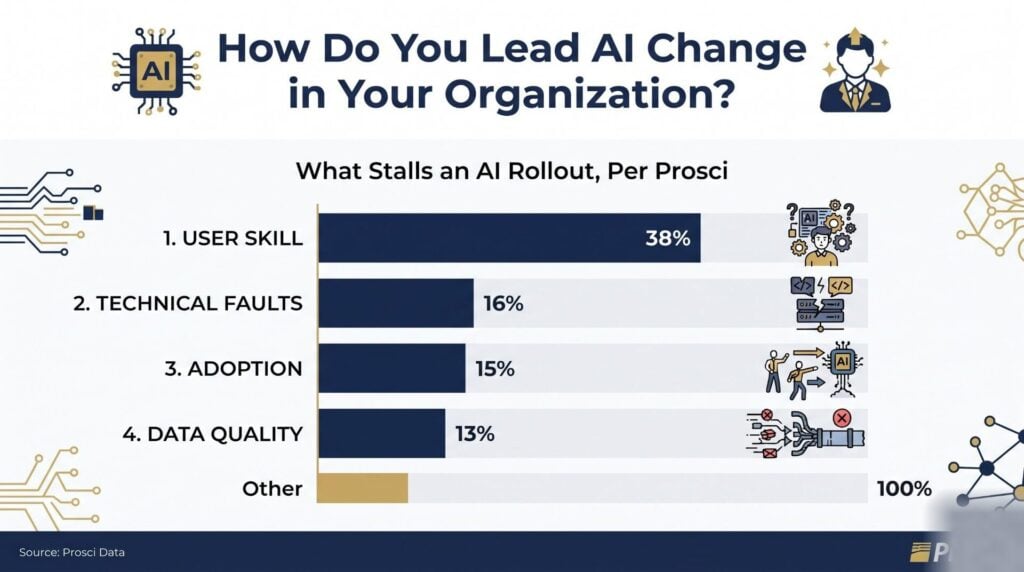
- The block is people, not the tech stack. Prosci research across 1,107 professionals traced 63% of AI implementation problems to human factors.
- Answer the job question before someone else does. Judgment work stays human, and staff need to hear which parts of their role that covers.
- Your own use of the tools wins more people than your launch email did.
- Momentum lives on the calendar. Name an owner, set a monthly review, and keep both once the novelty fades.
Read together, those points land on one hard truth: the parts you can hand off matter least. Tool choice can go to a group; belief cannot. What follows is about the half you keep.
Why does AI change need a leader, not a memo?
AI change needs a leader because the hard part is human, not technical. Prosci research across 1,107 professionals traced 63% of AI rollout problems to human factors. User skill alone made up 38% of them, while technical faults made up 16%. A memo cannot build skill, and it cannot answer the question each person asks in private: what does this mean for me? Perceptyx read 20 million staff survey answers in January 2026 and logged its biggest shift yet in what drives engagement: how well change gets handled, and trust in senior leaders, moved to the top.
People decide whether AI use is safe long before they decide whether it is useful.
Who should lead AI change in your business?
The right person has standing, not the best tool knowledge. Staff follow the leader who can move a deadline, guard an hour, and say no to a weak idea. In its analysis of the same study, Prosci scored leadership support at +1.65 in firms with very smooth AI rollouts, against -1.50 in the ones that struggled, on a scale of -2 to +2. In founder-led organizations that sponsor is you: the daily work can sit with someone else, but the backing cannot. Tool skill helps, though it is not the qualification.
Split the job in two so neither half gets dropped:
- The sponsor sets the focus, funds the hours, and uses the tools in public.
- The lead runs the pilot, gathers the questions, and says plainly what broke.
What should you say when you announce AI?
Say four things, in this order: the problem you are solving, what changes on Monday, what stays the same, and where jobs stand. That last one shapes how the first three get heard. Be exact about it: name the tasks AI will take on, then name the calls that stay with the person doing the job. Vague comfort reads as a dodge, because it is one. If you cannot promise head count, promise the process: notice, training, and a real say in what gets handed to a machine. Write it before you say it.
Then say it again, more often than feels right, because one all-hands does not beat what your team is reading online.
How do you handle resistance when leading AI change?
Treat pushback as data, then answer the worry under it, because most of it never reaches you as an argument. A 2026 survey of 2,400 knowledge workers in Europe and North America found staff quietly skipping the tools, ignoring new steps, and at times pretending to use a system they had dropped. Much of that came from reading the rollout as a plan to cut jobs. So ask what would have to be true before someone tried it, give a real opt-out for the first month, and pull your sharpest doubter into testing.
Fix what they find, in the open, because nothing moves a wary team faster than a complaint that turns into a change.
Telling fear apart from a real design flaw is hard from inside the room. AI Advisory from AI Smart Ventures gives founder-led teams a vendor-neutral read on where AI adoption has stalled, drawn from work with close to 1,000 organizations.
What is the biggest mistake leaders make with AI?
The biggest mistake is naming a tool instead of a problem, then treating adoption as someone else’s job, usually the tech lead’s. Grant Thornton’s 2026 AI Impact Survey of 950 business leaders, run in February and March, found just 6% named change leadership and workforce enablement as a skill they must have, while only 19% of tech chiefs called their workforce fully ready. The second mistake follows the first: going wide before one thing works. One team, one repeat task and one month of proof teach you more than a launch to everybody.
How do you keep momentum after the first wins?
Put the change on a calendar instead of a launch date. Prosci’s Tim Creasey calls AI adoption a never-ending phase two, since the tools keep moving and there is no tidy finish line to mark. So build a rhythm people can predict: a monthly session where two colleagues show what they built, a named owner for questions, and a short written note of what changed will hold attention long after the buzz dies. Momentum is not a mood you protect. It is a standing slot that survives a busy quarter.
Close stalled pilots out loud rather than letting them rot on a road map. Pearl Meyer’s Q1 2026 poll of 108 senior leaders and board members found AI mostly made a firm’s old weak spots louder.
What does a successful AI transformation look like?
Success looks dull from the outside: staff use AI on their own work without asking, say plainly when the output was wrong, and reach for the tools in normal work rather than in special projects. Measurement is the second sign: Wharton’s third annual study of more than 800 business leaders found 72% now track what AI does to the bottom line through a set process, and three in four report a gain. The best sign is quieter: new ideas start coming from your team instead of from you, month after month.
Frequently Asked Questions
How do leaders successfully drive AI adoption in their teams?
They use the tools in front of people, then build AI into work that already happens. Bring an AI-drafted summary to a meeting, show the prompt, and show what you fixed. Ask each team for one repeat task worth automating, then guard the hours to test it. Praise the person who reports a failure as warmly as the one who reports a win.
What does an AI change leader actually do day to day?
Three things, mostly: answer questions, clear blocks, and repeat the point of the change. In a normal week that means a short check-in with whoever runs the pilot, a call on a stuck login or license, and a word about progress in a meeting you already hold. It is not a full-time job in a growing business, but it is a weekly one.
How long does it take to lead a team through AI change?
Plan on a quarter to prove one use case and about a year for it to feel normal. The first four to six weeks go on one workflow with a small group. Weeks six to twelve widen it to a second team and surface the edge cases. The habit forms in months four to twelve, and only where team leads keep asking about the work.
Should the owner lead AI change or hand it to someone else?
The owner backs it and someone else runs it. Backing cannot be handed over, because staff read what matters from whoever holds the budget and the calendar. Daily work belongs with a capable lead who has time set aside. The common failure is the reverse: an owner names a lead, then never mentions AI again, which tells everyone the change is optional.
What should a leader say when staff ask if AI will cut jobs?
Answer straight, and never promise what you cannot hold. Say which tasks you expect AI to take on, say that judgment, client trust and the final call stay with people, then set out how you will handle role changes. Silence gets filled with worse answers than yours. If a role will shift, say so early and pair the news with real AI upskilling.
What do you do when a manager blocks the AI rollout?
Meet them in private and find out which risk they are guarding against. Team leads often resist because they own the numbers and cannot afford a bad quarter while their people learn. Give them cover: a smaller pilot, a slower ramp, or relief on one target. Then make their result visible when it lands. A won-over lead carries more weight than any policy.
How often should leaders talk about the AI change?
Weekly in some small form, monthly in a set one. A one-line update in a meeting you already hold beats a big talk nobody recalls, because repetition signals the change is here to stay. Vary what you show: a result one week, a mistake the next, a question you cannot yet answer. Say it at launch only and it reads as a project.
How do you pick who goes first in an AI rollout?
Pick a team with a painful repeat task, a lead who wants the help, and work you can measure in weeks. Skip your busiest group and your most doubtful one in round one. Volunteers beat the drafted, since keen early users absorb the friction and still report back. Two or three of them are enough to prove the point and keep the result easy to explain.
What happens if the first AI pilot fails?
Say so in the open, explain what you learned, and start a second one within a month. A pilot that quietly vanishes teaches your team that AI work is theatre. Most first tries fail on scope, not on tech: the task was too varied, or the data behind it was a mess. Pick a narrower task with cleaner inputs and keep the same group.
How do you keep senior leaders visibly involved?
Give each of them one task they own and one place it gets reported. A leader who shows their own AI-drafted work at a monthly review stays in it; one who only signs off a budget does not. Put AI on an agenda you already hold instead of starting a new group. Ask each of them which part of their week AI now touches.
How do you know the AI change has stuck?
You know it has stuck when people stop asking permission and start asking better questions. Watch three signals: repeat weekly use by a team rather than by one keen person, staff floating ideas you never raised, and new hires picking up the AI workflow during onboarding. If you stepped back for a month and used to hold steady, the change now belongs to them.
What does it cost to get outside help leading AI change?
Scope and time drive it, not head count, so ask any partner for a defined start, named outputs, the hours your team must give, and a clear exit point. Help is usually heavy for one quarter, then thins to coaching as your own lead takes over. AI Smart Ventures offers AI advisory built around that handover. Schedule a consultation to scope a sensible sequence.
Executive Summary
Leading AI change is a human job, not a technical one. Research across more than a thousand workers puts most of the trouble down to people, not systems, and 2026 staff data ranks trust in leaders among the top drivers of engagement. The work is specific: name the problem, answer the job question straight, back one pilot, meet pushback with facts, and hold a monthly rhythm once the buzz fades. Success looks quiet: staff use AI on real work, admit its errors, and start suggesting what to try next.
What Should You Do Next?
This week, pick one repeat task and one willing team, then write the four-part launch note: the problem, what changes, what stays, where jobs stand. Book a standing monthly review before the pilot starts, and name the person who fields questions until then. Show your team your own AI-drafted work before you ask anyone else to change.
AI Smart Ventures offers AI Advisory for growing businesses working through AI adoption, change management and the order a rollout should follow. Schedule a consultation to map your first 90 days of AI change with clarity and confidence.
People Also Read
- Which AI Tools Should I Use First? A Practical Business Guide
- What Is NotebookLM and How Can Your Team Use It?
About the Author
Nicole A. Donnelly is the Founder of AI Smart Ventures and an AI Adoption Specialist with 20 years of experience as a founder and CEO and over a decade leading AI adoption initiatives. She helps businesses integrate artificial intelligence with clarity and confidence, driving innovation and sustainable growth. Nicole has trained over 20,217 professionals in Applied AI, delivered 624 workshops, and worked with close to 1,000 organizations across diverse industries.
Expertise: AI Transformation, AI Strategy, AI Implementation, AI Adoption, Applied AI, Marketing, Business Operations
Disclaimer: This content is for informational purposes only and does not constitute professional business or technology advice. Results vary based on industry, existing systems and implementation commitment. Contact AI Smart Ventures for a consultation regarding your specific situation.