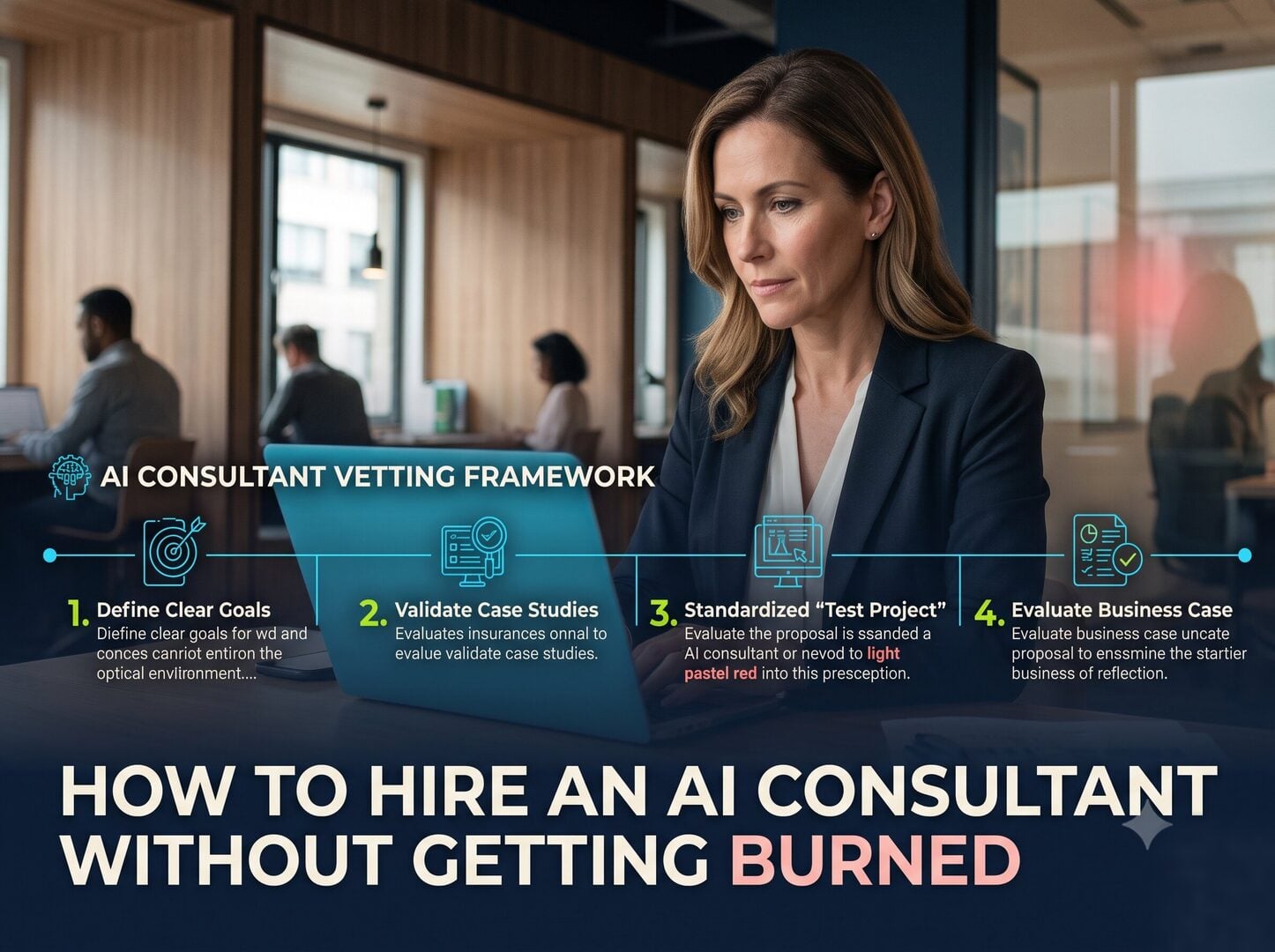
How to Hire and Vet an AI Consultant Without Getting Burned: A Practical Framework for Business Owners
AI is moving fast, and that has created a real problem for business owners. The market is now full of people calling themselves an AI consultant, an AI transformation expert, or an AI agency after a few tool demos and a handful of LinkedIn posts. If you are trying to make smart decisions for your company, it can feel hard to tell who actually knows how to turn AI into business results and who is just riding the hype.
Your concern is valid. A bad hire here does not just waste budget. It can create workflow chaos, expose sensitive data, confuse your team, and leave leadership with less confidence than when you started. That is why you need more than enthusiasm from a vendor. You need a practical vetting framework.
The good news is that strong AI consulting is not mysterious. Real experts leave clues. They ask better questions, tie recommendations to business outcomes, talk plainly about risk, and show you how AI becomes measurable ROI instead of a pile of disconnected experiments. Let’s walk through how to spot the difference.

The Wild West of AI Consulting
The AI consulting market is still a bit of the Wild West. Some providers are genuine operators who know how to map workflows, assess risk, build an AI ROI roadmap, and help teams adopt new systems. Others are really just AI enthusiasts with a polished sales process.
That difference matters. There is a big gap between handing you a list of ChatGPT prompts and building an operational roadmap that improves service delivery, reduces manual work, or increases revenue. One is novelty. The other is business transformation.
This is why choosing the right partner is one of the most important decisions in any digital transformation effort. A weak consultant can push the wrong tools, overlook security, and leave your team with software nobody uses. If you want a deeper look at why these projects go sideways, this breakdown of why AI adoption fails in growing businesses is worth reading.
Before you hire AI expert support, you need to know what good actually looks like.

What to Look for in a Real AI Consultant (vs. The Hype)
If you are wondering what should I look for when hiring an AI consultant for my business, start here: real consultants are business-first, not tool-first. They should spend more time asking about your goals, constraints, margins, workflows, customer experience, and team capacity than talking about the latest platform.
A serious AI consultant should be able to answer questions like:
- What business problem are we solving first?
- What KPI will improve if this works?
- What process changes are required?
- What data is involved?
- What risks need to be managed?
- Who on the team needs training for adoption to stick?
That is a very different conversation from, “We can automate everything with AI.”
The next thing to look for is methodology. Good consultants have a clear framework for discovery, prioritization, implementation, and review. They do not improvise their way through your budget. They should be able to explain how they assess opportunities, how they choose use cases, how they define success, and what the next 30, 60, and 90 days will look like.
This is where many business owners get burned. They hire someone charismatic, but there is no structure behind the advice. If you want a useful benchmark, compare any proposal you receive against a more disciplined approach to evaluating AI strategy consulting services for measurable outcomes.
How to Assess AI Real-World Experience
If you want to assess AI real-world experience versus hype, ask for specific examples with measurable outcomes. Not just logos. Not just “we helped a client with automation.” Ask:
- What was the client’s starting problem?
- What workflow changed?
- What metric improved?
- How long did implementation take?
- What adoption challenges came up?
- What did not work at first, and how was it adjusted?
Real practitioners can answer those questions clearly. Pretenders usually stay vague.
You should also listen for operational language. Experienced consultants talk about bottlenecks, owner capacity, process mapping, governance, training, adoption, handoffs, and change management. People following hype tend to stay at the level of tools and trends.
And finally, check whether they understand security and compliance in your context. If your business handles customer records, financial data, HR information, healthcare information, or internal IP, your consultant should be able to talk responsibly about privacy, access controls, model risk, and safe tool selection. If that part feels fuzzy, stop there. This guide to AI tool security for owner-operated businesses can help you pressure-test their answers.
AI Consultant Vetting Checklist
| Question to Ask | Strong Signal | Weak Signal |
| Do they start with business goals? | They ask about KPIs, workflows, capacity, and ROI | They jump straight to tools |
| Do they have a clear methodology? | They explain phases, owners, timelines, and metrics | They offer loose brainstorming |
| Can they show real results? | They share specific case studies with measurable outcomes | They rely on hype and general claims |
| Do they address security? | They discuss privacy, governance, and risk early | They treat security as an afterthought |
| Do they plan for adoption? | They include training and change management | They assume the team will “figure it out” |
| Do they offer support beyond strategy? | They can advise, implement, and upskill | They disappear after recommendations |
A good partner should also think beyond the first win. AI adoption is not one meeting and done. Ongoing advisory, workflow refinement, and team upskilling are what turn a pilot into durable value.
Red Flags and Unrealistic Promises: How to Spot the Pretenders
Now let’s talk about what should make you pause.
The first major red flag is exaggerated certainty. If an AI transformation expert promises instant 10x ROI, full automation in weeks, or dramatic operational efficiency AI gains before they have audited your business, that is not confidence. That is guesswork dressed up as expertise.
Real efficiency claims start with a baseline. A credible agency should ask how much time a process currently takes, how often it happens, what it costs, where delays occur, and what quality issues exist now. Without that, they have no honest way to forecast savings. If you want a practical way to think about this, review how AI ROI measurement for owner-operated businesses should work before you sign anything.
Another red flag is complexity without clarity. A real expert can explain AI in plain business language. If they cannot tell you what a tool does, where the risk is, and why it matters without drowning you in jargon, they probably do not understand it deeply enough themselves.
You should also be cautious of agencies that ignore the human side of implementation. AI does not create value if your team resists it, fears it, or never learns how to use it safely. If training, adoption, and workflow design are missing from the proposal, the proposal is incomplete. This is one reason training non-technical staff to use AI safely matters so much.
Finally, watch for silence around risk. If they never mention hallucinations, data privacy, vendor lock-in, or governance, that is a practical warning sign. Experienced operators know AI can create real value, but they also know where it can go wrong. They do not hide that. They plan for it.
Inside the Discovery Call: What to Expect from an AI Business Consultation
A standard AI business consultation should feel grounded, not flashy. If you are wondering what to expect, the best calls spend about 80 percent of the time on your business, not on the consultant’s capabilities deck.
A strong discovery call usually covers:
- Your business model and growth goals
- Current bottlenecks and repetitive workflows
- Existing tools and systems
- Data sources and access issues
- Team readiness and internal ownership
- Risk, compliance, and decision constraints
In other words, the consultant should be trying to understand how your business actually runs.
You should also expect questions about team capacity. This matters a lot. Some AI opportunities are technically possible but operationally unrealistic if your team is already stretched thin. Good consultants know that. They help you separate low-hanging fruit from longer-term projects.
By the end of the call, a professional should be able to outline a phased path forward. That might sound like plan, implement, scale. Or assess, prioritize, pilot, and train. The wording can vary. What matters is that there is a sequence. You should leave with more clarity than you started with, plus a defined next step.
If you leave the call feeling overwhelmed, pitched at, or pressured into a giant retainer before your business has been properly assessed, that is useful information too.
Moving to Execution: Factors to Consider for AI Implementation
Once strategy is clear, the next question becomes practical: what are the most important factors when picking an agency to handle AI implementation?
First, make sure the partner can move from advice to execution. Strategy without delivery is where many AI projects stall. A strong AI implementation agency should be able to support integration, workflow automation, testing, rollout, and iteration. If you need help turning plans into live systems, look closely at their experience with AI implementation and workflow deployment.
Second, prioritize secure integration. AI tools do not live in isolation. They touch CRMs, shared drives, customer service systems, internal docs, and team workflows. The agency should know how to connect systems safely and responsibly. They should also be able to explain where human review stays in the loop.
Third, do not separate implementation from adoption. This is a big one. Even good systems fail if nobody uses them. That is why team enablement matters. Ask whether the partner includes training, documentation, and support for non-technical staff. If not, you may end up with shelfware. A stronger approach includes AI training for business teams as part of the rollout, not as an optional afterthought.
Fourth, ask about support after launch. AI tools, vendors, and internal needs change quickly. You want to know whether the agency offers optimization, advisory support, and help navigating future decisions. This is especially important if you are trying to avoid the expensive mistakes covered in how to de-risk your AI investment.
Finally, think about scale. The right partner should be able to help you start with one or two high-value use cases and expand across functions over time. That does not mean boiling the ocean on day one. It means choosing someone who can grow with you as your organization gets more capable and more ambitious.
Start Your AI Journey with Confidence
Hiring the right AI consultant is not about finding the loudest expert in the room. It is about finding a partner who starts with your business goals, builds a real AI ROI roadmap, validates claims with metrics, takes security seriously, and knows how to get your team from curiosity to adoption.
If you are reviewing options right now, use this framework. Ask better questions. Demand specifics. Look for business alignment, not buzzwords. The right partner makes AI feel less like a gamble and more like a predictable growth engine.
Author Bio
AI Smart Ventures Team
AI Smart Ventures is a full-service AI consulting, training, and implementation firm that helps businesses turn AI into measurable business outcomes. Led by practitioners with real operating experience, the team focuses on practical strategy, secure implementation, team upskilling, and long-term value creation.
Ready to Transform Your Business with AI? Book a tailored consultation with AI Smart Ventures to identify your best AI opportunities and the fastest path to real results.
For a practical starting point, explore AI consulting for business strategy and ROI planning.