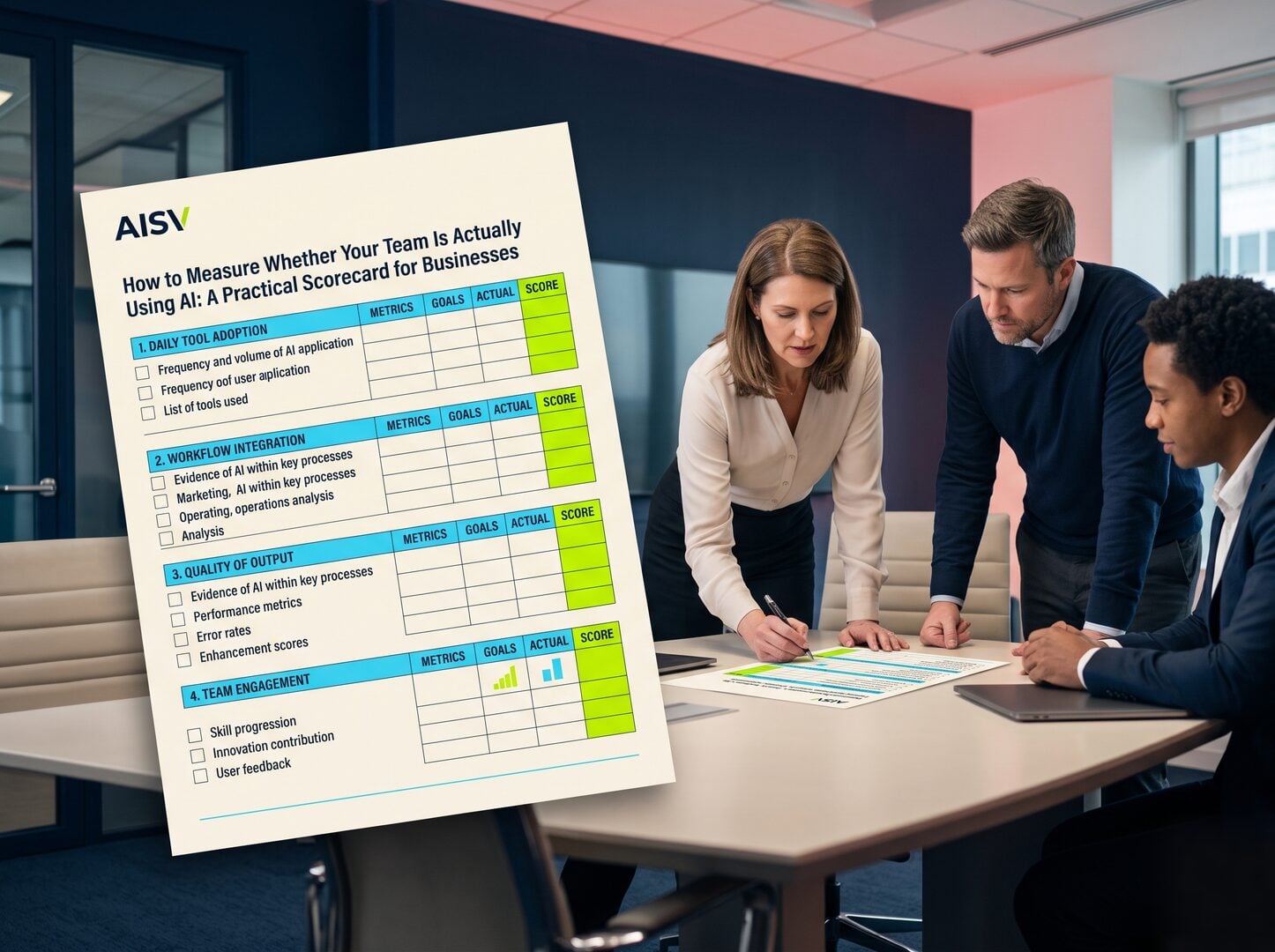
How to Measure Whether Your Team Is Actually Using AI: A Practical Scorecard for Businesses
The AI Adoption Illusion: How to Turn AI Tools Into Measurable ROI
A lot of businesses are living through the same pattern right now. They buy a few AI subscriptions, run a couple of excited team meetings, test some prompts for a week or two, and then everything goes quiet. The licenses are still active. The budget is still being spent. But the actual behavior inside the business has not changed very much.

What Is the AI Adoption Illusion?
That is the AI adoption illusion. It looks like progress because tools were purchased. It feels like momentum because people talked about it. But buying software is not the same as building capability. Real AI adoption happens when your team uses AI inside actual workflows, with enough confidence and consistency to create measurable business value.
For owner-operated businesses, this gap gets expensive fast. You end up with software bloat, scattered experiments, and a leadership team that knows AI matters but cannot prove whether it is helping. The good news is that this is measurable. If you want real ROI, you need to move through four stages in order: adoption, confidence, effectiveness, and business outcomes. That is what this article will help you do.

Why Your Team Isn’t Using the AI Tools You Bought
If your AI tools feel like a ghost town, the problem is usually not the tool itself. It is usually one of three things. Your team does not know exactly what to use it for, they are worried about doing it wrong, or the tool feels like one more complicated thing on top of an already busy day.
That matters because most people do not resist AI in theory. They resist confusion. If someone opens a tool and stares at a blank box with no clear use case, they will go right back to the old way of working. If they worry that a bad output will make them look careless, they will avoid the tool altogether. And if leadership has not clearly explained that AI is there to support their role, not replace it, people will naturally keep their distance.
How to Increase AI Adoption Across Your Team
Create Psychological Safety
So the first move is simple and important: create psychological safety. Say it plainly. AI is here to reduce repetitive work, improve quality, and give people more leverage. It is not a test of who is the most technical person in the room. It is a learnable business skill. When teams hear that clearly and repeatedly, resistance usually drops.
Replace Logins With Hands-On Training
The second move is to stop handing out logins and calling that training. Real AI team training is hands-on. People need to use the tools in live business scenarios, not just watch a demo. That is why structured programs matter. For example, Applied AI Course Level 1 works because it helps professionals practice AI in the context of real work. That kind of training closes the gap between curiosity and actual behavior.
Start With Fast, Low-Risk Wins
The third move is to create fast wins. Pick two or three tasks that are repetitive, low-risk, and easy to improve with AI. That might be drafting first-pass emails, summarizing meeting notes, turning sales call transcripts into follow-up actions, or organizing customer feedback themes. When a team member saves 30 minutes on a task they already hate doing, confidence rises quickly. Version one does not need to be perfect. It just needs to be useful.
Provide Ongoing Support After the Kickoff
Finally, give people support after the kickoff. This is where many businesses stall. They train once, then disappear. A better model is to assign an internal AI champion or bring in outside support through AI consulting for business. Someone needs to answer questions, troubleshoot workflows, and keep momentum moving. Adoption grows when people know they are not figuring it out alone.
How to Make Sure Your Marketing Team Is Using AI Effectively
Once your team is actually using AI, the next question is more specific: how do you make sure your marketing team is using AI effectively?
Audit Your Existing Workflows First
Start by auditing the workflows that already exist. Do not begin with the tool. Begin with the bottleneck. Where is your marketing team losing time, getting stuck, or producing inconsistent output? Common examples include content drafting, campaign ideation, repurposing long-form content, analyzing CRM data for lead scoring, reporting on campaign performance, and building first-pass audience research. AI should be mapped to those points of friction.
Move Beyond Generic Prompting
Next, move beyond generic prompting. This is where a lot of teams plateau. If everyone is using random prompts in random ways, the output will be inconsistent. Strong AI marketing strategy depends on brand-specific guidance. That means clear prompt libraries, approved use cases, examples of strong outputs, and rules for tone, positioning, and review. If your team is producing content, this step is non-negotiable. AI should support your brand voice, not flatten it.
Keep Humans in the Loop
Just as important, keep humans in the loop. AI can accelerate drafting, analysis, and ideation. It should not replace strategic judgment. Your marketers still need to refine messaging, catch weak claims, protect brand standards, and make sure the final work actually fits the audience. Fast content that sounds generic is not a win. The goal is better work, delivered more efficiently.
Use AI Upstream, Not Just Downstream
The best teams also use AI upstream, not just downstream. In other words, do not wait until execution to bring AI in. Use it during planning. Ask it to help cluster customer pain points, pressure-test campaign angles, summarize market themes, or identify content gaps. Then review those outputs together in team meetings. When teams regularly share what worked, what failed, and what needs tuning, AI becomes part of the operating system instead of a side experiment.
Build an AI Scorecard to Measure What’s Working
If you want to know whether your AI marketing strategy is actually working, you need a scorecard. Not a vague sense that people are using it more. Not a few screenshots from a workshop. You need AI adoption metrics and AI effectiveness KPIs that connect activity to outcomes.
The Five Core Categories to Track
The five core categories to track are adoption, efficiency, output, performance, and quality.
Measure Before and After
The key is to measure before and after, not just after. If you do not know how long campaign reporting used to take, you cannot prove that AI improved it. If you do not know your baseline content volume, you cannot show increased output. Measuring AI success starts with clean baselines.
Keep the Scorecard Visible
One more thing: keep the scorecard visible. Review it monthly. Use it in leadership meetings. If adoption is high but performance is flat, your workflows need work. If performance is up but only one person is using the tool, you have a scaling problem. The scorecard is not just for reporting. It is for decision-making.
How an AI Agency Should Measure Implementation Success
When you zoom out from one team and look across the business, the question changes. It becomes: how should an AI agency measure the success of their implementation?
Define Macro Success Upfront
The answer starts before implementation begins. Macro success needs to be defined upfront. That might mean reducing operational costs by a specific percentage, improving response times, increasing revenue from a key function, or recovering a target number of hours per month. If those targets are fuzzy, the implementation will feel fuzzy too.
Measure Time-to-Value
From there, measure time-to-value. How quickly did the project move from planning into live use? How long did it take for the workflow, agent, or automation to become reliable enough for real business use? AI implementation should not live forever in pilot mode. A strong partner helps you get to practical value quickly and safely.
Track Capability Growth Inside the Team
You also need to measure capability growth inside the team. Did people get more confident? Are they operating more independently? Are they solving more problems without waiting on outside help every time? This is one of the clearest signs that an implementation is working. Good implementation does not create dependency. It builds internal strength.
Review Risk and Governance
Then look at risk and governance. Has data been handled securely? Are there clear rules for approved use? Has the partner helped you think through privacy, compliance, and review practices? This part matters even more in regulated industries, but honestly, it matters everywhere. Fast implementation without guardrails is not mature implementation.
Stay Strategically Aligned Over Time
Finally, measure strategic alignment over time. AI work should not drift into disconnected experiments. If you are working with an advisor or agency, they should be helping you stay aligned with business goals as tools, priorities, and market conditions change. That is where ongoing AI Advisory and AI Consulting become valuable. The best partners do not just launch a project. They help you map, act, reflect, and tune so the work keeps producing value.
From AI Tools to Real Business Results
If your team has AI tools but not clear results, you are not alone. Most businesses do not have a technology problem first. They have an adoption and measurement problem. The path forward is practical. Build confidence. Tie AI to real workflows. Track AI adoption metrics, AI effectiveness KPIs, and quality standards together. Then review what is actually changing in the business.
AI success does not come from more experimenting in random directions. It comes from a clear plan, the right tools, and proper team training. That is exactly where AI Smart Ventures can help. If you want to clarify your best AI opportunities, build a practical roadmap, and turn AI into measurable ROI, book a tailored consultation with AI Smart Ventures to identify your best AI opportunities and the fastest path to real results.