Why an AI Pilot Program Runs Over
Last Updated: November 2026
An AI pilot program is a short, scoped test of an AI tool on one real task. It has a start date, a finish date and a question to answer, and most of them answer that question late. The reason is rarely that someone added new work: it is that the same work had to be done twice.
AI Smart Ventures has guided growing businesses through this exact stretch, where the tool works in the demo and the schedule slips anyway. Owners plan for the setup and the training. Few plan for the second pass: records fixed, outputs checked, the task run again because the brief was vague.
That second pass is where a pilot quietly loses its deadline, and the cost is not only time. A pilot that drags past its decision date stops being evidence and becomes an argument. People lose interest, the sponsor moves on, and you end up with neither a rollout nor a clean no.
Key Takeaways
- The overrun is rework, not new scope: the hours go on fixing records and checking output. GitClear’s 2026 research found work rewritten within two weeks up 15% across 623 million code changes.
- Checking is a line item, not a leftover: CFOs in one 2026 survey spend 26% of their working week verifying or correcting AI output.
- Data clean-up outlasts every estimate: 43% of data leaders told Precisely and Drexel LeBow that data readiness was their biggest obstacle.
- An unwritten scope has no ending: only 31% of those leaders had metrics tied to named business measures, so results get argued.
- Name the decider in week one: a date without a person attached is a suggestion, and pilots drift on suggestions.
- Cap the data work to the sample: clean only what this one task reads, and give the wider clean-up its own dates.
Read those six together and a pattern shows up: each one is about work that happens after the tool is switched on. AI adoption is not the install: it is the second pass, and a plan that leaves it out will read as an overrun.
Why does an AI pilot run longer than planned?
Because the task gets done more than once. A pilot plan usually assumes one pass: wire the tool up, run the work, read the result. In practice the first pass exposes bad records, an unclear instruction or an output nobody can sign off. The team then runs it again with the fix in place, and each loop is small. Three or four of them is a month, and nobody wrote that month into the plan.
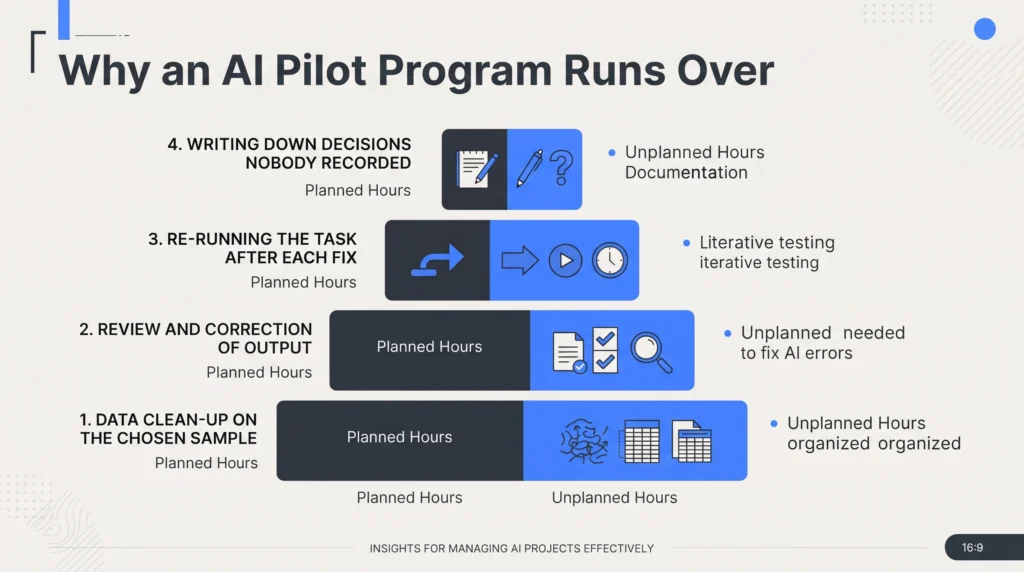
Scope creep takes the blame because it is visible. Someone asks for a second use case, and the extra work has a name and an owner. Rework has neither, and it hides inside tasks the plan already listed, so the schedule looks intact until the week it fails. Ask a team mid-pilot what they did on Tuesday and you will hear about a spreadsheet nobody planned to touch, and that is the overrun. It has been there since week one.
Where do the extra hours in a pilot go?
Mostly into checking: finance teams spend 26% of their working week verifying or correcting AI output. That figure comes from the 2026 CFO Sentiments Survey, run by Global Surveyz for Datarails. A pilot runs hotter: nothing is trusted yet, so everything gets read twice. Add the hours spent fixing records, re-running the task, and explaining the result to whoever approves it, and the review loop is the pilot.
Two findings in the same survey explain why. 65% of the 270 CFOs said their most common frustration was a confident answer built on the wrong data. Another 56% had seen team members get different output from the same prompt. Both force a person to read every line, and review stays flat until a team can predict which outputs are safe to skim. Flat review on rising volume is what pushes a pilot past its date.
Why does data clean-up take over a pilot?
Because the gap between data people believe they have and data a model can read only shows up when something reads it. The 2026 State of Data Integrity and AI Readiness study comes from Precisely and Drexel University’s LeBow College. In it, 88% of more than 500 data leaders said they were ready on data, while 43% named data readiness as their biggest obstacle. A pilot is where the second answer wins.
Clean-up is open-ended, which is what makes it dangerous to a fixed window. Nobody can say how many duplicate records sit in a customer list until they look, and looking is most of the job. Teams then face a choice they did not plan for: clean the whole source, or clean only what this task needs. The second is almost always right for a pilot: pull a sample, fix it, and leave the wider work to its own project.
What does an unwritten pilot scope cost?
It costs you the ending: without a written scope, there is no line between finished and not finished, so results get re-argued. The Precisely study found only 31% of those data leaders had metrics tied to named business measures. The 25th annual State of the CIO survey asked 662 IT leaders much the same thing. Only 47% had set formal AI metrics, and 32% called ill-defined measures a barrier to scaling.
An unwritten scope also invites the one thing it was meant to prevent. When nobody agreed what the pilot would answer, every new idea sounds in scope and gets absorbed rather than refused. Generic AI consultants rarely push back here, because a widening pilot looks like progress. The measures teams do set lean toward operational efficiency, which works if one is written down. A scope is five lines: the task, the measure, the sample, the date, the decider.
How do you hold a pilot inside its window?
Plan the rework instead of hoping it away. Measure the task before you change anything, so you have a baseline. Put review hours in the schedule as a named block with an owner. Cap the data clean-up to the sample this task needs, then fix the decision date in week one. None of that makes the pilot shorter; it makes the plan honest, which is what stops the overrun.
Review hours are the ones people forget, so give them an owner and a number. One named reviewer, a set slot each day, and a tally of outputs that needed no change, a small fix, or a rebuild. That tally is your result; it is also change management, because the reviewer will later train everyone else. Their AI literacy is the quiet asset the pilot builds. If the slot keeps getting skipped, week two is a better place to learn that than month five.
AI Smart Ventures has worked with close to 1,000 organizations, and the first conversation is usually about the review loop. Our AI Consulting team helps set the scope and the decision date before a pilot starts.
Frequently Asked Questions
What does it mean to run a pilot, not a rollout?
A pilot is a test with an end date and a question; a rollout is a commitment. The pilot covers one task, one team and a fixed sample, and it is allowed to fail. That permission is the point. A rollout assumes the answer is yes, so running a pilot as a small rollout removes the only thing it gives you.
Can you run an AI pilot on free tools?
Often yes, and it is a fair way to start. Free tiers of the main assistants will show whether the task suits AI at all. They usually cap daily use, though, and may not carry the data terms your work needs. What the free tier does not change is the demand on your time: clean-up and the review loop stay the same size.
What counts as rework inside a pilot?
Any work the plan assumed would happen once and that happened again. Re-running a task after fixing an instruction counts, and so does correcting records the first run rejected. Redoing an output a reviewer sent back counts too. Rework is not failure; it is how a pilot learns. It becomes a problem only when the schedule was written as though it would not occur.
How much review time should a pilot allow for?
Plan for review to be the largest single block of human time in the pilot. Finance teams in Datarails’ 2026 survey of 270 CFOs reported 26% of their working week on verifying or correcting AI output. A pilot runs hotter, because nothing is trusted yet. A daily slot with one named reviewer is the usual shape. The tally of what needed changing is the output.
Does rework mean the AI tool is the wrong one?
Not by itself: early rework usually points at the inputs or the instruction rather than the model. Change one thing and run the task again before you blame the tool. What suggests a wrong fit is rework that stays flat while everything else improves. If that share has not moved after weeks of clear instructions and clean inputs, the tool is the variable left.
Should you fix the data before the pilot starts?
Fix only the slice the pilot will touch. A full clean-up has no natural end, and starting one first delays the answer you wanted. Pull the sample the test needs, correct that, and write down what you found. That record is the business case for the wider work. Teams that clean everything first often spend the whole window on data and never test the tool.
Who decides that a pilot has finished?
One named person, agreed before the pilot starts, and ideally the one who owns the work rather than the tool. A committee cannot end a pilot, because a committee can always ask for one more week. Give that person the written scope, the review tally and a date. Then let them say yes, no or extend once. Naming them early is what makes the date real.
What belongs in a written pilot scope?
Five things: the one task, how you will measure it, the sample size, the decision date, and the name of the decider. Add a line on what the pilot will not test, so a new request has somewhere to be refused. Keep it on one page and share it before anything is switched on. Pilots that end in argument rarely had this page.
Why do pilots drift past their decision date?
Because the date was never attached to a decision. A pilot with an end date but no decider simply stops being discussed, and the work carries on without a verdict. Drift also happens when the measure arrived late, so nobody can agree what the result was. Both are fixed on paper before the pilot starts; adding weeks once the window has gone fixes neither.
Is more pilot time ever the right answer?
Yes, once, and only for a reason you can name. A single extension is fair when the clean-up uncovered something the plan could not have known. It also holds if the reviewer was away for half the window. It is not a way to avoid deciding, so treat a second extension as the answer itself. Write the new date beside the original one, and say why.
What should a pilot hand over when it ends?
Four things, whatever the verdict: the review tally, the instructions that worked, the data fixes you made, and a note on what broke. That package turns a test into AI capability building rather than a story someone tells. It also stops the next team repeating your first fortnight. A pilot that ends with only an opinion has spent its hours and kept nothing.
How do you start a pilot that holds its window?
Write the one-page scope first, then name the reviewer, then pick the tool. Keep the sample small enough that one person can read every output in week one. That is where you learn your real rate of rework. Scope drives what a pilot takes, so ask a partner for milestones and a clear exit point. AI Smart Ventures works this way with growing businesses. Schedule a consultation to set your scope and decision date.
Executive Summary
An AI pilot program runs over because the work repeats, not because the scope grew. The first pass exposes bad records, a vague instruction or an output nobody will sign, and each fix means running the work again. Checking is the biggest claim on human time: finance leaders in one 2026 survey put it near a quarter of their week. Data clean-up has no natural end unless you cap it to the sample. Without a written scope and a named decider, the pilot cannot finish at all. Plan the second pass and the dates hold.
What Should You Do Next?
This week, write the one-page scope for the pilot you plan to run. Name the task, the measure, the sample, the decision date and the decider. Then name the reviewer and block the time before you pick a tool. Keep a tally from day one of what needed no change, a fix, or a rebuild.
AI Smart Ventures offers AI Consulting for growing businesses planning a pilot that has to finish on time. Schedule a consultation to set your scope, your review loop and your decision date.
People Also Read
- The Business Owner’s AI Tools Guide: What to Use and What to Skip
- How to Build an AI Change Management Framework
About the Author
Nicole A. Donnelly is the Founder of AI Smart Ventures and an AI Adoption Specialist with 20 years of experience as a founder and CEO and over a decade leading AI adoption initiatives. She helps businesses integrate artificial intelligence with clarity and confidence, driving innovation and sustainable growth. Nicole has trained over 20,217 professionals in Applied AI, delivered 624 workshops, and worked with close to 1,000 organizations across diverse industries.
Expertise: AI Transformation, AI Strategy, AI Implementation, AI Adoption, Applied AI, Marketing, Business Operations
Disclaimer: This content is for informational purposes only and does not constitute professional business or technology advice. Results vary based on industry, existing systems and implementation commitment. Contact AI Smart Ventures for a consultation regarding your specific situation.