
How Traditional Businesses Can Adopt AI Without a Bloated Consulting Bill
Key Takeaways
- You do not need a full-time AI director or a giant consulting contract to start using AI well.
- The smartest path for most traditional companies is fractional AI advisory, a clear roadmap, and focused implementation.
- The fastest wins usually come from workflow mapping, not from buying the newest tool.
- Non-technical teams adopt AI better when training is role-specific, practical, and tied to daily work.
- The best AI consulting for traditional businesses is led by practitioners who care about ROI, security, and adoption, not hype.
Introduction: The AI Dilemma for Traditional Businesses
If you run a manufacturing company, real estate firm, law office, retail business, or service company, AI can feel like it was built for someone else. The headlines are loud. The tools change every week. And most of the examples seem to come from tech companies with deep budgets, internal engineers, and time to experiment.
That creates a real tension. If you do nothing, you risk falling behind competitors who are already using AI to move faster, cut admin work, and improve customer response times. But if you do it badly, you can burn money on software nobody uses, overwhelm your staff, and end up with one more expensive project that never quite lands.
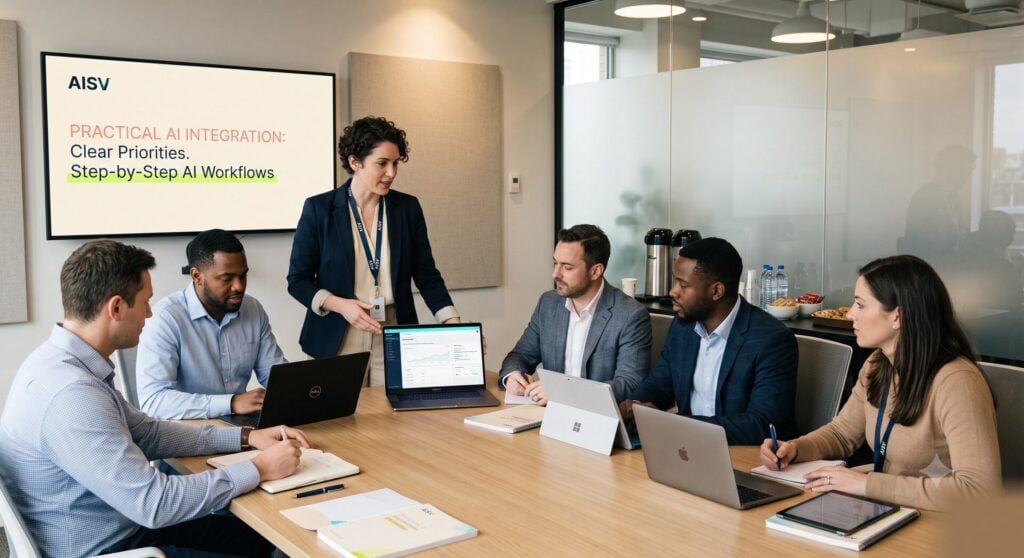
Here is the good news: practical AI implementation does not require a complete systems overhaul or a seven-figure consulting bill. In most traditional businesses, the real win comes from a simpler formula: clear priorities, fractional expertise, and step-by-step AI integration tied to actual workflows. That is the path this article will walk through.
How to Access Expert AI Strategy Without Hiring a Full-Time Director
One of the biggest myths in AI adoption is that you need to hire a full-time executive before you can make progress. In reality, a strong Chief AI Officer or AI Director is expensive, hard to find, and often unnecessary for a business that is still figuring out where AI fits.
That is where a fractional AI director or fractional AI advisory model makes sense. Instead of taking on full executive overhead, you bring in experienced guidance for the parts that matter most: identifying opportunities, setting priorities, reviewing vendors, building governance, and keeping momentum going. You get senior thinking without carrying a full-time salary before the business is ready for it.
This matters because good AI decisions are rarely just tool decisions. They are business decisions. An outside advisor can look at your operations with fresh eyes, audit where time is being lost, and tell you where AI will actually help. Just as important, they can tell you where it will not. That objectivity saves money. It also helps you avoid the vendor demo trap where every platform looks like the answer until the bill shows up. If you want a deeper look at that decision process, AISV has a helpful piece on how to de-risk your AI investment.
So what should you ask a fractional advisor to do? Start with a tight scope:
- Assess your current workflows
- Identify 3 to 5 high-value AI opportunities
- Build an AI roadmap for business priorities over 6 to 12 months
- Set basic usage guidelines and governance
- Support implementation reviews on a monthly or quarterly basis
That gives you expert advice on AI without having to hire a full-time AI director before you have the need, budget, or internal clarity.
Moving From Guesswork to a Step-by-Step AI Integration Plan
Most failed AI projects start the same way: someone buys a tool before the business has defined the problem. A marketing team tries one platform. Ops tests another. Sales signs up for a third. A few people get excited, a few get confused, and six months later the company has subscriptions, no system, and no measurable return.
That is what random acts of AI look like.
The better path is a step-by-step AI integration process built around business workflows. In plain English, that means you do not start with the tool. You start with the work.
A Practical Step-by-Step AI Integration Plan
- Workflow Mapping
List the repeatable tasks across the business. Reporting, customer service replies, proposal drafting, lead qualification, scheduling, internal knowledge sharing, content production. This is where most hidden AI opportunities live. - Opportunity Scoring
Rank each workflow by time saved, error reduction, revenue impact, and ease of implementation. A process that saves 15 hours a week with low risk should usually beat a flashy but complex use case. - Tool and Security Review
Only after the workflow is clear do you evaluate tools. At this stage, you also look at data sensitivity, access controls, and integration needs. - Pilot Build and Testing
Start small. One team. One workflow. One measurable outcome. Test, adjust, and document what works. - Reflect and Tune
Review results against KPIs, then refine. This is how AI stops being a one-off experiment and becomes an operating system for improvement.
This is also why the best practitioners to help stop the guesswork in corporate AI adoption are not just theorists. You want people who actually build, test, and train around these systems. Strategy matters, but strategy without execution is just an expensive slide deck.
A good AI consultant for traditional businesses will tie every recommendation back to a real business goal. Maybe the goal is cutting reporting time by 50 percent. Maybe it is improving lead response speed. Maybe it is reducing cost-to-serve in customer support. The roadmap should make those links obvious.
Here is a simple example. A traditional service business had four people manually building weekly client reports. After workflow mapping, they identified that data collection and first-draft reporting were highly repeatable. They introduced an AI-assisted reporting workflow, trained one pilot team, and reduced reporting time by roughly 15 hours a week. Nobody had to become technical. They just stopped doing low-value steps by hand.
If that pattern sounds familiar, you may also want to read why AI adoption fails: the top mistakes growing businesses make and the owner-operator’s guide to generative AI.
Driving AI Adoption Without Overwhelming Your Non-Technical Staff
This is where many leaders get stuck. They may believe AI matters, but they also know their people are tired. They have already lived through new software rollouts, process changes, and too many logins. If AI shows up as one more thing to learn on top of everything else, resistance is predictable.
You have to treat AI adoption as a people process, not just a technology project.
Start by naming the real concerns out loud. Staff may worry that AI will replace them. They may worry they will look behind. They may worry they will break something or expose sensitive data. If leadership pretends those fears are not there, adoption slows down. If leadership addresses them directly and shows how AI will remove low-value work, confidence rises.
A smart move is to begin with a pilot team and target quick wins that make daily work easier. Pick a process where the payoff is obvious. For example:
- faster first drafts of client emails
- internal meeting summaries
- proposal outlines
- customer service response suggestions
- recurring reporting support
When people see AI saving them 30 minutes here, an hour there, the conversation changes. It stops being abstract.
Training matters too, but generic tech tutorials usually fail. Non-technical business owners need AI adoption without overwhelm, and that means role-based training. Sales needs one set of use cases. Ops needs another. Marketing needs another. Frontline teams need hands-on examples from their own workflows. That is why practical upskilling works better than broad lectures.
A useful concept here is what AISV teaches through operational workflow thinking: map AI into the job people already do, so it feels like a natural extension of work, not a new chore. If you want a practical example of this approach, see AI for operational efficiency: simplifying workflows without the overwhelm and how to train non-technical staff to use AI safely.
A Simple Safe-Use Framework for Non-Technical Teams
- Set clear boundaries: define what data should never be pasted into public tools
- Use approved tools only: reduce risk by narrowing the stack
- Require human review: AI drafts are drafts, not final answers
- Document best practices: save prompts, examples, and approved workflows
- Create an escalation path: if a team member is unsure, they know where to ask
That kind of structure reduces fear and increases adoption. It also protects the business while people build confidence.
Identifying the Right AI Consultants for Non-Tech Native Companies
If you are looking at top consultants for helping highly traditional businesses adapt to the AI era, the first thing to know is this: the loudest firm is not always the right one. Traditional companies need practical partners, not hype merchants.
So how do you vet an AI consulting partner well? Start with a few simple questions.
What to Look For in AI Consultants for Corporate Adoption
| Criteria | What Good Looks Like | Red Flag |
|---|---|---|
| Industry fit | Experience with traditional business models and operational realities | Only talks in startup or enterprise tech examples |
| ROI focus | Defines KPIs like time saved, cost reduced, leads increased | Talks mostly about innovation without measurement |
| Communication style | Plain language, clear steps, realistic expectations | Heavy jargon, vague promises, buzzwords everywhere |
| Tool approach | Workflow-first and tool-agnostic | Pushes one platform no matter your needs |
| Delivery model | Strategy, implementation, and training all connected | Hands you a roadmap and disappears |
| Security mindset | Clear governance, privacy, and approval processes | Treats security as an afterthought |
The best AI consulting for traditional businesses usually comes from practitioners who understand operations, not just software. They know that adoption fails when recommendations ignore team capacity. They know that buying the wrong vendor can create hidden switching costs. They know that measurable impact matters more than flashy demos. For more on that, AISV has useful reads on AI consulting costs for small business and how B2B companies can choose the right AI consulting partner for measurable ROI.
This is also where AI Smart Ventures stands out. The approach is built for businesses that want results, not experimentation for its own sake. That means practical roadmaps, workflow automation, secure implementation, and custom training that helps teams actually use what gets built. It is a full path from planning to adoption, which is exactly what traditional businesses usually need.
Conclusion: Your Practical Path Forward with AI
Traditional businesses can absolutely adapt to the AI era. You do not need a giant budget, a huge technical team, or a bloated consulting bill to get there. What you need is a clear business case, the right level of expert support, and a step-by-step plan tied to real workflows.
So start there. Look at where your team is losing time. Identify the repeatable work. Pick one or two high-value opportunities. Then bring in the right partner to help you move with confidence, not guesswork. Ready to Transform Your Business with AI? Book a tailored consultation with AI Smart Ventures to identify your best AI opportunities and the fastest path to real results.