Who Owns Your AI? Copyright Suits, Data Warnings, and AI Copilots
Dear Friend,
In our AI Smart Labs session this week, we worked on getting our AI voice right, again. We fed the tools real samples of how we actually write, looked hard at what came back, and cut the fluff, generic lines that do not sound like us. We added even more guidelines to cut the fluff.
AI only sounds like you when you show it how you talk. Once we loaded our own writing in, and give it a very detailed voice and style guide, the drafts stopped reading like a press release and started reading like a person.
Here are the top stories from this week:
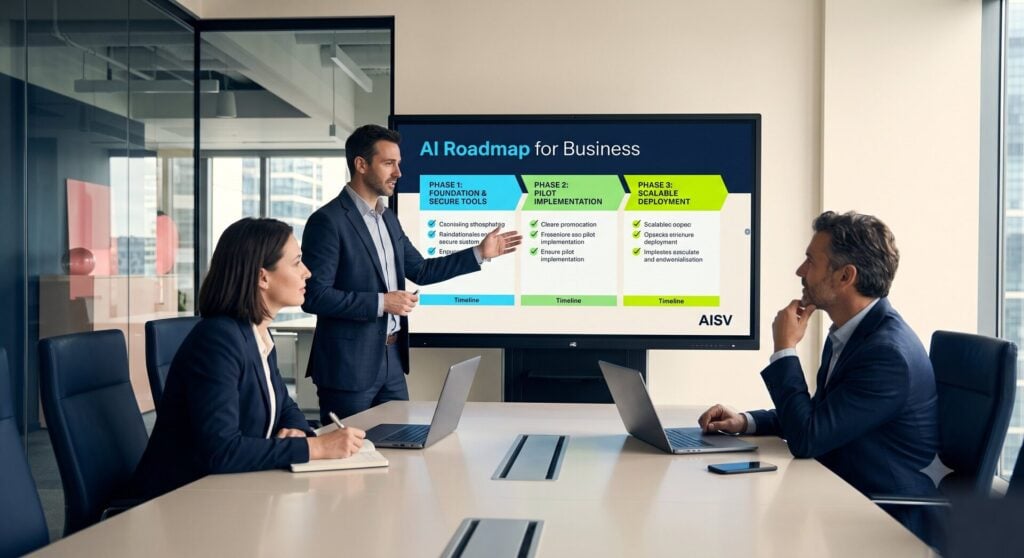
Our Most Requested Right Now: AI Strategy and Consulting
You know AI can help your business, but figuring out where to start, which tools to trust, and how to keep your data safe can feel like a lot. Doing it without overwhelming your team makes it harder.
That is where we come in. We look at your real goals and build a safe, simple roadmap that fits your team’s capacity. We only recommend secure tools, and we hand you a clear, phased plan your team can actually follow.
You walk away with a practical AI roadmap built for your business, not a pile of subscriptions and guesswork. We’ll also be your guide through implementation, so you can easily overcome any speedbumps along the way and you’ll get consistency in support.
Publishers Take Google to Court Over How Gemini Was Trained
A group of major publishers and the author Scott Turow sued Google this week. They say Google trained its Gemini AI on millions of copyrighted books it was only allowed to use to make titles searchable. The lawsuit claims Google also stripped out copyright information to hide where the material came from. It points to an internal Google note that allegedly warned the practice could cost the company tens of billions in fines.
My Take: The detail that jumped out is the alleged cover-up, not the training. Courts have leaned toward calling AI training fair use, so the plaintiffs are aiming at the part that looks like concealment instead. That should worry any company quietly running AI over content it does not own.
When we build content systems for clients, we log which parts are AI-assisted and which are human, not for a courtroom but because a clear record is the only honest answer when a partner asks. I would start keeping that record now, before anyone asks you for it.
Source: Hachette Book Group

Microsoft’s CEO Says You May Be Paying for AI Twice
Satya Nadella, the CEO of Microsoft, published a warning to companies that use AI. He argues you pay once with money for the usage, and again with the private business knowledge you feed the model to make it useful. His point is that the big labs can learn from that data and end up competing with their own customers. Open models are already picking up traffic, close to 29 percent of the requests routed through one popular developer gateway last month.
My Take: Microsoft is an investor in both OpenAI and Anthropic, and this CEO warning you about proprietary models is not a neutral observation. It is a nudge toward the open models Microsoft would love you to run. That does not make him wrong.
We read a vendor’s data terms before we send it anything real on a client build. We treat every model as a vendor we can swap, not a partner we confide in. The cheap-and-easy era of pointing your whole business at one frontier tool is ending, and self hosted models are trending.
Source: Yahoo Finance

MIT Students Built a Working Jet Engine With AI Copilots
At MIT, 31 students formed teams and got four weeks to design, build, and test a small jet engine. Many had never seen the inside of one. They used AI copilots through a single platform that pulled together several frontier models, and the winning team fired a working engine. The organizers found performance lined up with how far along students were in school, and said the real skill was judgment, not typing prompts.
My Take: Everyone reads this as “AI replaces engineers.” I read it the other way. The person who understood the problem and could judge the output won, and the newest students, who knew the least, gained the most from a copilot. That makes education and judgment more valuable, not less.
When we build for clients, the AI is the copilot and a person owns the review step, because the model is happy to be confidently wrong. I would put my newest hires on AI copilots for real work now, since the skill that compounds is judging the output, not producing the first draft. The teams that win the next few years will be small, skilled, and fast.
Source: MIT News

MIT’s AI Agents Build Practice Worlds So Robots Can Learn
Researchers at MIT and Toyota Research built a system called SceneSmith. It uses three AI agents to create detailed 3D rooms, like kitchens and garages, where robots can practice chores before they ever run in the real world. The rooms hold about six times more objects than older methods, so robots get far more to work with. That cuts the slow, costly trial and error of testing in a real space.
My Take: The robot is the boring part. AI now builds the practice ground for other AI, the same trick the labs use when they train models on made-up data. Cheap, endless simulation is becoming the thing that decides how fast physical automation shows up.
When we roll out an automation for a client, we test it behind the scenes first,, because the failures are inevitable and we want control over the who gets to see this practice.
Source: MIT News

AI Companies Are Growing Revenue Faster and Faster
A batch of AI companies reported that their revenue is not just growing, it is speeding up. Anthropic said its run rate reached about 47 billion dollars, up from roughly 30 billion only two months earlier. Older software companies are riding it too. Clio, an 18-year-old legal software maker, hit 500 million in recurring revenue after adding AI, and Gusto crossed a billion. One caution: each company defines “revenue” a little differently.
My Take: Skip the labs’ run-rate contest, which uses fuzzy math anyway. The number that tells the real story is Clio and Gusto, steady companies whose sales jumped once they built AI into a product people already paid for. We look at a vendor’s revenue and staying power before we put a client’s workflow on top of it, because a tool that folds in a year is a migration you pay for later. I would bet on AI that thickens an existing business over a lab chasing its next run-rate milestone.
Source: Business World Online

Tool picks of the week
AI Use Policy : AI Smart’s AI use policy that you can copy and adapt. With Google in court over how Gemini was trained, this is the document that sets your own rules for what data and content your team feeds into AI.
Snitcher: Identify website visitors and get email reveals, allows you to trigger outreach automations and turn traffic into leads.
Workflow & SOP Creator: A free tool that maps how your work gets done and writes clear SOPs. It ties to the MIT jet engine story. The teams that won had a person owning the process, and this is how we document that human step so AI copilots help instead of guessing.
Got a burning question, a fresh take, or just want to share your latest AI wins? Hit us up at [email protected]. Your insights keep this community growing and thriving!
See you in the Lab,
-Nicole A. Donnelly
Founder, AI Smart Ventures
AI Strategy – AI Training – AI Consulting – AI Implementation