

AI Tools for Small Marketing Studios and Agencies in 2026
Last Updated: July 2026
An AI tool for small marketing studios and agencies is a software platform. It uses AI to automate and improve core marketing tasks. These tools handle content creation, search engine improvement, client reporting, and ad management. According to McKinsey’s State of AI research, agencies that use AI report faster turnaround and lower costs. They also get stronger client results without adding headcount.
AI Smart Ventures has guided hundreds of growing businesses through AI adoption in marketing. The team works directly with owner-operators to find the right tools for their workflows. They help build lasting steps around those tools. These insights come from working with agencies across many different industries.
Most marketing studios already know AI tools exist. The real issue is knowing which ones solve real problems. You also need to know how to add them to current workflows. The key is not breaking what already works. The sections below cover the key areas where AI helps agencies grow output without growing overhead.
Key Takeaways
- Start with high-volume tasks. Automate client reporting and social media scheduling first. These show the fastest gains.
- Choose AI content tools built for multi-client work. Look for brand voice management and team teamwork features.
- Use AI-powered SEO and ad tools to run research at scale. A manual team cannot match this speed.
- Write internal policies on AI use, client data privacy, and disclosure. This protects your agency and your clients.
- Build a staff training plan with pilot projects and named internal champions. This drives real adoption.
- Agencies that adopt AI in targeted ways report close to 40% faster time-to-value on key outputs.
The takeaways above outline the most critical areas. The sections below go deeper into each one. They help you take action right away.
What Tasks Should Agencies Automate First?
Start with high-frequency, low-creativity tasks. These give marketing studios the fastest returns. Recurring, rule-based tasks take the most staff time. They don’t add unique value to client outcomes. Social media scheduling, draft client reports, and client intake are the top three areas. Start with these first. Each hour saved from manual data entry goes toward strategy and creative work. You can also use it for client outreach.
Social media scheduling tools let teams batch content for a full week or month. You can plan it all at once. Report tools pull campaign data from your sources and format it in minutes. Client intake tools route leads directly into your CRM with no manual typing. Workflow tools like Zapier AI connect these systems without coding. Teams that start here build confidence fast. They also build the habits needed for more advanced automation later.
How Does AI Improve Client Reporting?
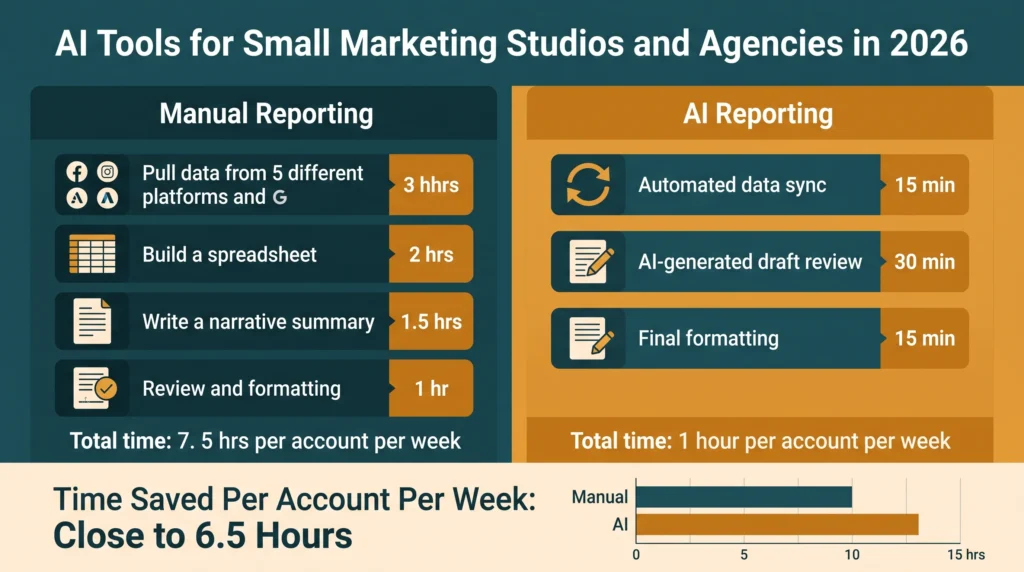
AI improves client reporting by replacing manual data work with automated dashboards. These dashboards sync directly to your data sources. Teams once spent hours pulling numbers into spreadsheets. With AI, they can now focus on trends instead. They can spend that time on strategic advice for clients. This shift changes how clients see your agency. You become an advisor, not just a data gatherer. That strengthens client bonds and increases retention.
Platforms like Looker Studio work with AI connectors. They catch unusual shifts in campaign metrics early. They flag problems before they grow. Predictive forecasting lets you show clients what outcomes are likely. According to HubSpot’s State of Marketing report, agencies using automated reporting save close to 50% of their reporting time. That frees teams to focus on client growth and strategy.
Which AI Content Tools Are Worth Paying For?
The right AI content tools for agencies are built for multi-client work. They’re not just for individual use. General writing tools make decent drafts. But they don’t store brand voice guidelines or manage team permissions. They also can’t keep client tone profiles separate. For agencies, those features are essential. You need them to produce quality work at speed and scale.
Platforms like Jasper offer brand voice libraries, team workspaces, and approval workflows. These match how agencies already work. They cut back-and-forth between writers, editors, and account managers. Built-in SEO scoring checks content before a human reviewer sees it. To judge cost, calculate time saved per piece and multiply across your monthly output. A tool that saves three hours per week pays for itself fast.
Ready to build an AI content workflow for your agency? AI Smart Ventures offers AI Marketing services designed to help growing businesses build fast, flexible content operations. Schedule a consultation to find the right tools and workflows for your team.
How Can AI Boost SEO for Agency Clients?
AI helps SEO for agency clients in three ways: keyword research, content gap analysis, and technical audits. It works at a speed that manual methods can’t match. Traditional SEO work is slow. It’s also limited by your team’s hours. You can only give so much time to each account. AI SEO platforms automate the hardest parts of research. This frees your team to focus on execution and client outreach.
Automated keyword clustering groups related search terms into content themes. This makes it faster to build a publishing calendar for each client. Content brief tools pull competitive data and search intent together in minutes. Technical SEO audit tools can scan thousands of pages. They rank issues by their likely impact on search results. One SEO specialist can manage more accounts with these tools. Quality and depth don’t have to suffer.
How Do You Keep AI Use Safe and Ethical?
Keeping AI use safe requires clear written policies before problems come up. Without formal guidelines, staff make their own choices. They decide which tools to use and what data to share. They also choose how to disclose AI-assisted work. Inconsistent practices create legal and reputational risk. They may also break client confidentiality agreements. The FTC has published guidance on AI and deceptive practices that every agency should review.
A practical AI usage policy covers four key areas. First, it lists which tools are approved for client work. Second, it sets rules for what client data can go into AI platforms. Third, it sets disclosure standards for AI-assisted content and analysis. Fourth, it creates a review step to keep the policy current. This matters as tools and rules change. Review your contracts early. Confirm that using AI tools doesn’t break any data privacy terms.
How Should Agencies Train Staff on AI Tools?
Training staff on AI tools works best with a structured plan. A self-directed approach rarely works. Most adoption failures aren’t because tools are too hard. They happen because teams never build consistent habits. A formal training program creates shared standards. It also closes a key gap. It matches the tools you pay for with the ones your team actually uses.
Start by naming one or two internal AI champions. They should learn the tools deeply and teach their colleagues. Run a 30-day pilot on a real client account. Document the results. Use those results to build a training session for the rest of the team. Agencies with a structured approach see full adoption in 60 to 90 days. Teams without a plan often take six months or more.
Frequently Asked Questions
What are the best AI tools for marketing agencies in 2026?
The best AI tools for marketing agencies in 2026 include Jasper for content creation. Semrush AI handles keyword research and technical audits. Looker Studio with AI connectors automates reporting. For social media, Buffer and Later offer AI-assisted scheduling and caption generation. Zapier AI connects these tools into automated workflows. The best mix depends on which tasks take the most staff time. Start with one high-volume area before adding more tools.
How much should a marketing agency budget for AI tools?
Most marketing agencies should budget $300 to $1,500 per month for AI tools. This depends on team size and number of client accounts. Entry-level plans start around $50 per month. Agency-tier plans with team features run $100 to $500 per platform each month. Calculate return on investment based on hours saved per week. Don’t just compare prices.
Can AI tools replace human copywriters at a marketing agency?
AI tools do not replace human copywriters. They make first drafts and handle high-volume content tasks. This frees copywriters to focus on strategy, editing, and brand storytelling. The best agency teams use AI to increase output per writer, not to cut headcount. Human judgment is still essential for tone, accuracy, and cultural nuance. It also helps create content that stands out where generic AI output is now common.
How do AI tools help with managing multiple client accounts?
AI tools help agencies manage multiple accounts by centralizing brand voice guidelines. They also automate repetitive tasks and make reports for each client. Platforms with multi-client workspaces let account managers switch between clients without losing context. Automated scheduling and reporting cut the manual work needed to keep multiple accounts running. One account manager can handle more clients without a drop in quality.
What risks come with using AI at a marketing agency?
The main risks include data privacy violations if client data goes into unsecured platforms. You also risk inconsistent quality if AI outputs aren’t reviewed before delivery. There is reputational risk if AI use isn’t disclosed when required. Over-reliance on AI content can reduce the originality of your work. Reducing these risks requires clear internal policies, regular quality review, and ongoing training.
How long does it take to see results from AI tools?
Most agencies see measurable gains within 30 to 60 days of adopting AI tools in one focused area. Full team adoption typically takes 60 to 90 days with structured training. Agencies that see the fastest results start with one specific bottleneck. They measure the impact, then expand. Results slow when teams try to adopt too many tools at once without a clear plan.
Should marketing agencies disclose AI use to clients?
Openness is the right approach. Many clients expect to know when AI tools are involved in their content or analysis. This is especially true in regulated industries where disclosure rules are growing. Disclosing AI use builds trust and sets clear expectations. According to Salesforce’s State of AI research, client trust is now one of the top concerns for agencies adopting AI. Review your client contracts to confirm AI use doesn’t break any data privacy or exclusivity terms. Update your service agreements to match your current practices.
How can I get started with AI tools for my agency?
Working with an AI strategy advisor helps speed up the step of finding and using the right tools. AI Smart Ventures helps growing businesses and owner-operators build AI workflows that match their goals, team size, and client mix. Schedule a consultation to get a structured adoption plan built around your agency’s specific needs.
Executive Summary
Marketing studios that adopt AI tools in targeted ways are getting ahead. Those that rely on manual work are falling behind. The highest-impact areas are task automation, AI-powered reporting, content creation, and SEO research. Each area delivers measurable time savings. You can redirect those savings toward higher-value client work. Clear internal policies on data privacy and disclosure protect your investment. A structured staff training program does the same. Start with one bottleneck, measure results, and expand from there. A clear plan is what turns tools into real results.
What Should You Do Next?
Find the single task that takes the most time in your agency workflow. Research AI tools built for that function. Run a 30-day pilot with one tool on one account. Document the hours saved. Use those results to build the case for broader team adoption. Name an internal champion to lead the step. Schedule a training session once the pilot wraps up. AI Smart Ventures offers AI Marketing for growing businesses looking to build AI-powered marketing operations. Schedule a consultation to get a structured adoption plan built around your agency’s specific goals.
People Also Read
About the Author
Nicole A. Donnelly is the Founder of AI Smart Ventures and an AI Adoption Specialist with 20 years of history as a founder and CEO and over a decade leading AI adoption plans. She helps businesses connect AI with clarity and confidence, driving innovation and lasting growth. Nicole has trained over 20,217 experts in Applied AI, delivered 624 workshops, and worked with close to 1,000 businesses across diverse industries.
Expertise: AI Transformation, AI Strategy, AI Rollout, AI Adoption, Applied AI, Marketing, Business Operations
Disclaimer: This content is for informational purposes only and does not constitute expert business or tech advice. Results vary based on industry, current systems and rollout commitment. Contact AI Smart Ventures for a consultation about your specific situation.

