
US Owner-Operators Selling Europe AI Compliance Guide
Last Updated: June 2026
A US owner-operator selling Europe AI compliance review is a 3-step check. First, confirm GDPR data terms on every AI tool that holds EU customer data. Second, add a clear AI label to all EU-facing content. Third, review your AI tool stack once a year as EU rules update. The EU AI Act came into force in August 2024. It set 4 risk tiers for AI tools. Most AI marketing tools sit in the 2 lowest tiers. They need only a label.
AI Smart Ventures helps US owner-operated teams review their AI stacks for EU rules. Most US teams with standard AI marketing tools are in a low-risk tier. They need only a label update, not a tool swap. AI consulting work includes a full AI tool audit and a rules check against current EU law.
Key Takeaways
- Know Your Risk Tier – Most AI marketing tools sit in the “limited risk” or “minimal risk” tier under the EU AI Act. These tiers need a label and data care, not tool bans or permits.
- Add a Label – If your EU marketing uses AI-generated text, images, or chatbots, add a short label. “Created with AI assistance” meets the rule for most limited-risk tools.
- Check Your Data Settings – Before sending EU customer data to any AI tool, confirm it has GDPR data terms. Most major tools offer these if you opt in.
- Avoid High-Risk AI – High-risk AI covers tools that make AI decisions about credit, hiring, or insurance. Standard content and email tools do not fall here.
- Review Annually – EU AI rules are still rolling out. Review your AI tool stack once a year against the current EU AI Act and GDPR updates.
What Is the EU AI Act for US Sellers?
The EU AI Act sets rules for AI tools used within the EU. It applies even when the provider is based outside the EU. US owner-operators who sell to EU customers and use AI tools fall under the act. It sorts AI tools into 4 tiers: banned uses, high risk, limited risk, and minimal risk.
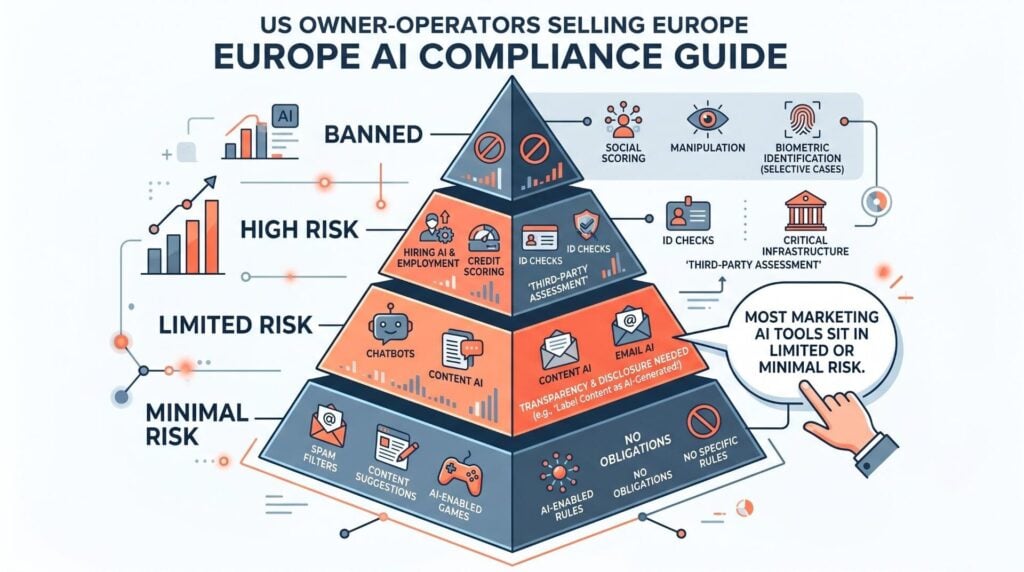
A 2024 McKinsey survey found that 68% of US firms with EU customers did not know the EU AI Act applied to them. For most owner-operators, content tools, email AI, and chatbots sit in the 2 lowest tiers. The rules are clear: add a label, check data settings, and avoid AI tools that make decisions with no human review.
Which AI Marketing Tools Are Safe for EU Customers?
Most AI marketing tools are in the “limited risk” or “minimal risk” tier. Limited-risk tools must show a label that says the content is AI-assisted. Minimal-risk tools need no label at all. The key question is whether the tool talks directly to your EU customer or works quietly in the background.
A 2024 Deloitte technology survey found that 79% of marketing AI tools used by teams under 50 people sit in the limited or minimal risk tier. Tools that move into a higher tier are ones that rank, score, or make AI decisions about individual customers with no human review. For a vetted list of AI marketing tools by task type, see AI tools and apps on the AI Smart Ventures hub.
| AI Marketing Tool | EU AI Act Tier | Action Required |
|---|---|---|
| AI content writer (blog, email, ads) | Limited risk | Add AI label |
| AI chatbot on your website | Limited risk | Add “AI assistant” label |
| AI email subject line tool | Minimal risk | No label needed |
| AI social media scheduler | Minimal risk | No label needed |
| AI scoring or ranking of EU leads | High risk | Seek legal review |
| AI profiling or biometric tools | High to banned | Do not use |
The table above covers standard owner-operated marketing tools. If your AI use includes AI decisions about individual EU customers, seek legal advice before you proceed.
How Do You Handle EU Customer Data in AI Tools?
EU customer data falls under GDPR as well as the EU AI Act. GDPR needs a legal basis to use EU customer data. It also needs GDPR data terms with any AI tool that holds that data. You must not send EU personal data to tools that lack these terms. Most major AI tools offer GDPR data terms, but you need to opt in or sign them.
The 3 data rules that matter most for owner-operated teams are simple. Use tools with GDPR data terms. Do not enter EU customer names or emails into tools without those terms. Keep a short log of which tools hold which EU customer data. Teams that follow these 3 rules pass most EU data audits without changes to their core AI stack.
What Must You Tell EU Customers About AI-Generated Content?
EU customers have a right to know when they read AI-generated text. They also have the right to know when they talk to an AI chatbot or view an AI-created ad image. The label rule under the EU AI Act is clear for most owner-operated teams. Add a line such as “Created with AI assistance” to AI-generated content. Label chatbots as AI tools. These 2 steps cover the label rule for most limited-risk marketing tools.
A 2024 Gartner survey found that 61% of EU consumers trusted a brand more after seeing a clear AI label. A short label adds trust and meets the legal need at the same time.
Six label rules for AI marketing to EU customers are:
- Label AI-Generated Text – Add “Created with AI assistance” to any AI-written content for EU customers, including blog posts, emails, and ads.
- Label AI Chatbots – Show “AI assistant” or “Powered by AI” on any chat window where an AI tool responds to EU customer messages.
- Label AI-Generated Images – Add a visible label to any AI-created images used in EU marketing, including social posts and ad creatives.
- No Hidden Profiling – Do not use AI to build hidden profiles of EU customers for scoring or ranking without their knowledge and consent.
- No Manipulation – Do not use AI that targets known weak points to push EU customers into a purchase. This sits in the banned tier.
- Keep a Label Log – Keep a short log of which AI tools you use and what labels you show EU customers. This log helps if you receive an EU rules inquiry.
These 6 rules cover the core label needs for most owner-operated teams selling into Europe.
How Do You Build a Compliant AI Marketing Workflow?
A compliant AI marketing workflow combines 3 things. First, GDPR data terms on every AI tool that holds EU customer data. Second, a clear AI label on all EU-facing content. Third, an annual check to catch rule changes. Most owner-operated teams can build this workflow in a single day.
AI Smart Ventures offers AI marketing and AI consulting for US teams selling into Europe. The review covers tool-by-tool tier checks, a data settings audit, a label template, and a 12-month review plan.
Five steps to build a compliant AI marketing workflow for EU customers are:
- Audit Your AI Tools – List every AI tool you use for EU-facing marketing. Check the EU AI Act tier for each one on the EU official rules page.
- Add a Label to All EU Content – Add a short AI label to all EU-facing AI-generated content. Use one template: “This content was created with AI assistance.”
- Check Data Terms – Log in to each AI tool and confirm it has GDPR data terms. Save the agreement as a record.
- Set a No-Go List – List any AI tools you will not use for EU customer data. Include tools without GDPR terms and tools that make AI decisions about EU customers.
- Schedule an Annual Check – Set a calendar reminder each August to review your AI tool list against current EU AI Act and GDPR updates. August is the EU AI Act start date.
Teams that follow these five steps have a clear EU rules posture. They can respond to any customer or EU inquiry about their AI use within minutes.
Frequently Asked Questions
Does the EU AI Act apply to US businesses selling into Europe?
Yes. The EU AI Act covers any firm that sells to EU customers using AI tools. This is true no matter where the firm is based. A US owner-operator who uses AI to write email campaigns or run a chatbot for EU customers falls under the act. Most standard marketing AI tools sit in the limited or minimal risk tier and need only a clear label.
What AI tools are safe for EU marketing?
Content writing AI, email AI, social media tools, and SEO tools sit in the limited or minimal risk tier. Limited-risk tools need a label. Minimal-risk tools need no action. Avoid tools that make AI decisions about individual customers with no human check, such as AI lead scoring or AI-driven credit decisions. When in doubt, check the EU AI Act risk guide on the EU official site.
What label do you need for AI-generated content in Europe?
Add a short line to any AI-generated content for EU customers: “This content was created with AI assistance.” For chatbots, add “AI assistant” or “Powered by AI” at the start of any chat session. For AI-created images, add a visible label. These 3 labels cover the EU AI Act label rule for most limited-risk marketing AI tools used in standard EU-facing campaigns.
How does GDPR apply to AI tools used for EU marketing?
GDPR needs a legal basis to use EU personal data. It also needs GDPR data terms with any AI tool that holds EU customer data, plus a record of what tools hold what data. Before adding EU customer data to any AI tool, confirm it offers GDPR data terms. Most major AI tools do offer these, but you need to opt in or sign the terms as a separate step.
What is the difference between EU AI Act and GDPR for marketing AI?
The EU AI Act covers AI tool risk tiers and labels. GDPR covers EU customer personal data. Both apply when you use AI to market to EU customers. The EU AI Act asks you to label AI-generated content and avoid high-risk AI uses. GDPR asks you to hold EU customer data only in tools with valid data terms. Most owner-operators need to take 2 steps: add a label and check data terms.
What EU AI Act tier do most marketing AI tools fall under?
Most content writing, email, and social media AI tools sit in the “limited risk” tier. Limited risk means you must add a label, but there are no bans or permits needed. Some AI tools that work in the background sit in the “minimal risk” tier and need no action at all. Only tools that make AI decisions about EU customers or use biometric data enter the high or banned tiers.
What happens if a US business does not follow EU AI Act rules?
EU AI Act violations can result in fines. The fine level depends on which rule was broken. For most limited-risk label failures, the first step is a notice to fix the issue, not an immediate fine. US firms with active EU customers should treat the EU AI Act as a real legal duty and add the needed labels to avoid official attention.
How do you get help building an EU-compliant AI marketing workflow?
Schedule a consultation with AI Smart Ventures to get a full AI tool audit, an EU AI Act tier check, a GDPR data terms review, and a clear label template for your team. AI consulting work covers the full rules checklist and a 12-month review plan so your stack stays current as EU rules evolve.
Executive Summary
US owner-operators selling into Europe must follow EU AI Act and GDPR rules when using AI for marketing. Most standard AI marketing tools need only a label and a GDPR data check to stay in line. Add “Created with AI assistance” to EU-facing AI content, confirm GDPR data terms for each tool, and review your stack each August to stay current.
What Should You Do Next?
List every AI tool you use for EU marketing, check its EU AI Act tier, confirm GDPR data terms, and add a label to all EU-facing AI-generated content.
We offer AI marketing and AI consulting for US owner-operated teams. Schedule a consultation with AI Smart Ventures to get a same-day action list, a label template, and a 12-month review plan for EU rule changes.
People Also Read
- What Your AI Vendor Isn’t Telling You: 10 Questions Before Signing
- How to Choose AI Tools for Marketing: A Practical Guide
About the Author
Nicole A. Donnelly is the Founder of AI Smart Ventures and an AI Adoption Specialist with 20 years of experience as a founder and CEO and over a decade leading AI adoption initiatives. She helps businesses integrate artificial intelligence with clarity and confidence, driving innovation and sustainable growth. Nicole has trained over 20,217 professionals in Applied AI, delivered 624 workshops, and worked with close to 1,000 organizations across diverse industries.
Expertise: AI Transformation, AI Strategy, AI Implementation, AI Adoption, Applied AI, Marketing, Business Operations
Disclaimer: This content is for informational purposes only and does not constitute professional business or technology advice. Results vary based on industry, existing systems and implementation commitment. Contact AI Smart Ventures for a consultation regarding your specific situation.