

What Are AI Agents and How Can Your Business Team Use Them?
Last Updated: August 2026
An AI agent is a software system that takes a goal, plans the steps, then acts across your tools until the job is done. A chatbot answers you; an agent does the work and reports back. It reads a request, works out what comes next, calls the software you gave it, and checks its own output. Acting without a prompt at every step is what makes it an agent.
AI Smart Ventures has guided growing businesses through AI adoption since well before agents had a name. The pattern in those rooms rarely changes. Teams grasp the idea in a minute, then stall for weeks on one line: where does a tool that drafts end, and a tool that acts on its own begin?
Getting that line wrong costs you quietly. Buy an agent for work nobody can describe, and you pay for output nobody trusts. Skip agents entirely and you keep paying skilled people to carry data between systems that could talk. Neither mistake shows up on a dashboard, which is why both persist.
Key Takeaways
- An agent plans and acts, while a chatbot only answers. What splits them is whether the software touches your other systems on its own.
- Task length predicts success better than any demo. Agents are timed against how long a human expert needs, and they slip as that clock runs on.
- Agents fail in patterns, not at random. A 2026 review of 19 test suites sorted the failures into six groups, led by bad tool calls and drift on long jobs.
- Every useful agent needs three things: a task you can describe, its own access to the systems involved, and one named owner of the result.
- Oversight is running behind adoption almost everywhere. Agree who approves what before the second agent lands, not after one goes wrong.
Notice what those five share: none is about the model. Agent value turns on how well your work is written down, who owns the result, and how much freedom the software gets. This is a management question in a technical costume, which is why AI strategy beats tool shopping.
What Is an AI Agent, and How Is It Different?
An AI agent differs from a chatbot in the one way that counts: it acts. A chatbot takes your words and hands back words. An assistant drafts and edits inside the app you already have open. An agent gets a goal plus a set of keys, then works the steps on its own, calling other software as needed. Same model, very different blast radius.
| Type | What it does | What it can touch |
|---|---|---|
| Chatbot | Answers questions in a chat | Nothing outside that window |
| Assistant | Drafts where you work | The file in front of you |
| Agent | Pursues a goal over several steps | Whatever systems you granted it |
Vendors blur these three constantly, so read the access screen and not the headline. If the software cannot reach past its own window, it is an assistant with a bold name.
How Long a Task Can an AI Agent Hold?
Success falls as tasks get longer, and there is now a public measure of it. METR tracks a task-completion time horizon: the length of job, timed against a human expert, that an agent finishes at a given success rate. Its January 2026 update grew the test set from 170 tasks to 228 and lifted eight-hour jobs from 14 to 31.
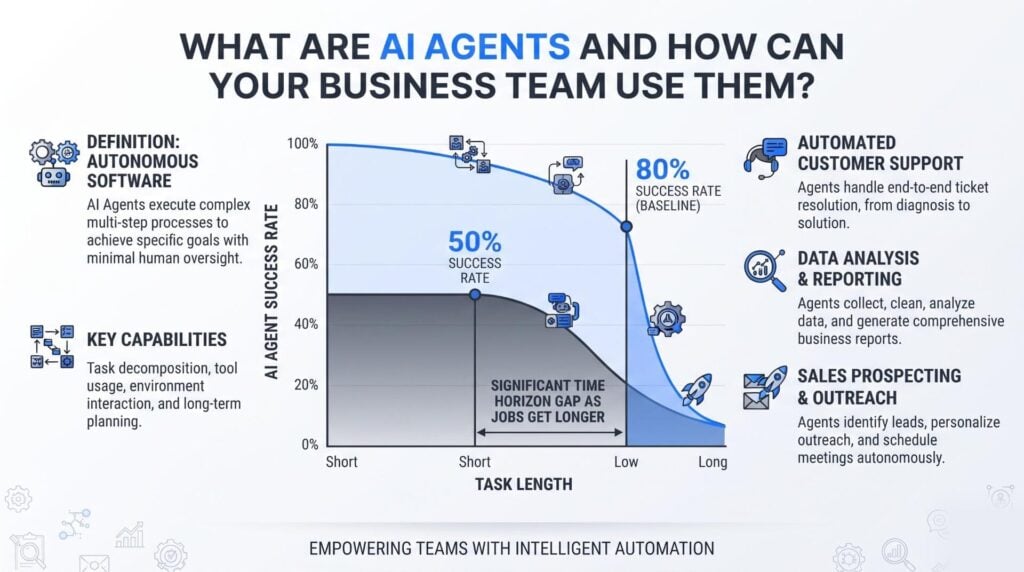
Two numbers from that work belong in your planning meeting. METR reports both a 50% and an 80% time horizon, and the gap between them is the honest picture of your risk. Frontier horizons have doubled every seven months or so since 2019, though from 2023 alone the current set puts that nearer four. Read it as a moving line, never a promise.
What Work Do Teams Hand to Agents First?
Teams start with work that repeats, has a clear finish line, and sits across two or more systems. Chasing missing details, matching two lists, pulling a weekly summary from records someone else keeps: those are the classic first jobs. The thread here is not difficult. It is that one person could write the steps down and a second could follow them.
The fit tests get sharper than one page can carry. Marketing agents and service agents each bring their own failure modes. At this level the screen stays simple. Does the task have written steps, a result you can check, and someone who would notice if it went wrong? Two yeses out of three means a writing job first, on the way to practical AI.
Where Do AI Agents Still Fall Down?
Agents break in known ways, and those ways are now catalogued. A July 2026 review drew on 27 benchmark and audit papers covering 19 test suites, then sorted what goes wrong into six groups. The list runs from tool calls made with the wrong details, through plans that break a rule you set, to drift on long jobs as context piles up.
Two findings belong in your buying notes. Failures compound faster than task length grows, so a job twice as long is far more than twice as likely to break. Strong scores on single steps also fail to predict success end to end. Extra scaffolding around the model fixes neither problem.
What Has to Be True Before an Agent Helps?
Three things have to be true, and none of them is about the software. Someone must describe the task well enough that a new hire could run it. The agent needs its own access to each system, granted on purpose and not borrowed from a person’s login. One named human must own the result. Miss any of the three and you have bought a liability.
That middle point is where most teams are weakest. Okta’s May 2026 study of 292 executives and 492 knowledge workers frames it as three questions: where are my agents, what can they reach, and what can they do? Only 34% of firms gave agents the same security controls as staff, and 52% of employees used AI tools without approval.
Working out which tasks clear that bar takes an afternoon and saves you months. Talk to our AI implementation team about running that screen before a single agent goes live.
Who Is Accountable When an Agent Acts?
Whoever approved the agent is accountable, and that has to be written down before the second one lands. Right now oversight lags adoption. In EY’s March 2026 poll of 500 technology leaders, 52% said department-level AI projects ran with no formal approval or review, and 78% said uptake was outrunning their ability to manage the risk. That is a change management gap.
Grade the freedom rather than argue about it. Some agents need a yes before every action. Others get a plan signed off once, then run it start to finish. A few, where mistakes are easy to undo, can work inside limits you set and raise a hand at the edge. Record which grade each agent holds and who signs for it.
Frequently Asked Questions
What is an AI agent and how does it differ from a chatbot?
An AI agent pursues a goal over several steps and acts on other software, while a chatbot only answers in a conversation. Ask a chatbot about an unpaid invoice and it explains the process. Give an agent the same question and it can search the ledger, match the record, and draft the chase email. The line between them is access, not brains.
How do business teams use AI agents day to day?
Most daily use falls into four groups: gathering facts from several places, matching records that should agree, drafting routine mail from real data, and filing things where they belong. A weekly summary that someone now builds by hand from three systems is a typical first job. Teams start on internal work rather than anything a customer sees, because mistakes there stay easy to catch.
How do you deploy an AI agent without technical expertise?
You do not need to write code. Most growing businesses start inside software they already pay for, where agent features arrive as settings rather than builds. The hard part is never technical: it is writing the task down, deciding what the agent may reach, and naming who checks the output. Putting one live has its own playbook, which needs more room than a definition page.
Is an AI agent the same as the automation we already have?
No. Older automation follows rules you wrote in advance and does the same thing every time, while an agent picks the order itself. That helps when jobs vary and hurts when they do not. If your task never changes shape, a plain rule is simpler to run and easier to audit. Save agents for work where a judgment call sits between the steps.
Can an AI agent replace a member of staff?
Not in any way you should plan around. Agents take pieces of jobs, not whole roles, and the pieces they take are the dull, well-described ones. A person still owns the result, spots the odd case, and answers for it. The real gain is hours moved off admin and back onto work that needs a human, which is the human-first AI position.
How much work can one AI agent handle at a time?
Less than the sales pitch suggests, and the limit follows task length rather than task count. Measured success drops as jobs stretch out, which is why test suites track how long a human expert would need. Keep first agents on jobs a person could finish inside an hour. Long chains that run for days are where small errors eat the time you saved.
What data does an AI agent need to see?
Only what the task needs, and no more. Grant accesses one system at a time rather than handing over a general login, and chooses read-only where the agent has no cause to write. This matters more than it does with chat tools, because an agent acts on what it reads. Review that access on a schedule, since rights pile up long after the reason has gone.
How do you know if an AI agent is working well?
Measure the same task both ways before you decide. Time how long a person takes and how often they get it right, then run the agent for two to four weeks against that mark. Count the corrections, not just the outputs. An agent that works fast but needs a fix on half its output has moved effort rather than removed it.
What goes wrong most often with AI agents?
Bad tool calls top the list, which means the agent picks the right action with the wrong details. Close behind sit plans that break a rule you set, and drift on longer jobs as context piles up. A 2026 review across 19 test suites found these failures compound faster than tasks lengthen. The defense is short tasks, tight access, and a person who checks early runs.
Do AI agents need their own logins?
Yes, and it is worth insisting on. An agent running under a staff login is invisible in your records, inherits every right that person holds, and keeps working after they leave. Its own identity gives you an audit trail and a switch you can flip. Only about a third of firms give agents the same controls as staff, so assume yours has work to do.
Should you tell people when an agent did the work?
Tell them whenever the agent speaks to someone outside your team, or shapes a decision that affects them. Inside the team, a note on the record is usually enough. Saying so costs nothing and protects trust you would otherwise spend months winning back. Several states now require people to be told when they are dealing with an AI system, so check what applies locally.
What does it take to get started with AI agents?
Start with scope, not software. Pick one task that repeats, write its steps down, list the systems it touches, and name the person who owns the result. That groundwork often takes two weeks and shapes almost everything after it. Cost tracks how many systems are involved and how much AI literacy your team has, so capability building comes first. Book a consultation to size the work honestly.
Executive Summary
AI agents take a goal, plan the steps, and act across your tools, which is what splits them from chatbots and from in-app assistants. What they can hold is bounded by task length: success drops as jobs get longer, and known failures compound faster than tasks stretch. Three things decide whether an agent earns its place: a task you can describe, access of its own, and one person who owns the result. Oversight is running behind adoption, so agree who approves what before the second agent lands.
What Should You Do Next?
This week, list the five tasks your team repeats most and mark the ones a new hire could run from written steps alone. For each survivor, note which systems it touches and who would notice if the output were wrong. A task with a blank in either column is a writing job, not an agent job, and you can fix that yourself.
AI Smart Ventures offers AI Implementation for growing businesses deciding where agents fit and where they do not. Schedule a consultation to turn that task list into a shortlist you can defend.
People Also Read
- AI Meeting Assistants Compared: Otter vs Fireflies vs Granola vs Copilot
- How to Evaluate AI Tool Demos Without Getting Sold
About the Author
Nicole A. Donnelly is the Founder of AI Smart Ventures and an AI Adoption Specialist with 20 years of experience as a founder and CEO and over a decade leading AI adoption initiatives. She helps businesses integrate artificial intelligence with clarity and confidence, driving innovation and sustainable growth. Nicole has trained over 20,217 professionals in Applied AI, delivered 624 workshops, and worked with close to 1,000 organizations across diverse industries.
Expertise: AI Transformation, AI Strategy, AI Implementation, AI Adoption, Applied AI, Marketing, Business Operations
Disclaimer: This content is for informational purposes only and does not constitute professional business or technology advice. Results vary based on industry, existing systems and implementation commitment. Contact AI Smart Ventures for a consultation regarding your specific situation.

