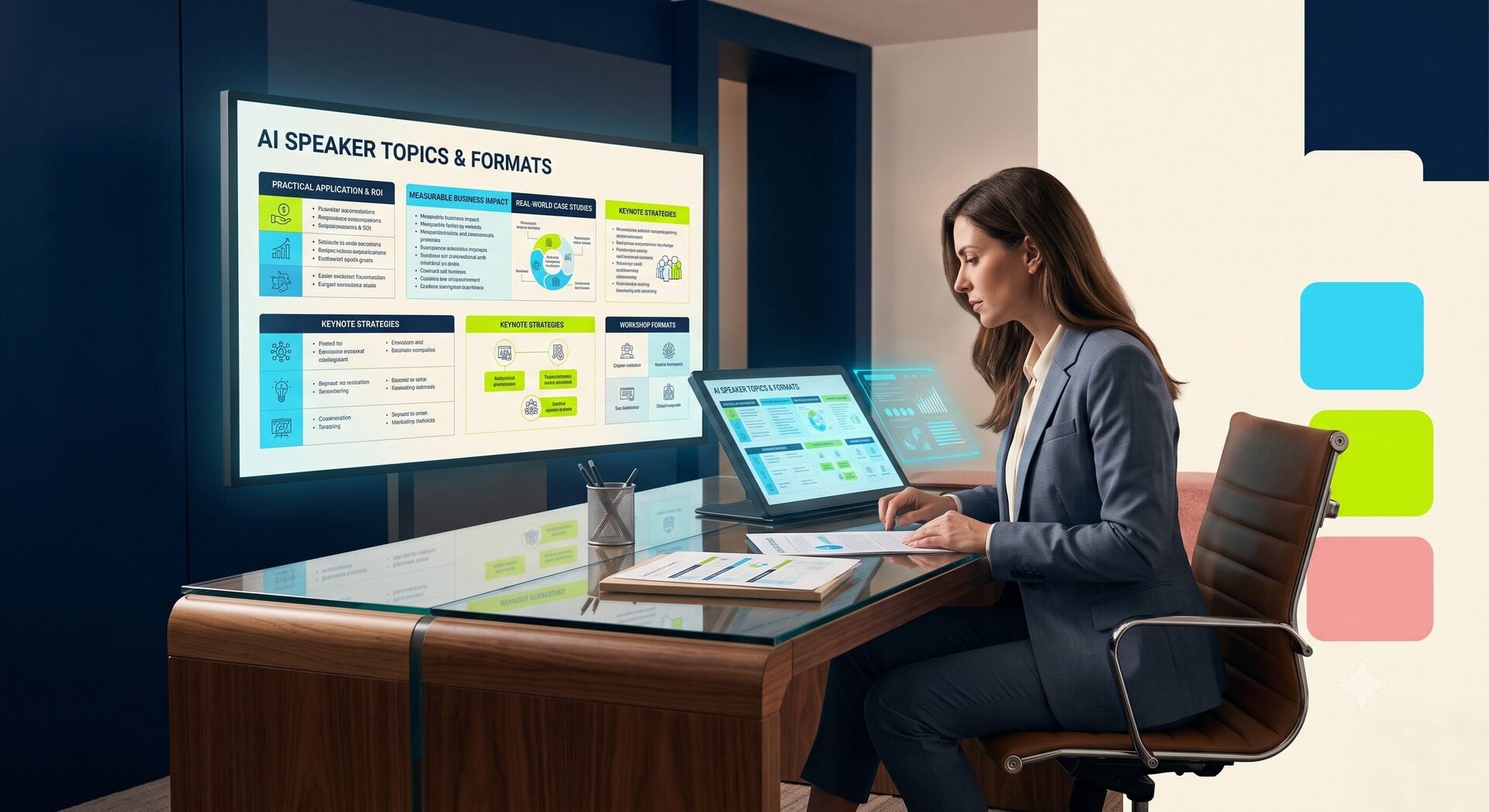
What Does an AI Speaker Actually Cover? A Topic and Format Guide for Conference Planners in 2026
If you’re planning a conference in 2026, you’re probably asking a more practical question than you were two years ago. It is no longer, “Should we have an AI speaker?” It is, “What will an AI speaker actually cover, and will it help this audience do better work?”
That shift matters. Event audiences are more informed now. They have already seen the flashy demos. They have already heard the big predictions. What they want next is clarity. They want to know where AI fits, where it creates measurable ROI, and what they can safely do with it on Monday morning.
That is why this AI event planner guide focuses on the real decision in front of you: choosing the right AI speaker topics, the right format, and the right level of business practicality for your audience. If you are sorting through keynote options right now, it also helps to review The Ultimate Guide to Choosing and Booking an AI Speaker for Corporate Events before you make your shortlist.

The Evolution of AI Keynotes: What Event Planners Should Expect in 2026
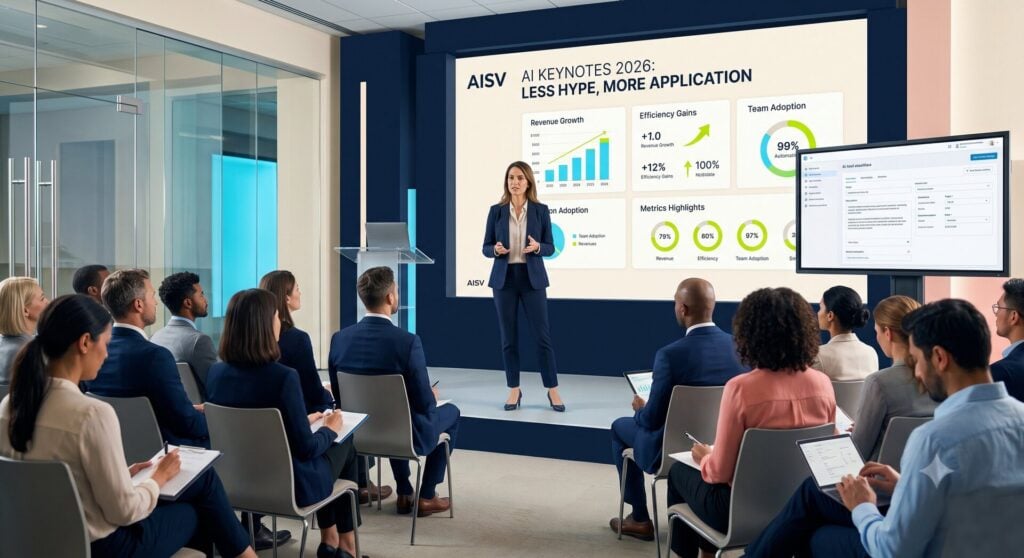
So, what should event planners expect from an AI keynote speaker 2026? In one sentence: less hype, more application.
In 2023 and 2024, many talks started with broad explanations of what AI was. In 2026, that baseline is no longer enough. Most corporate audiences already know the terms. They know ChatGPT exists. They know automation is changing work. What they need now is a speaker who can answer the real business question: How do we use AI in a way that improves revenue, saves time, reduces cost, or lowers risk?
That means strong AI keynotes are becoming more practical and more outcome-driven. Planners should expect talks that connect AI to KPIs like productivity, cost-to-serve, speed, pipeline growth, customer experience, and team adoption. A good speaker should not just say AI is changing everything. They should show where it changes specific workflows and what success actually looks like.
You should also expect more live demonstration, but with better judgment. In 2026, audiences like seeing tools in action, but they do not need reckless stage experiments. They want risk-free, well-prepared demos that illustrate a real use case without turning the session into chaos. The best speakers use live examples to make AI feel accessible, not to show off.
Another big shift is the rise of governance and workforce readiness. A serious AI keynote now needs to address safe usage, privacy, compliance, human review, and team upskilling. Corporate audiences know AI can move fast. They also know a bad rollout creates confusion, security issues, and stalled adoption. That is why event planners should expect content that balances opportunity with guardrails.
Finally, the strongest talks in 2026 are tailored. Generic overviews are losing ground. Industry associations, leadership teams, and corporate conference audiences expect use cases that fit their world. A finance audience needs different examples than a healthcare audience. A marketing team needs different workflows than an HR team. And across all of it, the best speakers frame AI as human-AI collaboration, not as a fear-based story about replacement.
Core Topics an AI Speaker Covers at Corporate Conferences
What topics does an AI speaker cover at a corporate conference? The short answer is this: the best AI speaker topics connect strategy, workflows, adoption, and results.
First, a strong speaker should cover strategic AI integration for leadership and operations. This is where many business audiences are stuck. They do not need fifty new tools. They need help deciding where AI belongs in the business. That includes workflow mapping, identifying bottlenecks, spotting automation opportunities, and understanding where AI can create leverage without creating a mess. For many audiences, this is the moment where AI stops feeling abstract and starts feeling operational.
Second, AI for marketing and sales growth is almost always relevant. Conference planners should expect practical examples around content creation, lead generation, customer research, sales enablement, follow-up workflows, and campaign optimization. The key is not “AI writes faster.” The key is AI helps teams move faster while protecting quality and improving output. If your audience includes owners, marketers, or revenue leaders, this topic usually lands well. For planners focused on growth teams, Building an AI-First Marketing Function: A Guide for Owner-Operators is a useful companion read.
Third, a high-value speaker should address how to build a practical AI roadmap. This is especially important for executive audiences. They need help moving from scattered experimentation to a plan. A useful keynote or breakout should explain how organizations can prioritize use cases, define success metrics, sequence adoption, and avoid buying tools before they know the business case. In other words, the content should help leaders think beyond novelty and toward execution. This is also where internal capability matters, which is why many organizations pair speaking with a broader learning path like the ideas explored in From AI Curious to AI Capable: A 90-Day Path for Business Owners.
Fourth, any credible AI speaker in 2026 should cover privacy, security, and responsible use. This is no longer a side note. It is a core topic. Audiences want to know what data can be used, what should stay out of public models, where human review is required, and how organizations can build safe internal practices. For regulated industries, this topic becomes even more important. If a speaker skips it entirely, that is a red flag.
Fifth, workforce readiness matters just as much as technology. Good AI talks cover training, upskilling, and culture change because tools do not create value on their own. Teams do. A speaker should help the audience understand how to move people from curiosity to confidence. That may include role-based adoption, simple prompting habits, workflow redesign, or how to build an AI-ready culture without overwhelming staff.
Put simply, the most useful AI speaker content is not about AI in theory. It is about AI for business growth, better decisions, safer adoption, and clearer next steps.
Keynotes, Workshops, and Breakouts: Choosing the Right AI Presentation Format
Once you know the topics you want covered, the next question is format. And this is where many events get it wrong. The best AI conference formats depend on the outcome you want.
Keynotes
A keynote is best when your goal is alignment, energy, and momentum. If your audience is still hesitant, fragmented, or overwhelmed by AI, a keynote can reset the conversation. It is the right format for large groups, opening sessions, leadership summits, and company kickoffs. A strong keynote should simplify the landscape, reduce fear, and give the audience a practical lens for what comes next.
Workshops
A workshop is best when your goal is implementation. This is where teams actually map workflows, identify use cases, test ideas, and leave with an action plan. If the keynote is the spark, the workshop is where the work begins. Corporate AI workshops are especially valuable for departments that need to move from inspiration into execution. They also help prevent the common post-event problem where everyone feels excited for a day and then nothing changes. If that concern sounds familiar, Why AI Adoption Stalls in Owner-Operated Teams After the First Workshop is worth reading.
Breakout Sessions
Breakouts work well when your audience has different functions with different needs. Marketing may need AI content workflows. HR may need policy guidance and recruiting use cases. Operations may need automation examples. Sales may need prospecting and follow-up systems. Breakouts let you get specific without forcing one generic session on everyone.
Executive Briefings
For senior leadership groups, an executive briefing can be the best fit. This format is less about tool demos and more about strategy, governance, risk, and prioritization. It gives the C-suite space to ask higher-level questions, pressure-test assumptions, and de-risk decisions before they invest further.
In many cases, the best event design is a mix: keynote for alignment, breakout for relevance, workshop for action. If you are unsure which combination makes sense, AI Speaker vs. AI Trainer vs. AI Consultant: Which Does Your Leadership Team Actually Need? can help you sort the roles clearly.
How to Evaluate and Select the Perfect AI Speaker for a Non-Technical Business Audience
How do you evaluate whether an AI speaker’s content is relevant for your audience? Start here: a good non-technical AI speaker makes business value obvious without making the audience feel behind.
That means the first filter is business relevance. If the speaker spends most of their time on model architecture, coding, or technical jargon, they are probably not the right fit for a general corporate audience. A strong speaker for business events should focus on outcomes, workflows, adoption, and ROI. They should be able to explain machine learning, large language models, or automation in plain language that a busy executive or team lead can use.
A simple way to assess fit is what we call the 3-Step AI Speaker Evaluation Method:
- Check the outcome focus — Do they speak in terms of time saved, cost reduced, revenue improved, or risk managed? Can they connect AI to real business workflows?
- Check the translation skill — Can they explain complex ideas with relatable examples? Do they make non-technical people feel capable instead of confused?
- Check the action value — Will attendees leave with a framework, checklist, or next step they can actually use? Is there substance beyond inspiration?
Next, look for practical frameworks. The best speakers do not just share trends. They give audiences tools for thinking and acting. That might be a workflow map, a use-case filter, an AI policy starter, or a simple adoption model. These frameworks matter because they help the audience remember what they learned after the event is over.
You should also review how the speaker handles Q&A. This is one of the clearest quality signals. A strong speaker can take messy, real-world questions and answer them with nuance. They do not default to hype. They do not dodge risk. They can say, “That depends,” and then explain what it depends on in business terms. If you want a deeper checklist, How to Vet an AI Speaker for Your Organization in 2026 breaks this process down further.
Finally, make sure the speaker takes safe use seriously. In 2026, a credible AI speaker should talk about privacy, secure workflows, human review, and responsible adoption as naturally as they talk about productivity. That balance is what makes a speaker useful for real organizations, especially when HR, legal, operations, and executive teams are all in the room.
A great non-technical AI speaker leaves people thinking, “I can see where this fits, I understand the risks, and I know what to do next.” That is the standard.
Bring Real AI ROI to Your Next Event with AI Smart Ventures
By now, the answer is clear. In 2026, an AI speaker should cover far more than trends. They should help your audience understand where AI creates value, how to adopt it safely, and what actions matter most next. The right speaker creates momentum. The wrong one creates more noise.
AI Smart Ventures helps conference planners, leadership teams, and organizations bring AI to life in a way that is practical, engaging, and grounded in business outcomes. Through tailored speaking and hands-on sessions, the team focuses on industry-relevant use cases, safe workflow integration, and measurable ROI. Whether you need a keynote that energizes the room or a workshop that gets teams building, the goal is the same: turn AI from a buzzword into something useful.
Ready to bring AI to life at your next event? Book a tailored consultation with AI Smart Ventures to secure an engaging, ROI-focused AI speaker for your corporate conference. If you are still comparing options, AI Programs for Industry Associations: Moving Beyond Demo Fatigue offers another helpful lens on what strong AI programming should look like.