

What Does Good AI Oversight Look Like?
Last Updated: September 2026
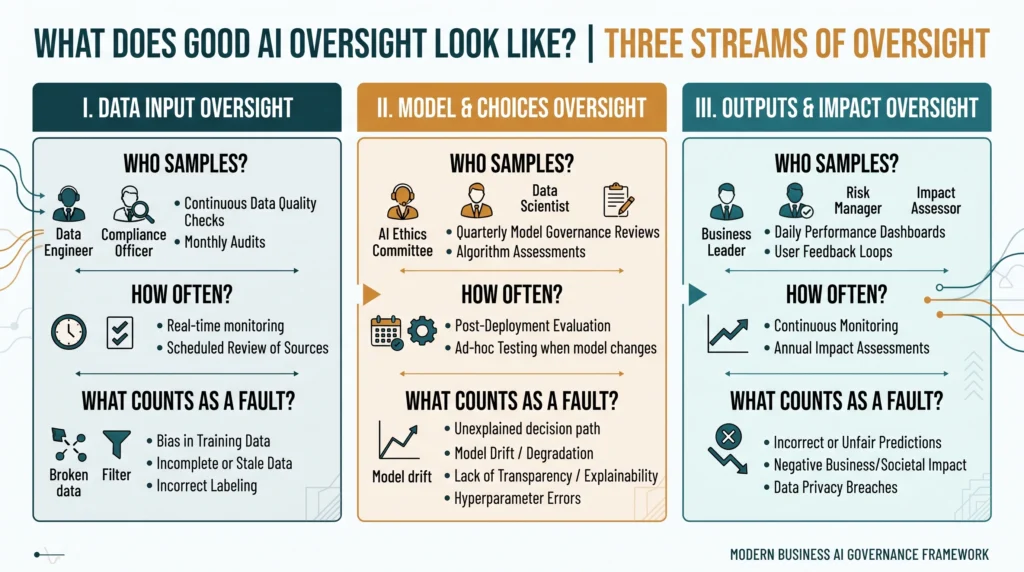
AI oversight is the standing system a firm uses to watch how AI gets used, not one check on one draft. It covers three streams: the data your team feeds in, the calls people make from an answer, and the work that goes out under your name. Good oversight names who samples each, how often, and what counts as a fault worth fixing.
AI Smart Ventures has guided growing businesses through AI adoption in professional services, health care, finance, and freight. One pattern shows up in most of them. Leaders can point to a review step for finished work, yet no one samples what staff type into the tools, and no one writes down the calls made on the strength of an answer.
A system that watches only the last step misses the two spots where harm starts. Client records reach a public tool long before anyone reads a draft. A choice gets made in a meeting, from an answer no one kept. Neither shows up in a review of finished work, and both land on the founder.
Key Takeaways
- Oversight is a system, not a step: it covers inputs, choices, and outputs, and it runs on a set date rather than on a bad feeling.
- Talk is running ahead of practice: ISS STOXX reviewed 3,048 US firms in March 2026 and found only 8% disclosed board-level oversight of AI, with 9% naming a written AI policy.
- Sample the inputs first: Cyberhaven Labs reported in February 2026 that 39.7% of data moving into AI tools holds sensitive material.
- Checking outputs alone breeds nodding: a reader who is shown an answer tends to accept it, so a check on the final draft measures manners more than fact.
- Log the call, not just the answer: note what the tool said, what the person did, and what made the gap, since that line is your only proof judgment was used.
- Match the cadence to the stakes: read client work weekly, sample prompts and uploads monthly, and walk through choices with each team once a quarter.
Read together, those six points move oversight off a list of good ideas and onto a date in the diary. The faults worth catching are quiet ones. No one reports a slow slide in quality, or a habit of pasting client files into a free account. You find those by looking, on purpose, at a small sample of ordinary work.
What does good AI oversight look like in practice?
Good AI oversight is a repeating routine with four named parts. You list the tools in use, sample what goes into them, note the calls taken from their answers, and read a slice of the work they produce. One person owns each part, each runs on a set date, and what turns up gets written down and closed out. Skip those four and oversight is just views gathered after a mess.
The word oversight does a lot of quiet work, which is why research keeps stalling on it. Keeping an Eye on AI, an April 2026 paper from twenty researchers, says human oversight still lacks a shared basic meaning and that oversight architectures are not well defined. Your working version is smaller. Write down what you sample, who does it, how often, and what a bad result sets off. That page is your design.
Why is reviewing AI outputs alone not enough?
Because a reader who sees only the final answer has lost the two things that would let them judge it: what the tool was given, and what the person meant to do. Checking output catches typos, odd tone, and nonsense. It rarely catches a smooth answer built on the wrong client file. It also misses the drift where staff stop reading closely because the tool has been right for weeks.
The pull towards going along with a machine is well known. In a 2025 study in La Radiologia Medica, nine radiologists read the same brain scans twice, once with AI marks added. Among the least practised readers, correct “normal” ratings fell from 63.3% to 23.3% once a false mark appeared. These were trained doctors; a reviewer with a full inbox will not do better, so a good system has to look behind the output.
What should a leader sample, and how often?
Sample three streams on three clocks. Weekly, read a handful of AI-assisted items that went to clients. Monthly, sample prompts and uploads to see what data is going in. Each quarter, sit with a team and walk through the calls they made from an AI answer. Small frequent samples beat one yearly audit, because a habit is easy to see while it is still forming.
Cadence matters more than coverage. You are not trying to check everything; you are trying to notice when the shape of the work changes. Five items read each week closely tell you more than 200 skimmed once a year. Set the sample to what one person can read in an hour, and log findings in the same place every time. The log then builds into a trend line rather than a pile of notes.
| Stream | What you sample | How often | What a fault looks like |
|---|---|---|---|
| Inputs | prompts, uploads, linked files | monthly | client data in a personal account |
| Choices | calls made from an AI answer | quarterly | no note of why the answer was followed |
| Outputs | client work and internal reports | weekly | a claim no one can trace to a source |
| Tools | the list of what is in use | quarterly | a tool in daily use that no one approved |
Setting that cadence is workflow optimization, not policy writing. AI consulting from AI Smart Ventures helps growing businesses build a sampling routine that fits the week their teams already have.
How do you oversee the inputs going into AI?
Watch what your team puts in, because the input shapes the answer and carries most of the data risk. Keep a list of approved tools and accounts, then sample what flows into them. Cyberhaven Labs reported in February 2026 that 39.7% of data moving into AI tools holds sensitive material, much of it through personal logins. Those sit outside company sign-on and leave no trace.
Input oversight is mostly a problem of not knowing, and you can fix much of it without buying a thing. Ask each team to list the tools they truly use, not the ones on the approved list, and promise no blame. Tool-first AI agencies often stop at setup, so the sampling habit is yours to build. Then agree on two or three kinds of data that never leave your systems, and check it each quarter against real habits.
How do you oversee the decisions people make?
Ask for the decision, not the output. For any call worth a look, ask three things: what did the tool say, what did you do, and what made the gap between them? If the answer to the third is nothing, they did not decide; they passed it on. Writing that down is not red tape. It is the only way to see whether judgment is still in play.
Reviewing calls also shows where AI literacy is thin, making it coaching as much as control. When someone can say why they went against an answer, they know the work. When they cannot say why they took it, they need AI upskilling, not a stricter rule. Keep the note short: one line in the project file, never a form. Then read a sample with the team, and treat a well-argued override as the habit you want.
How do you tell real oversight from theatre?
Real oversight turns up findings; theatre turns up attendance. If your last three reviews ended with no change to a prompt, a permission, a tool, or a workflow, you were reading a report, not running a review. Real oversight also has an unhappy month, where something turns up, and someone has to fix it. A system that has never flagged anything is not proof you are safe, more often proof no one is sampling.
The gap between talking about AI risk and watching it is now measured. The Conference Board reported in April 2026 that the share of S&P 500 firms naming AI as a risk climbed from 12% to 83% between 2023 and 2025, while only 23% called their board highly fluent in AI. Talk moved first and practice lagged. The same gap turns up in founder-led firms, where the policy sits in a folder, and sampling never starts.
- Findings get logged: each review ends with a written item, a named owner and a date, even when the item is small.
- The sample moves around: you rotate which team, tool and week you look at, so no one can tidy up first.
- Overrides are visible: staff can point to work where they went against the tool, and say what they saw that it missed.
- Something has been switched off: a tool, a permission or a workflow has been stopped because a review said so.
Frequently Asked Questions
What is the 30% rule in AI?
The 30% rule is an informal rule of thumb, not a standard: hand roughly a third of the tasks in a role to AI and keep human judgment on the rest. Nobody owns the figure, and no study backs it, so treat it as a starting stance. Give away the routine steps, and keep the calls a person can be held to.
Who is responsible when AI goes wrong?
The people who chose, set up, and used the tool. A model cannot carry blame, and a vendor contract does not move it to the supplier when your client is harmed. Inside your firm, it should rest with one named person per AI-backed workflow, not a committee. Oversight is how that person does the job, sampling the inputs, the calls, and the outputs on a set date.
What is human oversight in AI?
Human oversight in AI means a person can inspect, question, override, or stop an AI system, and does so as a matter of routine. The key word is routine. A one-time sign-off at launch is approval, not oversight. Real oversight carries on after go-live, with named people, a fixed cadence, and a written log. It assumes the person can act on what they find, including switching a tool off. That authority is the part most firms leave out.
Why is human oversight important in AI?
Because AI tools sound sure whether or not they are right, and they slide quietly as your data and market shift. Without someone sampling the work, that slide stays unseen until a client spots it. Oversight also protects the people using the tools by making the rules plain. When staff know what is checked, they stop guessing where the line sits and raise problems early.
What is the difference between AI governance and AI oversight?
AI governance is the set of rules: which tools are allowed, which data is off limits, and who decides. AI oversight is the routine that tests whether those rules hold up in daily work. Governance is written once and revised now and then. Oversight runs on a cadence and turns up findings. Many firms have the first without the second, so the policy looks complete while nothing is checked.
How often should you review an AI system?
Match the frequency to the stakes. Client-facing work deserves a weekly sample, because faults there leave the building. Inputs deserve a monthly look, since new tools and habits appear fast. Calls and the tool list suit a quarterly review. Add an unplanned review after any incident or big change. Small, frequent samples show drift far sooner than one yearly audit.
Can AI tools help with AI oversight?
Yes, for the counting work. Software can flag odd usage, track which accounts touch sensitive files, and log volumes no person could read. It cannot judge whether an answer suited a given client. The IAPP AI Governance Profession Report 2025 found 77% of the firms it surveyed working on AI governance, and most of that work is human judgment with tooling behind it.
How do you start building AI oversight?
Start with a list and one sample. Write down every AI tool in use this week, then read five pieces of AI-assisted client work closely and note what you find. That takes an afternoon and settles most arguments about where to focus, because you are working from what your team did rather than from opinion. Schedule a consultation to agree on the cadence your team can keep up.
Executive Summary
AI oversight is a standing system, not a final check. Reviewing outputs alone is the common shortcut, and it fails twice: it misses what staff feed in, and it misses the calls made from an answer. Useful oversight samples all three streams on set clocks, names an owner for each, and closes every finding in writing. Talk runs ahead of practice, with few US firms naming board-level oversight. AI Smart Ventures observes that the gap closes with a sampling habit, not a new platform.
What Should You Do Next?
This week, write a one-page oversight sheet: the three streams, who samples each, how often, and what sets off action. Run the first input sample yourself, so you see what your team is pasting in. Book the next four review dates now, because unplanned oversight does not happen.
AI Smart Ventures offers AI consulting for growing businesses that want practical AI running under a real watch. Schedule a consultation to design a sampling routine your leaders will keep.
People Also Read
- AI Consulting for Service Businesses: How It Differs from Product Companies
- What Is Applied AI and Why It Matters More Than Chasing AI Trends
About the Author
Nicole A. Donnelly is the Founder of AI Smart Ventures and an AI Adoption Specialist with 20 years of experience as a founder and CEO and over a decade leading AI adoption initiatives. She helps businesses integrate artificial intelligence with clarity and confidence, driving innovation and sustainable growth. Nicole has trained over 20,217 professionals in Applied AI, delivered 624 workshops, and worked with close to 1,000 organizations across diverse industries.
Expertise: AI Transformation, AI Strategy, AI Implementation, AI Adoption, Applied AI, Marketing, Business Operations
Disclaimer: This content is for informational purposes only and does not constitute professional business or technology advice. Results vary based on industry, existing systems, and implementation commitment. Contact AI Smart Ventures for a consultation regarding your specific situation.

