How to Compare AI Consulting Firms for Strategy, Implementation, and Training
You’ve decided AI matters for your business. Now you’re staring at a list of firms that all promise the same thing: strategy, implementation, and training wrapped into one tidy package. The hard part isn’t finding a vendor. It’s figuring out which one will actually walk you from a good idea to daily usage without stalling out halfway through.
This guide breaks down how to compare AI consulting firms that handle the full lifecycle, so you can invest with confidence instead of crossing your fingers and hoping it works.
Key Takeaways
- An end-to-end AI engagement covers the unbroken chain from discovery to daily usage: audit, strategy, build, deployment, and training. Nothing gets handed off and dropped.
- Hiring one unified AI partner beats juggling separate vendors, because it prevents misaligned strategy, friction at handoffs, and technical debt.
- The first 90 days of a rollout should dedicate roughly 40% of the timeline to team upskilling and change management, not just the technical build.
- Real AI ROI measurement tracks hours saved, error-reduction rates, revenue generated, and time-to-competency for your staff.
- Boutique AI consultancies often outperform legacy giants for mid-market projects through agility, specialized focus, and hands-on training that guarantees adoption.

Decoding the End-to-End AI Engagement: Phases of Enterprise Transformation
So what does an end-to-end AI engagement actually look like? At its core, it’s an unbroken chain. You start with a question about where AI could help your business, and you don’t stop until your team is using the solution every day and getting measurable results. A true full-service partner owns every link in that chain, so nothing gets lost in translation between the people who plan and the people who build.
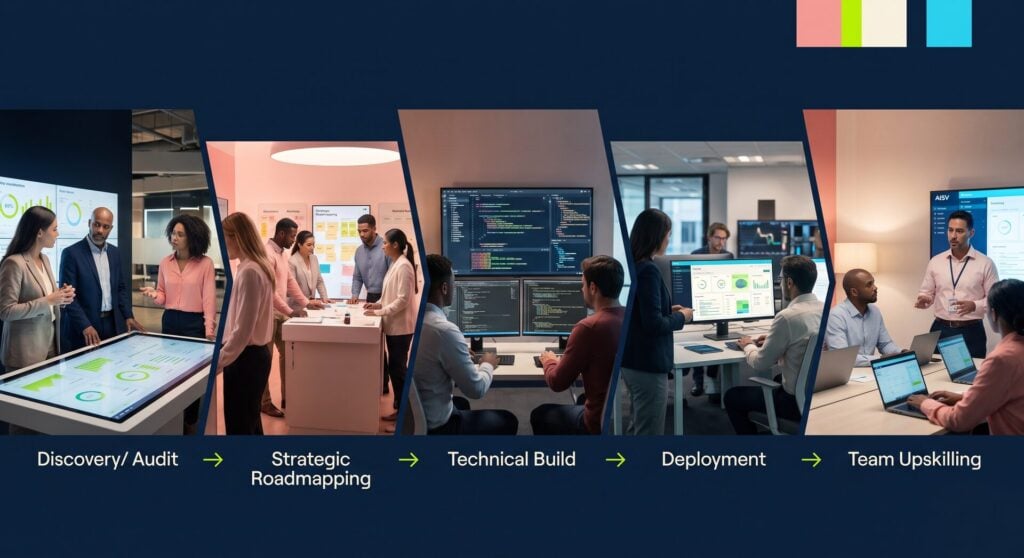
A full-lifecycle enterprise AI transformation typically moves through five phases. First comes Discovery and Audit, where consultants dig into your operations, workflows, data, and team capabilities to find the highest-value opportunities. Then comes Strategic Roadmapping, which turns those findings into a clear 12-month plan with defined actions, owners, timelines, and KPIs tied to real business outcomes.
From there you move into the Technical Build, where the roadmap becomes live, integrated software. Next is Deployment, where those tools go into your actual environment and start running inside real workflows. The final phase is Team Upskilling, where your people learn to use what was built, so the technology sticks instead of gathering dust.
Here’s what most firms skip: the work doesn’t end at launch. Continuous AI advisory keeps your initiatives on track as tools change, regulations shift, and priorities evolve. Without that ongoing guidance, even a strong strategy quietly fragments over the following six months.
That’s why true transformation is iterative, not one-and-done. The best partners follow a simple cycle of map, act, reflect, and tune. They keep refining what works and recalibrating what doesn’t, so your results compound over time instead of fading after the kickoff excitement wears off.
The Silo Trap: Why a Unified AI Partner Outperforms Multiple Vendors
It’s tempting to shop around. Hire a strategy firm here, a dev shop there, and a training vendor somewhere else. The problem is that every seam between vendors is a place where things break. You end up with misaligned objectives, technical debt, and painful friction every time work gets handed from one team to the next.
Think about what actually happens. Your strategy vendor writes a beautiful plan in week one. Your implementation vendor discovers in week ten that the plan doesn’t match your real systems, your data, or what your team can execute. A unified AI partner never lets that gap open, because the same people who designed the strategy are the ones building it. What you plan is what you get.
There’s also a real time-to-value advantage. When one cohesive team owns both the backend infrastructure and the frontend user adoption, decisions happen faster and accountability is crystal clear. Nobody points fingers. Nobody restarts from scratch. You get to measurable outcomes weeks sooner than a stitched-together vendor lineup would allow.
Best of all, integrated partners bake AI change management into the technical build from day one. They design tools with the end user in mind, provide training alongside deployment, and make sure the people who need these tools feel confident rather than overwhelmed. Adoption isn’t an afterthought bolted on at the end. It’s built into every decision from the start.
Bridging the Gap: Aligning AI Strategy with Technical Implementation
Once the strategy is set, how do consultants actually turn it into working software inside your business? It starts with a thorough audit. Before anyone writes a line of integration code, a strong partner maps your existing tech stack, your workflows, and your data security posture. This is how you avoid building something that looks impressive but doesn’t fit how you actually operate.
The technical rollout phase is where AI strategy and implementation become real. This is the hands-on execution layer: custom API integrations, data pipelines that turn raw business data into usable insight, and secure AI environments configured to meet enterprise-grade standards. Every deployment is scoped with security as a foundational requirement, following secure-by-design principles that comply with frameworks like SOC 2 and GDPR.
Here’s the part that separates useful tools from expensive experiments. Your AI has to connect directly to your core business systems, your CRM, your ERP, and your operations software. When AI is mapped into the systems your team already lives in, it eliminates repetitive manual work where the work actually happens. When it’s isolated in a separate tool nobody opens, it becomes shelfware, no matter how clever the technology.
None of this ships without rigorous testing. A responsible partner debugs, tests, and establishes governance frameworks during deployment, with clear policies and human-in-the-loop review built in. That governance layer is what keeps your AI defensible, compliant, and trustworthy long after launch.

The Human Element: Leading Operations Teams Through the First 90 Days of AI
Let’s be honest about why AI projects fail. It’s almost never the technology. It’s people. The most sophisticated tool in the world is worthless if your team refuses to use it, works around it, or quietly reverts to the old way. That’s why employee training and change management is the single most critical part of adoption, not a nice-to-have.
If you’re a mid-market operational leader preparing your department for a big transition, start with communication. Be transparent about what’s changing and why. Secure early stakeholder buy-in from the people whose daily work will shift. When your team helps shape the rollout instead of having it dropped on them, resistance drops and adoption climbs.
Now, what should your operations team expect during the first 90 days? A realistic timeline breaks into three chunks. In Weeks 1 through 4, you map current workflows and run pilot testing on a contained slice of the business, so you learn where the friction really is before scaling.
In Weeks 5 through 8, you deliver targeted upskilling and begin a phased rollout. This is where people build genuine confidence by using the tools on their own real work. In Weeks 9 through 12, you tighten the feedback loops, gather what’s working and what isn’t, and optimize the system based on live results rather than assumptions.
A useful rule of thumb: dedicate at least 40% of your rollout timeline to team upskilling, not just the technical build. Underinvest here, and you’ll have a great tool that nobody trusts.
And skip the generic AI lectures. Confidence comes from hands-on, workflow-specific training where people open accounts, build tools, and complete real projects during the session itself. The “get your hands dirty” approach is the difference between training that changes behavior and training that changes nothing.
Measuring the Impact: The ROI of a Unified AI Approach
If you’re wondering how to measure the return on combining strategy, tool building, and staff training into one project, start by defining specific, honest KPIs. The metrics that matter most are hours saved across teams, error-reduction rates in key processes, and direct revenue generated or recovered. Vague promises about “efficiency” don’t count. Numbers you can track do.
Bundling the work also lowers your Total Cost of Ownership. When one partner handles strategy, implementation, and training together, you eliminate the duplicated discovery, the redundant onboarding, and the costly rework that comes from disconnected vendors solving the same problem three different ways. The unified approach simply costs less to run over the life of the system.
Don’t forget to measure your people. Time-to-competency, meaning how quickly staff move from confused to fluent, is a core indicator of training effectiveness. Fast time-to-competency means your investment starts paying off sooner, because employees with high AI literacy commonly reach around 50% time savings by shifting from blank-page starts to AI-assisted refinement.
Finally, the biggest returns show up after launch. Ongoing AI advisory captures compounding value by helping you scale new use cases, refine existing workflows, and adapt as the landscape moves. The initial project delivers the first win. The advisory relationship keeps the wins coming.
Boutique vs. Big Tech: Comparing AI Consultancies and Choosing Your Partner
When you’re comparing a boutique firm against a giant like Deloitte or Accenture, the trade-off is real. Large firms bring name recognition and deep benches, but they also bring high overhead, slower timelines, and generalized playbooks that may not fit a mid-market business. Boutique AI consultancies compete on agility, specialized focus, and personalized attention from senior practitioners who are actually in the room, not just on the invoice.
To compare firms side by side, use a consistent checklist so you’re weighing the same things across every option.
| Criteria | What to Look For |
| Technical depth | Real integration and build experience, not just slide decks |
| Post-launch support | Ongoing advisory, not a project that ends at handoff |
| Hands-on training | Live, workflow-specific upskilling included in the engagement |
| Security posture | Secure-by-design, with SOC 2 and GDPR compliance built in |
| Business focus | KPIs tied to outcomes, not technology for its own sake |
Watch for red flags during the proposal phase. Be cautious of any firm that leads with technology instead of business outcomes, leans on overly academic framing, or treats training as an optional add-on. If a proposal can’t tell you how it will change a specific number in your business, keep looking.
Before you sign anything, ask the questions that reveal how a firm really operates. Who owns the intellectual property once the work is done? What specifically happens if user adoption fails? How will you secure our proprietary data? Who stays engaged after launch, and how often? Do you train our team or just hand over a tool?
The answers separate genuine partners from vendors who disappear after the kickoff call. A firm that answers all five clearly, and backs its answers with real commitments, is a firm worth trusting with a comprehensive contract.
AI Smart Ventures vs. The Giants: The Mid-Market Advantage
So how does AI Smart Ventures compare to a legacy giant like IBM for a mid-market AI strategy and implementation project? The difference comes down to speed, focus, and who’s actually doing the work. Where large firms move through bureaucratic layers and generalized processes, AI Smart Ventures runs nimble and results-oriented, led by practitioners who understand what it means to operate under pressure and be responsible for outcomes. For a mid-market business, that focus matters more than a famous logo.
Does AI Smart Ventures include hands-on employee training and change management in its engagements? Yes, intrinsically. Training isn’t a separate line item you hope to afford later. It’s woven into every implementation, because the team has seen firsthand what happens when tools ship without adoption. The whole point is to guarantee usage, not just delivery.
That operations-first, holistic model shows up across the offerings. Programs like AI Your Ops help teams map workflows and build real automations, the Applied AI Course takes professionals from AI-curious to AI-capable, and embedded AI advisory keeps your strategy on track long after launch. One client automated 99% of its customer service operations and generated $177,000 in combined savings and repurposed labor value, with every team member upskilled rather than laid off.
Is an end-to-end AI Smart Ventures package worth the investment for automating your operations? If your goal is measurable ROI rather than experimentation, the answer is straightforward. You’re not buying a tool. You’re buying a focused, funded path that turns AI potential into hours saved, errors reduced, and revenue gained, with a partner who stays engaged until the numbers move.
Ready to Transform Your Business with AI? Book a tailored consultation with AI Smart Ventures at aismartventures.com to identify your best AI opportunities and map the fastest path to measurable ROI.