
What Is AI for Business Owners? A Practical Starter Guide
Last Updated: August 2026
AI for business owners is software that learns from examples instead of following rules a coder typed in first. It reads, writes, sorts, summarizes and predicts, and you direct it in plain language rather than in code. That makes it the first business tool most owners can run without a technical team. AI is not one product, and it is not a plan. It is a skill you aim at one task you already repeat each week.
AI Smart Ventures has guided growing businesses through their first year of AI adoption in trades, law firms and health care. That work points to one pattern: owners who grasp what the tools are doing tend to make calmer decisions later, while the ones who begin with a sales demo often start over within a quarter.
Getting this wrong costs you in a quiet way, and rarely in a single bad purchase. The bill shows up in half-used plans, in a team that stopped trusting the output months ago, and in a year spent waiting for an answer that never arrives on its own.
Key Takeaways
- Treat AI as a group of tools, not one product. Three kinds do nearly all the work: assistants that draft and sum up, forecast tools that predict from past data, and links that move data between apps.
- You are not late. The Federal Reserve’s 2026 Report on Employer Firms found 46% of firms using AI, yet only 7% of those users had built it in fully.
- Match the task to the strength. Writing and marketing, personal productivity, and planning or analysis are the firm’s name most often, and they share one trait: a bad answer is easy to spot.
- Accuracy is the real limit, named as the top challenge by 46% of AI users in that same survey. Build a review step in from day one instead of hoping clean work arrives.
- Count the hours, not just the licences. Staff now spend about 6.4 hours a week fixing and re-prompting AI output, according to the 2026 Work AI Index.
- Start with one weekly task and a written standard for a good result, because one finished workflow teaches you more than six half-run trials.
Read those six together and a theme appears: nearly every problem owners hit with AI is a problem of fit, not of tooling. The model is able; the real question is whether the task you handed it is one it can hold. That question has an answer, and finding it is most of the work.
What does AI actually mean in a business?
In a business, AI means software that makes useful output from patterns rather than from rules you wrote. Three kinds cover nearly everything an owner meets. Assistants draft, sum up and answer questions in plain language. Forecast tools read your past data and work out what comes next. Links move data between apps so no one retypes it. Most products mix all three, which is why the group feels murky from outside, and all three break in their own ways.
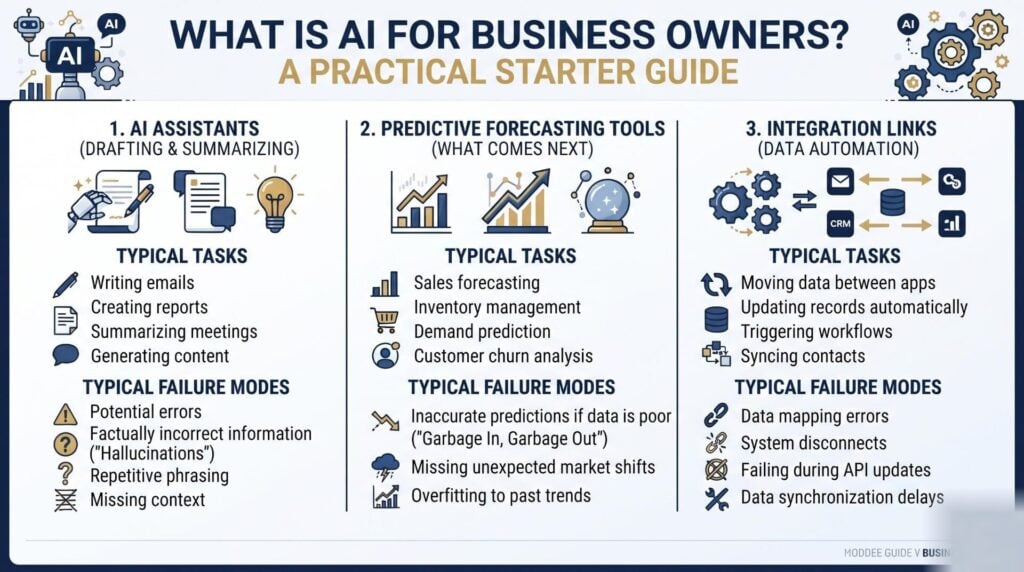
An assistant will always hand you an answer, right or wrong, since making language is all it does, while a link fails loudly and simply stops. So with an assistant you review the output each time, and with a link you check the setup once and then watch for silence.
What is AI genuinely good at right now?
AI is good at language work with a clear goal and a result you can check. That covers drafting, rewriting, summing up, translating, sorting and pulling facts out of files. Firms report the same. In the Federal Reserve’s 2026 Report on Employer Firms, the top uses were writing or marketing at 83%, individual productivity at 61%, and planning or analysis at 51%. Each of those is a task where a weak answer stands out in seconds.
The pattern behind that list is worth saying out loud. AI does best where you already know what right looks like, because then you can fix it fast and move on, and worst where no one would catch a wrong answer for weeks. Volume matters too, since a weekly task repays its setup far faster than a quarterly one.
Where does AI still fail business owners?
It fails hardest on exact figures, on prediction from your own tables, and on work that carries blame. Accuracy was the top challenge named by AI users in that Federal Reserve survey, at 46%. A paper posted on 3 August 2026, Why Large Language Models Fail at Tabular Prediction, tested this directly and found the models losing to plain stats methods fifty years older as a table gains columns. Columns are what break it.
A sheet of past sales is just what an owner wants to hand across, and one of the weakest places to begin. Use an assistant to describe, sort and sum up that data, then use a real forecast tool, or a person who knows the trade, to predict from it. The second limit is blame, since a model cannot carry a duty of care and someone still signs the work.
How many owners are actually using AI?
Just under half. The Federal Reserve’s 2026 Report on Employer Firms, published on 3 March 2026 and built on 6,525 replies gathered between September and November 2025, found 46% of firms using AI, with 15% more set to begin within a year. A third have no plans at all. Depth is the real surprise here, because among the firms that do use it, about half say they are still testing.
The breakdown is worth keeping in front of you:
- 46% of firms use AI now, 15% mean to begin within twelve months, and 33% have no plans.
- Among users, about half are still testing, 44% have partly built AI into their processes, and just 7% have built it in fully.
- Users report gains in productivity (71%), quality of goods and services (39%) and sales (31%), while most saw no change in labor costs.
- Of the third with no plans, over half said AI does not apply to their business, and 30% simply prefer not to use it.
Two things fall out of those numbers. Almost no one has finished, so the gap between you and a rival is smaller than the noise suggests, and testing is simply the normal state right now. Treat it as a stage with an end date rather than a fixed way of life.
What changes in your business when you start?
Review changes first. Someone has to read what the model made, and that job is real work that eats real hours. The 2026 Work AI Index, a survey of 6,000 full-time staff across three countries, put that checking at about 6.4 hours a week per person. It also found 69% of AI users sending out work they had not fully read. Plan the review step, or it will happen by accident.
Two other things shift quietly. Standards become explicit, because a model has to be told what good looks like, and writing that down lifts the human version too. Ownership shifts as well, since someone has to decide which tasks are in scope, and change management gets much harder when that someone is no one in particular.
What are the first honest steps to take?
Pick one task you repeat each week, write down what a good result looks like, and run it for two weeks while logging every fix you make. If the fixes shrink, widen the task. If they hold steady, the fit is wrong, and swapping tools rarely repairs a problem of fit. Keep the scope small enough that you could stop on a Friday and lose nothing but two weeks of notes, because that limit is what keeps the test honest.
Three habits make the difference in that period. Tell the tool what you want, why, and which file to read, since vague requests always produce vague drafts. Keep a note of the requests that worked, because that note becomes your first real piece of AI literacy. Check the output against something true, never against how sure it sounds, since operational efficiency grows out of that habit rather than out of the tool you picked.
Not sure which task to start with? AI Smart Ventures offers AI Advisory for founder-led organizations picking a first workflow, drawing on 20,000+ professionals trained in Applied AI.
Frequently Asked Questions
What’s the best AI for business owners?
There is no single best one, and that is the honest answer. The right choice depends on the task you want done and the software you already run, since most business systems now include AI you have paid for. Name the task first, then check what your current tools can do. Picking a tool is its own call, and it gets easier once the task is clear.
How can business owners use AI day to day?
Most owners use it for writing and marketing, personal productivity, and planning or analysis, the three most common uses in the Federal Reserve’s 2026 Report on Employer Firms. In practice that means drafting a proposal, summing up a long email thread, tidying a messy list, or turning rough notes into a plan someone else can follow. Pick tasks you repeat weekly, since repeat use is what makes saved time visible.
Can AI make you money fast?
Not reliably. AI cuts the time it takes to produce work, but it does not create demand, and a buyer still has to want what you make. Owners who earn well with these tools tend to sell a service they already knew well, then use AI to serve more clients in the same week. Treat daily income claims as marketing. The real gain is hours returned.
What is the 30% rule for AI?
There is no official 30% rule. It is a loose test that goes around online: if a change does not improve time, quality or trust by roughly a third, the upheaval is not worth it. As a habit it is fair enough, though the number itself is made up. A better test is whether the task repeats often enough that a modest gain adds up across a year.
Do I need technical skills to use AI?
No. Fewer than 1% of workers need advanced AI skills, according to the OECD’s June 2026 review of AI and skills, while most need everyday digital skills plus the ability to read and question data. What counts far more is stating the result you want clearly and judging whether the answer came back right. Those are management skills, and owners often have them already.
Is AI the same thing as automation?
No, and mixing the two up causes most early let-downs. Automation follows a fixed path you define, so it repeats exactly and fails loudly when something changes. AI makes a fresh judgment each time, so it copes with messy input but varies between runs. Many of the best setups pair them: automation moves the work along, and AI reads or writes the part that needs a call.
Will AI take jobs in my business?
Usually it changes roles well before it removes any. Firms in the Federal Reserve survey reported almost no change in labor costs from AI, while 71% reported higher productivity, which points to the same people doing different work. Repeat drafting and lookup go first. What grows is review, judgment and client contact, which is why AI upskilling counts more than headcount planning.
How do I keep company information safe with AI?
Start with a one-page rule on what may be pasted into a public tool and what may not. Client records, contracts and anything covered by an agreement belong in accounts your firm controls and can audit. Accuracy and owning their own ideas were among the reasons owners gave for holding back in a San Francisco Fed research brief on adoption. Write the rule before your team needs it.
How much does it cost to get started with AI?
Start with scope rather than spend. Pick one repeating task, agree what a good result looks like, run it for two weeks, and note every fix. That single record tells you whether to widen, switch or stop, and it costs you nothing but focus. Most owners need help with sequence, not with software. Schedule a consultation with AI Smart Ventures to plan a first workflow and an AI readiness check.
Executive Summary
AI for business owners is a group of tools, not one product. Assistants draft and sum up, forecast tools predict, and links move data between the apps you already run. Use is now common across growing businesses, yet very few have built it in fully. These tools are strongest on language work with a result you can check, and weakest on exact figures and prediction from tables. What changes when you start is review, not headcount, because someone has to read the output. The first honest step is one repeating task, one written standard, and two weeks of notes.
What Should You Do Next?
This week, list the five tasks you repeat most often, then mark the two that are mostly reading or writing. Run one of them through an AI assistant every working day for two weeks and keep a short log of what you had to fix. That log, rather than a demo, is the proof you need to decide what comes next.
AI Smart Ventures offers AI Advisory for growing businesses taking their first steps with practical AI. Schedule a consultation to turn that two-week log into a staged plan with clear steps.
People Also Read
- n8n vs Make vs Zapier for AI Automation: Which Is Best in 2026?
- AI for Solopreneurs: The Best Tools When You’re a Team of One
About the Author
Nicole A. Donnelly is the Founder of AI Smart Ventures and an AI Adoption Specialist with 20 years of experience as a founder and CEO and over a decade leading AI adoption initiatives. She helps businesses integrate artificial intelligence with clarity and confidence, driving innovation and sustainable growth. Nicole has trained over 20,217 professionals in Applied AI, delivered 624 workshops, and worked with close to 1,000 organizations across diverse industries.
Expertise: AI Transformation, AI Strategy, AI Implementation, AI Adoption, Applied AI, Marketing, Business Operations
Disclaimer: This content is for informational purposes only and does not constitute professional business or technology advice. Results vary based on industry, existing systems and implementation commitment. Contact AI Smart Ventures for a consultation regarding your specific situation.