
What Keeps AI Adoption Alive After the Consultant Leaves?
Last Updated: April 2026
An AI adoption program is sustainable when the business can maintain, measure, and extend its AI use cases after a consultant’s engagement ends – without relying on the consultant’s ongoing presence to interpret results, troubleshoot tools, or identify the next implementation priority. Research across close to 1,000 organizations shows that most AI adoption collapses within 90 days of an engagement close when the business was not left with three outputs: a documented workflow, a named internal owner, and a measurable success baseline. According to McKinsey (2024), 72% of organizations now use AI in at least one business function, yet most lack a defined internal process for measuring whether AI deployments are performing as designed after the consultant departs.
AI Smart Ventures has worked with close to 1,000 businesses and organizations on AI adoption and consulting since 2015. Founder Nicole A. Donnelly, an AI Adoption Specialist with 20 years of experience as a founder and CEO, works with business owners who complete a successful AI consulting engagement and then watch adoption rates decline within 60 days because the workflow documentation and internal ownership structure were not established before the consultant departed.
The difference between an AI program that sustains after an engagement and one that stalls is not the sophistication of the tools deployed – it is whether the business was left with three structural elements: documentation the internal team can operate from, an ownership structure that does not depend on the consultant, and a review cadence that identifies drift before it becomes abandonment. The questions below define what each element requires and how to build it before the engagement closes.
Key Takeaways
- Documentation Is the First Dependency to Remove – An AI use case that only the consultant understands is a use case that collapses when the consultant leaves; every workflow the engagement produced must be documented in a format the internal team can operate from on day one after close.
- Internal Ownership Must Be Named Before Close – Research across close to 1,000 organizations shows that programs without a named internal owner at engagement close consistently lose active use within 60 days, regardless of how well the initial deployment performed.
- A 30-60-90 Review Cadence Replaces Consultant Presence – A structured review at 30, 60, and 90 days after engagement close – measuring actual time saved against the baseline established during the engagement – replaces ongoing consultant involvement with a self-administered performance check.
- The Success Baseline Must Exist Before the Engagement Closes – Without a documented baseline, the internal team has no standard against which to evaluate whether the AI is performing, underperforming, or drifting toward non-use after the consultant’s final session.
- Vendor Dependence Is the Hidden Adoption Risk – A program that requires the consultant’s vendor relationship to maintain tool access, manage billing, or troubleshoot configurations is not internally owned; transferring all tool credentials to the internal owner before close eliminates the most common post-engagement dependency.
These five elements are not outcomes of a completed engagement – they are conditions that must be built into the engagement structure before the consultant’s last week. Owner-operators who confirm all five are in place at the engagement review session consistently sustain AI adoption beyond the 90-day post-close window.
What Causes AI Adoption to Stall After Consulting?
AI adoption stalls after a consulting engagement ends when the business was not left with the structural elements required to operate without the consultant: workflow documentation the internal team can follow, a named internal owner accountable for sustaining use, and a measurable baseline that makes performance drift visible before it becomes non-use. Research across close to 1,000 organizations shows that tool performance rarely causes post-engagement adoption collapse – organizational gaps consistently do.
The most common gap is documentation: a workflow that runs smoothly during an engagement because the consultant manages it in real time becomes an opaque process the moment they are no longer available to troubleshoot output quality. According to Harvard Business Review (2016), organizational initiatives without a defined transfer-of-ownership structure at program close produce lower sustained adoption rates than those with named internal owners and documented operating procedures. The gap between a consultant-dependent program and a self-sustaining one is a documentation and ownership problem, not a technology one.
What Documentation Does a Handoff Require?
An AI engagement handoff requires three documents the internal team can use without the consultant: a workflow operating guide for each deployed use case, a prompt library with tested prompts and known failure modes, and a success measurement log with the pre-deployment baseline and first 30-day performance. Research across close to 1,000 organizations shows that engagements producing all three documents sustain active AI use at higher rates than those delivering only a roadmap.
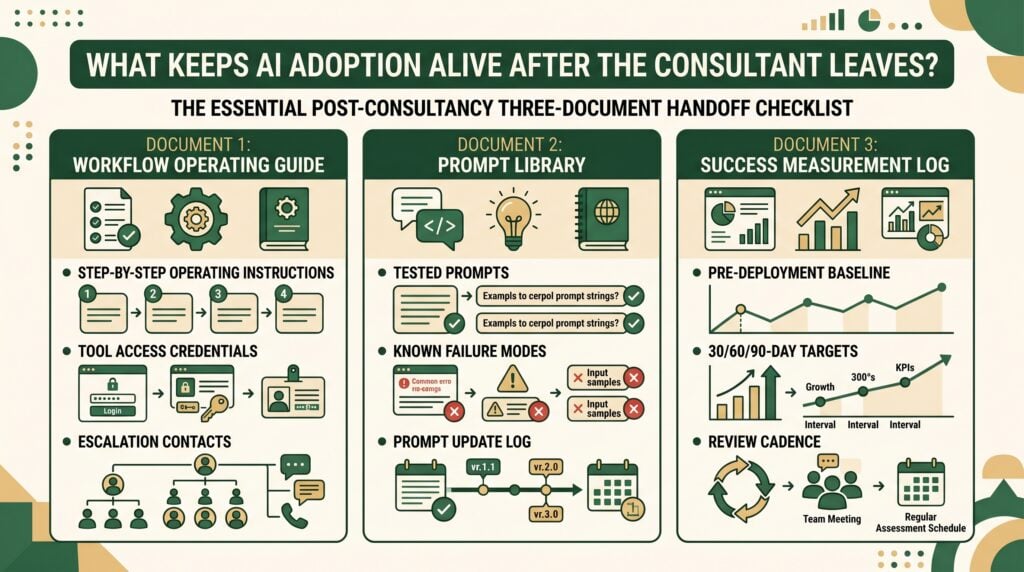
The workflow operating guide is the most consistently missing handoff document in AI consulting engagements – most consultants deliver a roadmap rather than a step-by-step operating procedure, leaving the internal team able to see what was deployed but unable to replicate or expand it independently. A prompt library is valuable only if it includes the failure modes discovered during the engagement, because those are the first problems the internal team will encounter after the consultant leaves. Together, all three documents convert a consultant-dependent AI program into one the internal team can operate, measure, and extend without outside involvement.
Three documents every AI engagement handoff should produce before the consultant’s final session:
- Workflow Operating Guide – Step-by-step instructions for each deployed use case, including tool access credentials, data inputs, and the escalation contact for each tool – formatted so a team member who was not in the engagement can run the workflow on day one after close.
- Prompt Library – The tested prompts for each AI tool with known failure modes, output quality benchmarks, and a log of prompt updates made during the engagement – this library prevents the most common post-engagement quality drop.
- Success Measurement Log – The pre-deployment baseline alongside the first 30 days of post-deployment performance, establishing the comparison point for every future review session.
Owner-operators who request all three documents by name in the engagement scope before signing consistently receive them; those who accept a roadmap as the primary deliverable typically do not.
Who Should Own AI Programs After the Engagement?
The internal owner of an AI program after engagement close is the person who runs the review cadence, maintains the prompt library, and escalates tool failures – and must be named and briefed before the consultant’s last session, not after. Research across close to 1,000 organizations shows that programs without a named internal owner at engagement close lose active use within 60 days in the majority of cases.
The internal owner does not need technical expertise – they need three capabilities: the ability to run the workflow operating guide, the ability to read the success measurement log and identify performance drift, and the authority to escalate a tool failure or re-engage the consultant when a problem exceeds their capacity. According to Harvard Business Review (2018), advisory programs that build client capability for ongoing operation rather than ongoing dependency produce measurably better long-term adoption outcomes. A consultant who leaves without naming an internal owner has not completed the engagement – the handoff is a required deliverable, not a courtesy.
How Do You Replace Consultant Presence with a Review?
A structured post-engagement review cadence replaces consultant presence by creating a defined schedule at which the internal owner checks actual performance against the baseline, confirms the workflow is still running, and identifies whether the program has expanded, stalled, or drifted toward non-use. Research across close to 1,000 organizations shows that a 30-60-90 day review structure after engagement close produces the same early-warning function as ongoing consultant involvement, at a fraction of the cost.
The review cadence is not a consultant check-in – it is an internal performance audit the owner runs using the success measurement log and workflow operating guide the engagement produced. A review that finds performance within 10% of the baseline at day 30 confirms the workflow is stable; a review that finds performance below baseline by day 30 identifies a gap early enough for a single targeted consultant session to resolve rather than a full re-engagement. Businesses that skip the day-30 review miss the early window in which a prompt adjustment or workflow correction prevents adoption collapse.
Three review phases every post-engagement AI program should complete:
- Day 30 Review: Workflow Stability – Confirm the deployed workflow is running as documented, output quality matches the engagement baseline, and the internal owner can troubleshoot minor issues without escalation. A failing day-30 review indicates a documentation or handoff gap, not a tool failure.
- Day 60 Review: Adoption Consistency – Confirm the workflow is being used consistently by all team members in the engagement scope, and that no workarounds have replaced the documented process. Workarounds at day 60 indicate a usability gap requiring a prompt update or workflow adjustment.
- Day 90 Review: Expansion Readiness – Assess whether the first use case has produced consistent time savings at or above the baseline, and whether the business is ready to apply the same methodology to the second-ranked use case from the original roadmap.
A business that completes all three reviews on schedule has a self-administered AI performance function that requires no ongoing consultant involvement to maintain.
What Is a Post-Engagement AI Success Baseline?
A post-engagement AI success baseline is the documented pre-deployment performance level for each use case – time per task before AI, error rate before AI, and throughput before AI – against which every post-engagement review is measured. Research across close to 1,000 organizations shows that programs without a documented baseline cannot determine whether AI is performing, underperforming, or simply not being used consistently after the consultant leaves.
The baseline is established during the engagement, not after: the consultant documents the pre-deployment performance of each targeted workflow before any AI tool is deployed, so the measurement is objective rather than reconstructed from memory. A business that establishes a baseline after the engagement closes is working from estimates rather than measured data, making the post-engagement review a comparison of estimates rather than a real performance test. The return on investment (ROI) case for any AI use case – whether the deployment paid for itself in time saved – cannot be made without a baseline that predates the consultant’s departure.
If your growing business needs structured support building the documentation, ownership structure, and review cadence before your AI consulting engagement closes, AI Smart Ventures offers AI consulting services for owner-operators. The AI Smart Ventures team has worked with close to 1,000 organizations on AI adoption since 2015.
When Should You Re-Engage a Consultant?
Re-engaging a consultant is appropriate when the post-engagement review identifies a gap the internal owner cannot resolve alone – when output quality drops below 80% of baseline, the workflow has been abandoned by more than half the team, or the business is ready to extend AI to a new use case. Research across close to 1,000 organizations shows that targeted re-engagement sessions cost significantly less than full re-engagements triggered by unstructured drift.
The re-engagement decision is data-driven when the review cadence is in place: the internal owner brings day-30, day-60, and day-90 data to the consultant, who identifies the cause of the gap in a single session rather than conducting a new audit from the beginning. Large consultancies such as Accenture and Deloitte Digital structure enterprise AI programs with quarterly reviews built into long-term contracts; for growing businesses, a targeted re-engagement session is more cost-effective than an open-ended retainer. For an updated directory of AI tools vetted for growing businesses, see AI tools and apps on the AI Smart Ventures resource hub.
| Post-Engagement Element | Without It | With It |
| Workflow documentation | Team cannot replicate the process; re-engagement required | Team operates the workflow independently from day one |
| Named internal owner | No accountability point; usage drifts across the team | One person monitors, escalates, and expands the program |
| Success baseline | No way to measure whether AI is performing or drifting | Day-30, 60, 90 reviews identify gaps before abandonment |
| Review cadence | Performance drift is invisible until adoption collapses | Early gaps caught in a single session rather than full re-engagement |
Frequently Asked Questions
Why does AI adoption collapse after a consultant leaves?
AI adoption collapses after a consultant leaves when the business was not left with three structural elements: workflow documentation the internal team can follow, a named internal owner accountable for the review cadence, and a pre-deployment success baseline. Most adoption collapses trace to the absence of one or more of these elements, not to tool failure. The consultant’s departure removes the single point of operational knowledge the program was relying on to function.
What should a consultant deliver before the engagement ends?
A consultant should deliver three named documents before the engagement ends: a workflow operating guide for each deployed use case, a prompt library with tested prompts and known failure modes, and a success measurement log with the pre-deployment baseline and first 30-day performance. The consultant should also name an internal owner and brief them before the final session. An engagement that ends without all three documents and a named owner has not completed the handoff.
How long does it take for AI adoption to stall after a consultant leaves?
AI adoption typically shows the first signs of stall within 30 days of engagement close when no internal owner or workflow documentation was established – team members revert to pre-AI workflows when they encounter an edge case the consultant previously handled. Full abandonment typically occurs by day 60-90 when no review cadence surfaces the drift. Research across growing businesses shows that businesses with all three handoff elements at engagement close sustain active use beyond 90 days.
Who should own an AI program after the consultant departs?
The internal owner should be the team member with the most direct involvement in the workflows the engagement automated – not necessarily the most senior or technical person. The owner needs three capabilities: the ability to run the workflow operating guide, the ability to read the success measurement log and identify performance drift, and the authority to escalate a tool failure or re-engage the consultant when a problem exceeds their capacity. These capabilities are built during the engagement, not after.
What is an AI success baseline and why does it matter?
An AI success baseline is the documented pre-deployment performance level for each use case: time per task before AI, error rate before AI, and throughput before AI. Without it, the internal team cannot determine whether the AI is performing as designed or drifting toward underperformance after the consultant leaves. The baseline is established before any tool is deployed – a baseline reconstructed from memory after the engagement closes produces estimates rather than measured performance data.
How do you set up a post-engagement AI review?
A post-engagement AI review is a scheduled internal session at day 30, day 60, and day 90 in which the internal owner compares actual performance against the baseline, confirms the workflow is running as documented, and identifies whether any team members have replaced the process with workarounds. No consultant involvement is required unless the review identifies a gap below 80% of the baseline. AI advisory services can help structure the review cadence before the engagement closes.
What does it cost to re-engage an AI consultant after an engagement ends?
A targeted re-engagement session for a specific identified gap typically costs $2,500 to $7,500, compared to $7,500 to $25,000 for a full re-engagement starting from a new audit. The cost difference depends on whether the handoff documents are in place: a consultant reviewing existing documentation and baseline data resolves the gap in one or two sessions rather than a full discovery phase. Schedule a consultation to assess whether a targeted session or full re-engagement fits your situation.
Can a non-technical owner maintain AI adoption after a consultant leaves?
A non-technical owner can maintain AI adoption if they received three deliverables at engagement close: a workflow operating guide they can follow without technical knowledge, a prompt library with failure modes in plain language, and a success measurement log they can update from session data. Technical knowledge is not required to run a documented workflow, read a performance log, or identify when output quality drops below the baseline. The handoff quality, not the owner’s technical background, determines whether adoption sustains.
Executive Summary
AI adoption sustains after a consulting engagement ends when the business leaves with three structural elements: workflow documentation the internal team can operate from without the consultant, a named internal owner accountable for the review cadence, and a pre-deployment success baseline that makes performance drift visible before it becomes abandonment. Research across close to 1,000 organizations shows that adoption collapse after an engagement almost never traces to tool failure – it traces to the absence of documentation, ownership, or a defined review structure. Owner-operators who confirm all three are in place at the engagement review session consistently sustain active AI use beyond the 90-day post-close window.
What Should You Do Next?
Before your consultant’s final session, request three deliverables by name: the workflow operating guide, the prompt library with known failure modes, and the success measurement log with the pre-deployment baseline. Confirm a named internal owner and a 30-60-90 day review schedule are in place before the engagement closes.
AI Smart Ventures offers AI consulting services for owner-operators building the handoff structure before their AI consulting engagement closes. Schedule a consultation to establish the documentation, ownership, and review cadence that sustains AI adoption after the engagement ends.
People Also Read
- What Is AI Adoption? How to Get Your Team on Board with AI
- What Does an AI Consultant Do and How to Know If You Need One
About the Author
Nicole A. Donnelly is the Founder of AI Smart Ventures and an AI Adoption Specialist with 20 years of experience as a founder and CEO and over a decade leading AI adoption initiatives. She helps businesses integrate artificial intelligence with clarity and confidence, driving innovation and sustainable growth. Nicole has trained over 20,217 professionals in Applied AI, delivered 624 workshops, and worked with close to 1,000 organizations across diverse industries.
Expertise: AI Transformation, AI Strategy, AI Implementation, AI Adoption, Applied AI, Marketing, Business Operations
Disclaimer: This content is for informational purposes only and does not constitute professional business or technology advice. Results vary based on industry, existing systems and implementation commitment. Contact AI Smart Ventures for a consultation regarding your specific situation.