
What Should Agencies Tell Clients About Using AI?
Last Updated: August 2026
An AI disclosure for agencies is a plain note telling a client how the agency used AI on their work. It says which tasks used a tool, whether any of their data went into one, who checked the output, and who holds the rights. Good ones name the job rather than the tech, so a client can judge the risk without knowing a thing about models.
AI Smart Ventures has guided growing businesses through AI adoption across many service trades, from ad shops to founder-led organizations. One pattern holds in nearly all of them: the hard talk is rarely about the tool, but about what the client assumed and what nobody put in writing.
That gap costs money now. Buyers audit their suppliers on AI, and the ones who feel misled do not warn you first. They move the work, and the referrals go with it. Getting there first costs one honest talk and one clause.
Key Takeaways
- Tell them by risk, not by tool: speak up when AI could change how a client reads the work, not when a model helped you find facts.
- Put the detail in each scope of work, not just the master contract, since “the agency may use AI” settles nothing when the mix shifts job to job.
- Sort out rights before you hand the work over: you can sign over what a person wrote, but not what a model made.
- Treat each prompt as a note to a stranger, agree to an approved tool list in writing, and keep private files out of the rest.
- Answer “did AI make this?” in one straight sentence, then walk them through the steps, because hedging reads as guilt when nothing went wrong.
- Tell them before they spot it, since being found out turns a dull process question into a trust problem.
Look at what those six share: each is a call you make before the work starts, the only point where you still set the frame. After you send it, you answer someone else’s find, on their clock.
What does AI disclosure mean for an agency?
For an agency it means telling the client three things: where the AI touched the job, what happened to their data, and who signed off on the result. It is not a broad warning that your shop owns new tools. It is a note tied to one piece of work, written down and handed over before the client ever thinks to ask.
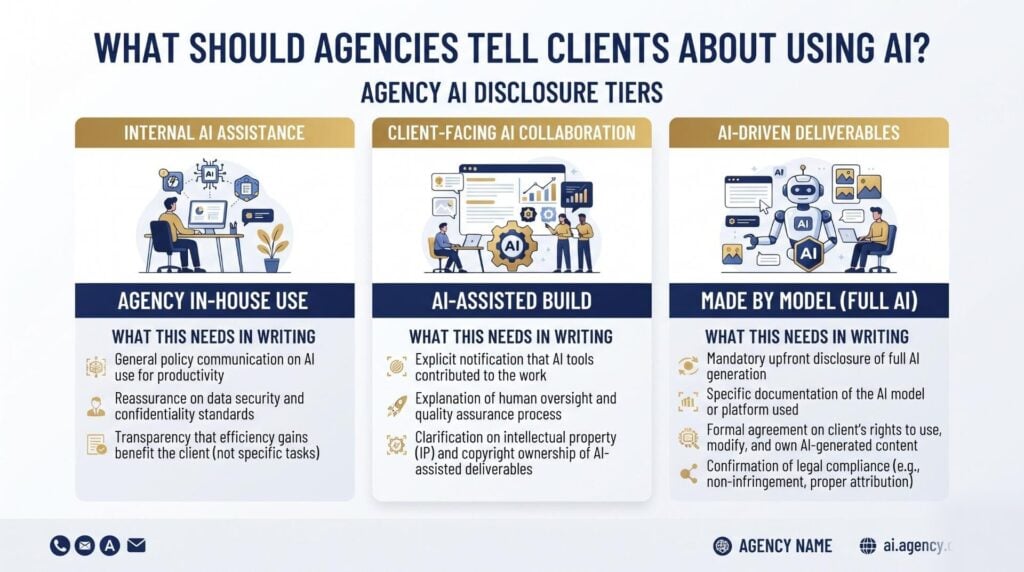
In practice it is one line in the scope of work and one in a status note. Three levels matter, because clients react to them differently:
- In-house use. AI helps you research or take notes, and never touches what you send.
- Assisted build. AI drafts, a person edits, and that person owns what ships.
- Made by model. What you hand over came mostly from a tool.
The first almost never needs a note; the third always does. Knowing which one you are in is basic AI literacy.
When is AI disclosure expected or required?
It is required when law or the contract says so, and expected any time a client would feel misled without it, so those are two tests and you must pass both. Trade bodies now back a risk-based take on the same rule: flag the work when AI could change how someone reads it, not each time a tool was open.
The IAB, the digital ad trade body, put out the first industry AI Transparency and Disclosure Framework on 15 January 2026:
- Flag by real effect. Label work when AI shifts who or what it seems to show in a misleading way.
- Keep the trail in the file. Machine-readable tags ride with the asset and outlive the email thread.
- Call out risky cases. Synthetic humans, digital twins, AI voices and chat agents in ads are flagged already.
The same research found 82% of ad execs think Gen Z and Millennial buyers feel good about AI-made ads. Just 45% do.
What belongs in your client AI contract clause?
Five things: what you tell them, who holds the rights, what data may go into a tool, who covers the risk of a claim, and who checks the work. Put the broad promise in the master contract and the detail in each scope of work, because a clause saying only “the agency may use AI” helps nobody once a lawyer starts asking.
| Clause | What it should settle |
|---|---|
| Disclosure | Which tasks use AI, per scope of work |
| Ownership | Who holds rights, on what basis |
| Confidentiality | Which client files may enter a tool |
| Indemnity | Who carries a third-party claim |
| Review | Who checked the output, and how far |
You do not have to draft this cold. The IPA and ISBA updated their joint client contract template on 27 November 2025, adding new clauses on AI. Their legal hub, revised 2 April 2026, adds draft clauses and an AI policy template.
AI Smart Ventures offers AI Advisory for growing businesses writing their first client AI terms, drawn from work with close to 1,000 organizations. Talk to our advisory team before your next renewals.
Who owns the AI-assisted work you deliver?
You own and can sign over the parts a person wrote, but what a model made alone may hold no rights, so you cannot promise a client sole use of it. Most agency contracts miss this, since the standard clause assumes all you hand over is yours. Say what holds rights and what does not, then fix the gap in scope.
The US Copyright Office put out Part 2 of its AI report on 29 January 2025. Human authorship stays the base of copyright, and prompts alone do not make a work protected. Where a person edits or builds on the output, that human part can hold rights. The Supreme Court would not review Thaler v. Perlmutter on 2 March 2026, so the human-only rule stands.
So keep the briefs, drafts and edit history, because that file is your proof of who made the calls.
What about client data fed into AI tools?
Treat each prompt as a note to a stranger, since client names, unreleased work, buyer records and money detail have no place in a free consumer tool. Your privacy clause almost surely bars it already, whether or not anyone has read it lately. Agree the approved tool list in writing, and keep personal data out unless the terms clearly allow it.
Thomson Reuters asked 1,816 professionals in March and April 2026 for its Future of Professionals report, and found 34% using AI tools their firm has not cleared. Buyers are not soft about it: 78% of corporate clients call AI-driven quality gains very important, but only 6% say most providers deliver.
Where personal data is in play, the tool is a data processing agreement (DPA), which sets out how a supplier may handle personal data for a client. If your AI vendor sits outside that DPA, you have made a risk nobody signed up for.
How should you answer “did AI make this?”
Answer in one straight sentence, then walk through the steps, because “Yes, AI drafted it and I rewrote it” beats any hedge you could build. Clients rarely mind the tool; they mind finding out late, and they mind the hint that they paid for judgment nobody used. The straight answer also lets you show where that judgment went, which is what practical AI looks like inside a client relationship.
The pull for labels is not small. Fractl asked 1,008 US buyers and 150 marketers in the second quarter of 2026, and found 84% want AI content labeled. Only 20% of firms always say so, and a third never do.
Here are the part agencies miss. IAB found 73% of Gen Z and Millennial buyers said a clear label would lift their odds of buying or change nothing. Telling people is not a risk.
Being found out is.
What if a client says no AI at all?
Ask what they mean first, because a flat ban is rarely workable when spellcheck, translation, transcripts, ad platforms and your own job software all run models now. Clients almost always mean one narrower thing: no AI-made creative, no client data in public tools, or nothing shipped that a person did not write. Get that rule in writing and you can keep it.
Then judge whether you can staff the account that way, and say so plainly if you cannot. The Advertising Association put out a UK best practice guide on 5 February 2026, through the government and trade Online Advertising Taskforce, and its eight rules set openness beside oversight.
A client who banned AI and then spots a model-made image in your deck will not accept that it was only a first draft. Redo the scope instead.
Frequently Asked Questions
What does “AI disclosure” mean?
It means telling someone that AI helped make what they are reading, seeing or buying, and at what level. For an agency it covers three points: which tasks used AI, whether client files went into a tool, and who checked the output. The 2026 trade line is risk-based, so you speak up where AI could change how a person reads the work.
Do you need to disclose the use of AI?
Sometimes by law, often by contract, and nearly always by good practice. Ads, political content and some regulated notices carry labeling duties that vary by state and country. Past that, your client contract rules. The test is simple: if the client would feel misled on learning how the work was made, say so. Fractl found 84% of buyers want AI content labeled.
How do you properly disclose AI use?
In writing, before you send the work, and in exact terms. Name the tasks rather than the tools, since tools change monthly and the client cares about the job. State what a person did, what a model did, and who stands behind the accuracy. Put the standing promise in your master contract and the project detail in each scope of work.
Can you provide an example of an AI disclosure statement?
A workable one runs to two sentences. “AI tools helped with research, first drafts and transcripts on this project. Everything we sent was reviewed, edited and approved by named members of our team, and no private client file went into a tool outside the approved list.” Add that tool list as an appendix, and update it whenever the list changes.
What is the 30% rule in AI?
The 30% rule is an informal guide saying AI can handle roughly 30% of the tasks inside a typical role, leaving judgment and answerability with people. It is a rule of thumb, not a measured standard, and no regulator backs it. For telling clients it is little help, because they care which 30% ran on a tool, not how big that share was.
Can clients tell you used AI?
More often now, yes, though AI detectors stay unreliable and produce false claims. Clients notice the tells: flat structure, repeated phrasing, sure-sounding detail that turns out wrong, or a file whose history does not match how you usually work. Never let a detector be your risk model. Assume a sharp client could reach a fair suspicion, and plan your answer now.
Should you credit AI in the work you deliver?
Credit the people, and describe the process. Listing a model as a contributor muddies who is answerable, and US copyright law does not treat a machine as an author, a rule the Supreme Court left alone in March 2026. Name the humans who made the creative calls, and make sure the named person can explain how the work came together.
What if your subcontractors use AI?
Their AI use is your problem, because the client hired you. Push the same terms down the chain: an approved tool list, a rule on private files, and a short written note with each delivery. Freelancers and production partners often run tools you have never checked, so ask at onboarding, and file the answer where your account team can reach it.
How do we get started on an AI disclosure policy?
Start with a two-week run, not a document. Week one, list each tool your team already uses and which client data touches it. Week two, write the wording and the approved tool list, then take both to your two biggest clients before the next renewal. Scope drives the effort here, not headcount. Schedule a consultation to work through your client AI terms.
Executive Summary
AI disclosure for agencies is a contract question now, not an ethics debate. Clients expect to know where AI touched the work, what happened to their data, and who stands behind the result. The 2026 trade line is risk-based: speak up where AI could change how the work is read, and skip the note for in-house research. Sort out rights before you hand the work over, and keep private files out of unapproved tools. Being found out costs far more than telling them.
What Should You Do Next?
List each AI tool your team touched last month, and mark which client data ran through it. Draft a two-sentence AI note plus an approved tool list, then walk both through with your two biggest accounts. Add the five contract terms above to your scope of work template, and run it as change management.
AI Smart Ventures offers AI Advisory for growing businesses setting client AI standards with clarity and confidence. Schedule a consultation to build terms your clients accept and your team can follow.
People Also Read
- AI for Project Management: How Asana AI, Monday AI, Notion AI, and ClickUp AI Compare
- What Is Multimodal AI and How Are Businesses Using It?
About the Author
Nicole A. Donnelly is the Founder of AI Smart Ventures and an AI Adoption Specialist with 20 years of experience as a founder and CEO and over a decade leading AI adoption initiatives. She helps businesses integrate artificial intelligence with clarity and confidence, driving innovation and sustainable growth. Nicole has trained over 20,217 professionals in Applied AI, delivered 624 workshops, and worked with close to 1,000 organizations across diverse industries.
Expertise: AI Transformation, AI Strategy, AI Implementation, AI Adoption, Applied AI, Marketing, Business Operations
Disclaimer: This content is for informational purposes only and does not constitute professional business or technology advice. Results vary based on industry, existing systems and implementation commitment. Contact AI Smart Ventures for a consultation regarding your specific situation.