
When Not to Hire an AI Consultant at All
Last Updated: November 2026
When not to hire an AI consultant is a question with six answers, and none is about the consultant. Hiring is wrong when the problem is not an AI problem, when no one can say what better looks like, or when no senior person has free hours. It is also wrong when the work is small enough to learn, when something must be fixed first, or when the goal is to be seen using AI.
AI Smart Ventures has guided growing businesses through AI adoption, and some of those talks end in advice to wait. Owners who buy well can already say what the first month would change, and buying help does not create that answer.
Hire into any of the six and you pay for a result no one inside can judge or run. The quieter loss goes unwritten: your people end the year no closer to the work.
Key Takeaways
- Rule out three non-AI causes: a process no one wrote down, records two systems disagree about, and a decision no one has made. A firm can name them and fix none.
- Most stalls are about groundwork: 81% of 220-plus senior IT leaders at large firms had delayed, cut back or dropped an AI project in a year, says Transcend research of 13 May 2026.
- Free hours block more than funding: 42% named bandwidth and competing priorities as the top barrier to AI investment, against 8% naming limited capital, in an October 2026 Fiber Broadband Association survey.
- Performative AI is measured now: 48% of 1,000 US full-time staff overstate their AI use or skill, says Visier research of 22 September 2026.
Three of those four describe your own building, not the market. Skill is the one thing an outside firm can truly sell, which is why it sells first, and why it is rarely the gap.
When is hiring an AI consultant the wrong move?
Six cases, and all six are checkable in a day. Hiring is wrong when the problem is not an AI problem, when no one can say what better looks like, or when no senior person has free hours. It is wrong when the work repeats enough that your people should learn it, or when a prerequisite must be fixed first. The sixth is wanting to be seen using AI.
That last one is the awkward case, and it is now measured. Visier asked 1,000 US full-time staff in September 2026. It found 48% overstate their AI use or skill to colleagues or leaders at least some of the time. Separately, 45% feel pressure to use AI they are not confident using. A project bought to produce a launch note will produce one, and nothing else. Saying so costs a consultancy work, which is rather the point.
| The case | Do this instead |
|---|---|
| not an AI problem | write the process down, or add hands |
| better undefined | time the task, set one number |
| no senior hours | shrink it to fit a free owner |
| small, repeating | two people, hours, one workflow |
| groundwork missing | fix records or logins first |
| seen using AI | name what will change, report that |
Is your problem actually an AI problem?
Often it is not, and four non-AI causes sit behind most requests. There may be a process no one wrote down, so nothing is steady enough to automate, or records two systems disagree about. There may be a decision no one has made, or a plain staffing gap, where the work needs more hands rather than different tools. A consultant can name all four and fix none of them.
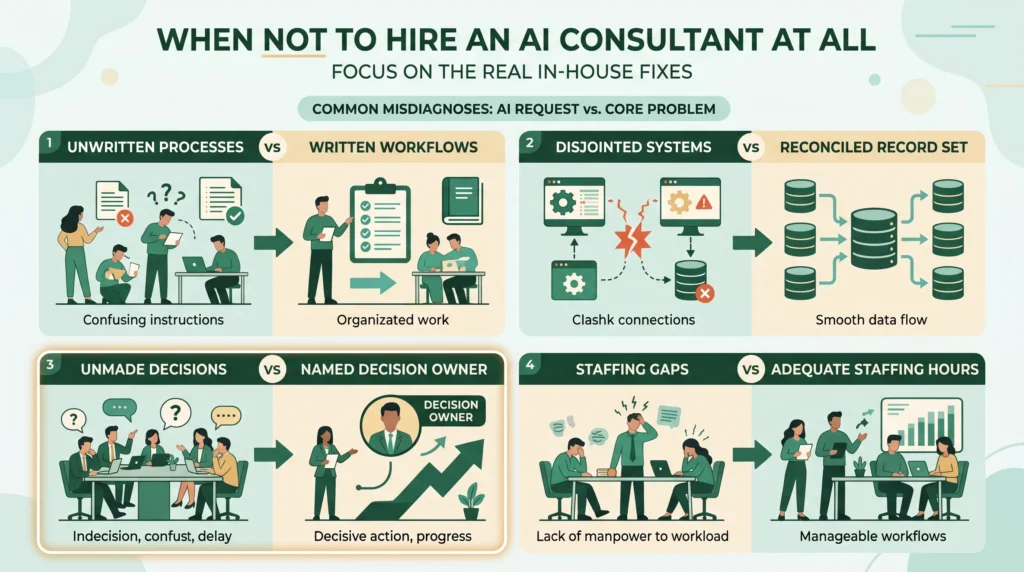
The unmade decision is easiest to miss, because it hides inside a technical request. A Vanson Bourne survey of large-firm decision-makers, reported on 6 November 2026, found 37% saying AI had muddled who owns a decision. That muddle does not arrive with the tool; the tool exposes it. Read your request back and ask which of the four it describes. Where the honest answer is a process or a person, the AI part waits.
Can anyone inside say what better looks like?
If no one can, the job cannot be scoped and the result cannot be judged. Better needs a number and a date: quotes go out in one day instead of four, by 31 March. Without that line the firm supplies its own version of better, and you have no standing to argue. Ask two people in the team to write the line apart, then compare what comes back.
Vagueness at the top travels all the way down. In the same Visier research, 32% of staff said their employer has no clear plan for how AI affects their jobs, and a further 27% were unsure whether one existed. Buying AI consulting on top of that only moves the argument into someone else’s scope. Spend two weeks timing the task by hand, because a baseline you took yourself does more AI strategy work than any slide deck.
Will anyone senior be free to decide?
Someone has to answer scope questions within days, each week, from week one. Where no senior diary can hold that, the job strands the firm running it. The pattern is familiar: a firm arrives, maps the work, then waits. Four weeks later the map is stale and the invoice is not. This is a question about free hours rather than commitment, and free hours are easier to check than goodwill.
The numbers bear that out. In an October 2026 Fiber Broadband Association survey of North American member firms, 42% named bandwidth and competing priorities as the main barrier to AI investment. Limited capital was named by 8%, and the group read that as a capacity problem rather than a funding one. Test your own diary before you test the market, and if the hours are not there, shrink the work rather than buy a bigger firm.
Should your own people learn this work instead?
Yes, whenever the task is small, repeats often and sits inside one team. The first time you change a workflow is the best AI upskilling your business will get, because the lesson sits on real work with a real measure. Buying speed trades that away: you get the workflow running sooner and no one inside who can explain why it was built that way, which surfaces in month five.
Some of that learning is happening without you. In the same member survey, about two thirds of firms relied on no AI training, ad hoc training or limited informal learning. Only 7% had a full learning strategy, so the real choice is not training against no training. It is capability building against what your team teaches itself on a Friday. Pick one repeating task, give two people weekly hours, and revisit hiring once practical AI literacy has somewhere to grow.
Which prerequisite has to be fixed first?
Usually one of four, and each one is dull. Records no one trusts, or logins no one can grant inside a month. A process held in two people’s heads, or one owner who does not exist yet. Pay a firm to work around any of these and you buy a result that runs until the workaround meets reality. That is no fault of the supplier; the part you skipped was load-bearing.
Transcend research, published on 13 May 2026 with more than 220 senior IT leaders at firms above 5,000 staff, counts how often this happens. It found 81% had delayed, cut back or dropped at least one AI project in twelve months, and the average firm had three stalled. Another 93% met data permission or governance trouble somewhere in the project, and 85% were missing at least one of four basic capabilities. Fix the groundwork first and the same AI implementation gets smaller.
AI Advisory includes the case against hiring. It is a short read of your own setup that ends in a written answer, and sometimes that answer is to wait and fix one thing.
So when does outside help genuinely earn it?
When four things are true at once: you can say what better looks like in one line with a number, and one named person can answer inside a few stated working days. The groundwork is either fixed or scoped as work someone owns. And the task is new to your team and needed soon, or big enough that learning it first would cost a season. Three out of four is a wait.
That fourth condition is the real line, and it is about time, not difficulty. Outside help is worth buying when someone has done this before and can skip the months you would spend finding which step breaks. It is not worth buying for the look of momentum, which is the market AI gurus with zero operational depth are built to serve. Research across growing businesses shows the firms passing this test arrive with a measure, an owner and a date.
Frequently Asked Questions
How do you tell a process problem from an AI problem?
Write the process down first. If two people who do the work produce different step lists, you have a process problem, and automating either list makes the clash permanent. The same test works on records: export them and read fifty rows. Where the fields contradict each other the fix is the data rather than the model, and an AI problem is what is left.
Does deciding not to hire mean falling behind?
Rarely, because the thing you would be behind on is usually a pilot. Most stalled AI work fails on groundwork rather than speed. A quarter spent writing one process down and cleaning one record set puts you ahead of a rival who bought a build on top of neither. What does hurt is deciding nothing and calling it patience, so set a date.
What if leadership wants AI progress announced?
Give them something true to announce. A written process, a measured baseline and two trained people are real progress, and they hold up better in six months than a pilot no one uses. Say plainly which workflow you are working on and which number you expect to move. Claims built on work no one inside can explain vanish from the next update.
Who owns the work when you do not hire anyone?
One named person with hours in their week, not a committee and not the keenest volunteer. Give them the workflow, a weekly slot and permission to stop. Then ask for one written page a month: what changed, what the measure says, what is stuck. If those hours cannot be found, that answers the hiring question too, because an outside firm needs the same person.
Can a short paid review still be worth it?
Yes, and it is the one purchase that survives a decision not to hire. A bounded review ends in a written answer another firm could act on: which workflow, in what order, measured how, and whether to go on at all. Keep it to a few weeks, and insist the possible answers include waiting. A review that cannot recommend stopping is a sales step.
How long should you expect to wait before hiring?
Long enough to clear whatever is blocking you, which is normally one quarter rather than one year. Writing a process down takes days of real attention, cleaning one record set takes weeks, and finding an owner with free hours takes a reshuffle. Put dates against those three, then book the hiring conversation for the week after the last of those dates lands.
What signs mean you waited too long on your own?
Three tend to show up together. Your team has worked the same workflow for two quarters with no measured change. People have quietly built private workarounds no one can see, and the same question keeps arriving unanswered at the same meeting. At that point you are circling rather than learning, and buying judgment costs less time than another quarter of change management.
Where should you start if you decide not to hire?
With the two smallest checks. Write one workflow down, step by step, beside the person who does it, then export the records it touches and read them. Those two sittings settle most hiring questions, because together they show whether anything is steady enough to build on. Schedule a consultation with AI Smart Ventures if you want that read tested before you decide.
Executive Summary
Six cases make hiring an AI consultant the wrong move. The problem is not an AI problem, no one can say what better looks like, or no senior person has free hours. The work is small enough for your team to learn, something must be fixed first, or the goal is to be seen using AI. Each has an in-house answer, and most take a day to check. Outside help earns its place when you hold a measure, a named decider, settled groundwork and a reason speed matters.
What Should You Do Next?
This week, run the two checks: write one workflow down with the person who does it, then read fifty rows of the records it touches. Put a dated line against the result you want, and name the person who could answer a firm’s questions within three working days. If any comes back empty, that is your quarter’s project.
AI Smart Ventures offers AI Advisory for growing businesses deciding whether outside help is warranted at all. Schedule a consultation to test your own four conditions before you brief a single firm.
People Also Read
About the Author
Nicole A. Donnelly is the Founder of AI Smart Ventures and an AI Adoption Specialist with 20 years of experience as a founder and CEO and over a decade leading AI adoption initiatives. She helps businesses integrate artificial intelligence with clarity and confidence, driving innovation and sustainable growth. Nicole has trained over 20,217 professionals in Applied AI, delivered 624 workshops, and worked with close to 1,000 organizations across diverse industries.
Expertise: AI Transformation, AI Strategy, AI Implementation, AI Adoption, Applied AI, Marketing, Business Operations
Disclaimer: This content is for informational purposes only and does not constitute professional business or technology advice. Results vary based on industry, existing systems and implementation commitment. Contact AI Smart Ventures for a consultation regarding your specific situation.