
Why AI Agents in Production Stay Stuck in Pilot
Last Updated: November 2026
An AI agent in production is software that takes several steps on its own and acts on your live systems, and nobody says yes to each step. That sets AI agents in production apart from other AI tools. A drafting tool hands you something to read; an agent books, sends or updates before anyone looks. The question is not how good it is. It is what it may do.
AI Smart Ventures has guided growing businesses through AI adoption to this exact point, where the agent works and nobody will sign for it. Owners expect a build problem, and it rarely is one. The demo was fine, the work is done, and the open item is a sentence nobody has written: what may this thing do when no one is in the room?
Leave that sentence unwritten and the agent lives in pilot, minded by one person who cannot take a holiday. In founder-led businesses, that is often the owner. An agent earns its keep only in the runs nobody reads, so this is not a loose end in your AI strategy. It is the job.
Key Takeaways
- An agent ships the call, not a draft: by the time you read the output the action has landed, so a later read is a repair rather than a check.
- Oversight now has a measured bill: G2’s 2026 AI Agents Report, a July 2026 survey of 1,019 B2B decision-makers, found 45% losing over a quarter of expected gains to oversight and rework.
- Checking moves, it does not stop: a 2026 audit of 63 published sources names this the reduced-supervision paradox.
- Steps stack up; they do not even out: a production agent measured in July 2026 finished 75.2% of 165 long tool-chain tasks first time.
- Blast radius is a list you can write: name every action the agent may take, then mark the ones you could not undo by Friday.
- Unattended is a status you grant: no agent gets there alone, so a pilot ends in a choice rather than a score.
Read the second and fourth together, and the shape shows. The checking is what costs you, and a long run is where checking is hardest, since each step reads as fine alone. So agents stall at the permission line rather than the build.
What changes when AI acts instead of drafting?
The read moves to after the fact. A person reads a drafting tool’s work before it counts, so a weak output costs you a minute; an agent sends the email, so a weak output is a client who has it. The rest of what makes agents hard follows from that one change: how far it reaches, who is on call, and what ready means. Quality still matters, but it stops being the gate.
This is a different stall from the familiar one, where a pilot flatters a tool and the rollout disappoints. Here the pilot was honest and the thing still waits, because the next step is not more testing but a grant of authority. Someone has to say which actions now happen unprompted, and nobody takes that on while the list of actions is vague. So the agent keeps its minder, and AI adoption stops at one desk.
What does production mean for software that acts?
It means the actions count and nobody reads them first. For a drafting tool, production is mostly uptime and who has access. For an agent it is a state of trust: runs go out unread, and the business wears what they do. Read that way, your agent may have been in production for weeks under the label of a pilot, or sat in pilot for months while a person pressed yes on every step.
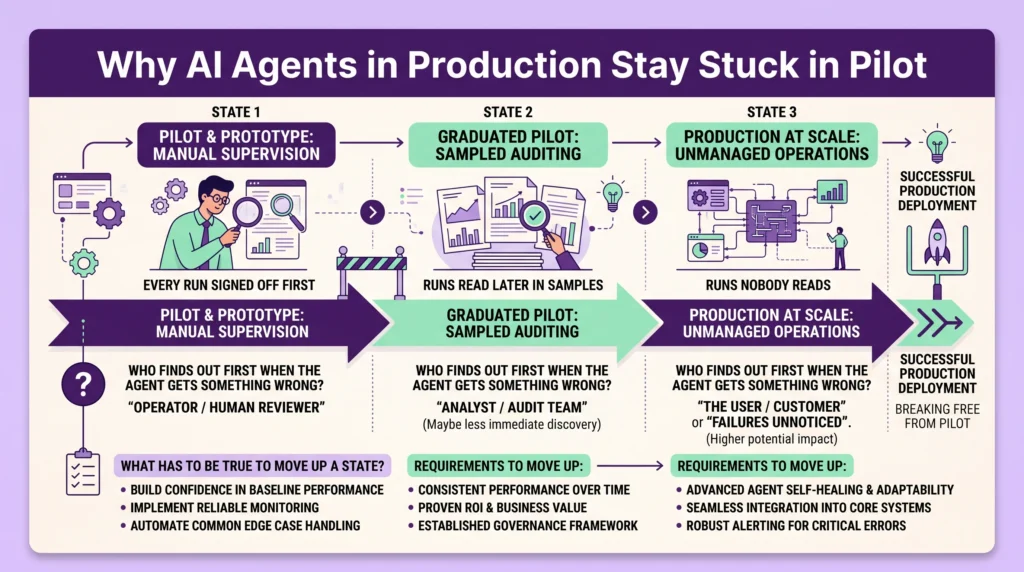
So write down which of three states each agent is in today: every run signed off first, runs read later in samples, or runs nobody reads. The middle state is where most live work sits, and teams describe it loosely, which is how an argument starts once something goes wrong. Naming the state takes five minutes and settles who answers for the thing, which does more for workflow optimization than another round of tuning.
Why do small agent errors turn into big ones?
Because the steps stack up rather than evening out. A run that reads a record, picks a rule, drafts a note and sends it has four chances to go wrong. A bad read at step one arrives at step four looking settled, and nothing in the output says it rests on a wrong start. So reading the output tells you less than you hope, and the last step is the one that hurts.
Research shows how stubborn this is. On a set of long tool-chain tasks, a production agent described in July 2026 finished 75.2% of 165 tasks first time, with a built-in checker that caught about a fifth of its own errors. An ACL 2026 paper on multi-agent systems sorts the leaks into four kinds, among them a missing piece of data and a reference that drifts onto the wrong thing. Those are the ones that read as fine.
How far does one wrong action reach?
As far as its reach allows, which is nearly always wider than the job. An agent that files an expense can often edit older ones, and one that answers a client can often write to the record behind the reply. The gap between what it needs and what it can touch is your blast radius, and an afternoon measures it. List the actions, then ask one thing of each. Who finds out if this one is wrong?
Then sort that list by how hard each action is to undo. Some slips you fix before lunch and nobody outside ever knows. Others leave your building the moment they happen, which makes them permanent whatever your systems allow. The 2026 audit behind the reduced-supervision paradox found recovery raised in only two of its 63 sources, and the right to challenge an action in one. This is thin ground everywhere, so your own judgment fills the gap.
| What the agent may do | Can you undo it? | Who finds out first |
|---|---|---|
| Update an internal record | yes, if someone spots it | your own team |
| Send a message outside | no | the person who got it |
| Commit you to a date | only by asking | the client |
Who is paying attention during a live run?
A named person whose week has room for it, or nobody at all. That is the real choice, and most teams made the second one by accident. Watching an agent is not like reading a draft, since you judge a string of small moves that each look sensible alone. G2’s 2026 AI Agents Report found 31% of the 1,019 buyers it surveyed saying staff spend six hours a week or more on this.
The same survey found 45% losing over a quarter of expected gains to oversight and rework, while 47% said agent ownership and controls stay informal or get set team by team. Read together, those say the watching is real work that nobody has been handed. So give it to someone by name and put the hours in their week, as human-first AI rather than a favour. Vendors selling automation as AI will tell you the watching goes away.
What must be true before it runs unattended?
Four things, and none of them is a score. Every action it may take is on paper, with the ones you cannot undo marked. A named person has hours in their week to read its work. You have agreed out loud what it may never do alone. And it has already done this work right at the real pace, on the awkward cases. Miss one of the four and you are not ready.
The 2026 audit behind the reduced-supervision paradox puts it in colder terms. It read 63 published sources, 46 of them research papers, then asked whether a delegated action stays tied to authority, interruption, independent judgment, recovery and the right to challenge it. In plain words: someone granted it, someone can stop it, someone else judges it, and the run can be read back. Any rules that bind you here vary by sector, so ask your own advisers.
AI Smart Ventures has delivered 624 workshops, and this is the hardest hour in them. Our AI Implementation team helps you write the action list and the limits before anything runs unwatched.
Frequently Asked Questions
Where are agents already doing real work?
In narrow, repeating jobs with a clear finish line. Sorting incoming requests and routing them, chasing a missing document, matching two lists, or closing a request that fits a known pattern. G2’s 2026 report found 66% of B2B agent buyers running agents in limited or scaled production. The thread is a task with a known right answer, few steps, and an obvious owner when it goes wrong.
Should you read open source agent code before you buy?
No, and you do not need to. Code shared in public shows how builders put agents together, which helps an engineer and misses the point for an owner deciding whether to let one act. Ask your builder four things instead: what it may touch, what it may never do, who reads its output, and how you stop it mid-run. Those answers set your risk.
Does a tool that writes for you count as an agent?
Not on its own. A tool that writes gives you text, images or code and hands them over, so a person still decides what happens next. An agent carries that result into your systems and takes the next step without asking. The same model can sit behind both, so the test is whether anything leaves the screen unprompted. Knowing that line is basic AI literacy.
When is it safe to stop watching every run?
Once the agent has handled your awkward cases right at the real pace, and someone can say what it did to get there. Counting weeks is the wrong measure, so count finished runs a person read and agreed with. Move to spot checks when the surprises stop, and write down what would send you back to reading all of it. That habit is capability building.
Can you undo what an agent did?
Sometimes, and the answer belongs on paper before go-live rather than worked out on a bad day. Internal edits usually come back, above all where a copy survives. Anything that left your building does not: a sent message, a filed return, a published page. Sort the agent’s actions into those two piles, then keep the second pile behind a person for a month.
Does a quiet month mean the agent is working?
Not by itself, because silence is also what a skipped step sounds like. An agent that avoids the hard cases looks just like one that handles them, unless somebody counts. Pick a few finished runs each week and read them end to end, the ones that went well included. Quiet plus a sample you have read is evidence. Quiet alone is just quiet.
What should you tell the team working beside it?
Tell them what it does, what it may not do, and who to tell when it goes wrong. Say plainly whether anyone’s work is now being checked by it. The usual failure here is silence, which people fill in with the worst version they can picture. Ten minutes of this is change management, and AI upskilling follows, because the people nearest the work spot trouble first.
Why does a working agent still wait months to go live?
Because what is left is not a build problem. Someone has to grant it leave to act unwatched, and that call needs a written action list, a named reader and an agreed limit. Those take afternoons, not a quarter, yet nobody owns them. Practical AI tends to stall on a choice of this shape: quick to make, awkward to own, invisible on any plan.
What gets an agent out of pilot and into live use?
One written page, not another test. List every action the agent can take, mark the ones you cannot undo, name the person who will read its output, and write the one thing it may never do alone. Scope drives the effort here, so ask any partner for staged milestones and a named exit point. Schedule a consultation to settle those four lines.
Executive Summary
AI agents in production stall at a permission line, not a build problem. An agent acts, so the read comes after the fact, and that drives the rest: how far it reaches, how far a mistake travels, and who reads its work. Four things must hold before it runs unattended: a written action list, the actions you cannot undo marked, a named reader with hours in their week, and work already done right at the real pace. Oversight is real work, and operational efficiency arrives once it sits in someone’s diary.
What Should You Do Next?
This week, write the action list for the agent you have running, on one page. Mark every action you could not undo by Friday, then name the person who will read its output and how often. Agree one thing it may never do alone, and tell the team beside it.
AI Smart Ventures offers AI Implementation for growing businesses deciding how much a live agent may do unwatched. Schedule a consultation to turn that action list into limits your team can hold.
People Also Read
About the Author
Nicole A. Donnelly is the Founder of AI Smart Ventures and an AI Adoption Specialist with 20 years of experience as a founder and CEO and over a decade leading AI adoption initiatives. She helps businesses integrate artificial intelligence with clarity and confidence, driving innovation and sustainable growth. Nicole has trained over 20,217 professionals in Applied AI, delivered 624 workshops, and worked with close to 1,000 organizations across diverse industries.
Expertise: AI Transformation, AI Strategy, AI Implementation, AI Adoption, Applied AI, Marketing, Business Operations
Disclaimer: This content is for informational purposes only and does not constitute professional business or technology advice. Results vary based on industry, existing systems and implementation commitment. Contact AI Smart Ventures for a consultation regarding your specific situation.