
When an AI Vendor Changes Pricing Mid-Contract
Last Updated: November 2026
AI pricing changes are moves a vendor makes to what you pay for a tool, or to how that amount gets worked out. Mid-contract is the hard version: your term is signed, renewal is months off, and the change arrives as an email, not an offer. Two things hide under one name: the number can move, or the meter. Your contract treats those as two rights, and caps only one.
AI Smart Ventures has guided growing businesses through AI adoption at the point where a working tool stops being a fixed line. The pattern is steady, because nobody read the fee clause while the team was busy proving the tool worked, so the first close read happens under pressure with the new terms already dated.
Wait for renewal, and you give up the only window where a vendor still wants something from you. Mid-term they want your quiet yes, which is worth asking a price for. Say nothing and the new model becomes the agreed model.
Key Takeaways
- Read which right they used: a fee-change right and a service-change right are two clauses, and a billing-model switch falls under the second.
- A model switch can leave the plan alone: GitHub’s docs mark request-based billing as legacy, and still cover Copilot Pro and Pro+ annual subscribers who stayed on it past 1 June 2026.
- Your term decides whether it reaches you: that turns on the term you signed, not the date you first bought.
- Vendors re-price often now: in 2026 Stripe data cited by BCG, 67% of hypergrowth firms re-priced three or more times in two years, against 22% of low-growth ones.
- The cap they give you ships switched off: GitHub’s budget rules halt usage only once an admin turns on “Stop usage when budget limit is reached”.
- Ask for change control, not just a cap: a 2026 clause checklist asks for notice of big changes, plus exit or rollback rights if performance shifts.
Those six point at one habit: the clause you need was written before the tool mattered. So this is a reading job first and a talk second. None of it needs AI strategy work, and the ground you can win sits in notice, numbers and a cap you set.
Can an AI vendor change pricing mid-term?
Only where your contract gives them that right, and most do give one. The common wording keeps a right to change fees, often with notice and often from the next billing cycle. What it rarely allows is a change inside a term you prepaid. So the first question is not whether the change is fair, but which clause the vendor stands on, and whether that clause reaches your term.
Vendors move pricing often enough that this is a standing risk, not bad luck. Stripe surveyed more than 2,000 businesses for work BCG published on 30 October 2026, and 67% of the fastest-growing ones had changed pricing three or more times in two years. Low-growth firms ran at 22%. The vendors most likely to move are those whose product is still finding its shape, which fits most AI tools a founder-led team holds.
Is a new billing model a price change?
Not in the way your contract means it, and that gap catches most people. A price-protection clause caps a number, while a move from a flat seat to a metered unit changes what the number is tied to, so the cap holds while your bill still moves. GitHub’s 2026 switch shows the shape: the plans stayed, and a metered credit unit took over the job a request count used to do.
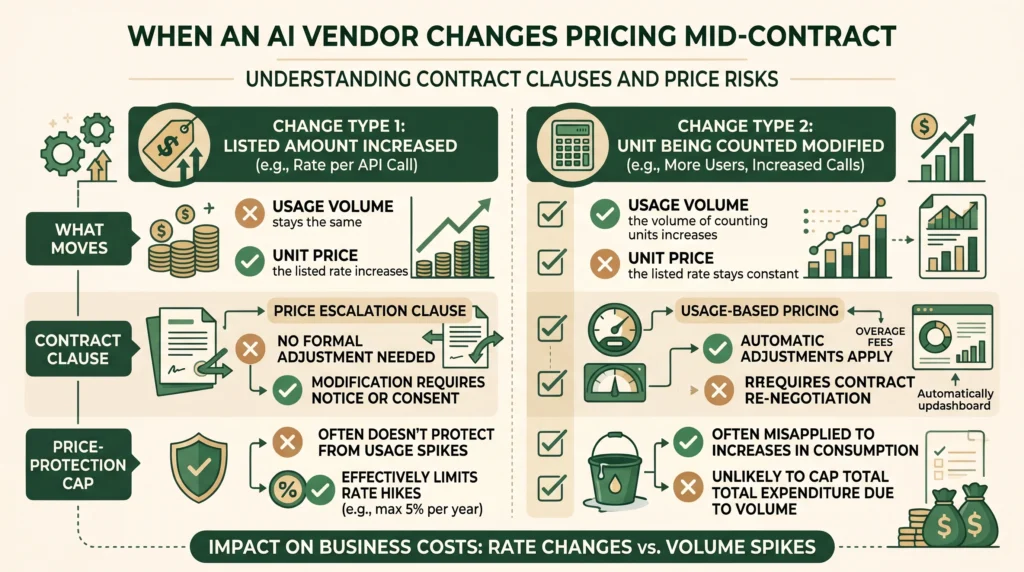
Read the new unit before arguing about the amount. GitHub’s billing pages say credits are the billing unit for metered Copilot use, that usage is measured by the tokens each request consumes, and that the model chosen sets the rate. The credits you get are pooled across the whole account, not per head. They do not carry over either, and the pool resets at midnight UTC on the first day of each month.
| What changed | What your clause probably covers |
|---|---|
| The listed amount per seat | A fee-change right, with notice |
| The unit being counted | A service-change right, often uncapped |
| Which models are included | A product-change right, often silent |
What notice should a vendor give you?
Whatever your contract says, which is often less than feels fair. Notice for a fee change often runs to the next billing cycle, and nothing forces a vendor to be kind. The practical test is different: count the days between the email and the date it bites, then ask whether that is long enough to measure your real usage. If it is not, your first request is time, not money.
Notice is also the clause worth fixing for next time. A February 2026 clause checklist from MN Advocates asks buyers to seek notice of material changes, transparency on their impact, and “exit or rollback rights where risk or performance materially changes”. That last phrase is the useful one, because it ties your way out to something you can test, not to a number. Write it into your next deal while this one still stings.
What can you actually do mid-term?
More than most buyers try, though none of it reopens the deal. Ask for the change in writing with the clause named, then ask for the transition window to be stretched, since vendors build those windows to keep customers calm. You can switch on every cap the vendor offers. And you can put the gap between old and new in a note, so next year’s talk opens with evidence.
Sequence matters more than force here, so pull one month of real usage before you reply, because a vendor talk without your own numbers becomes a talk about theirs. Then name one person to own the bill: this is change management, not buying, and an unowned meter drifts. Generic AI consultants will offer to reopen the whole deal, which mid-term is mostly theatre. The quieter route holds: measure, cap, record, then raise it on your own date.
- Get the clause in writing: ask which term allows the change and which date it starts.
- Measure first: one month of your own usage beats any estimate the vendor sends.
- Switch on the caps: set a hard limit per person, then one across the account.
- Write the note: record what moved, what it did, and what you want at renewal.
AI Smart Ventures has trained over 20,000 professionals in Applied AI, and a first session here is often a contract read rather than a tool review. Our AI Advisory team works through the clause, the caps and the note with you.
How do you put a ceiling on AI usage charges?
With the controls the vendor built, which often arrive switched off. GitHub’s budget rules are a clear published example. A budget set per head always enforces a hard stop. Budgets set for a team or the whole account halt spending only once an admin turns on “Stop usage when budget limit is reached”, and that setting is off by default. Without it, charges keep running past your limit.
Caps work best paired with a floor you will not drop below. The same pages note that inline code completions and next edit suggestions are not billed in credits and remain unlimited, even at an enforced limit. So a hard stop does not switch the tool off; it stops the metered part. AI Smart Ventures observes that teams who learn that split early stop fearing the cap. That is AI literacy applied to a bill.
Frequently Asked Questions
Does your AI bill move when nothing else does?
Yes, once the meter replaces the plan. A metered bill tracks what your team did that month, so a busy fortnight shows up without anyone buying anything. Pooling softens this, because the usage you get is shared across the account rather than split per head. The volatile part is not the plan you chose; it is the volume your team puts through it.
Which direction is AI pricing actually moving?
Sideways, then uneven, because the shift that matters is not up or down but from fixed to usage-linked. BCG wrote in October 2026 that it is premature to declare seat-based pricing dead, and that hybrid models, a subscription plus a usage element, are now the leading approach. A hybrid bill has a steady half and a swinging half. Plan the swinging half.
What drives the swing in a usage-based charge?
Three things, and only one is your doing. Usage is measured in tokens rather than actions, so two similar tasks can consume differently. The model chosen sets the rate, and a default can change without you picking anything. Pooled usage does not carry over, so a quiet month buys you nothing in a busy one. Forecast the busy month, not the quiet one.
Can you refuse a mid-term billing change?
Rarely outright, and more often than you would guess in part. If the clause requires notice, insist on the full window. If it reaches only the next billing cycle, a prepaid term may be untouched until it ends. Where the change is big, some contracts give you a right to object or exit. Read the clause before you decide the answer is no.
Does a price-protection clause cover a new meter?
Often not, and this is the most common gap. Such a clause fixes a number for a term. Replace the unit that number applies to and the clause can stay honoured while your bill moves anyway. Ask for wording that covers the pricing structure, not only the figure. Buyers who learn this once tend to add a consent step for any structural change.
What counts as a material change to your service?
Whatever your agreement defines, and many do not define it at all. A workable test is whether the change alters what you rely on: the result, the model behind it, or how the amount is worked out. One 2026 clause checklist ties exit and rollback rights to a real shift in risk or performance, which gives you a hook you can test.
Who should own an AI tool’s bill internally?
One named person, with the admin access to act. Finance sees the total but not which team drove it, and the team that drove it rarely sees the total. Give the owner three jobs: watch monthly usage, keep the caps set, and read every vendor email about terms. That is workflow optimization applied to your own back office, and it takes a few hours.
Do buyers prefer usage pricing or a fixed plan?
Buyers are split, and the old default is losing. A Futurum write-up of a 2026 buyer survey, published on 12 May, found 43% preferring consumption-based pricing and 27% favouring outcome-based models, with fewer than one in five still picking classic per-user pricing. So a vendor moving to usage often follows demand. That does not make the timing yours, though it changes what you ask for.
Should you switch vendors when the pricing moves?
Rarely on the first change, because switching carries costs no contract shows. Moving means migrating data, rebuilding the links you wired up, and taking your team back down the learning curve they just climbed. The capability building you paid for restarts. Price the move in weeks of lost output, then weigh that against one term of the new model, and switch only when the gap repeats.
How do you plan next year around a moving meter?
Plan the shape, not the total. Build your figure from three inputs you can observe: how many people really use the tool, how often the work repeats, and which parts are metered rather than included. Then set a ceiling you are willing to defend and cap to it. Revisit each quarter instead of each year, because that is practical AI budgeting now.
What does reviewing your AI contracts involve?
Reading, in a set order. List every AI tool, find the fee-change and service-change clauses in each, then write the notice period beside them. One tool takes an hour; ten take a week spread thin. Scope drives what any partner charges, so ask for named deliverables and an exit point. Schedule a consultation to read your clauses before the next vendor email lands.
Executive Summary
AI pricing changes arrive mid-term as two events: the amount can move, or the unit it is measured in. Your contract treats those as two rights, and a price clause caps the first while rarely touching the second, so a billing-model switch can leave the listed plan alone while the bill moves anyway. GitHub’s shift to usage-based billing worked that way, and its Pro and Pro+ annual subscribers stayed on legacy billing past 1 June 2026. Your levers mid-term are notice, numbers and the caps the vendor ships switched off.
What Should You Do Next?
This week, open the two AI contracts you spend most on and find three things in each: the fee-change clause, the service-change clause, and the notice window. Write them on one page beside each tool’s term end date. Then log into the admin console of your largest metered tool and set a cap per head, so the next change finds you holding a ceiling.
AI Smart Ventures offers AI Advisory for growing businesses whose AI tools re-priced faster than their plans did. Schedule a consultation to turn one vendor email into a clause you understand, a cap you control and real operational efficiency.
People Also Read
About the Author
Nicole A. Donnelly is the Founder of AI Smart Ventures and an AI Adoption Specialist with 20 years of experience as a founder and CEO and over a decade leading AI adoption initiatives. She helps businesses integrate artificial intelligence with clarity and confidence, driving innovation and sustainable growth. Nicole has trained over 20,217 professionals in Applied AI, delivered 624 workshops, and worked with close to 1,000 organizations across diverse industries.
Expertise: AI Transformation, AI Strategy, AI Implementation, AI Adoption, Applied AI, Marketing, Business Operations
Disclaimer: This content is for informational purposes only and does not constitute professional business or technology advice. Results vary based on industry, existing systems and implementation commitment. Contact AI Smart Ventures for a consultation regarding your specific situation.