
Why Do Two Reviewers Accept Different AI Work?
Last Updated: October 2026
AI quality assurance is the bar you hold AI work to, plus the check that applies it. Most teams have built the check and skipped the bar. So two people read the same draft, one says yes, the other sends it back, and each thinks they are doing the job right. Neither is being sloppy. Nothing on paper tells either one where the line sits.
AI Smart Ventures has guided growing businesses through AI adoption in law, finance, health care and freight. One scene turns up in nearly every rollout. Two able people read one AI draft, land on opposite calls, and the row that follows is about adjectives rather than about the work.
What that costs you is not one bad draft. It is a team that stops trusting its own review step, because a yes starts to look like a matter of who read it that morning.
Key Takeaways
- No one wrote the bar down: left alone, each reader builds a private bar and applies it in good faith, so both calls hold up.
- The split lands on the soft criteria: in a study out on 4 May 2026, pairs of reviewers sharing one rubric barely lined up on impact and engagement.
- Samples lift agreement, long rubrics sink it: a May 2026 rubric test found real samples raised agreement, while a more complex rubric cut it.
- Rewording is not agreeing: Agreement Without Alignment, out on 9 October 2026, reworded the clauses judges fought over, lifted their agreement with each other, and left their match with human experts flat.
- One line per sample: each piece carries the call and the single reason for it, so the next reviewer can copy it.
Read together, they move the row off opinion. Two reviewers who split are rarely clashing on judgment. They are filling one blank with their own guess, and real work in that blank makes most of the row go away.
Why do two reviewers reach different verdicts?
Because each reviewer is applying a bar they wrote themselves. Given nothing to compare against, they fall back on habit, on the last complaint they handled, and on what they would have written. One reads for care with facts, another for tone, a third for whether a client could follow it. All three are fair ways to answer “is this good enough”, and nothing in the task says which one wins.
The gap shows up between whole groups, not just two desks. Checkr polled 3,000 working Americans in February 2026, half of them managers and half not. Among the managers, 40% said they trust day-to-day AI output often or almost always. Among the staff, 9% said the same. Same tools, same work, two settled views. A whole population can sit that far apart, so two colleagues need no special reason to.
Why can’t “accurate” or “professional” settle it?
Because an adjective names how the work felt to you, not what is in it. Two reviewers can both call a draft weak and mean two things: one means the greeting, the other the hedging in paragraph three. They agree on the word and still split on the thing. The adjectives that cause the most trouble are the ones that sound most settled, since nobody asks what they mean.
Research puts a number on that. In a study out on 4 May 2026, 14 reviewers graded 160 conference abstracts against one shared rubric, two of them per abstract. On the objective criteria, they lined up fairly well. On impact, engagement, and how widely the work applied, the subjective ones, agreement between the two fell to poor or fair, scoring 0.151 to 0.553. A shared rubric did not save the subjective half.
What does a shared bar look like in practice?
A small set of real work, each piece marked pass or fail, each one carrying a line that says why. Ten or twelve is plenty. Half of them should sit near the line rather than at the easy ends, since near the line is where readers split. The set swaps the adjective for a comparison, so a reader asks which of these the draft is closest to.
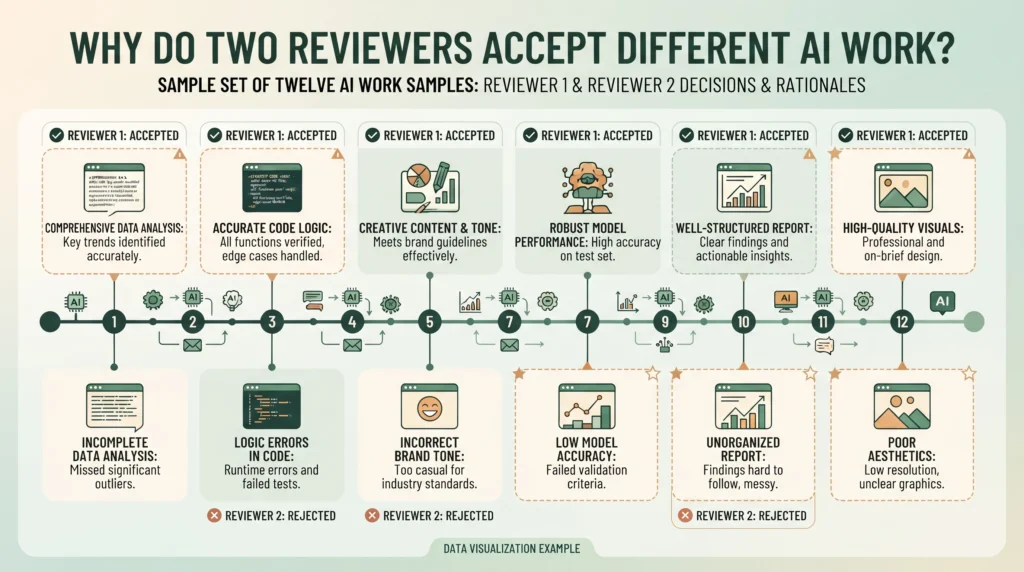
That design has support. A May 2026 paper by Jessica Huynh and colleagues tested what happens when you change a rubric that people and machine raters both score against. Adding representative samples and more context raised how far the two agreed. Making the rubric more complex cut it. The urge to settle a row by writing more rules therefore works backwards, while pinning the rule to a sample is the plainer move that holds.
| What a reader is handed | What they do with it |
|---|---|
| An adjective | Apply their own reading of it |
| A longer rubric | Read less of it, then apply their own |
| Twelve marked pieces | Compare the draft and name the closest one |
How do you build the set from work you already have?
Pull it out of your archive, not out of a workshop. Take thirty AI drafts you have sent or sent back this quarter, and sort them by the call you made at the time. Keep the dozen that two people fought over or that nearly got through. Write one line each naming what drove the call. That is your set, and it took an afternoon.
Most firms hold the raw stuff and have no habit of using it. The Thomson Reuters Institute 2026 AI in Professional Services Report, out on 9 February 2026 from more than 1,500 people in 27 countries, found them using these tools with little steer on how to measure that use, and only 18% knew their firm tracked returns at all. Drafts you turned down are measurement you have already paid for.
AI Implementation from AI Smart Ventures turns that archive into a bar your readers share, built into the workflow rather than a policy nobody opens.
How do you settle a live disagreement with it?
Put the draft beside the set and ask one thing: which marked piece is this closest to? Whoever says pass must point at a pass sample and say why the draft matches it. Whoever says no does the same with a fail. If neither can find a match, you have found a hole in the set, and the hole is now the thing to fix rather than the draft.
There is a tempting shortcut here, and new work suggests it fails. On 9 October 2026, Sangdo Han and Moonsoo Kim put out Agreement Without Alignment, which reworded the rubric clauses five machine judges disagreed on most. The judges then agreed with each other more. Their match with human experts did not move at all. Clearer wording bought consensus and not correctness, which is what a long row about definitions tends to buy you.
When should an example be replaced?
When the work it stands for stops showing up. A sample earns its place by being a case a reviewer might meet this month. A bid you turned down for a service you no longer sell teaches nobody, and a set full of those gets skipped within weeks. Swap one out when a new kind of work arrives, and drop anything nobody has pointed at in a quarter.
AI Smart Ventures observes that the sets which last are the ones somebody edits in the open, where a swapped sample keeps its old line beside the new one so a reviewer can see what moved. AI gurus tend to sell a rubric template instead, since a template photographs well and needs no archive. The slower version builds real AI literacy and makes workflow optimization stick, because a reviewer who argued a sample in reads the next draft differently.
- Put it in on arrival: the first time a new kind of work reaches review, mark that piece and keep it.
- Drop it on silence: a sample nobody has cited in a quarter stands for work you no longer do.
- Keep the old line: leave the previous reason in view, so the change itself can be read.
- Hold the size: a set past twenty stops being something anyone scans before calling it.
Frequently Asked Questions
What is AI quality assurance in plain terms?
AI quality assurance is deciding what counts as good enough AI work, then checking work against that call. The first half is the part teams skip. Without it you have reviewers, a review step and no shared bar, which is what lets two people pass different things. Written down, the bar is mostly a short set of marked samples, not a page of rules.
Will AI replace the person who reviews AI work?
No, because the reviewer’s real job is deciding what good means here, and that call sits with whoever carries the fallout. Tools can flag missing sources, broken math and lines that fight each other, which cuts the work a lot. What they cannot do is say which borderline draft your firm will send out under its own name. That call stays with people.
Is there a tool that ends reviewer disagreement?
No tool ends it, because the split is about your bar and not your software. Review platforms help once a bar exists: they hold the samples, show two scores side by side, and log who called what. Bought before the bar is agreed, they just speed up two people falling out. Agree the samples first, then pick somewhere to keep them.
Does the 30 percent rule help set a quality bar?
No. The phrase floats around in several forms, most of them saying AI should take on about a third of a task while people keep the rest, and no standards body publishes it. A fixed share says nothing about where your line sits, since one draft can be fine for a note and wrong for a client. Use marked samples of your own work.
Which review skills survive when AI writes the draft?
Three hold their worth: knowing the subject well enough to see an error, being able to say in one line why a draft failed, and being willing to send work back. The first two turn a call into something a colleague can copy. Reading for flow and tidying up have largely gone to the tools. The judgment calls have not.
How many examples does a team need to line up?
Ten to twelve works as a start, with about half sitting near the line. Fewer than eight leaves common cases bare, and more than twenty stops being something anyone scans before deciding. Add a piece when a split finds a hole, rather than on a schedule. The measure that counts is how often two reviewers now land on the same call alone.
How do you tell whether your reviewers now agree?
Have two people score the same ten pieces apart from each other, then compare. Measures exist for this, and a LREC 2026 guide to picking one says to match the measure to the task, report a confidence range, and look at where the splits cluster rather than at the headline number. The cluster tells you which sample to add next.
Can you show the example set to the AI tool itself?
Yes, and it is one of the better uses for it. Pass and fail samples with their reasons give a tool a sharper target than an instruction to be accurate and professional, so more drafts arrive near the bar. Keep reviewing the output anyway. A tool fed your samples will miss in exactly the same spots your set is thin.
How do you store examples without exposing client data?
Swap real names, figures and account details for invented ones while keeping the shape of the work, since the shape is what a reviewer compares against. Hold the set where the work already lives rather than in one person’s folder, and check it against your own data policy before anyone adds a client file. A set kept secret will not get used.
How do we get started agreeing a quality bar?
Pick the one AI output your team falls out over most, pull ten pieces you have already passed or sent back, and write the single reason beside each. Effort tracks how many kinds of work you cover, not how many people you employ, and it drops sharply when you start with one. Schedule a consultation to build that first set from decisions you have already made.
Executive Summary
Two reviewers wave through different AI work because nobody wrote the bar down, so each applies a bar of their own. Adjectives cannot settle that split, and reviewer pairs agree least on the subjective criteria even when they share a rubric. Real samples lift agreement while longer rubrics sink it, and rewording contested clauses buys consensus without buying correctness. Build the set from work you have already passed or sent back, a dozen pieces with one line each, then settle splits by comparing instead of arguing.
What Should You Do Next?
This week, take the AI output your team falls out over most and pull ten pieces you have already passed or sent back. Mark each one pass or fail, add the single reason, and ask two reviewers to judge the next three drafts by comparison alone. Where neither can find a match, you have your next sample.
AI Smart Ventures offers AI Implementation for founder-led organizations that want a shared quality bar designed into daily work, with change management sized to the team you have. Schedule a consultation to turn your own past calls into a bar two readers can both apply.
People Also Read
- How AI Is Changing the Agency Strategy Retainer in 2026
- How to Run AI Office Hours for Your Member Organization in 2026
About the Author
Nicole A. Donnelly is the Founder of AI Smart Ventures and an AI Adoption Specialist with 20 years of experience as a founder and CEO and over a decade leading AI adoption initiatives. She helps businesses integrate artificial intelligence with clarity and confidence, driving innovation and sustainable growth. Nicole has trained over 20,217 professionals in Applied AI, delivered 624 workshops, and worked with close to 1,000 organizations across diverse industries.
Expertise: AI Transformation, AI Strategy, AI Implementation, AI Adoption, Applied AI, Marketing, Business Operations
Disclaimer: This content is for informational purposes only and does not constitute professional business or technology advice. Results vary based on industry, existing systems and implementation commitment. Contact AI Smart Ventures for a consultation regarding your specific situation.