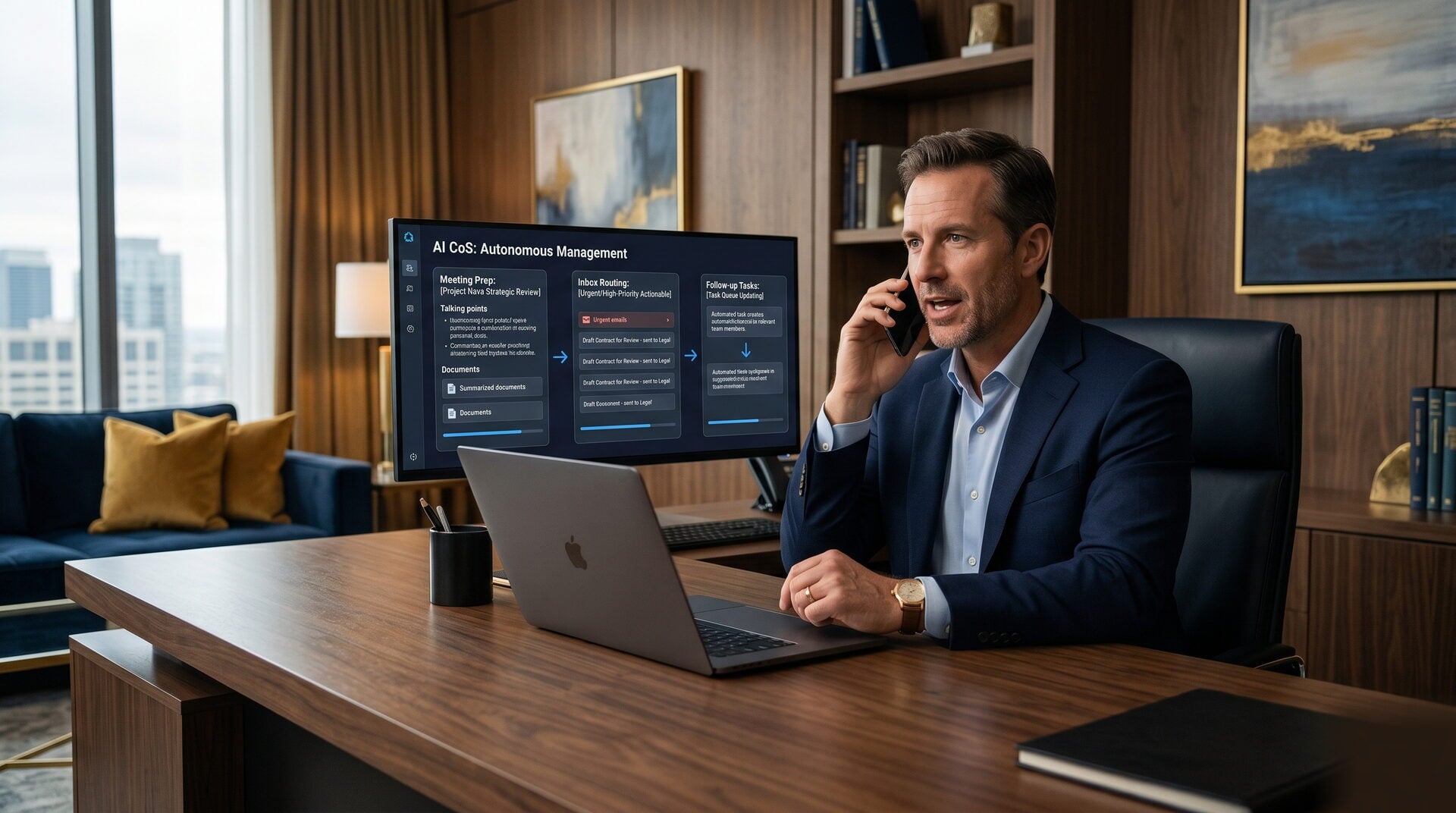
AI Chief of Staff for Owner-Operators: A Force Multiplier
Last Updated: May 2026
An AI chief of staff for an owner-operator is a set of AI tools and routines. It handles the prep, follow-up, and coordination work the founder used to do by hand. This frees the owner to spend more time on decisions only they can make. McKinsey’s 2025 AI productivity study found that owner-operators who set up this kind of system gained an average of 11 hours per week. They reinvested those hours in strategy, sales, and the work that grew revenue.
AI Smart Ventures has worked with close to 1,000 growing businesses on AI use. Owner-operators use AI as a chief of staff to run their week without adding a full-time hire. They report more control over their time within the first 30 days.
Key Takeaways
- Force Multiplier – An AI chief of staff acts as a force multiplier. It handles the work that takes the owner’s time but not the owner’s judgment. It frees up 11 hours per week, per McKinsey’s 2025 AI productivity study.
- Three Core Jobs – An AI chief of staff does three core jobs: prep, follow-up, and coordination. Prep covers briefings, research, and agendas. Follow-up covers summaries, next steps, and reminders. Coordination covers scheduling, routing, and sorting incoming requests.
- No New Hire – An AI chief of staff system covers the same coordination and prep work as a full-time operations hire. It does so at a fraction of the cost, making it right for many owner-operated businesses.
- Setup Time – Most owner-operators have an AI chief of staff system running in two to three weeks. They start with one job, usually prep or follow-up, before adding the next.
- First Step – List the five tasks that eat the most time each week. Focus on tasks that do not require a judgment call only you can make. Those five tasks are the first jobs for your AI chief of staff.
Owner-operators who build an AI chief of staff system stop doing low-value coordination work. They start spending that time on the high-value calls, plans, and relationships that grow the business.
What Is an AI Chief of Staff for Owner-Operators?
An AI chief of staff for owner-operators is a system of AI tools. It handles prep, follow-up, and routing work so the owner spends time only on what they alone can do. It is not a single tool. It is a set of connected routines that run in the background and surface only what needs the owner’s attention. The system works like a skilled right-hand. It knows the owner’s priorities and handles everything else.
Deloitte’s 2025 AI operations study found that owner-operators who set up an AI chief of staff system reported 44 percent fewer interruptions in their work day after 60 days. The system filtered, sorted, and prepped inputs that used to arrive unstructured. Those inputs once demanded the owner’s immediate attention. For an owner-operator, fewer interruptions means more focus blocks per week. More focus blocks are where the high-value work actually gets done.
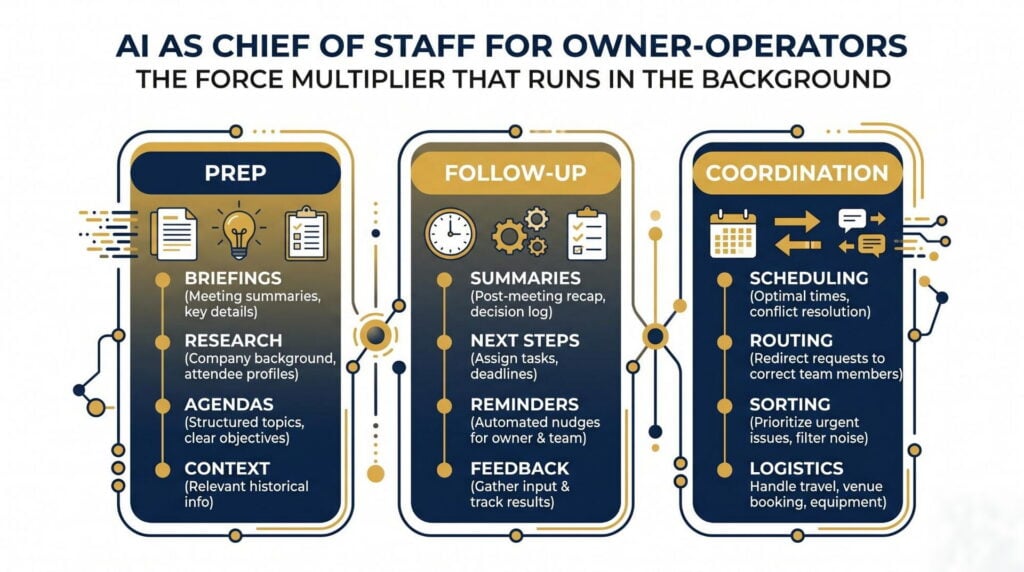
Three things an AI chief of staff does that free up owner time:
- Meeting Prep – The AI pulls the key facts, open items, and context for every meeting the day before it happens. The owner walks in ready without spending 20 minutes gathering notes the morning of.
- Post-Meeting Follow-Up – The AI writes the meeting summary and lists the next steps. It then sends the follow-up to the right people within 30 minutes of the call ending. The owner moves on to the next task.
- Inbox and Request Routing – The AI reads incoming requests and sorts them by type and priority. It also drafts replies for the low-stakes ones. The owner sees only the messages that need a real decision.
Start with one of the three jobs above. Get it running well in week one. Then add the next job in week two before building the full system.
Why Do Owner-Operators Need an AI Chief of Staff?
Owner-operators need an AI chief of staff because the coordination work in a growing business expands faster than the owner’s available hours. A founder who once handled five accounts with 30 focused hours now runs ten accounts. That same founder spends 15 of those hours on prep, follow-up, and routing. A trained AI system could handle all of that. The math does not change without a structural fix.
PwC’s 2025 founder time study found that owner-operators without an AI chief of staff system spent an average of 14 hours per week on prep, follow-up, and coordination tasks. Those with a system in place spent only 3 hours on the same tasks. That 11-hour gap is the force multiplier. It comes from routing the right work to the AI. The high-judgment tasks stay with the owner.
The AI advisory team at AI Smart Ventures maps the owner’s weekly work into high-judgment and low-judgment tasks and builds the AI chief of staff system around the low-judgment pile first.
How Do Owner-Operators Set Up an AI Chief of Staff System?
Setting up an AI chief of staff system takes three steps. First, map the weekly task list into prep, follow-up, and routing jobs. Second, pick one job to automate. Third, run it for two weeks before adding the next job. The two-week test shows the owner where the AI output needs adjusting. It does this before the system runs on more tasks. Most owners have all three jobs running by the end of week six.
Accenture’s 2025 AI productivity report found that owner-operators who set up their AI chief of staff system one job at a time had 67 percent fewer setup issues. That is compared to those who tried to automate all three jobs at once. The one-job approach let them fix the AI output before it ran on a full week of tasks. A bad AI summary or a wrong routing decision catches itself in week one when only one job is live. That is harder to catch when the full system runs across all meetings and messages.
| Setup Phase | Job | Time to Live |
|---|---|---|
| Week 1-2 | Pick one job (prep, follow-up, or routing) and test on real work | 2 weeks |
| Week 3-4 | Add the second job and run both in parallel | 2 weeks |
| Week 5-6 | Add the third job and run the full system | 2 weeks |
| Week 7+ | Review output weekly and adjust prompts as needed | Ongoing |
The AI implementation team at AI Smart Ventures sets up AI chief of staff systems for owner-operators. The first job is live in week one and the full system is running by week six.
What Are the Risks of an AI Chief of Staff System?
The main risks are wrong output sent to a client and a routing error that buries a high-priority message. A third risk is an owner who stops reviewing AI output because it usually looks right. Each risk shows up in the first 30 days if the owner reviews the AI output for 10 minutes each day. A brief daily check catches errors before they reach a client. It also catches errors before they cost the owner time to fix.
McKinsey’s 2025 AI productivity study found that owner-operators who set up an AI chief of staff system without a daily output review had at least one client-facing error in the first 60 days. That happened in 31 percent of cases. Those who ran a 10-minute daily review had no client-facing errors in the same period. A 10-minute review is a small cost. The system returns 11 hours of time each week in exchange.
Three risks to check in the first 30 days of any AI chief of staff system:
- Wrong Output to a Client – An AI summary or follow-up that goes to a client with incorrect facts damages trust fast. Fix: set a rule that no AI output goes to a client without one human read first. Follow this rule for the first 30 days.
- Buried Priority Message – An AI routing system can sort a high-priority message into the wrong category. Fix: check the sorted inbox each morning and look for any message that the AI routed to the wrong pile.
- Review Fatigue – Owners stop reviewing AI output after it looks right for two weeks. Then errors reach clients. Fix: keep a fixed 10-minute daily review slot on the calendar even after the system feels routine.
Check all three risks at the 30-day and 60-day marks. Adjust the AI prompts for any job that produced an error in the review window.
How Do You Know If Your AI Chief of Staff System Is Working?
The clearest sign an AI chief of staff system is working is a shift in how the owner spends their hours. The owner spends more time on work only they can do. They spend less time on prep, follow-up, and routing. Track two numbers each week: hours spent on high-judgment work and hours spent on coordination tasks. If high-judgment hours go up and coordination hours go down, the system is doing its job.
Deloitte’s 2025 AI operations study found that owner-operators who tracked both numbers for 90 days were 53 percent more likely to keep and expand their AI chief of staff system. That is compared to those who measured only cost. The time data showed the real return in a way that a cost number alone could not. Set a 30-day check on both numbers after adding each new job to the system. Use the data to decide whether to add the next job or adjust the current one first.
Frequently Asked Questions
What is an AI chief of staff for an owner-operator?
An AI chief of staff handles prep, follow-up, and routing work for the owner. It is a system of routines that runs in the background. The system surfaces only what the owner needs to act on. Most owner-operators have it running within six weeks. It frees up 11 hours per week on average for the owner’s high-value work.
How is an AI chief of staff different from a regular AI tool?
A regular AI tool does one job when the owner asks it to. An AI chief of staff runs daily routines in the background without any prompt. It handles prep, follow-up, and routing on a set schedule each day. The owner interacts with it only when the output needs a decision or a review. The difference is proactive vs. reactive use of the same underlying tools.
What tasks does an AI chief of staff handle for owner-operators?
An AI chief of staff handles three types of tasks: prep, follow-up, and routing. Prep means meeting briefings, research, and agendas. Follow-up means summaries, next steps, and reminders. Routing means sorting, drafting replies for, and flagging incoming requests. These tasks eat 10 to 15 hours per week for most owner-operators without a system.
How long does it take to set up an AI chief of staff system?
Setting up an AI chief of staff system takes two to six weeks. Start one job in week one and add the second in week three. The full three-job system is usually running by week six. The time depends on how much adjustment the output needs in week one. A one-job approach cuts setup issues by 67 percent versus all three at once.
What does an AI chief of staff cost for an owner-operator?
An AI chief of staff system costs $100 to $400 per month in tool fees. The setup time is four to eight hours in the first two weeks. A 10-minute daily review is needed in the first 30 days. The return is 11 or more hours of freed owner time per week. That covers the tool cost in the first month.
How do you keep an AI chief of staff system on track over time?
Run a 10-minute daily review of AI output for the first 30 days. After that, a weekly review is enough. Check whether the AI prep output is accurate before meetings each week. Also check whether routing puts messages in the right place. Update the AI prompts any time the output drifts, usually every four to six weeks.
Can an AI chief of staff replace a human operations hire?
An AI chief of staff covers the prep, follow-up, and routing tasks of a hire. It cannot replace the judgment and trust a skilled human brings to complex problems. For owner-operators not yet ready for a full-time hire, it covers the most time-consuming tasks. The cost is a fraction of a full-time operations salary. As the business grows, the AI system and a human hire can work together.
How much does AI Smart Ventures charge to set up an AI chief of staff system?
Contact AI Smart Ventures for a scoping estimate based on your task list. Setup typically runs between $1,500 and $4,000 for a full three-job system. That includes the task map, tool selection, prompt build, and a 30-day review. Most owner-operators recover the setup cost in the first four weeks. The freed hours return to the business within the first month.
Executive Summary
An AI chief of staff for owner-operators is a system of AI routines. It handles prep, follow-up, and routing work. The owner then spends time only on high-judgment decisions. The system frees 11 hours per week on average. It runs in two to six weeks and costs under $400 per month in tools. The main risks are wrong output reaching clients and review fatigue. Both are caught with a 10-minute daily check in the first 30 days.
What Should You Do Next?
List the five tasks that eat the most time each week. Focus on tasks that do not need a judgment call only you can make. Those five tasks are the starting point for your AI chief of staff system.
AI Smart Ventures offers AI consulting for growing businesses that want to build an AI chief of staff system without trial-and-error setup. Schedule a consultation to get a task map and AI system design built for your current work week and business stage.
People Also Read
- What Is AI Social Listening and How Does It Work?
- Best AI Tools for Accounting: What CPAs Are Using in 2026
About the Author
Nicole A. Donnelly is the Founder of AI Smart Ventures and an AI Adoption Specialist with 20 years of experience as a founder and CEO and over a decade leading AI adoption. She helps businesses add AI with clarity and confidence. Nicole has trained over 20,217 professionals in Applied AI, delivered 624 workshops, and worked with close to 1,000 organizations across diverse industries.
Expertise: AI Transformation, AI Strategy, AI Implementation, AI Adoption, Applied AI, Marketing, Business Operations
Disclaimer: This content is for informational purposes only and does not constitute professional business or technology advice. Results vary based on industry, existing systems and implementation commitment. Contact AI Smart Ventures for a consultation regarding your specific situation.