
AI Cost per Outcome for Owner-Operators: A Better Metric Than Cost per Seat
Last Updated: May 2026
An AI cost-per-outcome metric measures what a tool costs against what it produces, including time saved and revenue added, going beyond the monthly seat price. McKinsey’s 2025 AI ROI report found businesses using this metric cut wasted AI spend by 37 percent compared to those tracking cost per seat only. For a lean-budget owner-operator, that gap matters because a tool that pays for itself is very different from one that does not.
AI Smart Ventures has worked with close to 1,000 growing businesses on AI use. This includes owner-operators who switched to outcome-based tracking and cut their AI spend while keeping the tools that delivered real results. The sections below explain what cost per outcome means, how to calculate it, and how to act on it.
Key Takeaways
- Metric Goal – AI cost per outcome measures what you pay for each result, such as hours saved or leads screened each month. It replaces the cost per user seat as the key measure.
- Waste Reduction – Businesses using this metric cut wasted AI spend by 37 percent per McKinsey’s 2025 AI ROI report. That compares to those tracking seat price only.
- Seat Price Blind Spot – Cost per seat tells you what a tool costs but not what it earns. A $50 seat saving 10 hours per month beats a $20 seat the team seldom opens.
- Calculation – Divide the monthly tool cost by results produced that month, such as hours saved, leads screened, or drafts done. That gives your cost per outcome.
- First Metric – Pick one outcome to track per tool before the next billing cycle and compare it to the monthly cost. That is your first cost-per-outcome number.
Owner-operators who measure AI by outcome make faster decisions about which tools to keep, cut, or expand.
What Is AI Cost per Outcome?
AI cost per outcome is the monthly tool cost divided by the results it produces, such as hours saved or leads screened. It gives the owner one clear number to compare across tools, so keep-or-cut decisions rest on value rather than seat price. The seat price alone tells you what a tool costs but not what it earns.
Deloitte’s 2025 AI operations report found businesses tracking one outcome per tool were 44 percent more likely to expand AI use in year two compared to those tracking cost only. The outcome number gave them a clear reason to add seats or tools. For an owner-operator, one outcome metric per tool is all you need – track cost, track result, divide, and decide.
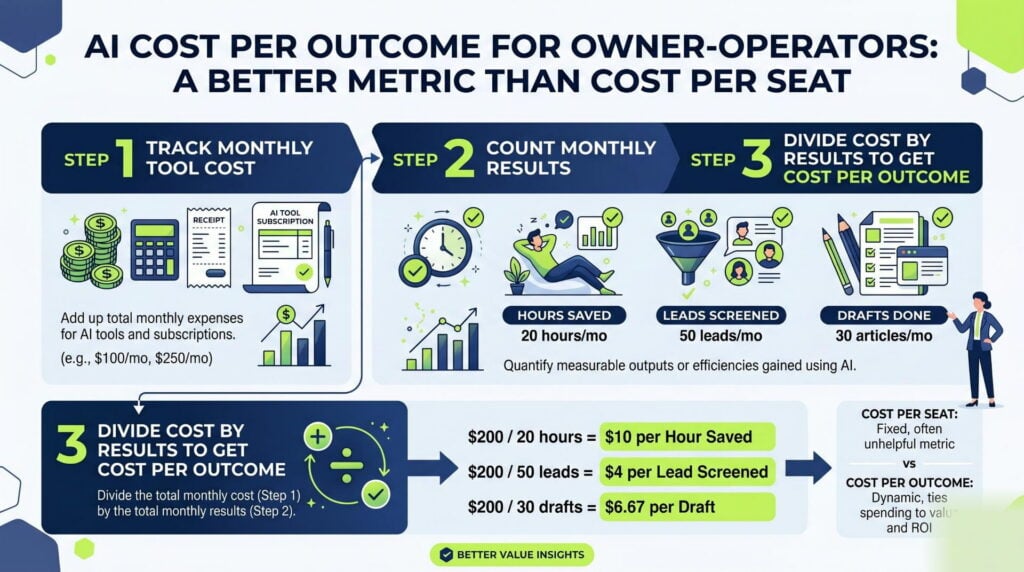
Three AI outcomes owner-operators track most often:
- Hours Saved – Track how many hours per month the tool saves the main user, then divide the monthly cost by that number. A tool delivering results at $5 per hour saved is easy to justify in any budget review.
- Leads Screened – Count how many leads the tool screens each month and divide the cost by that number. A tool screening 50 leads at $200 per month costs $4 per lead.
- Drafts Completed – Count the drafts the tool finishes each month, then divide the tool cost by that count. A tool finishing 80 drafts at $100 per month costs $1.25 per draft.
Pick the outcome easiest to count in your current setup and track it for 30 days before your next AI budget review.
Why Does Cost per Seat Mislead Owner-Operators?
Cost per seat shows what a tool costs but not what it returns. Two tools at the same price can have very different values, and without a result to compare against the price, the owner has no reliable way to know which tool to keep. A $50 seat saving 10 hours a month is not the same as a $50 seat the team seldom opens.
PwC’s 2025 AI trust report found businesses cutting tools by seat price often removed tools that saved the team time while keeping cheaper tools no one was using. For an owner-operator, removing the wrong tool is a costly mistake that shows up weeks later when the work slows down. One outcome metric per tool makes the value visible before any cut is made.
The AI advisory team at AI Smart Ventures reviews AI tool stacks for owner-operators and assigns an outcome metric to each tool before the next billing review. Cuts are then made on value, not price.
How Do You Calculate AI Cost per Outcome?
Calculating AI cost per outcome takes three steps. First, find the monthly tool cost. Second, count the results the tool produced that month, whether hours saved, leads screened, or drafts done. Third, divide the cost by the result count to get one clear number per tool per month.
Accenture’s 2025 AI study found businesses tracking a cost-per-outcome number made keep-or-cut decisions 48 percent faster than those relying on vendor reports. The number gave a clear answer rather than a feeling. For an owner-operator, getting this number takes under 30 minutes and is easier to act on than any vendor demo. Do it once per quarter for each tool in the stack.
| Metric | What It Measures | What It Misses |
|---|---|---|
| Cost per seat | Monthly price per user | Whether the user gets value |
| Cost per outcome | Value per result produced | Setup time and learning curve |
| Time to payback | Weeks to break even | Ongoing value after payback |
| Net time saved | Hours returned per month | Quality of the saved time |
The AI implementation team at AI Smart Ventures sets up cost-per-outcome tracking for growing businesses so the owner has a clear number for each tool before the next budget cycle.
What Are the Risks of Cost-per-Outcome Metrics?
The main risk is picking an outcome that is hard to count each month, which makes the metric unreliable. Setting a target too high for a new tool is another common risk, as is dropping a tool before the team has had 60 days to learn it. Early numbers are often lower than the tool’s long-term value, so start simple and adjust as data comes in.
McKinsey’s 2025 AI ROI report found 38 percent of businesses that dropped a tool in the first 30 days later found it was still delivering value that the outcome metric had been too narrow to capture. For an owner-operator, a cost-per-outcome number is a tool for better decisions, not a pass-fail test. Check the metric, then check the team’s view before you cancel.
Three risks to check before cutting any AI tool based on cost-per-outcome numbers:
- Hard-to-Count Outcome – If the outcome is hard to count each month, the metric will not be reliable. Fix: pick a different outcome that takes under five minutes to count. Start tracking that one instead.
- Too-High Target – If the target is set too high in the first 30 days, the tool will appear to fail before the team learns to use it. Fix: set a loose target for the first 60 days and tighten it after.
- Too-Early Cut – If you cancel a tool after 30 days of low numbers, you may cut one that was about to improve. Fix: ask the team about their actual use before canceling any tool in the first 90 days.
Check all three risks before making a final keep-or-cut call and use the team’s feedback as a second input alongside the number.
How Do You Know If Your AI ROI Is on Track?
The clearest sign AI ROI is on track is a falling cost-per-outcome number over time. Track it monthly for each tool and flag any tool where the number rises two months in a row, since a rising cost per outcome signals the team is getting less value from the tool.
Deloitte’s 2025 AI operations report found businesses reviewing cost-per-outcome numbers each quarter cut AI spend by 31 percent while holding or growing their AI-driven output at the same time. The quarterly review made it clear which tools to expand and which to drop. One 30-minute review per quarter per tool is enough — set the review date before the next billing cycle and use the cost-per-outcome number as the starting point.
Frequently Asked Questions
What is AI cost per outcome for owner-operators?
AI cost per outcome is the monthly cost divided by results the tool produced. Results include hours saved, leads screened, or drafts done. It gives the owner one number to compare across tools. Keep-or-cut calls are then based on value, not seat price. A pricier tool can have a lower cost per outcome if it saves more time.
Why is cost per seat a bad metric for AI tools?
Cost per seat shows what a tool costs each month but not what it returns. Two tools at the same price can have very different values. Without a result to compare, the owner cannot tell which tool to keep. One outcome metric per tool makes each tool’s value visible as a clear number. It also removes the guesswork from budget decisions.
How do you calculate AI cost per outcome?
Calculate AI cost per outcome in three steps. First, find the monthly cost of the tool. Second, count the results produced that month, such as hours saved or leads screened. Third, divide the monthly cost by the result count. One number per tool per month is enough for a clear keep-or-cut decision.
What is a good cost per outcome for an AI tool?
A good cost per outcome depends on what the tool is replacing. Compare the cost per hour saved to your team’s hourly rate. Any tool below that rate is paying for itself. Most owner-operators find below $10 per hour saved is worth keeping. Any tool above $25 per hour saved needs a closer look.
How often should owner-operators review AI cost per outcome?
Review AI cost per outcome once per quarter for each tool. Quarterly reviews catch trends early before unused seat costs add up. Set the review date before the next billing cycle. Cancel or downgrade before the next charge if the numbers do not hold. A monthly check is useful for new tools in the first 90 days.
What outcomes should owner-operators track for AI tools?
Track the outcome the tool was bought to produce. For output tools, track hours saved per month. For outreach tools, track leads screened or drafts done each month. Ask the main user what the tool does for them each week. Start with the simplest outcome to count.
Can you use cost per outcome for free AI tools?
For free tools, use the time cost of running the tool as the cost. If a free tool takes 30 minutes per week, count that as a cost. At $100 per hour, 30 minutes per week equals $200 per month. Divide that by the tool’s results to see if the time cost is fair. Cut any free tool that takes more time than it saves.
How much does AI cost-per-outcome setup cost?
AI cost-per-outcome setup for a lean team takes two to four hours of focused work. The cost for a basic tool stack review runs a few hundred dollars. The payback comes from removing tools that are not producing value, which usually saves more than the review costs in the first billing cycle. Contact AI Smart Ventures for a scoping estimate based on your AI tool count.
Executive Summary
AI cost per outcome is the monthly tool cost divided by results produced, giving the owner one number to compare across every tool in the stack. The main risk is picking an outcome that is hard to count or dropping a tool before the team has had 60 days to learn it. Start with one outcome per tool and track it for 30 days, then use that number at your next budget review to keep, cut, or expand tools.
What Should You Do Next?
Pick one AI tool in your current stack. Count how many useful results it produced last month and divide the monthly cost by that number to get your first cost-per-outcome figure. Compare it to the cost of doing the same work by hand.
AI Smart Ventures offers AI consulting for growing businesses that want to measure AI spend by value rather than seat price. Schedule a consultation to set up cost-per-outcome tracking for your full AI stack before the next billing cycle.
People Also Read
- How Do You Measure AI ROI? A Framework for Business Leaders
- How Do You Address Employee AI Anxiety Without an HR Department?
About the Author
Nicole A. Donnelly is the Founder of AI Smart Ventures and an AI Adoption Specialist with 20 years of experience as a founder and CEO and over a decade leading AI adoption. She helps businesses add AI with clarity and confidence. Nicole has trained over 20,217 professionals in Applied AI, delivered 624 workshops, and worked with close to 1,000 organizations across diverse industries.
Expertise: AI Transformation, AI Strategy, AI Implementation, AI Adoption, Applied AI, Marketing, Business Operations
Disclaimer: This content is for informational purposes only and does not constitute professional business or technology advice. Results vary based on industry, existing systems and implementation commitment. Contact AI Smart Ventures for a consultation regarding your specific situation.