
AI for Founder Board Reports: Brief Investors Faster
Last Updated: June 2026
Founders spend 8 to 12 hours preparing a board report each quarter. AI tools cut that to 3 to 4 hours by pulling data, drafting summaries, and building slides. The full workflow costs under $60 per month.
An AI system for founder board reports pulls key metrics, writes draft notes, and formats the final deck. According to McKinsey’s 2023 generative AI report, AI cuts document creation time by 30 to 50%. Most founders who use this workflow finish quarterly board prep in 3 to 4 hours instead of 8 to 12.
AI Smart Ventures has helped growing businesses build AI workflows across many areas. Board reporting is one of the highest-return use cases because it is data-heavy, repeatable, and tied to a fixed quarterly deadline. The tools that work best are in plans most founders already pay for.
Without a clear process, founders spend most prep time hunting for numbers. They miss the time needed to build the investor narrative. That is the core problem AI solves. Fix the process first, then the time savings follow.
Key Takeaways
- Prep Time – AI cuts quarterly board report prep from 8 to 12 hours to 3 to 4 hours, per McKinsey’s 2023 generative AI benchmarks.
- Data Pull – Tools like Rows connect to your CRM and finance accounts, pulling live metrics into a spreadsheet without manual data entry.
- Narrative Draft – Claude and ChatGPT write first-draft notes from raw numbers in under 10 minutes.
- Cost – A full AI board report stack costs under $60 per month, mostly from ChatGPT Plus at $20 per month.
- Board Preference – MIT Sloan research shows board members care about outcomes, not the details of every data point.
These five steps are not separate projects. They run in order, and each one feeds the next. Start at step one and the rest becomes faster every quarter.
Why Do Founders Struggle With Board Reports?
Most founders spend 60 to 70% of board report prep time collecting and formatting data. That leaves little time for the update board members want most. A typical quarterly report takes 8 to 12 hours. Most of that time is routine work, not strategic thinking.
AI flips this ratio. It handles the routine parts on its own. Founders can then focus on what matters: the insight, the priorities, and the next steps. Tools like Claude and ChatGPT turn raw metrics into a written update in under 10 minutes. That alone cuts most of the heavy lifting.
Which Parts of a Board Report Can AI Help With?
AI helps with four of the five main sections of a board report. It pulls and formats the financial summary, updates the metrics section, writes a draft CEO update, and formats the final deck. The one part it cannot handle is the founder’s judgment: which risks to highlight and what decisions to bring to the board.
The financial summary and metrics sections save the most time. Each quarter, the same tables need the same updates. AI pulls those updates from your connected data sources in minutes. The founder reads, edits, and approves rather than building from a blank page.
What AI Tools Work Best for Board Reports?
Three tool types cover the full workflow for under $60 per month. Data tools like Rows connect to your CRM and finance accounts. They pull live metrics into a spreadsheet on their own. AI writing tools like Claude or ChatGPT turn those numbers into a plain-English summary with the right prompt.
Presentation tools like Beautiful.ai or Gamma take the draft and build a slide deck in minutes. Mem is useful for founders who track notes across many investor accounts. None of these tools need technical skills to set up or maintain.
AI Smart Ventures offers AI advisory services to help growing businesses build AI workflows for board reporting. Visit the AI advisory page to learn more.
| Tool | Category | Cost | Best For | Limitation |
|---|---|---|---|---|
| ChatGPT Plus | AI writing | $20/mo | Narrative and commentary drafts | Needs strong prompts to be accurate |
| Claude Pro | AI writing | $20/mo | Long document analysis | Requires manual data paste |
| Rows | Data pull | Free tier | Live metric updates | Limited integrations on free plan |
| Beautiful.ai | Deck builder | $12/mo | Fast professional slide formatting | Fewer design controls than PowerPoint |
For a vetted list of AI tools for service businesses, see AI tools and apps on the AI Smart Ventures resource hub.
How Do You Protect Sensitive Data With AI?
The main risk is pasting private financial data into a public AI tool. Most platforms use your inputs to train their models by default. Check your privacy settings. Turn off model training before you share revenue figures, cap table data, or future forecasts. Both Claude and ChatGPT have this setting in their account controls.
A simple rule: share only what you would show in a public slide during the draft stage. Add exact numbers in your final edit. Paid business plans for both tools include a Data Processing Agreement (DPA). A DPA sets rules for how your data is stored and used. Request one before connecting any AI tool to a live data source.
Here are the key data checks before using AI for board reports:
- Training Data – Disable AI model training in your tool’s privacy settings before sharing any financial figures or forecasts.
- Data Storage – Check where the vendor stores data. For US-based founders, US servers are the standard expectation.
- DPA Coverage – Request a Data Processing Agreement from any AI vendor before connecting it to a CRM or financial tool.
- Access Control – Use role-based access so only the people who need the AI tool have login credentials.
How Long Does a Board Report Take With AI?
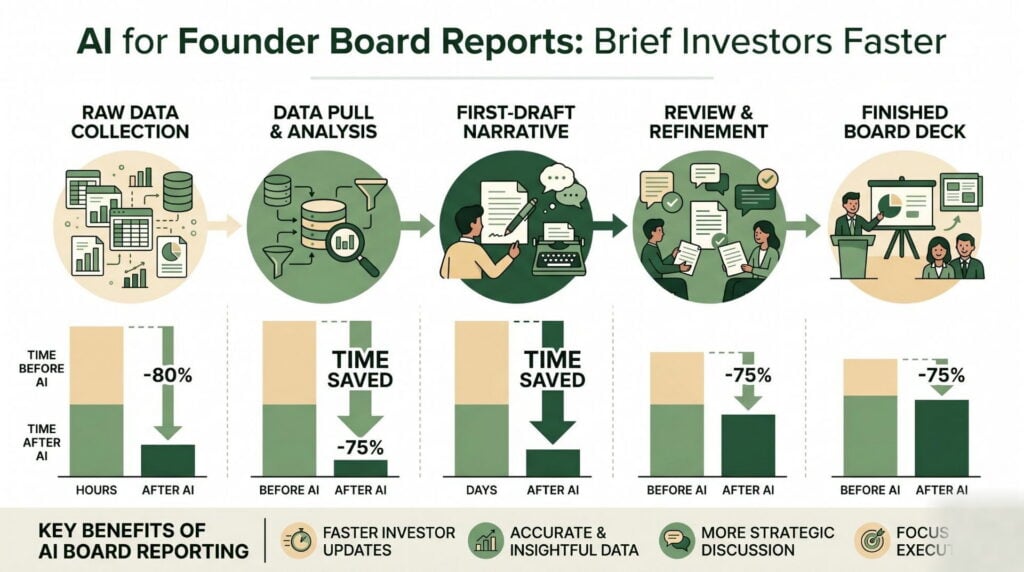
With a structured AI workflow, a board report takes 3 to 4 hours per quarter. Without AI, the same report takes 8 to 12 hours. Time drops in three areas. Data collection drops from 2 to 3 hours to under 30 minutes. Draft writing drops from 3 to 4 hours to under 1 hour. Slide building drops from 2 hours to under 30 minutes.
The remaining 1 to 2 hours are where the founder adds real value. This means reviewing the AI draft, refining the update, and adding the judgment only the founder can provide. This is the part that should take the most time. AI handles the rest so founders can focus on this final step.
Here is a 5-step workflow for an AI-assisted board report:
- Step 1: Data Pull – Connect Rows or a similar tool to your CRM and finance accounts. Set up metric exports that run the week before each board meeting.
- Step 2: Metrics Summary – Paste the latest metrics into Claude or ChatGPT. Ask it for a plain-English summary with notes on what changed from last quarter.
- Step 3: Narrative Draft – Ask the AI to write the CEO update from the metrics summary and three bullet points on your top priorities this quarter.
- Step 4: Slide Build – Paste the narrative into Beautiful.ai or Gamma. Apply your board template and review the layout.
- Step 5: Founder Review – Read the full draft as a board member would. Add the strategic decisions and judgment calls that only you can make.
This full sequence takes 3 to 4 hours. It gets faster each quarter as prompts and templates improve.
Frequently Asked Questions
What Goes Into a Founder Board Report?
A founder board report covers five sections: the financial summary, key metrics, a CEO update on progress and risks, decisions needed from the board, and an appendix of supporting data. The CEO update is the section board members read first and value most. It should explain what the numbers mean and what the team is doing about any gaps.
Which AI Tools Help Founders Prepare Board Reports?
ChatGPT Plus and Claude Pro are the most widely used AI writing tools for board report drafts. Both cost $20 per month. Rows is a free tool that connects to CRM and finance accounts for live metric pulls. Beautiful.ai formats decks for $12 per month. Together, these three tools cover the full workflow for under $60 per month and need no technical setup. Contact AI Smart Ventures for a consultation on the right AI stack for your board reporting workflow.
How Do You Keep Sensitive Financial Data Private When Using AI?
Turn off AI training data in your account settings before sharing revenue figures, forecasts, or cap table data. Both ChatGPT and Claude have this option in their privacy controls. Share metrics in rounded form during the draft stage and add exact numbers in your final review. Paid business plans for both tools include a Data Processing Agreement on request.
Can AI Write the Full Narrative Section of a Board Report?
AI writes a strong first draft in under 10 minutes when given the right inputs: key metrics, a note on what changed last quarter, and 3 to 5 bullet points on current priorities. The draft needs founder editing to add judgment, context, and tone. Plan 30 to 45 minutes of editing to produce a finished update that sounds like you.
What Format Do Investors and Board Members Prefer?
Most board members prefer a written update of 3 to 5 pages or a deck of 8 to 12 slides, sent 48 hours before the meeting. Shorter is almost always better. A clear report with direct metrics leads to better board discussions than a long report packed with data. AI tools that set page or slide limits help founders avoid including too much.
How Do You Make an AI-Generated Report Sound Like You?
Give the AI examples of your past board updates before asking it to write new content. Add phrases you use often. Describe how you normally frame challenges in the prompt. The more context you give the AI, the less generic the output. Plan 20 to 30 minutes on the first draft to match the tone before the report goes to the board.
What Are the Biggest Mistakes Founders Make in Board Reports?
The three most common mistakes are burying bad news in footnotes, including too much data without enough notes, and failing to state clearly what the board needs to decide. Investors and board members read reports to help, not to audit. A direct, honest report that names challenges and asks for clear decisions is far more useful than one that hides problems.
Executive Summary
AI cuts founder board report prep from 8 to 12 hours to 3 to 4 hours per quarter. The workflow uses three tool types: a data pull tool like Rows, an AI writing tool like Claude or ChatGPT, and a deck builder like Beautiful.ai. The full stack costs under $60 per month. Founders keep the 1 to 2 hours of strategic review. AI handles the data collection, first-draft writing, and slide formatting.
What Should You Do Next?
Take the key metrics from your last quarterly report and paste them into Claude or ChatGPT this week. Add a short prompt asking for a plain-English CEO narrative. Compare the output to what you wrote manually and note the time difference.
AI Smart Ventures offers AI implementation services for growing businesses building structured AI workflows for board and investor communications. Schedule a consultation to build a workflow matched to your reporting cycle.
People Also Read
- How Do You Prove AI ROI to Your Board? The 2026 Framework for Demonstrating Value
- How to Choose AI Tools for Marketing: A Practical Guide
About the Author
Nicole A. Donnelly is the Founder of AI Smart Ventures and an AI Adoption Specialist with 20 years of experience as a founder and CEO and over a decade leading AI adoption initiatives. She helps businesses integrate artificial intelligence with clarity and confidence, driving innovation and sustainable growth. Nicole has trained over 20,217 professionals in Applied AI, delivered 624 workshops, and worked with close to 1,000 organizations across diverse industries.
Expertise: AI Transformation, AI Strategy, AI Implementation, AI Adoption, Applied AI, Marketing, Business Operations
Disclaimer: This content is for informational purposes only and does not constitute professional business or technology advice. Results vary based on industry, existing systems and implementation commitment. Contact AI Smart Ventures for a consultation regarding your specific situation.